

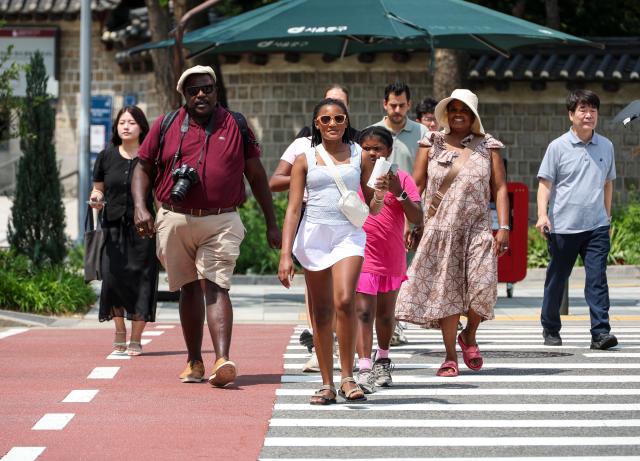
The migrant-background population rose by about 95,000, or 3.5 percent, to 2.81 million in 2025, according to census-based statistics released Monday by the Ministry of Data and Statistics. Its share of the total population increased from 5.2 percent a year earlier.
The increase more than offset a decline of about 83,000 among Korean-born citizens without a migrant background, keeping the country’s overall population broadly steady at 51.82 million, up just 12,000.
The figures show an increasingly diverse population with a younger age profile than the country as a whole.
Some 81.9 percent of people with a migrant background, or 2.30 million, were aged 15 to 64, compared with 69.2 percent of the total population. Those aged 65 or older accounted for just 5.8 percent, against 20.7 percent nationwide.
People with a migrant background represented 10.0 percent of all residents in their 20s and 9.5 percent of those in their 30s — roughly one in 10 across the two age groups.
Those in their 30s formed the largest group within the migrant-background population at 667,000, followed by people in their 20s at 607,000. The latter recorded the largest numerical increase, rising by about 36,000, or 6.4 percent, from a year earlier.
The statistics cover people who themselves, or at least one of their parents, have a migrant background. The definition includes foreign nationals, naturalized Korean citizens and second-generation immigrants, as well as North Korean defectors and certain other groups and their children.
Foreign nationals accounted for 2.11 million, or 75.1 percent, of the total. The remaining 701,000 were Korean citizens, including 397,000 second-generation immigrants and 256,000 people who acquired citizenship through naturalization or recognition of parentage.
The naturalization and recognition category grew 4.5 percent, the fastest among the main groups.
More than half of the migrant-background population — 56.0 percent, or 1.57 million — lived in Seoul, Incheon and surrounding Gyeonggi Province. Gyeonggi alone accounted for 907,000, nearly a third of the national total.
Their presence was proportionately greater in some areas outside the capital region. South Chungcheong Province had the highest share among provinces and major cities at 8.3 percent.
At the municipal level, people with a migrant background accounted for 22.7 percent of residents in Yeongam County in South Jeolla Province, followed by 20.3 percent in Eumseong County in North Chungcheong Province and 16.3 percent in Ansan, Gyeonggi.
In all, 21 cities, counties and districts had migrant-background shares of at least 10 percent.
The number of children and young people aged 24 or younger with a migrant background increased 6.6 percent to 787,000. They represented 7.7 percent of everyone in that age range, up from 7.0 percent in 2024.
The statistics draw on 27 sets of administrative records from 13 agencies and cover people who had lived in South Korea for at least three months as of Nov. 1, 2025.

Copyright ⓒ Aju Press All rights reserved.
