

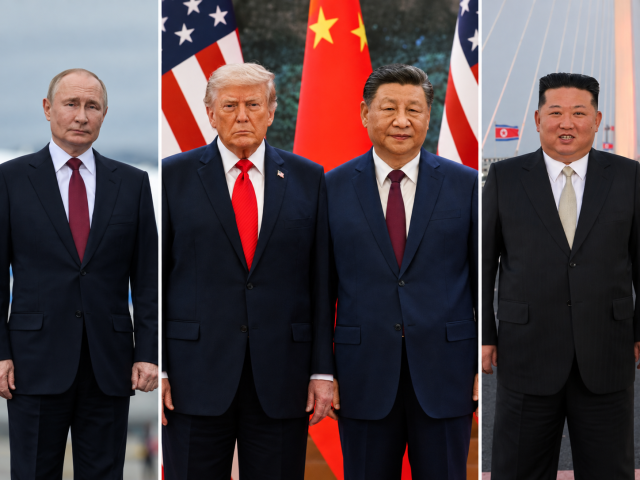
SEOUL, October 27 (AJP) - An unprecedented trilateral meeting among the leaders of the U.S., Russia and China on the sidelines of November’s APEC summit in Shenzhen could put denuclearization and Ukraine on the table.
Whether North Korea might receive a fourth invitation briefly returned to focus after Kim Jong-un’s surprise one-day visit to China amid murmurs about his health.
Kim traveled to China on Saturday across a new bridge that finally opened after more than a decade of delays.
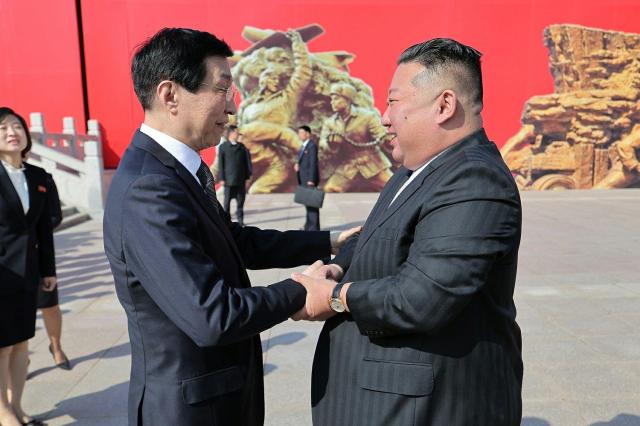
He went no further than Dandong, where he was greeted by Wang Huning, a member of the Chinese Communist Party’s Politburo Standing Committee, and returned home without meeting President Xi Jinping.
The Asia-Pacific Economic Cooperation summit in Shenzhen on Nov. 18–19 is expected to bring together world leaders including U.S. President Donald Trump and Russian President Vladimir Putin. Putin has proposed a trilateral meeting with Trump and their host, Xi. Trump responded favorably, saying a meeting among the three would be “a very positive thing for the world.”
Trump has also floated the idea of meeting Kim during his visit to China, but experts largely played down the likelihood of a summit arising from the North Korean leader’s trip.
“Kim Jong-un's visit to Dandong has nothing to do with a U.S.-North Korea summit,” People Power Party Rep. Kim Gunn, a former chief nuclear negotiator, told AJP.
“The purpose of the visit was to showcase the opening of the New Yalu River Bridge as an achievement to the North Korean people,” he said.
Trump would also be unlikely to share the spotlight from a high-profile meeting with Kim with the other two leaders, the lawmaker added.
“The Trump administration likely has its own channels to the North Korean leadership and would not need to rely on Beijing to arrange a meeting between Kim Jong-un and Donald Trump,” said Bonnie Glaser, managing director of the Indo-Pacific program at the German Marshall Fund.
“In fact, if Trump were to ask Xi for assistance, that would mean that Trump would owe him something, which Trump would want to avoid,” she said.
Kim’s earlier visits to China offer a precedent for speculation.
In March 2018, he made his first overseas trip since assuming power, traveling to Beijing to meet Xi. He returned to China in May for another meeting with Xi in Dalian, just weeks before his historic first summit with Trump in Singapore on June 12.
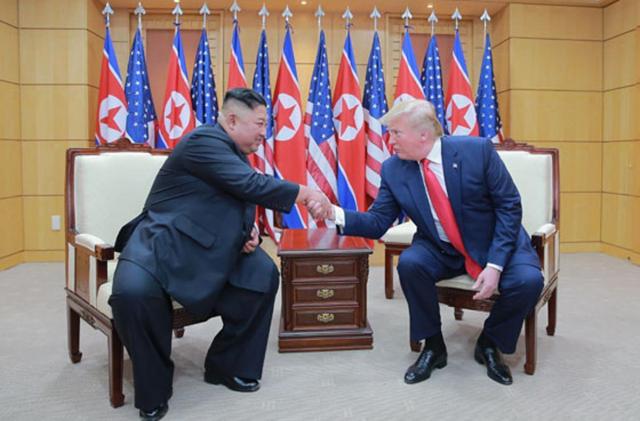
Kim visited Beijing again in January 2019, ahead of his second summit with Trump in Hanoi the following month. That meeting ended without an agreement, and a subsequent encounter at Panmunjom in June 2019 failed to produce a breakthrough in denuclearization negotiations.
The latest visit bore some resemblance to the diplomatic preparations of 2018 but served a different purpose, said Alexis Dudden, a professor of history at the University of Connecticut.
“Rather than laying actual groundwork for a summit in the coming weeks, Kim was trying to show that China is now the key to his regime's access to the world,” she said.
Kim’s first trip to China by car showcased the new bridge nine days after its opening. The four-lane, 3,026-meter crossing connecting Dandong and Sinuiju opened on Oct. 15, nearly 12 years after construction was completed in 2014 with approximately $310 million in Chinese investment.
Its long-delayed opening is expected to facilitate the movement of goods and people between the two countries.
In Dandong, Kim visited a museum commemorating China’s participation in the 1950–53 Korean War, paid tribute to Chinese soldiers killed in the conflict and toured a bus factory with Wang.
According to North Korean state media, Kim repeatedly invoked the countries’ friendship “forged in blood,” emphasizing their historical alliance.
Nobumasa Akiyama, a professor of international politics at Hitotsubashi University in Japan, said the visit should be understood primarily as an effort to reinforce ties with Beijing.
“My reading is that the clearest signal is the strengthening of China–North Korea relations,” Akiyama said.
The visit followed a series of high-level exchanges, including Xi’s state visit to Pyongyang in June and Wang’s visit in July to mark the 65th anniversary of the China-North Korea Treaty of Friendship, Cooperation and Mutual Assistance.
Those exchanges carried substantial bilateral significance regardless of whether another Trump-Kim summit materializes, Akiyama said. Closer ties with China, combined with Pyongyang’s growing partnership with Moscow, could also give Kim greater leverage in future negotiations with Washington.
“External support gives him greater room to negotiate and less pressure to accept an unfavorable offer,” he said.
China is by far North Korea’s largest trading partner. According to a Korea Development Institute report published in June, China accounted for roughly 95 percent of North Korea’s total trade in 2025.
The newly opened crossing could therefore provide Pyongyang with an important economic opportunity, although United Nations sanctions continue to restrict various forms of trade and industrial cooperation.
For Beijing, maintaining close contact with Kim also matters as Trump signals interest in reopening direct negotiations.
“If Trump does meet with Kim, Xi Jinping doesn't want to be caught flat-footed as he was in the first Trump administration when the US reached out to begin talks with North Korea,” Glaser said.
Xi may see value in demonstrating that Beijing remains central to developments on the Korean Peninsula, said Kerry Brown, director of the Lau China Institute and professor of Chinese studies at King’s College London.
“Xi would regard any strong moves by the U.S. to have influence over Pyongyang with suspicion,” Brown said. “The sort of adventurism of the DPRK is a very unwelcome distraction.”
Whether another meeting takes place may therefore depend less on China’s willingness to facilitate one than on what Kim believes he can obtain from Washington.
The White House has maintained that Trump remains willing to meet Kim without preconditions.
“As to whether a Trump-Kim meeting can be arranged, the ball is in North Korea's court,” Glaser said.
On Oct. 12, the State Department reaffirmed the U.S. commitment to the complete denuclearization of North Korea following high-level talks with Japanese officials in Tokyo.
Glaser said she considered it unlikely that Washington would abandon that objective, leaving a significant gap between the two sides even if Trump remains personally willing to meet Kim.
“More than establish groundwork for a future Kim-Trump meeting, Kim's Dandong visit appears to indicate that the DPRK will play hardball with the US this time,” Dudden said.
Whether or not Kim receives a fourth invitation, he is likely to cast a shadow if the three powerful men sit down together.
Copyright ⓒ Aju Press All rights reserved.
