SEOUL, November 02 (AJP) - South Korea is enjoying an export renaissance, approaching a $1 trillion annual milestone reached by only three other countries — China, the United States and Germany.
Shipments have strengthened across categories from chips to cosmetics despite geopolitical tensions and an increasingly hostile trade environment.
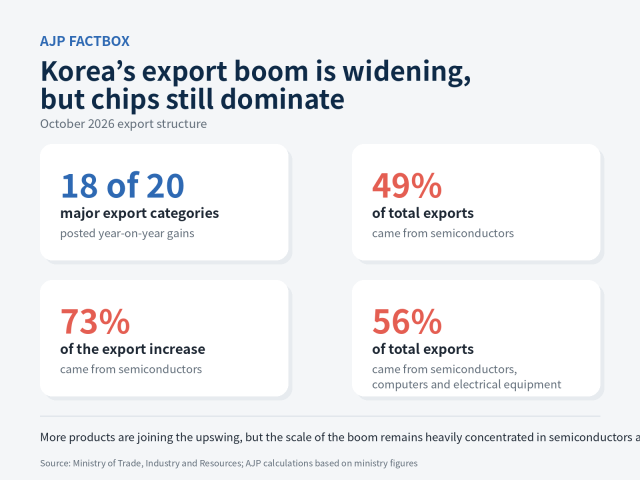
Still, semiconductors, computers and electrical equipment account for 56 percent of outbound shipments, leaving the economy that much exposed to the global AI investment cycle.
With domestic consumption recovering more slowly, the question is how long companies and governments can sustain the spending driving Korea’s windfall.
October trade data released on Sunday further underscored the staggering strength of chip demand turbocharging South Korea’s exports.
Exports increased in 18 of the 20 major product categories, while shipments excluding semiconductors rose 34 percent from a year earlier. Even that strong double-digit growth paled against the chip industry’s performance.
Semiconductor exports surged 259.4 percent to $56.44 billion, accounting for about 49 percent of total shipments. Chips generated roughly 73 percent of the $55.8 billion year-on-year increase in overall exports.
Total exports jumped 93.7 percent to $115.28 billion, bringing shipments in the first 10 months to $930 billion. That leaves Korea just $70 billion short of the trillion-dollar threshold, which the government expects to cross in November.
Some of the fastest-growing categories outside semiconductors were also tied to AI investment.
Computer exports surged 496.6 percent to $5.85 billion on demand for servers and enterprise solid-state drives. Electrical equipment exports climbed 74.0 percent to a record $1.99 billion as data-center construction supported demand for transformers, wires and cables.
“Growth is still concentrated in semiconductors, but the range of export improvement is gradually widening,” KB Securities analyst Ryu Jin-yi wrote in an Oct. 2 report, describing the trend preceding the latest figures.
Ryu noted that exports excluding both semiconductors and computers were improving, with stronger performances in steel, electrical equipment, nonferrous metals and general machinery.
Much of that improvement, however, was also supported by AI-related demand, including investment in data centers and power grids, she said.
There were gains beyond that investment chain. Cosmetics, biohealth and agricultural and fisheries products all set October export records, with shipments rising 57.5 percent, 30.2 percent and 11.6 percent, respectively.
The Bank of Korea (BOK) had already identified a broader recovery in September. In its Oct. 22 monetary policy briefing, the central bank said non-IT export growth had accelerated alongside continued triple-digit gains in IT products. It described consumption as recovering gradually, although stock-market losses and automobile strikes had temporarily interrupted that progress.
Korea’s exposure to the technology cycle nevertheless remains substantial.
At an Oct. 15 briefing on its Regional Economic Outlook for Asia and the Pacific, the International Monetary Fund (IMF) said Korea had benefited disproportionately from the AI boom through its semiconductor industry, particularly memory and logic chips.
The IMF also warned that the boom’s sustainability depended on AI generating revenue and delivering expected productivity gains. Concerns over profitability, financing and valuations could bring a sharp reassessment of the sector’s prospects.
Some of October’s export gains also reflected higher prices rather than greater shipment volumes.
Petroleum product exports jumped 80.0 percent in value and petrochemical exports rose 27.5 percent, supported by elevated oil prices. Their shipment volumes fell 7.5 percent and 6.8 percent, respectively.
Meanwhile, October’s manufacturing survey offered an early indication that demand momentum was easing.
The S&P Global South Korea Manufacturing Purchasing Managers’ Index fell to 51.3 from 53.9 in September. Manufacturing remained above the 50 threshold separating expansion from contraction for an 11th consecutive month, but growth in new export orders slowed sharply to a marginal pace.
“The positive demand momentum seen across South Korean manufacturing in the third quarter began to falter” as the fourth quarter started, said Usamah Bhatti, economist at S&P Global Market Intelligence, in the report.
The survey measures changes from the previous month, while the export figures compare shipment values with a year earlier. Slower order growth can therefore coexist with record export receipts.
Korea’s trillion-dollar milestone is drawing close. The harder test will be sustaining growth when the pace of AI spending eventually eases.

Copyright ⓒ Aju Press All rights reserved.