
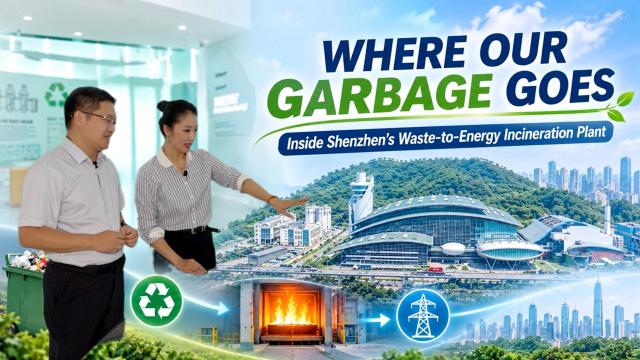
This video content was provided by Aju News Corporation's media partner CGTN.
SHENZHEN, November 16 (AJP) - We throw things away every day. Once the rubbish leaves our homes, we rarely think about where it goes. In Shenzhen, one waste-treatment plant is trying to bring this hidden part of urban life into public view. By opening its doors, it's giving people a closer look at what happens to their rubbish – and a chance to think about their own role in managing waste.
Park Sae-jin
Experienced journalist and editor at AJU PRESS specializing in multilingual news. I cover international diplomacy, geolpolitics, and policy, consistently delivering highly accurate, compelling reporting for a worldwide audience.
Copyright ⓒ Aju Press All rights reserved.
Related News
-
 New Uses for Household Waste: Resource Recycling Exhibition at Seoul Recycling Plaza
An exhibition proposing ways to practice resource recycling in daily life is set to open.The Seoul Metropolitan Government and the Seoul Design Foundation announced on November 10 that they will showcase the planned exhibition 'Forms of Circulation: The Resource Recycling Process' and the collaborative exhibition 'Upcycling PICK High-Consumption Popup x More Store' on the first floor of the Seoul Recycling Plaza in Seongdong-gu, Seoul.Both exhibitions connect the process of discarded resources being transformed back into products with the consumer experience of selecting those products, in line with the city's 'Household Waste Diet Project for 10 Million Citizens.'Launched on November 2, 'Forms of Circulation: The Resource Recycling Process' introduces products created through the resource recycling systems and upcycling processes established by participating brands and creators. Participants include IKEA Gangdong, Kolon Record, New Tab-22, Jeong Ji-won, Continu, Quolly, Plastic Mill, and Hee (H22), each showcasing their unique approaches to resource utilization.The 'Upcycling PICK High-Consumption Popup x More Store,' located in the lobby of the first floor of the Seoul Recycling Plaza, features products that embody the values of upcycling and eco-friendliness from participants such as More Store, Eco Party Meari, Bonecca, Aidan, and Surfing Dog.Cha Kang-hee, CEO of the Seoul Design Foundation, stated, “We will connect exhibitions, education, and experiences to ensure that upcycling takes root in citizens' daily lives and expand opportunities for them to encounter upcycled products and their values.”Both exhibitions will run until April 2027.* This article has been translated by AI.
-
New York Follows South Korea's Lead in Food Waste Recycling
New York City is adopting a food waste management system similar to the one established in South Korea over the past 30 years.The BBC recently reported on Seoul's food waste management system, noting that South Korea's food waste recycling rate has increased from 2.6% in 1996 to approximately 97% in 2023.South Korea implemented a pay-as-you-throw system in 1995 and made food waste separation mandatory in 1997. In 2005, the country banned the landfill disposal of food waste, and in 2010, it introduced RFID (Radio Frequency Identification) smart bins. By 2013, the country also prohibited the ocean dumping of food waste leachate.The RFID food waste disposal system charges residents based on the amount of waste they produce, allowing them to monitor their food waste output directly. According to the BBC, as of 2025, there are 151,934 smart bins installed in South Korea, serving over 8.61 million households.Separated food waste is also utilized for energy production. The Daejeon Bioenergy Center recycles 70-75% of the food waste it receives into energy, generating enough power for about 6,000 households daily. There are over 340 similar facilities across South Korea.The BBC explained that while food waste in landfills generates methane, a potent greenhouse gas, bioenergy facilities can capture it for fuel.New York City is using South Korea as a model to expand its food waste separation program. Starting in October 2024, residents will be required to separate their food waste, affecting approximately 3.4 million households. This initiative represents the largest organic waste recovery program in the United States.However, resident participation remains a challenge. The New York City Department of Sanitation recently engaged in over 60,000 conversations with residents across five boroughs and issued more than 63,000 violation notices to households that failed to comply with the separation regulations since the program's implementation.New York City has also installed over 400 smart composting bins. However, some residents have raised concerns about rodents congregating around these bins.According to the BBC, New York City processed about 140,000 tons of residential organic waste in 2025, which accounted for only about 9% of the annual generation of 1.5 million tons.Steven Cohen, director of the Sustainability Management Program at Columbia University, told the BBC, "South Korea's RFID bins can hold each resident accountable for their organic waste."Additionally, Joom-Sol Joo, a senior researcher at the Korea Environment Institute, stated, "South Korea has made significant progress in food waste recycling, but new technologies and policies are at a turning point to further advance this progress," according to the BBC.* This article has been translated by AI.
-
 South Korea to Revise Waste Fee System to Encourage Recycling
The South Korean government is set to revise its waste fee system to reduce everyday plastic use and promote resource recycling. The plan aims to increase the waste fee, which has been frozen for 14 years since 2012, to boost recycling rates.On June 30, the Ministry of Climate, Energy and Environment held a meeting at the Seoul Business Center to discuss improvements to the waste fee system. The waste fee system imposes costs on manufacturers and importers of products, materials, and containers that are difficult to recycle.During the meeting, the ministry plans to discuss the production and usage of short-lived plastic products, such as single-use items, their recycling potential, and the criteria and rates for imposing waste fees.The government's review of fee adjustments comes amid criticism that the current system does not effectively incentivize waste reduction. Currently, fees are imposed on single-use diapers, cigarettes, and plastic manufacturers, but the fee rates have remained unchanged since 2012.The government aims to encourage market participants, including manufacturers, to use recycled materials and integrate into recycling systems by overhauling the waste fee structure. This is expected to help curb plastic use and increase recycling rates.The meeting will also delve into the current operation and issues of the waste fee system, as well as trends in international systems like plastic taxes, to discuss future directions for reform and specific implementation plans.Kim Go-eung, Director of the Resource Circulation Bureau at the Ministry of Climate, stated, "It is time to revise the waste fee system to fulfill the historical task of transitioning to a plastic-free circular economy. We will strive to design the system carefully, balancing its effectiveness and social acceptance."* This article has been translated by AI.