
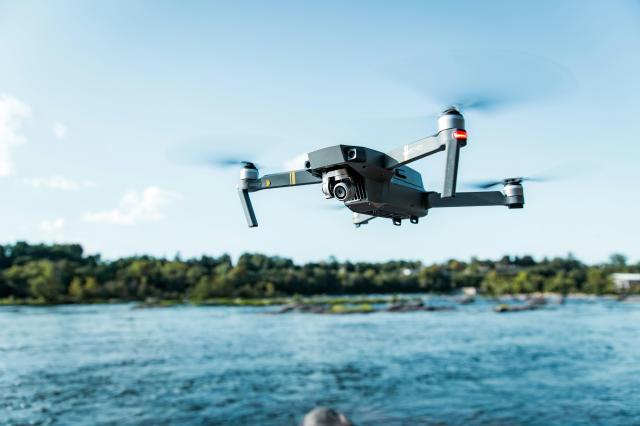
ZURICH, November 16 (AJP) -European countries are turning away from Chinese-made drones over fears of spying.
The German military, the Bundeswehr, will stop buying Chinese drones and gradually replace those already in service with systems meeting stricter security requirements, a Defense Ministry spokesperson said on Nov. 11. The ministry’s description of a phased withdrawal was narrower than an earlier report by German news magazine Der Spiegel that Chinese drones had been banned from barracks and training grounds with immediate effect. bundesregierung.de
Insiders estimate that German military units bought several thousand Chinese drones, many from Shenzhen-based DJI, according to specialist news site DroneXL. The ministry has not disclosed a total, citing military security.
The shift follows a series of reversals. Germany initially barred Chinese drones in 2023 but subsequently allowed units to purchase commercial models through simplified procedures. In November 2024, the Bundeswehr signed a framework contract for 500 DJI Matrice M30T drones, DroneXL reported.
The purchases reflected pressure to expand drone training as the war in Ukraine demonstrated the importance of inexpensive unmanned aircraft. Both Russian and Ukrainian forces have relied heavily on small commercial drones for surveillance and battlefield operations.
DJI’s reach extends well beyond the military. Swiss media reported in 2023 that the company accounted for more than half of the global civilian drone market. Its aircraft are also used by Swiss police for tasks such as documenting accident scenes and searching for missing people.
The security concerns increasingly extend to vehicles. Germany restricts access to sensitive military sites where vehicle sensors are considered a risk, although its Defense Ministry says there is no blanket ban on cars from particular countries or manufacturers.
Poland introduced restrictions on Chinese-made vehicles entering military facilities in February, with exceptions possible when specified functions are disabled and other safeguards are met. reuters.com
At the center of the debate is the information these devices collect. Cameras and other sensors can capture details of military installations and activities that could potentially reach manufacturers or intelligence services, Pablo Wey, a researcher at the Center for Security Studies at the Swiss Federal Institute of Technology in Zurich (ETH Zurich), told Swiss public broadcaster Schweizer Radio und Fernsehen (SRF).
The United States imposed restrictions years earlier. The U.S. Army ordered units to discontinue DJI drones in August 2017. The Defense Department subsequently imposed broader restrictions on commercial off-the-shelf drones over cybersecurity concerns.
DJI has repeatedly rejected suggestions that its products pose a security threat. In May, it released a security assessment it commissioned from U.S. cybersecurity firm OnDefend covering the Air 3S and Matrice 4E models.
The assessment found no clear evidence of hidden backdoors or data transmissions outside the United States during testing. Its findings applied to the hardware and software versions examined, and OnDefend recommended continued testing as updates are released.
Switzerland, which is neutral and belongs to neither NATO nor the European Union, faces similar questions. Its army already keeps networked vehicles away from particularly sensitive installations, SRF reported.
Swiss defense procurement agency armasuisse bought four DJI drones for trials conducted in 2021 to assess their usefulness in clearing unexploded ordnance and rehabilitating former firing ranges, according to a 2023 CH Media report.
The drones cost about 5,000 Swiss francs each, equivalent to roughly 6,000 dollars at current exchange rates. The army said they were intended for trials rather than tactical operations.
Wey argued for assessing each military application separately. Chinese drones could be acceptable where the risk of sensitive information leaking can be contained, but should be avoided where it cannot, he told SRF.
The search for alternatives creates opportunities for European suppliers, including companies with roots in Switzerland.
Auterion, founded in Zurich in 2017, develops software for autonomous drones. In April, its joint venture with Ukrainian manufacturer Airlogix announced a German-backed production contract for thousands of artificial intelligence-guided strike systems for Ukraine, to be manufactured in Germany.
Wingtra, which began as a research project at ETH Zurich, designs and assembles surveying and mapping drones in the city. Its products serve a different market from Auterion’s strike systems, but illustrate the range of capabilities emerging from Switzerland’s drone industry.
Price and performance remain obstacles to replacing Chinese equipment. Germany’s earlier purchases reflected the difficulty of finding European products that could compete with DJI on both, according to DroneXL. European manufacturers will need to meet those practical demands as well as stricter security standards to turn the shift in procurement policy into lasting orders.
Tags: drones, China, DJI, Germany, Bundeswehr, Switzerland, Swiss Army, armasuisse, ETH Zurich, Pablo Wey, Auterion, Airlogix, Wingtra, Poland, Ukraine, United States, NATO
Copyright ⓒ Aju Press All rights reserved.
