
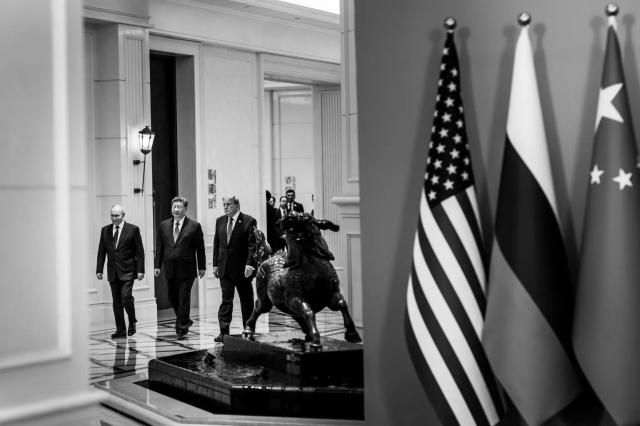
Donald Trump arrived in Shenzhen accustomed to being the event. At previous gatherings in Europe and Asia, other leaders had organized their diplomacy around his demands, his displeasure and his appetite for applause.
This time, the American president entered a production whose political purpose had already been established by his host. Xi Jinping occupied the center as convener and apparent go-between. Vladimir Putin received the recognition he wanted. Trump supplied the American presidency that made the photograph consequential.
All three could claim a historic occasion. Whether the occasion served American interests was considerably less clear.
The choreography deserves attention because Trump himself attached such importance to it. Xi personally greeted him at the airport, while a senior Chinese official welcomed Putin. There were flags, flowers and military honors.
In his interview with Fox News, Trump lingered over “the fanfare, the beauty, the pageantry” and treated the reception as evidence of national success.
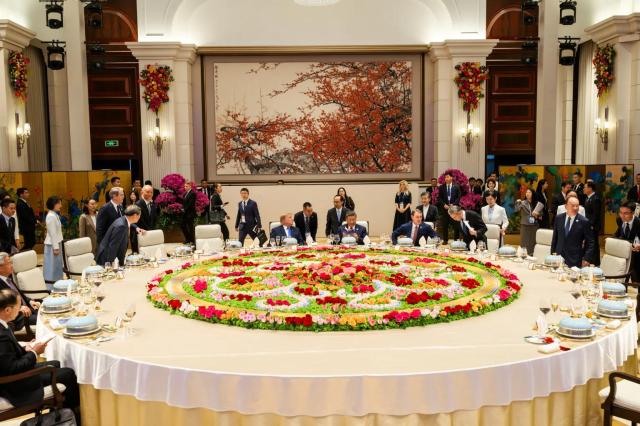
A president who measures diplomatic achievement by the magnificence of his welcome gives his hosts a remarkably inexpensive negotiating instrument.
Beijing could flatter Trump without loosening its relationship with Moscow.
The day before the trilateral meeting, Xi and Putin had reaffirmed their strategic partnership. China’s official account described Putin’s readiness to strengthen “back-to-back” coordination with Beijing. They were established partners comparing their interests before welcoming a third participant.
Xi’s position was therefore more advantageous than that of an ordinary intermediary. He could present himself as the statesman bringing rivals together while retaining a close partnership with one of them.
Washington’s presence validated his convening power; Moscow’s presence reinforced his preferred vision of an international order in which Western preferences no longer determine admission to the top table.
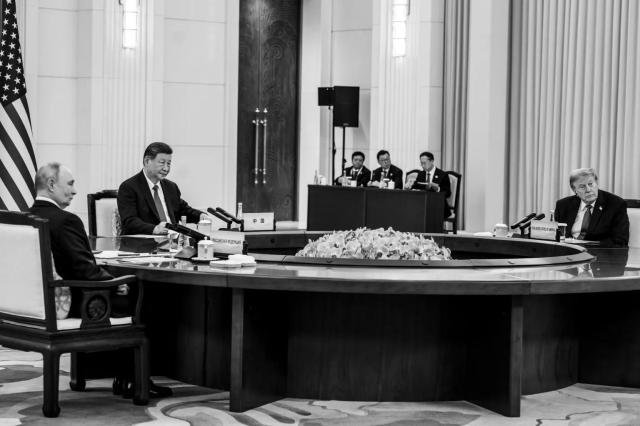
Trump received the more elaborate greeting. Xi retained control of what the gathering meant. For Putin, the reward was tangible before anyone discussed peace. He returned to the APEC leaders’ photograph for the first time since 2017.
His appearance beside the Chinese and American presidents offered a powerful answer to attempts to isolate him over Russia’s invasion of Ukraine. Recognition had been delivered without an accompanying settlement of the war.
Thomas Graham of the Council on Foreign Relations judged that the image validated both Russia’s claim to great-power status and Putin’s standing as a global leader. His was a substantial diplomatic return from a meeting whose declaration said nothing specific about ending the invasion.
Trump’s return was harder to identify.
At The Hague in June 2025, NATO allies agreed to a sharply higher defense spending target that he had demanded. In Malaysia that October, he announced trade agreements and attended the signing of an expanded Thailand-Cambodia truce.
Whatever the durability or merits of those achievements, the public proceedings revolved around American demands and transactions Trump could claim to have advanced. Shenzhen offered abundant attention but little comparable evidence of command.
Trump arrived after sweeping Democratic midterm victories had weakened his domestic political position. A president entering the lame-duck stretch of his second term had every incentive to seek a compensating display of authority abroad.
The familiar role of senior power broker, however, was less convincing beside two leaders pursuing well-established objectives of their own. Xi did not need Trump’s approval to sustain his partnership with Putin.
Putin needed American recognition more urgently than he needed another declaration of peaceful intentions.
Trump helped provide both men with what they wanted. The published outcome offered little evidence of what they had conceded in exchange.
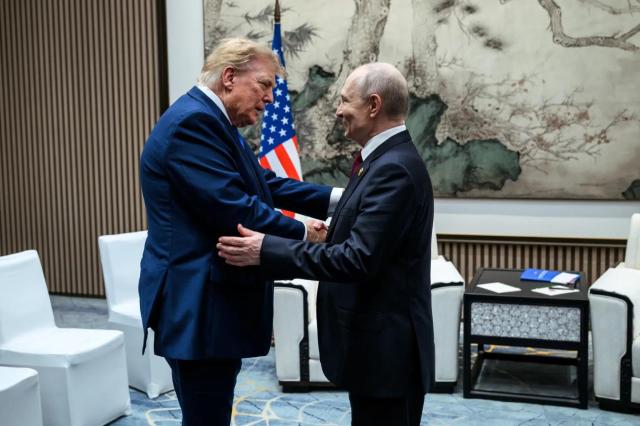
The comparison with Yalta is tempting, but history should not be recruited merely to furnish grander scenery.
Roosevelt and Churchill did not effortlessly dictate terms to Stalin in 1945. Soviet military control on the ground forced substantial concessions, particularly over Eastern Europe.
Yalta remains controversial precisely because the interests of smaller countries were subordinated to bargains among the powerful. Still, Roosevelt and Churchill arrived as partners representing an alliance, backed by extensive military and diplomatic preparation.
In Shenzhen, America’s allies were outside the three-way room. The established strategic partnership inside it belonged to the other two participants. Read the declaration in full and the distance between its billing and its contents becomes difficult to ignore.
Its four points address U.N. reform, supplies of refined petroleum products, the immunity of state officials and nuclear risk. It sets no nuclear reduction targets, negotiating calendar or verification arrangements. Its promise of dialogue on nonproliferation is not a commitment to denuclearization. No specific settlement is offered for Ukraine, Iran or the Korean Peninsula.
The protection of officials from international judicial overreach receives conspicuous attention. For Putin, against whom the International Criminal Court issued an arrest warrant over the alleged unlawful deportation and transfer of Ukrainian children, that language has an obvious political value.
The leaders were more explicit about protecting the prerogatives of power than about the restraints peace would require.
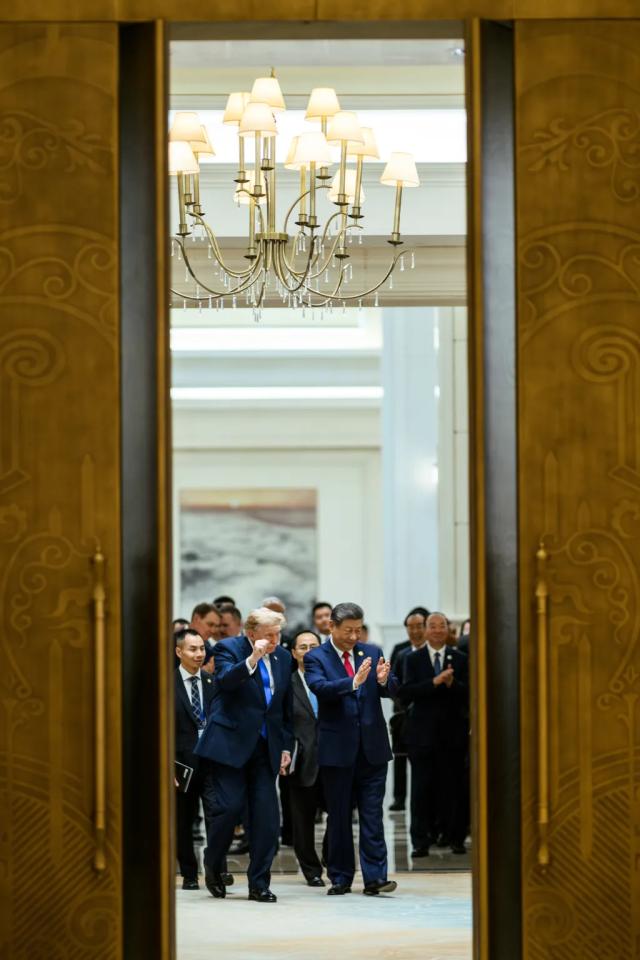
Putin’s subsequent remarks supplied an immediate test. After endorsing the language of peace, he threatened retaliation for attacks on the Crimean Bridge and rejected negotiations over proposed limited ceasefires involving energy infrastructure or the Black Sea in their aftermath. The declaration had not appreciably narrowed his freedom to escalate.
APEC—the multinational forum that brought these leaders together—receded behind their performance.
Its 21 economies had gathered to address regional integration, trade and growth. Xi urged them to regard themselves as passengers on the same ship and to look after one another. China also announced practical cooperation initiatives, including a 20 million dollar contribution. The forum had an agenda and work to do.
But the political spectacle conveyed a different hierarchy. Economic cooperation supplied the occasion; three powerful men claimed the defining conversation. Beijing used a regional gathering to demonstrate its ability to assemble a smaller, more imposing circle around itself.
Respect cannot be measured by the warmth of a handshake if decisions affecting smaller countries are treated as the prerogative of larger ones.
There is value in keeping nuclear powers in conversation. Their refusal to talk would be more dangerous. But that modest truth should not be inflated into a diplomatic triumph simply because the participants enjoy the historical comparison.
The deeper problem is the shrinking distance between national purpose and personal stature. Xi’s centrality, Putin’s rehabilitation and Trump’s hunger for recognition can all be satisfied by the same photograph. Peace requires concessions that may satisfy none of them.
Diplomatic dignity begins with restraint: the humility to recognize the limits of power and the decency to respect those who must live with its consequences.
In Shenzhen, three men claimed responsibility for world peace without committing to meaningful limits on their own power. Each secured recognition. None offered much restraint.
The room was full of power. What it lacked was the maturity to distinguish the world’s interests from their own.
*The writer is the managing editor of AJP.
**The views expressed are the writer’s own.
Copyright ⓒ Aju Press All rights reserved.
Related News
-
 Trump on Iran, Xi on Great Powers, Putin on Ukraine... Three Leaders' Summit with Diverging Views
The leaders of the United States, China, and Russia held their first trilateral summit on November 19 in Shenzhen, Guangdong Province, China. During the approximately 10 minutes of public remarks, the diplomatic priorities of each country were clearly highlighted. President Donald Trump of the United States prominently addressed the issue of Iran's nuclear weapons, while Chinese President Xi Jinping emphasized cooperation among great powers and underscored China's elevated status in the international community. Russian President Vladimir Putin focused on the issue of the Ukraine war.According to China Central Television (CCTV), the three leaders began their meeting at 4:25 PM at the Qilin Mountain Villa in Shenzhen and engaged in discussions for about 1 hour and 30 minutes. A notable point in Xi's remarks was his message positioning China as one of the world's major powers. He stated, "Positive interactions among great powers are not an option but a task that must be addressed," emphasizing the need for cooperation among the US, China, and Russia. He asserted that since the world is a community with a shared destiny, major powers have a special responsibility for international peace and stability.Xi particularly noted that China is developing a comprehensive strategic partnership with Russia and is also striving to establish a constructive and stable relationship with the United States. He stressed the need to create a framework for great power relations characterized by peaceful coexistence, overall stability, and balanced development. This message is interpreted as highlighting that China, having increased its economic, military, and diplomatic influence, is a key nation responsible for shaping the international order alongside the US and Russia. The summit, which brought together the leaders of the US and Russia, is also seen as a demonstration of China's diplomatic stature.President Trump focused on the issue of Iran's nuclear weapons. He emphasized that the US, China, and Russia are the world's three major nuclear powers and stated that they can cooperate to reduce nuclear weapons and mitigate the risks of nuclear weapon use. He particularly noted the need for a joint response to the nuclear proliferation threats posed by other countries, saying, "This is exactly what we are doing regarding Iran." He further emphasized, "We will not allow Iran to possess nuclear weapons." Trump's remarks are interpreted as underscoring the US's hardline stance toward Iran under the banner of international non-proliferation. By emphasizing that blocking Iran's acquisition of nuclear weapons is a measure for international security, he aims to legitimize the US's policy toward Iran.President Putin highlighted the Ukraine war as a core common interest among the three countries. He claimed that the US, China, and Russia share many overlapping interests in resolving regional conflicts, including the Ukraine dispute. He publicly stated that he discussed the Ukraine issue intensively during his meetings with Xi the previous day and with Trump on the same day. Putin emphasized that the three countries are victorious nations of World War II and bear a joint responsibility for maintaining international peace and security. He suggested that constructive cooperation among the three countries could contribute to global stability and proposed discussing energy security issues.Xi highlighted China's status as a great power and its international role, Trump focused on the US security agenda through the Iran nuclear issue, and Putin emphasized Russia's interests surrounding the Ukraine war. These matters are expected to have been the central topics of discussion at the trilateral summit.* This article has been translated by AI.
-
Xi Jinping Welcomes Trump at Airport, Embraces During Third Meeting This Year
Chinese President Xi Jinping personally welcomed U.S. President Donald Trump at the airport as he arrived in China to attend the Asia-Pacific Economic Cooperation (APEC) summit.President Trump arrived at Shenzhen Bao'an International Airport in Guangdong Province at around 5 p.m. local time on November 18, as reported by China's state-run Xinhua News Agency. President Xi went to the airport to greet Trump, marking their third meeting this year. Having met several times, the two leaders embraced warmly.In May, President Trump visited Beijing for a three-day stay and held talks with President Xi. In September, Xi visited the U.S. for a three-day stay in Washington. The two leaders have engaged in diplomatic exchanges by visiting each other's countries, and this time they met again in Shenzhen, where the APEC summit is being held.At Bao'an Airport, Xi stated, "When I visited the U.S. in September, President Trump and his wife personally came to the airport to greet me and organized a grand welcome ceremony. China values etiquette and has a tradition of reciprocating such gestures." He continued, "I welcome President Trump's return visit and look forward to exchanging in-depth views on significant issues related to China-U.S. relations, Asia-Pacific cooperation, and the global order." He emphasized the desire to develop a "constructive and strategically stable relationship between China and the U.S. based on respect, fairness, and equality."President Trump expressed gratitude for Xi's personal welcome at the airport and thanked the Chinese side for their special hospitality. He said, "I am very pleased to visit great China again, and President Xi is a great leader. I always enjoy meeting with him." He added, "I believe this visit will further develop our bilateral relations and be successful."Attending the airport welcome were Cai Qi, a member of the Standing Committee of the Political Bureau of the Communist Party of China, Wang Yi, the Foreign Minister, and Huang Kunming, the Party Secretary of Guangdong Province.Meanwhile, President Trump will attend the main session of the APEC summit on the morning of November 19. Following that, he will hold a working lunch and a summit with President Xi starting at 12:30 p.m. At 2:30 p.m., he is scheduled to hold a trilateral summit with Russian President Vladimir Putin. During the bilateral talks with Xi, Trump is expected to discuss key issues such as trade conflicts and export controls on advanced technology. The China-U.S. summit is anticipated to focus on economic matters. The trilateral summit, which is being held for the first time, is expected to address major international issues such as the Ukraine war and nuclear disarmament.* This article has been translated by AI.
-
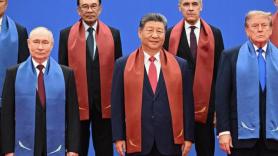 Trump, Xi, Putin make history, not deals
A zoomed photo of Presidents Vladimir Putin of Russia, Xi Jinping of China and Donald Trump of the U.S. in a group photo before the APEC Summit plenary session held at Shenzhen, China, on Nov. 19, 2026 (Courtesy of the Russian presidential office) SEOUL, November 19 (AJP) —U.S. President Donald Trump brought together the leaders of China and Russia for an unprecedented three-way summit Thursday, seeking a new nuclear arms agreement and progress on wars in Ukraine and Iran, but the historic gathering ended without an immediate breakthrough. The meeting with Chinese President Xi Jinping and Russian President Vladimir Putin marked a striking display of great-power diplomacy that could reshape the U.S.-dominated international order. Yet the three leaders remain divided over nuclear strategy, territorial conflicts and their competing visions of global security. "We are really making history," Trump declared as the leaders opened their talks at the Kylin Villa in Shenzhen on the sidelines of the Asia-Pacific Economic Cooperation (APEC) summit. The meeting lasted more than an hour, with no immediate joint statement or concrete agreement announced. Trump made nuclear arms control the centerpiece of the talks, calling on the world's three largest nuclear powers to cooperate in reducing their arsenals and preventing the spread of nuclear weapons. He acknowledged the formidable challenge of persuading nuclear-armed countries to surrender weapons they regard as essential to national security. "Once you have the nuclear weapons, it's very hard not to have them," Trump said. The initiative comes after the New START treaty, the last remaining nuclear arms control agreement between Washington and Moscow, expired in February, leaving the world's two largest nuclear arsenals without binding limits. Trump wants a new agreement that includes China, but Beijing has long resisted joining the negotiations, arguing that its nuclear stockpile is much smaller. China is estimated to possess more than 600 nuclear warheads, compared with more than 5,000 each held by the United States and Russia. Xi called for the eventual elimination of nuclear weapons and the creation of a nuclear-free world, according to Chinese state media. He also urged the three powers to maintain dialogue, avoid crossing each other's red lines and prevent confrontation. Putin invoked the three countries' common history as victors in World War II, emphasizing their shared responsibility for international peace and security. Despite the conciliatory language, their differences remain substantial. China continues to expand its nuclear capabilities even while advocating global disarmament. Washington wants Beijing included in any future arms control framework, while Moscow's war in Ukraine has deepened tensions with Western governments. U.S. President Donald Trump shakes hands with Russian President Vladimir Putin on the sidelines of APEC summit in Shenzhen, China, on Nov. 19, 2026. (Courtesy of the Russian presidential office) The gathering also highlighted a shifting balance among the three powers. Trump has placed considerable emphasis on his personal relationships with Xi and Putin, but the Chinese and Russian leaders have built a closer strategic partnership rooted in shared opposition to aspects of U.S. global influence. China has remained an important economic partner for Russia since Moscow's 2022 invasion of Ukraine, helping cushion the impact of Western sanctions. Trump held separate bilateral meetings with both leaders before the trilateral session. His meeting with Putin, their first since an inconclusive summit in Alaska in 2025, lasted about 40 minutes and focused heavily on Ukraine. Trump suggested that progress was possible but offered no details of a potential settlement. During his meeting with Xi, Trump raised the importance of keeping oil flowing through the Strait of Hormuz amid disruptions caused by the Iran war. Trade, agricultural purchases and Taiwan were also discussed. Presidents Donald Trump and Xi Jinping hold bilateral and expanded meeting on the sidelines of APEC summit in Shenzhen, China, on Nov. 19, 2026 Courtesy of China's foreign ministry For all the diplomatic spectacle, the central questions remain unresolved: whether China will enter serious nuclear arms negotiations, whether Putin will make concessions on Ukraine and whether Trump can reconcile competing interests that have resisted years of diplomacy. The three leaders have demonstrated their willingness to sit together. Whether they can agree on anything substantial is another matter.