
ZURICH, November 23 (AJP) - The European Union opened its third broad trade shield investigation in less than a month on Monday, this time into resins and glass fibre mainly from China, as Brussels shifts from targeted tariffs to wider walls around its struggling industries.
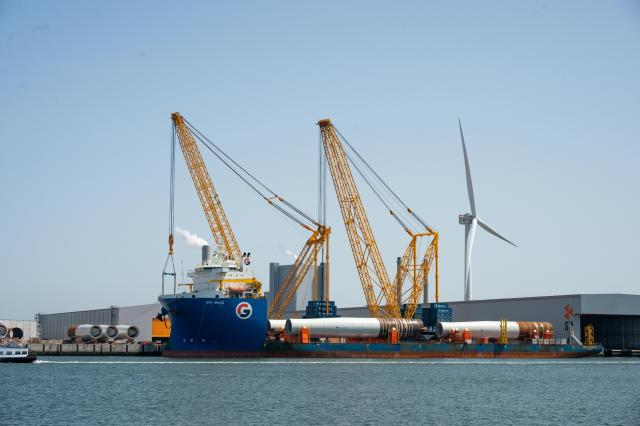
The European Commission, the EU’s executive arm, handles trade policy for all 27 member countries. Its new probe covers composite resins and glass fibre materials, which go into wind turbines, power grids, cars, aircraft and defense equipment, Euronews reported.
Composites are made by embedding thin strands of glass in resin, a liquid plastic that hardens. The result is lighter than steel but strong enough for the blades of a wind turbine or the hull of a boat.
For Europe, the materials sit at the heart of two priorities. The EU wants more wind power to cut its reliance on imported energy, and its governments are spending more on defense since Russia’s invasion of Ukraine.
The EU already charges extra duties on such products from China. European producers say Chinese makers dodged them by moving production to other countries and shipping from there.
The tool Brussels is using is called a safeguard. Unlike anti-dumping duties, which target unfairly cheap goods from a single country, a safeguard can cap imports from all trading partners through quotas or tariffs when a sudden surge threatens local producers. The investigation is expected to take nine to 11 months.
The case follows two others in quick succession. On October 30, the Commission opened a safeguard probe into hybrid cars after imports rose 49 percent to 1.42 million vehicles in the year to June. On November 6, it launched another into PET resin, the plastic used in drink bottles and polyester clothing.
Behind the moves lies a widening gap with China. Low-cost Chinese imports have risen 25 percent over the past year, and the EU’s trade deficit with China has reached about 1 billion euros ($1.09 billion) a day, Euronews reported.
European producers welcomed the latest probe. Ludovic Piraux, president of industry group Glass Fibre Europe, said the decision “confirms the seriousness of the situation facing Europe’s composite input materials industries.”
Europe’s chemical makers have been squeezed for years by high energy costs, weak demand and global overcapacity. The Commission opened 18 trade investigations in the chemical sector between January 2024 and June 2025, trade news site Textalks reported.
The car sector shows where the policy is heading. From December 1, under a deal agreed with Beijing in October, the EU will allow 350,000 Chinese hybrid cars a year into its market for four years. EU officials expect the cap to more than halve current Chinese hybrid exports, according to Euronews.
The shift matters well beyond China. Because safeguards apply to all exporters, carmakers and chemical producers in Japan, South Korea and other Asian countries could also face quotas, even where they have free trade agreements with the EU.
Final measures still need the backing of at least 15 member states representing 65 percent of the EU’s population.
China has not yet commented on the composites probe. Beijing has in the past answered EU trade cases with its own investigations, including an anti-dumping probe into European brandy after Brussels began investigating Chinese electric car subsidies in 2023.
For Asian exporters, the message from Brussels is becoming clearer. Europe is no longer fighting trade battles one product at a time.
Tags: European Union, European Commission, China, safeguard investigation, glass fibre, composite resins, PET resin, hybrid cars, trade deficit, Glass Fibre Europe, Japan, South Korea, anti-dumping
Copyright ⓒ Aju Press All rights reserved.
Related News
-
 EU Pushes for 3% Digital Tax Targeting Big Tech Amid Trump Threats
The European Union (EU) is actively pursuing the introduction of a digital tax aimed at large technology companies operating within its borders. This move is essentially targeting U.S. big tech firms, raising expectations of renewed trade tensions between the U.S. and the EU. President Donald Trump has been a vocal opponent of the digital tax.According to reports from Reuters and others, António Costa, the EU summit chair, announced on November 21 that the draft revision of the long-term budget for 2028 to 2034 includes a provision for taxing big tech companies in the region.Specifically, the tax would apply to companies with digital business revenues exceeding 50 million euros (approximately 74 billion won (KRW)) in the EU and global revenues exceeding 750 million euros (approximately 1.1 trillion won (KRW)) annually, imposing a 3% annual levy on net revenues generated from online advertising, intermediary services, and user data monetization.As a result, major U.S. tech companies such as Google, Microsoft, Meta, Apple, and Amazon are expected to be subject to this tax.Costa stated, "This is not a tax targeting specific companies or countries. It is intended to ensure fair taxation for all companies operating in our market." However, analysts suggest that by limiting the tax to digital companies and setting high revenue thresholds, the digital tax is clearly aimed at U.S. big tech firms.The EU has previously imposed astronomical fines and various regulations on U.S. big tech companies for violations of European laws, such as the Digital Markets Act (DMA) and the Digital Services Act (DSA). The Trump administration criticized these measures as non-tariff trade barriers and discrimination against American companies. In June, Trump warned that he would impose 100% tariffs on all products from countries that levy a digital tax on U.S. companies, separate from existing trade agreements.Political outlet Politico interpreted that the EU's move to advance the digital tax comes as Trump's political standing has weakened following the Republican Party's midterm election losses, leading the EU to perceive a lower likelihood of U.S. trade retaliation.However, the actual implementation of the digital tax at the EU level is expected to face challenges. Notably, Ireland, which hosts the European headquarters of many U.S. big tech firms, may oppose the measure. The Irish Times noted, "Many multinational big tech companies are paying taxes to Ireland on the income they earn across Europe," suggesting that the government may be concerned about a decrease in tax revenue.This digital tax proposal arises as the EU seeks to explore ways to expand its long-term budget resources. According to Reuters, the total amount proposed by Costa for the 2028-2034 budget is 1.582 trillion euros, which is 180.6 billion euros less than the original budget proposed by the European Commission.In addition to the digital tax, the EU has also suggested new revenue sources such as cryptocurrency taxation, increased tobacco taxes, electronic waste fees, and wireless frequency auctions. By increasing its own revenue, member state governments can reduce their contributions to the EU budget from their national finances.EU leaders are set to discuss Costa's proposal at a special summit on November 26-27. The EU budget and funding mechanisms require unanimous agreement among member states. The long-term budget is set to take effect in 2028, but the goal is to reach an agreement by December by narrowing differences among member states.* This article has been translated by AI.
-
Concerns Grow Over EU's Regional Production Preferences Impacting South Korean Firms
The European Union (EU) is accelerating legislation for its Industrial Acceleration Act (IAA) aimed at protecting domestic industries, prompting the South Korean government to engage in trade diplomacy to prevent discrimination against its companies. Officials met with 24 members of the European Parliament to request flexible application of regional production requirements and to express concerns over key trade issues such as the hybrid vehicle safeguard and the Carbon Border Adjustment Mechanism (CBAM).The Ministry of Trade, Industry and Energy announced that Park Jeong-seong, head of the Trade Negotiation Headquarters, visited Brussels, Belgium, from November 10 to 12 to discuss major trade issues with senior officials from the European Parliament and the European Commission.This visit marks the first on-site joint response of the 'Public-Private Task Force for Responding to the EU Industrial Acceleration Act,' which was launched on October 15. Senior officials from the automotive, battery, nuclear power, and steel industries accompanied Park to explain the contributions of South Korean companies to investment, employment, and supply chains in the EU, and to directly convey industry concerns.The EU's Industrial Acceleration Act aims to enhance the competitiveness of strategic industries by providing benefits for domestically produced products during public procurement and support processes. Following the announcement of the bill by the European Commission in March, discussions have continued in the Council and the European Parliament, which aims to finalize amendments by December.According to explanatory materials from the European Commission regarding the Industrial Acceleration Act, the EU aims to increase the share of manufacturing in its regional GDP from 14.3% in 2024 to 20% by 2035. To achieve this, it plans to utilize public procurement and support for strategic industries such as steel, cement, aluminum, and automotive parts, while also imposing regional employment and local production requirements on foreign investments above a certain scale.During the meetings, Park emphasized that South Korean companies have contributed to investment, employment, and supply chain development in the EU's strategic industries. He requested that South Korea be recognized as a reliable partner in public procurement and support.In particular, he called for a flexible application of regional production requirements in the automotive sector and for South Korean steel and nuclear power equipment to be recognized as EU products under the Industrial Acceleration Act.Accompanying industry representatives also conveyed specific concerns to the European Parliament members, urging that access for South Korean companies to the European market not be restricted.On November 12, Park met with Maros Sefcovic, the EU Commissioner for Trade and Economic Security, to discuss the Industrial Acceleration Act and key trade regulatory issues. Regarding the recently initiated EU safeguard investigation into hybrid vehicles, he emphasized the need for an objective investigation in accordance with World Trade Organization (WTO) norms. He also requested that if import quotas are introduced, sufficient quantities be allocated based on recent export trends and local market demand.On CBAM, he called for the swift and non-discriminatory recognition of domestic verification bodies, minimizing the scope of applicable items for downstream steel and aluminum products, and providing adequate transition periods.As the Korea-EU Free Trade Agreement (FTA) marks its 15th anniversary, discussions also included ways to expand cooperation in supply chains and economic security. On November 10, a policy meeting was held with over 40 officials from the European Parliament and the European Commission, and on November 11, a networking event for businesses was co-hosted with KOTRA and the Korea International Trade Association.Park Jeong-seong stated, "Korea and the EU have established a close industrial and supply chain cooperation relationship over the past 15 years based on the FTA. We will actively respond to ensure that the positions of our companies are adequately reflected in the EU legislative process through the public-private task force."* This article has been translated by AI.
-
 Korean firms eligible to supply EU satellite network
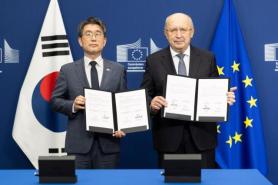
EU Defense and Space Commissioner Andrius Kubilius, right, and Jeoung Giyoung, deputy minister for the advanced capabilities program at South Korea’s Defense Acquisition Program Administration (DAPA), at a signing ceremony on satellite cooperation in Brussels on September 17, 2026. (Photo: © European Union) ZURICH, November 09 (AJP) -South Korean companies can supply non-sensitive parts and services for the European Union’s planned secure satellite network, a European Commission official said Monday, pointing to a potential new market for Korea’s space and defense industries. Korean firms are already eligible to join the IRIS² project as suppliers or subcontractors, the official told South Korean newspaper E-Today. Eligibility does not guarantee contracts, however, and any work would be subject to the program’s legal and technical requirements. Formal participation by the South Korean government would require a separate international agreement, the official said. The distinction gives Korean companies a potential commercial opening while Seoul and Brussels explore a broader partnership in secure satellite communications. IRIS², short for Infrastructure for Resilience, Interconnectivity and Security by Satellite, is intended to provide secure communications for governments and armed forces as well as commercial connectivity. Often described as Europe’s answer to SpaceX’s Starlink, the network is part of an EU effort to reduce dependence on foreign providers. The war in Ukraine has underscored the importance of reliable satellite links on the battlefield, adding urgency to Europe’s push for its own capabilities. “Security also depends on space,” European Commission spokesperson Thomas Regnier said, explaining that IRIS² would serve both civilian and military users. The first satellites are scheduled for launch by the end of 2029. Talks over the project’s operation and financing concluded in August, and its main suppliers have been selected. The comments follow a series of exchanges between Seoul and Brussels this autumn. On September 17, EU Defense and Space Commissioner Andrius Kubilius and a senior official from South Korea’s Defense Acquisition Program Administration (DAPA) signed an arrangement in Brussels to cooperate on secure satellite communications. The arrangement opened the way for discussions on a possible Korean link to IRIS². A joint working group held its first meeting in October, bringing together the European Commission, the European Space Agency, DAPA and South Korea’s Agency for Defense Development. The cooperation could give South Korea access to aspects of the program’s design while allowing European space companies to draw on Korean industrial expertise. Norway and Iceland are the only countries to have signed formal cooperation treaties with the EU on the program so far. South Korea is among the first countries outside Europe to enter discussions. Two Korean defense electronics companies see scope to contribute, although neither has established that its products meet the project’s requirements. Hanwha Systems cited its experience developing satellites, ground stations and terminals for low-orbit networks. It said it had not begun supplier talks. LIG D&A pointed to its satellite repeaters and advanced antennas developed for South Korea’s military satellite programs. Both companies said further checks would be needed to assess compatibility with IRIS² requirements. The potential opening would extend Korea’s growing defense business in Europe into space communications. Korean manufacturers have already secured major contracts in Poland for K2 tanks, K9 self-propelled howitzers and combat aircraft. Winning satellite work would depend on meeting a separate set of technical and security requirements. - Tags: IRIS², European Union, European Commission, European Space Agency, South Korea, Andrius Kubilius, Thomas Regnier, Defense Acquisition Program Administration, Agency for Defense Development, Hanwha Systems, LIG D&A, E-Today, Starlink, SpaceX, satellites, defense industry