
SEOUL, November 25 (AJP) - South Korean business sentiment weakened in November as manufacturers’ financing outlook deteriorated amid rising borrowing costs and tighter funding conditions.
The Economic Sentiment Index (ESI), which combines business and consumer surveys, fell 0.9 point to 99.9 as manufacturers’ financing outlook and households’ income and spending expectations weakened, according to the Bank of Korea (BOK) Wednesday.
The Composite Business Sentiment Index (CBSI) for all industries fell 0.7 point from October to 103.5. It stayed above 100 for a second straight month, meaning companies remained more upbeat than the 2003–2025 average.
The overall business outlook for December nevertheless rose 0.2 point to 102.0, the highest since September 2022.
The survey ran from Nov. 10 to 17, as bets on further Federal Reserve hikes jolted local markets.
The BOK is widely expected to raise its benchmark rate to 3.25 percent on Thursday, delivering its third increase this year at its final rate-setting meeting of 2026.
Manufacturing CBSI fell 0.8 point to 104.8 as product inventories piled up, with food and chemical makers hit by weak sales and a global supply glut.
Nonmanufacturing sentiment slipped 0.7 point to 102.5 on higher fuel and labor costs and a seasonal lull in outdoor leisure.
Exporters’ sentiment fell 2.7 points to 103.4, the lowest since April, as U.S. tariffs and a stronger won cut primary metal makers’ orders and won-denominated earnings.
Sentiment among domestic-oriented manufacturers rose 1.5 points to 105.3, the highest since May 2022.
Weak domestic demand remained the most cited business difficulty for both manufacturers at 21.2 percent and nonmanufacturers at 19.1 percent.
The share of manufacturers citing raw material costs fell 1.3 percentage points to 18.6 percent, while the share citing uncertain economic conditions rose 1.5 percentage points to 15.2 percent.
Price pressures also eased. Manufacturers’ selling-price index fell 1 point to 98, down from 112 in May and below 100 for a third straight month. A reading below 100 means more firms reported price cuts than increases.
Their raw material purchase-price index eased 1 point to 123 from 143 in May and is expected to slip further to 121 in December.
Consumers’ one-year inflation expectations also eased 0.1 percentage point to 2.6 percent in November, separate BOK data showed Tuesday.
Despite the decline in the headline ESI, its cyclical component, which strips out seasonal and irregular swings, rose 0.9 point to 100.8, the highest since June 2022.
Softer selling prices weaken the inflation case for a hike, while above-average business sentiment weakens the growth case against one.
Weaker household income and spending expectations echo the consumption slowdown Goldman Sachs cited this week in saying a hold was possible.

Kim Yeon-jae
Kim Yeon-jae is a journalist at AJU Press (AJP's English platform),
covering macroeconomics, international finance, and geopolitics.
He closely tracks central bank monetary policies, global energy supply chains,
and the Korean defense industry.
Copyright ⓒ Aju Press All rights reserved.
Related News
-
 AJP poll: Korea's year-end rate seen at 3.25% despite stock volatility
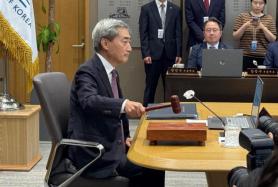
Bank of Korea Gov. Shin Hyun-song bangs the gavel at a Monetary Policy Board meeting at the central bank's headquarters in Seoul on July 16, 2026. Courtesy of the Bank of Korea SEOUL, November 23 (AJP) — The Bank of Korea is expected to bump up its base rate to 3.25 percent at its final rate-setting meeting of 2026 on Thursday, regardless of stock volatility from the AI crash, in a preemptive move ahead of an expected Fed hike in December, an AJP poll showed. All six economists agreed on the year-end rate, which would be the third raise by a quarter of percentage point following two consecutive hikes in the summer. Five expect another quarter-point move in the first quarter of 2027, most likely in February, taking the rate to a peak of 3.50 percent, a firmer consensus than in October's poll, when four of six respondents saw 3.50 percent as the peak. The same five expect the median of board members' six-month-ahead rate projections to rise to 3.50 percent from 3.25 percent in August, signaling another hike after this week. "Stronger growth and sticky underlying inflation justify pre-emptive tightening, although still-weak domestic demand could prevent unanimity," said Park Chong-hoon, chief economist at Standard Chartered in Seoul. Respondents were evenly split on Thursday's vote, with three expecting at least one board member to dissent in favor of a hold and three expecting a unanimous decision. The stock market's slide has not changed their rate call, even as the KOSPI fell 3.31 percent Monday to stand nearly 50 percent below its June record. But currency strength, which has helped ease import-price pressure, and concerns about repayment difficulties among leveraged investors have complicated the case for further tightening. The chip boom has done little for household spending, and the negative wealth effect from falling stocks is now weighing on consumption, said Park Sang-hyun, a senior researcher at iM Securities. He nevertheless expects the rate to peak at 3.50 percent in the first quarter. Real interest rates are already restrictive and financial vulnerabilities are building, making hikes beyond 3.50 percent likely to do more harm than good, said Kim Ji-na, an analyst at Eugene Investment & Securities. UOB was the lone exception on the peak, expecting the BOK to hold at 3.25 percent through 2027 as growth and inflation moderate. An additional hike would come into view only if inflation reaches 3 percent in the first quarter, said Ho Woei Chen, an economist at UOB. Edited and compiled by AJP. Graphics AI assisted. The poll's consensus runs ahead of bond-market expectations. The three-year government bond yield has fallen about 22 basis points since the October meeting, from 3.840 percent to 3.623 percent at Monday's close. The 10-year yield has dropped about 33 basis points from 4.152 percent to 3.827 percent. Bond markets are still pricing in a peak policy rate below 3.50 percent, Yoon Yeo-sam, a bond analyst at Meritz Securities, wrote in a report Monday. The BOK's guidance has nevertheless kept economists leaning toward another hike. When the board held rates last month, Governor Shin Hyun-song said growth and inflation were running stronger than projected in August. He pledged to keep policy tight until inflation settles at the 2 percent target, which he expects around 2028. Shin said the timing and pace of further hikes would depend on third-quarter growth and October inflation. The economy subsequently reported growth of 1.0 percent in the third quarter from the previous three months, well above the BOK's August forecast of 0.3 percent. Consumer and core inflation both ran at 2.8 percent in October. The BOK expects November inflation to remain in the high-2 percent range, citing persistent core price pressure. Minutes of the October meeting showed one board member warning that the surge in nominal growth could prolong core inflation, while another said the board should weigh the timing and size of further hikes. Some members also flagged the broader interest burden of higher rates, a concern that could produce a dissent Thursday. Finance Minister Lee Hyoung-il said Monday that economic growth could reach the high-3 percent range this year. The state-run Korea Development Institute, which raised its 2027 growth forecast to 3.9 percent this month, has also recommended maintaining a tight policy stance. The won weakened 9.7 won to close at 1,345.9 per dollar Monday after briefly slipping past 1,350. Renewed currency weakness would reinforce the case for tightening, Park Chong-hoon said. Thursday's rate projections will be watched as closely as the decision itself for signs of whether the board shares economists' view that one more hike lies ahead in 2027.
-
 AJP Factbox: Chp and energy prices still loom over PPI
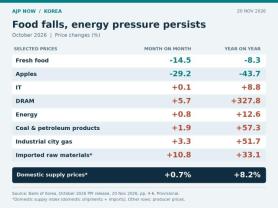
Source: Bank of Korea, November 20, 2026 release. October figures are provisional. Compiled and edited by AJP
-
 Korea's business sentiment hits 4-year high, factory outlook weakens
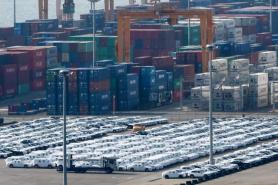
Vehicles and shipping containers await for shipment at a port in Pyeongtaek, Gyeonggi Province on April 15, 2026. AJP Han Jun-gu SEOUL, October 29 (AJP) - South Korean business sentiment hit a more than four-year high in October on stronger auto output and chip investment, even as manufacturers grew more downbeat about overall business conditions, central bank data showed Thursday. The all-industry Composite Business Sentiment Index (CBSI) stood at 104.2, the highest since August 2022, according to the Bank of Korea (BOK). Manufacturing CBSI rose to 105.6, its highest since June 2022, while the nonmanufacturing index reached 103.2, the strongest since September 2022. The headline improvement contrasted with manufacturers' assessment of overall business conditions. The manufacturing business-conditions BSI slipped 1 point to 78 in October, while its November outlook fell 3 points to 78. CBSI combines five indicators for manufacturers, including production, new orders, inventories, financial conditions and overall business conditions. A reading above 100 means composite sentiment is stronger than its 2003 - 2025 long-term average. October was also the first survey based on a revised sample reflecting 2024 corporate tax filings. The BOK cautioned that comparisons with September and earlier readings may partly reflect the regular three-year sample overhaul. The rise in manufacturing CBSI was driven largely by stronger production and orders after temporary disruptions from the Chuseok holiday last month and automaker strikes faded. Manufacturing production BSI rose 5 points to 94 and new orders gained 4 points to 91. The improvement was particularly pronounced in the auto sector, where the production index jumped 30 points and new orders rose 20 points. Passenger-car exports increased 40.9 percent from a year earlier during the first 20 days of October after falling 5.6 percent in September. The recovery spread into supplier industries. The inventory index for machinery and equipment fell 12 points as deliveries to semiconductor, shipbuilding and auto companies increased. A lower inventory reading contributes positively to CBSI. Chemical producers saw both production and new-orders indexes rise 19 points on stronger demand from battery and energy-storage system makers. Stronger activity, however, did not remove broader concerns among manufacturers. Weak domestic demand remained their most commonly cited business difficulty, accounting for 21.6 percent of responses, followed by higher raw material prices at 19.9 percent and economic uncertainty at 13.7 percent. Labor shortages and higher labor costs accounted for 8.0 percent, up 2.7 percentage points from September, while the share citing funding shortages rose 1.0 percentage point to 8.0 percent. Nonmanufacturing sentiment also improved as semiconductor-related investment spread into construction and other service industries. The business-conditions index for construction rose 12 points and its financial-conditions index gained 11 points, helped by orders for semiconductor plants, data centers and residential projects in the Seoul metropolitan area. Wholesale and retail profitability rose 9 points on stronger auto exports, transactions involving semiconductor-factory equipment, foreign tourist arrivals and seasonal medicine demand. Transportation and storage firms saw their business-conditions index rise 11 points and profitability gain 6 points as freight volumes and ocean shipping rates increased. The nonmanufacturing business-conditions BSI rose 2 points to 77, with its November outlook increasing 3 points to 78. The gap between composite sentiment and firms' overall assessment also remained visible in the outlook for November. The all-industry CBSI outlook stood at 101.8, with manufacturing at 103.0 and nonmanufacturing at 101.0, all above the composite index's long-term benchmark. Manufacturers' overall business-conditions outlook, by contrast, fell to 78. The Economic Sentiment Index (ESI), which combines selected business and consumer survey indicators, rose 0.9 point to 100.8, its highest since June 2022. Its cyclical component, which removes seasonal and irregular fluctuations, increased 1.0 point to 100.1. The ESI improvement was concentrated on the business side. Manufacturing financial-condition expectations and the nonmanufacturing business outlook each contributed 0.6 point to the index. Export expectations, household income expectations and consumer spending expectations each subtracted 0.3 point.