
GS retained the CEOs of its major subsidiaries while naming new heads for four energy and power units, prioritizing stability amid economic uncertainty.
GS Retail posted record quarterly revenue and operating profit in the third quarter under Heo’s leadership, while Lee was recognized for strengthening the group’s finances and supporting new businesses, including AI data centers. The appointments are subject to approval by the respective subsidiaries’ boards.
Tags: South Korea, GS Group, GS Retail, Heo Seo-hong, Lee Tae-hyung, Executive Reshuffle, Corporate Leadership, Retail Industry, Energy, Power Generation, Artificial Intelligence, AI Data Centers, Corporate Management, Korean Conglomerates

Kim Hee-su
Kim Hee-su is a bilingual reporter at AJU Press, covering defense and foreign affairs. Before joining AJP in 2025, she worked at The Korea Times, where she wrote interview stories, including a profile of North Korean defector Kim Gum-hyok, and produced digital content. She also previously worked as a researcher for KBS News 9’s International News Department, supporting correspondents in 10 countries around the world. She graduated from the University of Toronto in Canada with a double major in Book and Media Studies and East Asian Studies.
Copyright ⓒ Aju Press All rights reserved.
Related News
-
 GS Group Announces 2027 Executive Appointments, Promotes Heo Seo-hong and Lee Tae-hyung
GS Group has promoted Heo Seo-hong, president of GS Retail, and Lee Tae-hyung, vice president of GS Corporation, to the position of president as part of its regular executive appointments for 2027. The company aims to ensure management stability by retaining key subsidiary leaders while also focusing on nurturing young talent to strengthen its future growth foundation. On November 25, GS Group announced a total of 40 executive appointments, including the promotion of two presidents, the appointment of four new CEOs, the promotion of six vice presidents, the promotion of four senior managing directors, and the appointment of 24 new managing directors. Heo Seo-hong, who was promoted to president, was born in 1977 and has been leading efforts to improve profitability in core businesses and drive organizational innovation based on artificial intelligence (AX) since taking office last year. The fact that GS Retail achieved record-high quarterly sales and operating profit in the third quarter of this year is also cited as a reason for his promotion. Heo previously managed business operations and management at GS Energy and gained experience in new business investments by leading the acquisition of Hugel while serving as head of the future business team at GS Corporation. He plans to enhance the competitiveness of the retail business and accelerate management innovation based on AX. Lee Tae-hyung, the new president of GS Corporation, was born in 1970 and has held positions such as head of management planning at GS Energy and CEO of Incheon Comprehensive Energy. Since his promotion to vice president in 2023, he has managed the group's financial health and business portfolio as the head of the finance team (CFO) and portfolio management team. He has been recognized for supporting the discovery of new business opportunities, including artificial intelligence (AI) data centers, while maintaining a stable financial structure. He is expected to review the group's priorities for new business investments and funding strategies to support Chairman Heo Tae-soo's future growth strategy. Most of the CEOs of major subsidiaries have been retained. Following the replacement of CEOs at nine subsidiaries, including GS Global, GS Entec, GS E&R, and GS P&L last year, the company aims to ensure business continuity with the existing management team this year. However, new CEOs have been appointed for four energy and power subsidiaries. Kim Jin-hak, head of business strategy and overseas investment at GS Energy, will be appointed as CEO of Incheon Comprehensive Energy, while Lee Jong-jin, head of purchasing at GS E&R, will become CEO of GS Gumi Combined Heat and Power. Heo Chang-ik, head of management, and Yeo Seung-seop, head of the power sector, have been designated as CEOs of GS Donghae Power and GS Banwol Combined Heat and Power, respectively. There are a total of six vice president promotions. Among them are Kim Gi-hwan, senior managing director at GS Energy, as well as Heo Joo-hong and Kim Young-joo from GS Caltex, Kang Yoon-seok and Heo Chi-hong from GS Retail, and Seong Nak-hyun from GS Construction. New vice president Kim Gi-hwan will be responsible for renewable energy and new business strategies, identifying business opportunities in response to increasing power demand. New vice president Heo Joo-hong will oversee GS Caltex's petrochemical and lubricant businesses, while new vice president Kim Young-joo will serve as head of human resources. Kang Yoon-seok, the new vice president of GS Retail, will manage finance and compliance, while Heo Chi-hong will handle business strategy and overseas investments. Seong Nak-hyun, the new vice president of GS Construction, will focus on enhancing cost competitiveness based on his expertise in procurement. A total of 24 new managing directors have been appointed, representing a 33.3% increase from the previous two appointments, which had 18. Among them, eight are in their 40s, making up one-third of the total. Notably, GS Construction has appointed 10 managing directors, double the number from the previous appointment, selecting talent in key business areas such as housing, urban renewal, and data centers. A GS Group official stated, "Given the significant uncertainties both domestically and internationally, we have maintained stability while continuing the business innovations pursued by our major subsidiaries. We will support the discovery of new growth engines to create tangible results based on inter-subsidiary cooperation."* This article has been translated by AI.
-
 GS Group to Invest 30 Trillion Won in Asia's Largest AI Data Center
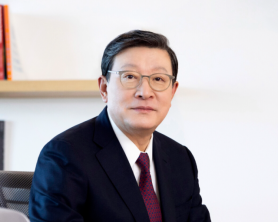
GS Group Chairman Huh Tae-soo. GS Group plans to invest 30 trillion won to build Asia's largest artificial intelligence (AI) data center campus in Gangwon Province. This massive project will have a power capacity of 2.4 gigawatts (GW) and is seen as a significant investment that could reshape the domestic data center market amid intensifying competition for AI infrastructure. On June 29, GS Group announced this initiative during the "Three Major Mega Projects National Report Meeting" held at the Blue House. The AI data center will be located in the Bukpyeong Second Industrial Complex in Donghae, Gangwon Special Self-Governing Province. GS Group aims to complete the first phase of the project, which will provide 1.2 GW of capacity, by 2028, followed by a second phase with an additional 1.2 GW by 2029. This rapid development aligns with the global competition for AI infrastructure and supports South Korea's strategy to become a global AI hub, a sentiment shared by both the public and private sectors. Recognizing the importance of data centers as a core infrastructure for the AI era, GS Group is solidifying its business plans, including the establishment of GS AI Infrastructure, a subsidiary under GS, to expedite the project. The group is quickly consolidating its key capabilities for the AI data center, including power generation, construction, and large-scale infrastructure operation. As the largest private power producer in South Korea, GS Power, GS EPS, and GS ENR possess extensive expertise in providing stable power supply for AI data centers. GS Construction, along with subsidiaries like Xi C&A and DC Bridge, has accumulated significant experience in constructing and operating data centers, including the Epoch Anyang Center and Goyang Magna Center. Additionally, GS Caltex has commercialized immersion cooling products for data centers, and through GS Ventures and GS Futures, the company continues to invest in AI-related startups, building a relevant technology ecosystem. Earlier this year, Huh Tae-soo, chairman of GS Group, stated in his New Year’s address that the company could secure business opportunities by harnessing its capabilities in energy, infrastructure, and operational know-how in response to the spread of AI, declaring 2026 as the year to visualize the impact of AI business. Meanwhile, the government announced plans to invest 800 trillion won in the southwestern region and 81 trillion won in the Chungcheong region as part of its three major mega projects, with a focus on establishing a semiconductor production complex worth 800 trillion won in the southwestern area.* This article has been translated by AI.
-
 South Korea's GS Group posts strong 4Q profit, but full-year earnings slip
Courtesy of GS SEOUL, February 10 (AJP) - South Korea’s GS Group reported stronger fourth-quarter earnings on improved refining margins, although full-year profit declined as weakness in petrochemicals and power generation weighed on results. In a regulatory filing on Monday, GS said fourth-quarter revenue rose 1.4 percent from a year earlier to 6.49 trillion won, while operating profit jumped 23.3 percent to 767.2 billion won. For full-year 2025, however, revenue slipped 0.3 percent to 25.18 trillion won and operating profit fell 4.9 percent to 2.93 trillion won. Energy affiliate GS Caltex led quarterly gains, posting a 136.5 percent surge in fourth-quarter operating profit to 653.4 billion won, while revenue rose 2.5 percent to 11.75 trillion won. For the full year, operating profit increased 61.3 percent to 884 billion won despite a 6.3 percent decline in revenue to 44.63 trillion won. GS Caltex said refining performance improved in the fourth quarter as product margins strengthened despite falling crude prices. Oil prices declined amid expectations of increased supply following higher OPEC output, but disruptions at overseas refineries and seasonal demand helped widen product spreads, supporting profits. GS Energy, another key subsidiary, reported fourth-quarter revenue of 1.66 trillion won and operating profit of 701.9 billion won, up 18 percent and 65 percent respectively from a year earlier. Within GS Energy, however, performance diverged by business segment. Power and district heating operations saw revenue fall 15 percent to 402.4 billion won, with operating profit declining 22 percent to 55.4 billion won due to lower electricity prices. A GS official said overall performance in 2025 was weighed down by persistently weak petrochemical margins amid global oversupply and softer demand, while profitability at power-generation affiliates declined. * This article, published by Aju Business Daily, was translated by AI and edited by AJP.