

Journalist
Kim Yeon-jae김연재
duswogmlwo77@ajupress.com
ReporterBank of Korea & Market, Macroeconomics
Kim Yeon-jae is a journalist at AJU Press (AJP's English platform),
covering macroeconomics, international finance, and geopolitics.
He closely tracks central bank monetary policies, global energy supply chains,
and the Korean defense industry. "Peering into the risks behind the euphoria."
covering macroeconomics, international finance, and geopolitics.
He closely tracks central bank monetary policies, global energy supply chains,
and the Korean defense industry. "Peering into the risks behind the euphoria."
Latest by Kim Yeon-jae
-
 BOK to expand beyond U.S. bonds for "active" FX management SEOUL, Sep. 16 (AJP) — The Bank of Korea (BOK) will turn more active and return-oriented in managing part of its foreign exchange reserves by increasing allocations to overseas bonds and expanding beyond U.S. Treasuries. The change would apply only to assets managed by domestic firms and would not alter the BOK's overall mix of stocks and bonds in its foreign reserves, the central bank said Wednesday. The shift comes as U.S. Treasury yields hover near two-decade highs, with the benchmark 10-year yield topping 5 percent this week and reaching about 5.04 percent Tuesday, its highest since 2007. The BOK said the move is aimed at broadening the investment skills of domestic asset managers rather than responding to short-term moves in Treasury yields. The change applies only to assets entrusted to Korean firms and will not alter the central bank's overall mix of stocks and bonds in its foreign reserves. The central bank will reduce passive developed-market stock mandates and expand overseas bond investment, replacing its existing U.S. Aggregate Bond strategy with a Global Aggregate strategy covering about 28 countries and roughly 30,000 securities. The move marks a shift from helping Korean asset managers build a basic overseas investment business toward training them to make active investment decisions and generate returns above market benchmarks. As part of the shift, the BOK will reduce mandates for developed-market equity funds, which largely follow benchmark indexes, and expand overseas bond mandates handled by domestic firms. It will also replace its existing U.S. Aggregate Bond strategy with a Global Aggregate strategy covering bonds across multiple countries and currencies. The change comes after overseas investing expanded sharply among South Korean individuals and institutions, reducing the need for the BOK to support relatively simple foreign equity investment strategies. Overseas equity funds held 163 trillion won ($118.9 billion) in net assets as of June, nearly six times the 27.7 trillion won recorded in 2020, according to Korea Financial Investment Association data cited by the BOK. Overseas equity exchange-traded funds accounted for 126.3 trillion won, surging from just 1.6 trillion won in 2020. Overseas bond funds remained much smaller at 11.1 trillion won. The growth has given domestic asset managers a larger independent business base outside the central bank's program, while years of BOK mandates have helped them build overseas investment teams and strengthen research, investment decision-making, risk management and settlement systems. The BOK began entrusting part of its foreign assets to domestic firms in 2012 with Chinese equities and expanded the program to developed-market stocks in 2019 and U.S. bonds in 2022. The amount entrusted to domestic managers rose from $100 million in 2012 to $3.21 billion in 2025 and remained at that level as of July this year. Five asset managers currently participate in the program. The portfolio consists of $1.92 billion in developed-market equities, $700 million in U.S. bonds and $590 million in Chinese stocks. AJP Takeaways - The Bank of Korea (BOK) will expand part of its foreign exchange reserve management beyond U.S. bonds by adopting a Global Aggregate strategy covering about 28 countries and roughly 30,000 securities. - South Korea's central bank said the change will give domestic asset managers more experience in active, return-oriented investing while leaving the BOK's overall stock-and-bond allocation unchanged. - South Korea's overseas investment market has grown rapidly, with overseas equity funds reaching 163 trillion won ($118.9 billion) in net assets as of June, reducing the need for the BOK to support simpler foreign equity strategies. 2026-09-16 12:00:00
 -
 Won falls, Korean bond yields hit multi-year highs as oil surges SEOUL, Sept. 15 (AJP) — The South Korean won weakened and government bond yields climbed to multi-year highs Tuesday as surging oil prices and U.S. Treasury yields fanned inflation and interest-rate concerns. The three-year government bond yield rose 6.6 basis points to 4.091 percent, its highest close since Oct. 26, 2023. The benchmark 10-year yield gained 6.4 basis points to 4.600 percent, the highest since Oct. 21, 2022. The won closed at 1,359.4 won per dollar in Seoul, weakening 12.1 won from Monday's 1,347.3. The dollar index stood around 99.6 at 3:30 p.m. “A renewed move higher in oil would complicate the inflation backdrop, keep yields supported and weigh on risk sentiment,” OCBC strategist Christopher Wong said. Oil prices jumped after Saudi Arabia shut its East-West Pipeline following a drone attack that damaged the route connecting its eastern oil fields with the Red Sea port of Yanbu. The pipeline had been carrying about 4 million barrels of crude a day and has served as a key route bypassing the Strait of Hormuz. Its shutdown threatens flows equivalent to roughly 4 percent of global oil supply. Shipping through Hormuz has already fallen sharply during the Middle East conflict, while renewed instability around the Red Sea and Bab el-Mandeb has added to concerns over oil flows. Brent crude rose to $107.55 a barrel Tuesday, while West Texas Intermediate climbed to $103.27. Eugene Investment & Securities estimated repairs to the Saudi pipeline could take two to six weeks. It said a one-month disruption could add about $10 a barrel to international crude prices and push WTI above $110. The brokerage also said strong spot premiums, backwardation and high refining margins could keep oil above $100 for the time being. TD Securities strategists Ryan McKay and Bart Melek also saw further upside risk to crude, saying longer repairs, reduced pipeline flows or further attacks could tighten the market. Higher U.S. yields added to pressure on Korean financial markets. The benchmark 10-year U.S. Treasury yield reached 5.0266 percent Tuesday, its highest level since 2007, while markets priced in a 93 percent chance of a quarter-point Federal Reserve rate increase this week. South Korea has secured most of its near-term crude needs despite the disruption. Domestic refiners have secured more than 90 percent of the crude needed for September and October based on year-earlier volumes, limiting the immediate risk of a physical shortage. With near-term supplies largely secured, oil prices and global interest rates remain the main risks for Korean government bonds and the won. AJP Takeaways - South Korea's three-year government bond yield rose to 4.091 percent Tuesday, its highest close since October 2023, while the 10-year yield reached 4.600 percent, the highest since October 2022. - The South Korean won weakened 12.1 won to 1,359.4 per dollar as oil prices and U.S. Treasury yields rose, with Brent crude climbing above $107 a barrel. - Eugene Investment & Securities, OCBC and TD Securities saw further upside risk to oil prices, with Eugene estimating that a one-month disruption to Saudi pipeline flows could push WTI above $110. 2026-09-15 17:23:53
 -
 AI may worsen capital concentration if left unchecked, BOK study SEOUL, Sept. 15 (AJP) —Eight out of 10 new jobs created through the rise of artificial intelligence were in South Korea’s capital region, suggesting the AI-driven economy could worsen capital overconcentration, a Bank of Korea study found Tuesday. Occupations highly exposed to generative AI added 247,000 jobs over the period, with the Seoul metropolitan area accounting for 80.8 percent of the increase, according to a study published on the latest Bank of Korea (BOK) Issue Note. The concentration was even greater in occupations highly exposed to agentic AI, which can plan and carry out workflows with limited human intervention. Of the 105,000 jobs added in those occupations in 2025, 88.3 percent were in the capital region. The capital region, comprising Seoul, Incheon and Gyeonggi Province, accounts for more than half of South Korea's employment. The researchers divided AI into generative, agentic and physical types and measured occupational and regional exposure to each. AI exposure refers to the extent to which tasks within an occupation can use or be automated by the technology. Exposure to generative AI was highest in Seoul, followed by Sejong, Gyeonggi Province and Incheon. Agentic AI exposure was also concentrated in Seoul, Sejong and Gyeonggi Province, while physical AI showed the opposite pattern. Exposure to physical AI was highest in North Gyeongsang, South Jeolla, North Chungcheong and Ulsan, where manufacturing and manual occupations make up larger shares of employment. The divide largely reflected differences in local employment and industrial structures. Office, sales, managerial and professional occupations with greater exposure to generative and agentic AI account for larger shares of employment in the capital region. Machine-operation, elementary and service occupations more exposed to physical AI are relatively more common outside it. The employment gains did not extend to younger workers. Among people in their 20s, employment in occupations highly exposed to generative and agentic AI declined in both the capital and non-capital regions. The researchers said university education remained focused on traditional knowledge accumulation, making it difficult for recent graduates to build the expertise and experience increasingly demanded by employers. Existing industrial concentration could widen the gap further. The capital region already accounts for 71.9 percent of employment in knowledge-intensive services and 74.4 percent in semiconductor manufacturing, according to the study. The findings were presented Tuesday at the BOK's 2026 Regional Economy Symposium in Daejeon, where separate research examined whether companies and regions were equipped to turn AI adoption into productivity gains. Eom Sang-min, professor of economics at Kyung Hee University, found that adopting AI did not by itself guarantee immediate productivity gains. Companies with larger shares of workers in their 30s showed clearer productivity improvements after adopting AI, while the effect was limited at firms with higher shares of employees aged 50 or older. Firms that spent more on employee training also recorded stronger gains. Companies outside the capital region tended to have older workforces and spend less on training than firms around Seoul, leaving them at a relative disadvantage in the AI transition. AI adoption did not reduce overall employment at the firms studied, but it had a negative effect on employment of workers aged 29 and younger. Eom called for retraining older employees and stronger employment support for young workers during the transition. Another study presented at the symposium examined how AI infrastructure could affect regional economies. Kim Young-sik, professor of economics at Seoul National University, found that AI data centers could raise total factor productivity, attract workers and increase gross regional domestic product in host areas. The gains could be partly offset if limited supplies of land and buildings raised rents and created congestion. Productivity gains concentrated in one region could also draw labor and other resources away from other areas and weaken production elsewhere, according to the study. Kim found that the effects depended not only on the size of a data center but also on local supply chains, trade links and labor-market conditions. The BOK issue note also identified opportunities for areas outside the capital region. AI could produce larger productivity gains in regions where human capital is scarce, while physical AI could help manufacturing regions expand into product development, process improvement and other knowledge-intensive services. The researchers called for stronger regional AI training systems, greater specialization in knowledge services linked to local manufacturing and concentrated investment to turn regional universities into AI hubs. The studies suggest that South Korea's regional AI gap will depend not only on where the technology is adopted, but also on whether local economies have the workers, training systems and industrial base needed to use it productively. AJP Takeaways - Bank of Korea researchers found that South Korea's capital region accounted for 80.8 percent of job gains in occupations highly exposed to generative AI between 2023 and 2025. - Bank of Korea research showed that South Korea's capital region is more exposed to generative and agentic AI, while non-capital regions face greater exposure to physical AI linked to manufacturing and manual work. - Research presented at the Bank of Korea's 2026 Regional Economy Symposium found that companies outside the capital region face weaker conditions for AI-driven productivity gains because they tend to have older workforces and lower training investment. - Bank of Korea researchers said regional AI training, manufacturing-linked knowledge services and stronger university-based AI hubs could help non-capital regions capture more of the technology's economic gains. 2026-09-15 14:55:03
 -
 Korea's M2 growth slows for first time this year in July SEOUL, Sept. 15 (AJP) — South Korea's annual M2 growth slowed for the first time this year in July as readily accessible savings deposits fell while term deposits and money trusts increased as interest rates went higher. M2, a broad measure of money supply, rose 5.8 percent from a year earlier, easing from 6.0 percent in June, according to data released Tuesday by the Bank of Korea (BOK). On a seasonally adjusted monthly basis, M2 rose 0.3 percent to 4,225.6 trillion won, slowing from a 0.7 percent increase in June. The slowdown came in the month when the BOK raised its base rate by 25 basis points to 2.75 percent, its first increase of the current tightening cycle. The BOK said term deposits and money trusts with maturities of less than two years led the monthly increase. Term deposits with maturities of less than two years increased by 27.3 trillion won in July, up sharply from a 7.1 trillion won increase in June, as corporate surplus funds and money related to the derivatives market flowed in. Money trusts with maturities of less than two years increased by 11.4 trillion won, compared with a 6.3 trillion won increase in June, as semiconductor companies increased deposits. Readily accessible savings deposits, meanwhile, shrank by 27.0 trillion won after edging up by 0.4 trillion won a month earlier. M1, which mainly covers cash and deposits that can be used immediately, fell 2.2 percent from June after rising 0.4 percent the previous month. Its annual growth rate slowed sharply to 6.4 percent from 10.0 percent. Broader liquidity measures also declined. Liquidity at financial institutions, or Lf, fell 0.4 percent from June after rising 1.0 percent, while broad liquidity, or L, declined 0.5 percent after increasing 0.8 percent a month earlier. Their annual growth rates also eased, with Lf slowing to 7.5 percent from 8.5 percent and L to 8.0 percent from 9.4 percent. M2 holdings by economic sector maintained the pattern seen in June, although the size of the moves narrowed. Nonfinancial companies increased their M2 holdings by 20.6 trillion won, down from a revised 37.8 trillion won increase in June. Households and nonprofit organizations reduced their holdings by 11.6 trillion won, compared with a 19.8 trillion won decline a month earlier. M2 under the previous statistical definition also lost momentum, falling 0.8 percent from June as annual growth slowed to 10.3 percent from 12.2 percent. Investment-fund holdings remained a major contributor, rising 48.9 percent from a year earlier and adding 5.0 percentage points to annual growth in the old-definition M2 measure. AJP Takeaways - South Korea's annual M2 growth slowed to 5.8 percent in July from 6.0 percent in June, marking the first slowdown this year. - The slowdown came as the BOK raised its base rate by 25 basis points to 2.75 percent in July, while readily accessible savings deposits fell sharply. - Nonfinancial companies continued to add M2 holdings while households and nonprofit organizations reduced theirs, although both moves were smaller than in June. 2026-09-15 12:04:20
 -
 South Korea's August terms of trade strongest ever SEOUL, September 15 (AJP) - South Korea's purchasing power from trade rose to its strongest level ever in August as soaring semiconductor prices more than offset renewed pressure from higher global oil prices, central bank data showed. The net barter terms of trade index jumped 27.1 percent from a year earlier, the largest gain since the series began in 1988, while the income terms of trade index climbed 60.0 percent, also a record increase, according to the Bank of Korea (BOK). Lag-adjusted export prices rose 39.6 percent from a year earlier, led by semiconductors, far outpacing a 9.9 percent increase in import prices. The net barter measure shows how much can be imported with the proceeds from one unit of exports, while the income terms of trade also take export volume into account. The improvement accelerated from July, when the net barter terms of trade rose 24.7 percent and the income measure increased 49.7 percent from a year earlier. Oil prices point to renewed pressure on import costs. Dubai crude averaged $88.75 a barrel in August, up 15.6 percent from $76.75 in July. Oil prices had fallen 3.4 percent in July, when lower energy costs and a stronger won moved in the same direction to help pull down import prices. The currency provided some relief in August. The U.S. dollar averaged 1,406.30 won, down from 1,497.43 won in July, translating into a 6.1 percent gain in the won on a monthly-average basis. The local currency had strengthened 2.0 percent in July. Import prices declined 2.4 percent from July for a third consecutive monthly drop. Measured in contract currencies, however, import prices rose 3.2 percent, widening the divergence already seen in July, when won-based prices fell while contract-currency prices increased. Won-based import prices remained 15.6 percent higher than a year earlier. Export prices showed the same currency effect. The won-based export price index fell 3.7 percent from July, its steepest monthly decline since December 2022, while export prices measured in contract currencies rose 2.2 percent. Won-based export prices were still 42.4 percent higher than a year earlier, extending their annual increase to a 12th consecutive month. Chips remained the key driver. DRAM export prices surged 253.4 percent from a year earlier and flash memory prices climbed 250.6 percent, although DRAM prices slipped 3.4 percent from July. Export volume increased 25.9 percent from a year earlier for a 10th consecutive gain, supported by computer, electronic and optical equipment as well as chemical products. The export value index jumped 75.8 percent. Import volume rose 12.0 percent from a year earlier, while the import value index gained 23.1 percent, with demand for electronic products and machinery remaining strong. AJP Takeaways - South Korea's net barter terms of trade rose 27.1 percent from a year earlier in August, the largest increase since records began in 1988, as semiconductor export prices continued to outpace import prices. - Won-based import prices fell 2.4 percent from July despite a 15.6 percent rise in Dubai crude as the average dollar-won exchange rate declined 6.1 percent. - The income terms of trade climbed a record 60.0 percent from a year earlier as stronger export prices combined with a 25.9 percent rise in export volume. 2026-09-15 07:57:00
 -
 Korea bond curve flattens as front-end yields hit multi-year highs SEOUL, Sept. 14 (AJP) — South Korea's government bond curve flattened further Monday as front-end yields climbed to multi-year highs while longer maturities retreated, sharpening expectations for a higher-for-longer tightening path ahead of this week's Federal Reserve and Bank of Japan meetings. The two-year Korean government bond yield ended at 3.932 percent and the three-year at 4.025 percent, their highest levels since Nov. 1, 2023. Longer maturities pulled back from Friday's highs. The 10-year yield had climbed to 4.540 percent Friday, its highest since Oct. 21, 2022, during the domestic bond-market turmoil triggered by the Legoland crisis. The divergence flattened the curve as the front end, which is more sensitive to expectations for the Bank of Korea's base rate, caught up with longer maturities that had already repriced higher on inflation, oil and fiscal risks. U.S. Treasuries showed a similar pattern. The two-year Treasury yield rose 4.4 basis points Friday to 4.594 percent, while the 10-year yield fell 2.4 basis points to 4.92 percent after briefly touching 4.98 percent following the latest U.S. inflation data. The move suggests investors are pricing more near-term Federal Reserve tightening while also buying longer-dated bonds on expectations that higher rates will eventually weaken demand and inflation. Markets now price roughly an 86 percent chance of a quarter-point Fed increase this week from the current 3.50 percent to 3.75 percent range. U.S. consumer prices rose 0.4 percent in August from the previous month and 3.4 percent from a year earlier. Core prices gained 0.3 percent on the month, slightly above expectations. Goldman Sachs shifted Monday to forecasting a 25-basis-point increase, while J.P. Morgan expects another hike in December. The policy move itself is becoming less important to markets than the path beyond September. Meritz Securities analyst Yoon Yeo-sam said Monday that a September hike had become the more realistic outcome, although he still believed the Fed would ideally avoid another increase. Attention should increasingly turn to whether September marks the end of the tightening cycle or whether another increase follows in December, he said. Mirae Asset Securities analyst Min Ji-hee had already forecast a quarter-point increase in a Sept. 10 preview and expects the Fed's rate projections for this year and next to move higher. The flattening in U.S. yields does not mean growth concerns alone are driving longer maturities lower. Oil briefly retreated around the inflation release, easing some near-term price pressure, before Brent crude returned above $100 a barrel as Middle East supply risks intensified. That leaves the Fed confronting sticky inflation while monetary conditions continue to tighten. BOJ adds pressure through the yen Japan presents a different risk for Korean markets. The BOJ is widely expected to raise its policy rate from 1 percent to 1.25 percent this week. All but two of 68 economists in a recent Reuters poll expect a hike, while 24 of 66 respondents see another increase to 1.50 percent as early as October or December. The immediate move is therefore largely priced. Markets are more focused on how quickly further increases follow. Japan's producer prices rose 7.6 percent from a year earlier in August, while yen-based import prices jumped 24.8 percent. Yoon expects the BOJ to raise rates to 1.25 percent this week and sees the tightening pace potentially accelerating toward one quarter-point increase every three to four months. He sees a terminal rate of 1.75 percent as increasingly plausible rather than 1.50 percent. The yen has strengthened sharply this month as markets priced faster BOJ tightening and investors reduced yen-funded carry positions. Higher Japanese rates make borrowing in yen less attractive and can force leveraged investors to unwind positions in higher-yielding assets elsewhere. A quarter-point hike already embedded in prices may have limited impact by itself. Guidance pointing to a faster pace of tightening could have a larger effect on Asian currencies, bonds and equities. Korea caught between Fed, BOJ and oil South Korea sits between the two tightening channels. Higher Fed rates lift global dollar funding costs and U.S. Treasury yields, putting upward pressure on Korean bond yields and potentially supporting the dollar against the won. BOJ tightening works through the yen and regional capital flows by reducing the attraction of yen-funded carry trades and raising the risk of abrupt position unwinds. Oil adds a third pressure point. South Korea's heavy dependence on imported energy means a sustained rise in crude prices can lift domestic inflation even without further weakness in the won. The Bank of Korea has already raised its Base Rate twice in succession from 2.50 percent to 3.00 percent and has said the timing and pace of further increases will depend on inflation, growth and financial stability. Domestic bond yields have repriced accordingly. Monday's 2.8 trillion won ($2.1 billion) 10-year government bond auction cleared at a weighted average yield of 4.510 percent, below Friday's 4.540 percent close. The front end, however, continued to move higher. Yoon expects the BOK's key rate eventually to reach 3.50 percent but said continued U.S. tightening and elevated oil prices could force markets to consider a terminal rate as high as 3.75 percent. A parallel rise across maturities would point to a broad inflation or term-premium shock. A flattening curve instead suggests markets are assigning more weight to additional tightening in the near term while also considering the eventual growth cost. AJP Takeaways - South Korea's yield curve flattened further as two- and three-year government bond yields climbed to multi-year highs while longer maturities retreated. - The move reflects growing expectations that the BOK may need to keep rates higher for longer as the Fed tightens further and oil stays elevated. - The BOJ poses a separate risk through the yen, with faster Japanese tightening potentially accelerating carry-trade unwinds and reshaping regional capital flows. - Markets are increasingly focused less on this week's expected quarter-point moves than on how far the Fed, BOJ and BOK tightening cycles still have to run. 2026-09-14 17:12:32
 -
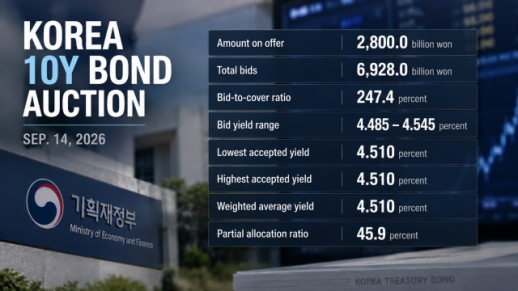 Korea's bond offering draws 2.5 times bigger bids despite rising yields SEOUL, Sept. 14 (AJP) — South Korea's 10-year government bond offering drew bids worth nearly 2.5 times the amount on offer despite yields hovering near multi-year highs. Bids totaled 6.928 trillion won for 2.8 trillion won ($2.1 billion) of 10-year government bonds offered, equivalent to 247.4 percent of the planned sale, according to the Ministry of Economy and Finance. The offering was sold at a weighted average yield of 4.510 percent, slightly below the benchmark 10-year government bond yield of 4.540 percent at the close on Friday and above the 4.415 percent recorded at the previous 10-year auction in August, reflecting the sharp rise in domestic bond yields over the past month. Bid coverage, however, improved from the previous sale. The August auction received 7.156 trillion won of bids for 3 trillion won offered, equivalent to 238.5 percent of the planned issuance. The coverage ratio was 8.9 percentage points higher than in August, although the absolute amount of bids declined as the offering size was reduced. Bids ranged from 4.485 percent to 4.545 percent, while both the lowest and highest accepted yields were set at 4.510 percent. The partial allocation ratio at the cutoff yield was 45.9 percent. The auction followed a sharp selloff in the domestic bond market last week, with the benchmark 10-year government bond yield ending Friday at 4.540 percent after rising 8.7 basis points in a single session. The rise in yields has come amid higher global bond rates and renewed inflation concerns driven by elevated crude oil prices. The latest sale nevertheless showed resilient demand for Korean government bonds, with the government placing the full amount offered despite sharply higher borrowing costs than at the previous auction. The 10-year bonds carry a 4.25 percent coupon and mature in June 2036. AJP Takeaways - South Korea's 10-year government bond auction received 6.928 trillion won of bids for 2.8 trillion won offered, producing bid coverage of 247.4 percent. - Bid coverage improved from 238.5 percent in August even as the weighted average auction yield rose 9.5 basis points to 4.510 percent. - The government awarded the full 2.8 trillion won despite elevated bond yields, although absolute bids declined from August as the offering size was reduced. 2026-09-14 14:21:02
 -
 Overdraft borrowing surges 10% amid stock investment in Korea SEOUL, Sept. 14 (AJP) — Overdraft borrowing at South Korean banks has surged around 10 percent to nearly 70 trillion won ($52 billion) so far this year amid frenzied retail stock investment, government data showed. Outstanding borrowing reached 69.73 trillion won at the end of July, according to Financial Supervisory Service data submitted to Rep. Park Sung-hoon. The figure represents funds actually drawn by borrowers rather than their total approved credit limits. The number of active overdraft accounts rose just 0.5 percent to 4.89 million from 4.87 million at the end of last year, while outstanding borrowing increased by 6.09 trillion won, or 9.6 percent, from 63.64 trillion won. The number of accounts increased at KB Kookmin Bank, KakaoBank and Hana Bank while declining at lenders including NH NongHyup Bank, Standard Chartered Bank Korea and Toss Bank. Average outstanding borrowing per active account rose 9.0 percent to about 14.25 million won in July from 13.07 million won at the end of last year. Most of the increase was concentrated between April and July. Outstanding balances rose by 5.78 trillion won during the four-month period, accounting for 95 percent of the total increase recorded in the first seven months of the year. Balances increased by another 1.15 trillion won, or 1.7 percent, in July alone despite a sharp correction in the domestic stock market. The number of active accounts edged up only about 0.1 percent. The July balance was the highest compared with past quarter-end figures since the end of 2021, when overdraft borrowing reached 70.18 trillion won amid low interest rates and a surge in retail stock investment. Borrowers, however, are paying substantially more for credit than during the previous peak. The weighted average interest rate on overdraft borrowing stood at 5.64 percent at the end of July, 1.70 percentage points above the 3.94 percent recorded at the end of 2021. The increase has raised questions over whether some of the borrowing is being used to finance leveraged stock investment alongside household demand for living expenses and other short-term funding. The Bank of Korea said in its September Monetary Policy Report released last Thursday that housing price gains in the Seoul metropolitan area and household loan growth were both accelerating. The trends have kept financial stability risks high on the central bank's policy agenda. The BOK also estimated that leveraged investment financed through unsecured credit and other forms of household borrowing expanded sharply in the second quarter. The FSS data, however, do not identify how borrowers used funds drawn from overdraft accounts. Park called on financial authorities to look beyond aggregate lending volumes and more closely monitor household cash flows and dependence on borrowing. AJP Takeaways - Outstanding overdraft borrowing at South Korean banks reached 69.73 trillion won at end-July, up 9.6 percent from the end of last year, while the number of active accounts rose just 0.5 percent. - Average borrowing per active account rose 9.0 percent to 14.25 million won, with 95 percent of this year's increase concentrated between April and July. - Overdraft borrowing is approaching its 2021 peak, but the average borrowing rate is 1.70 percentage points higher at 5.64 percent, leaving borrowers with heavier financing costs. 2026-09-14 10:51:14
 -
 Corporate tax to top income tax '27 as chips reshape Korea's tax base SEOUL, September 14 (AJP) -South Korea’s corporate tax revenue is projected to more than double next year from this year’s supplementary-budget estimate and exceed income tax receipts for the first time in 15 years, as the semiconductor windfall is expected to continue well into 2027. Corporate tax revenue is forecast to reach a record 216.7 trillion won ($161.5 billion) in 2027, according to the Ministry of Finance and Economy’s national tax revenue budget plan, surpassing the 180 trillion won expected from income tax. It would mark the first time since 2012 that corporate tax receipts have exceeded income tax revenue and the first time they have topped 200 trillion won. The surge reflects expectations for another sharp increase in operating profits, particularly at semiconductor giants Samsung Electronics and SK hynix, as the global memory-chip boom continues. Corporate tax receipts have already rebounded from 84.6 trillion won in 2025 to an estimated 101.3 trillion won this year under the supplementary budget. The government expects the figure to more than double to 216.7 trillion won next year. The extraordinary increase highlights how heavily Korea’s fiscal position is becoming tied to the semiconductor cycle. Corporate tax revenue rose from the 40 trillion-won range in the early 2010s to 103.6 trillion won in 2022, before collapsing to 80.4 trillion won in 2023 and 62.5 trillion won in 2024 as the chip downturn hit corporate earnings. The unexpected fall was a major contributor to tax-revenue shortfalls in those years, disrupting budget execution and narrowing the government’s room for fiscal policy. Income tax, by contrast, has followed a steadier upward path, supported by inflation, employment growth and rising asset prices. Revenue rose above 100 trillion won in 2021, reached 130.5 trillion won in 2025 and is estimated at 136.8 trillion won this year before climbing to 180 trillion won in 2027. Value-added tax, once the biggest source of national tax revenue, is projected at 91.4 trillion won next year, marginally higher from 86.6 trillion won estimated for this year. The growing dependence on corporate taxes has renewed concerns that Korea’s public finances could become increasingly vulnerable to swings in the semiconductor cycle — generating windfall revenue during chip booms but opening large fiscal holes when the industry turns down. The government plans to address that volatility through a new Future Response Fund, which would set aside part of tax revenue generated during boom years rather than immediately spending the entire windfall. Under the government plan, tax receipts exceeding the trend in domestic tax revenue over the previous 10 years would be accumulated in the fund and used both for investments intended to lift Korea’s potential growth rate and as a fiscal buffer during future downturns. The government says money accumulated during periods of strong revenue could later be transferred back to the general account when tax receipts weaken. The 2027 budget plan calls for 45.4 trillion won of the fund to support projects in four broad areas — youth, new growth engines, regional development and education and talent — while 12.5 trillion won would be used to reduce new government bond issuance. Another 104.4 trillion won would be held as reserve funds for fiscal stabilization and future spending needs. The government argues that using all of a temporary revenue surge for one-year spending would be inefficient, while using all of it to repay debt would also limit its ability to invest in longer-term growth. It plans to manage the accumulated assets with a target return at least equivalent to government bond yields. AJP Takeaways - Corporate tax revenue is projected to more than double to a record 216.7 trillion won ($161.5 billion) in 2027 from 101.3 trillion won estimated for 2026. - Corporate tax is expected to overtake income tax for the first time since 2012, underscoring how the semiconductor boom is reshaping Korea’s tax base. - The windfall also exposes Korea to sharper fiscal swings when the chip cycle turns. The government plans to channel part of excess tax revenue into its new Future Response Fund for growth investment and fiscal stabilization. 2026-09-14 07:43:22
 -
 Bank of Korea's AI rate-setters keep choosing not to decide SEOUL, September 11 (AJP) — Artificial intelligence can help analyze economic data, but it cannot be relied upon for policymaking because of its susceptibility to bias, a Bank of Korea study showed. The finding emerged from a joint forum the BOK hosted with the Korean Statistical Society on Friday, where researchers described AI systems that could interpret macroeconomic data and simulate rate decisions with fluent, plausible-looking reasoning — but whose errors kept skewing in the same direction no matter how the experiment was adjusted. Kim So-jung of the BOK's Statistical Research Team said building an AI agent system has become relatively straightforward. The harder question, she told the forum, is how much analysts can trust the output as such agents are handed greater autonomy — a question the central bank tested directly on its most consequential decision: where to set interest rates. In the experiment, large language models were fed macroeconomic data and summaries of the U.S. Federal Reserve's Beige Book, then asked to choose whether to raise, hold or cut rates. Their errors were not random, but skewed toward inaction in what researchers called a "hold bias" even when the data pointed elsewhere. BOK researchers then tried out handing different agents different roles and letting them argue it out. Again, it didn't work. The hold bias persisted through role-assigned, multi-agent debate, and in some runs grew stronger. Stretching the discussion from five rounds to 10 or 15 produced no consistent gain in accuracy either. The implication reaches beyond Seoul. A common assumption in multi-agent AI design is that pooling several models, or several instances of one, and letting them check each other will cancel out individual mistakes. The BOK results suggest otherwise when the agents share a foundation model as their errors can be correlated rather than independent so that debate multiplies the same blind spot instead of correcting it. A second BOK project produced a parallel warning. The bank built a system that routes news articles to five specialist AI agents — covering macroeconomics, finance, policy, corporate affairs and geopolitics — before combining their assessments into indicators of economic uncertainty. Tested on roughly 2,800 articles, the system scored F1 accuracy of about 0.75 to 0.81, a respectable but imperfect mark. Kim questioned whether agents drawn from the same underlying model can really be treated as independent experts merely because they were assigned different roles. None of this means the BOK is stepping back from AI. The bank already runs an agent system in production, using it in weekly analysis of its News Sentiment Index to flag what's driving changes in the gauge and cross-check those signals against market data — with analysts reviewing every output and feeding their judgment back into the system's memory. Human-supervised, narrow use case is a long way from letting AI agents debate their way to a rate decision, and Kim said closing that gap will require statistical tools that can identify, explain and control the specific biases AI systems carry — not just measure how often they happen to be right. Other presenters described the same caution from different angles. Song Kyung-ho of Yonsei University warned that AI models used in economic analysis can lose reliability once conditions shift away from what they were trained on, and proposed adaptive agents that detect such shifts and update their own methods in response. Park Se-ho of Hongik University argued that gaps between household survey data and national accounts often reflect real differences in what each dataset captures rather than errors to be smoothed away, and called for diagnosing those "distribution shifts" before adjusting survey weights. Park Mingue of Korea University said transfer learning can help fill gaps in recent data, but only where older and newer data behave similarly enough, and stressed that any new method needs rigorous validation before use. The throughline, as Kim put it, is that the question for policymakers is no longer whether AI can produce an economic judgment — it already can, fluently. It's whether researchers can pin down why that judgment is biased before they let it anywhere near an actual decision. AJP Takeaways - The Bank of Korea found AI's "hold bias" on interest rates persisted, and sometimes grew stronger, even when multiple AI agents debated the decision in different assigned roles. - Adding discussion rounds, from five up to 15, did not consistently improve the AI's rate-decision accuracy. - Researchers attribute the bias to agents sharing a common foundation model, so debate can amplify shared blind spots rather than cancel them out — a caution for any institution building multi-agent AI systems, not just central banks. 2026-09-11 17:10:36