

Journalist

Kim Yeon-jae김연재
duswogmlwo77@ajupress.com
ReporterBank of Korea & Market, Macroeconomics
Kim Yeon-jae is a journalist at AJU Press (AJP's English platform),
covering macroeconomics, international finance, and geopolitics.
He closely tracks central bank monetary policies, global energy supply chains,
and the Korean defense industry. "Peering into the risks behind the euphoria."
covering macroeconomics, international finance, and geopolitics.
He closely tracks central bank monetary policies, global energy supply chains,
and the Korean defense industry. "Peering into the risks behind the euphoria."
Latest by Kim Yeon-jae
-
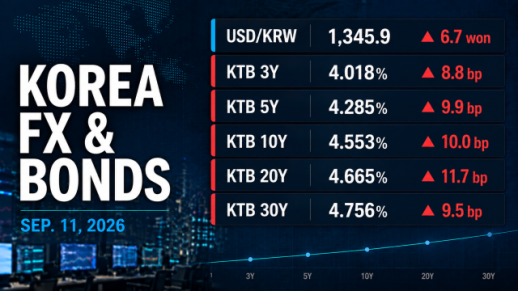 Korean 3-yr yield tops 4% for first time since 2023 SEOUL, September 11 (AJP) — South Korea's three-year government bond yield closed above 4 percent Friday for the first time in nearly three years, while the won weakened as oil-driven inflation fears sent global yields sharply higher. The three-year Korean government bond yield jumped 8.8 basis points to 4.018 percent, crossing the 4 percent threshold for the first time since Nov. 1, 2023. The yield had last closed above the level at 4.071 percent on Nov. 1, 2023, before falling to 3.979 percent the following day. Selling pressure was broad across the Korean government bond market. The benchmark 10-year yield climbed 10.0 basis points to 4.553 percent, while the 20-year yield rose 11.7 basis points to 4.665 percent, the largest increase among the key maturities tracked Friday. The 10-year yield also reached its highest level since October 2022 as Korean bonds followed a sharp global selloff. The South Korean won closed at 1,345.9 per U.S. dollar, weakening 6.7 won from the previous session. Global bond yields surged as another jump in oil prices intensified concerns that inflation could remain elevated for longer and force central banks to tighten policy further. Brent crude approached $110 a barrel Friday and was on course for an 11 percent weekly gain as escalating Middle East tensions threatened key energy shipping routes. The oil shock pushed the U.S. 10-year Treasury yield as high as 4.979 percent, close to the psychologically important 5 percent level, while longer-dated yields also climbed to multi-year highs. Higher U.S. yields fed directly into the Korean bond market, with the three-year yield particularly sensitive to expectations for the domestic policy-rate path. Inflation concerns had already intensified after U.S. producer prices rose 0.4 percent in August from the previous month and 5.4 percent from a year earlier. Several components feeding into the Federal Reserve's preferred Personal Consumption Expenditures price gauge also came in firm, pushing market expectations for a 25-basis-point Fed hike at next week's meeting to about 70 percent. The European Central Bank added to the global repricing after raising its deposit rate by 25 basis points Thursday, while investors also remained concerned about heavy sovereign-debt supply and fiscal pressures across major economies. Domestic monetary policy expectations offered little relief. The Bank of Korea said in its September Monetary Policy Report Thursday that inflation was expected to remain above its 2 percent target for a prolonged period and that it would determine the timing and pace of further rate increases while monitoring inflation, growth and financial stability. The BOK has raised its Base Rate at two consecutive meetings to 3.00 percent. The combination of higher global yields and expectations for further domestic tightening drove the three-year yield sharply above 4 percent after it had ended Thursday at 3.930 percent. Thursday's close itself was already 2.0 basis points higher than the previous session. The won came under pressure from the same combination of higher U.S. yields and oil prices. A stronger dollar followed the rise in Treasury yields, while higher crude prices worsened the outlook for South Korea's import bill as an economy heavily dependent on imported energy. Markets will next turn to U.S. consumer inflation data due Friday night in Korea, the final major inflation reading before the Federal Open Market Committee's Sept. 15-16 meeting. A stronger-than-expected core reading could reinforce expectations for a Fed hike and keep upward pressure on both U.S. and Korean yields, while a softer reading could offer some relief after Friday's sharp selloff. AJP Takeaways - South Korea's three-year government bond yield jumped 8.8 basis points to 4.018 percent, closing above 4 percent for the first time since Nov. 1, 2023. - The 10-year and 20-year yields also surged as oil prices near $110, higher U.S. Treasury yields and stronger global rate-hike expectations triggered broad bond selling. - The South Korean won weakened 6.7 won to 1,345.9 per dollar, with markets now focused on U.S. CPI ahead of next week's Federal Reserve meeting. 2026-09-11 16:58:41
 -
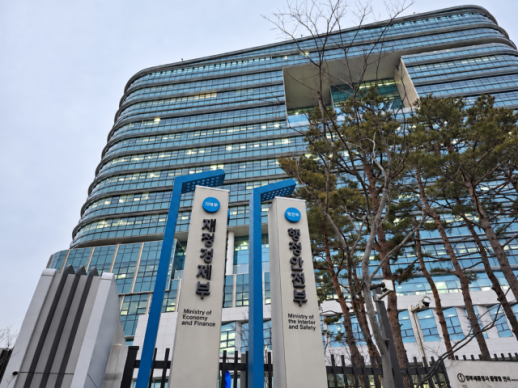 Finance ministry sees solid recovery for first time since 2024 SEOUL, September 11 (AJP) - South Korea's government said Friday the economy was in a "solid recovery" for the first time in two years on strong exports and revived domestic demand, but remained wary of inflationary pressure and employment weakness. The Ministry of Economy and Finance (MOEF) said in its September Green Book that exports increased sharply and domestic demand, including consumption, improved, marking the first use of the "solid recovery" assessment since September 2024. The government's assessment has become progressively more upbeat since the spring, dropping its reference to downside risks in June before describing the recovery as becoming entrenched in July and strengthening in August. Exports remained the main driver of the recovery, with outbound shipments jumping 68.7 percent from a year earlier to $98.25 billion in August, the third-highest monthly total on record. Semiconductor exports surged 209 percent to a record $46.65 billion, while computers and cosmetics also posted strong gains. Domestic indicators were more mixed, with overall industrial output unchanged in July from a month earlier while facility investment rose 7.5 percent. Retail sales fell 2.4 percent from June. Services output declined 1.3 percent and construction output slipped 1.1 percent. The labor market also showed uneven momentum despite stronger headline job growth, with the number of employed people rising by 184,000 from a year earlier to 29.15 million in August. The youth employment rate fell 1.0 percentage point to 44.1 percent, while manufacturing jobs declined by 38,000 and accommodation and food-service employment dropped by 61,000. Inflation remained another source of pressure, with consumer prices rising 3.1 percent in August from a year earlier, accelerating from 2.8 percent in July. Core inflation excluding food and energy climbed 3.4 percent. While upgrading its assessment of domestic conditions, the government turned more cautious on the external environment, saying uncertainty surrounding the Middle East war and U.S. tariff measures had "increased somewhat." The wording marked a shift from August, when the ministry said uncertainty stemming from the Middle East conflict remained present. The ministry said pressure on livelihoods persisted as uncertainty from the Middle East war increased somewhat, while high oil prices added inflationary pressure and employment conditions remained difficult for vulnerable groups and sectors. To ease the burden, it said it would closely manage supplies of key items and carry out measures to stabilize prices ahead of the Chuseok holiday. The ministry also said it would press ahead with its second-half economic growth strategy aimed at lifting potential growth and addressing economic polarization. AJP Takeaways - Seoul described South Korea's economy as being in a "solid recovery" for the first time since September 2024 as exports surged and domestic demand improved. - South Korea's August exports jumped 68.7 percent, but inflation returned above 3 percent while weakness persisted in youth and manufacturing employment. - South Korea's government upgraded its domestic economic assessment while warning that uncertainty from the Middle East war and U.S. tariff measures had increased. 2026-09-11 14:02:55
 -
 Korea's fiscal red shrinks to a 5-year low on chip boom SEOUL, September 11 (AJP) - South Korea's fiscal deficit thinned to a five-year low as of July as chip-driven corporate earnings and bigger employee bonuses along with brisk property and stock-market activity swelled tax receipts. The managed fiscal balance, a gauge of the government's underlying fiscal position that excludes social security funds, posted a deficit of 64.8 trillion won ($48.1 billion) in the January-July period, narrowing by 22 trillion won from an 86.8 trillion won shortfall a year earlier, according to the Ministry of Planning and Budget's September Monthly Public Finance report released Friday. The deficit was the smallest for the first seven months of a year since 2021, when it stood at 56.9 trillion won. Government revenue stretched 71.1 trillion won from a year earlier to 456.1 trillion won, substantially outpacing a 33.7 trillion won increase in expenditure to 476.2 trillion won. Tax revenue accounted for the bulk of the improvement, rising 41.4 trillion won to 274.0 trillion won. The improvement comes as South Korea's chip-driven earnings boom increasingly feeds through to corporate and household income while buoyant property and equity markets generate additional tax revenue. The ministry attributed a 12.2 trillion won increase in income-tax receipts to higher earned-income taxes following an increase in performance bonuses and stronger capital-gains tax revenue as property transactions increased. Corporate tax revenue rose 4.4 trillion won as company earnings improved. South Korea's semiconductor makers have been at the forefront of the earnings recovery, benefiting from soaring memory-chip prices and demand linked to artificial intelligence. Value-added tax receipts increased 8.1 trillion won, helped by stronger private consumption and higher imports. Asset-market activity delivered an additional boost to the government's coffers. Securities transaction tax revenue jumped 6.4 trillion won on heavier trading and the restoration of tax rates. The rate returned this year to 0.05 percent for KOSPI transactions and 0.20 percent for KOSDAQ trades after reductions in previous years. Revenue from the special tax for rural areas rose 8.5 trillion won, with the ministry citing increased KOSPI trading turnover. Total revenue also received support outside conventional taxes. Non-tax revenue rose 9 trillion won to 30.1 trillion won, while fund revenue increased 20.7 trillion won to 152.0 trillion won. The consolidated fiscal balance, which subtracts total spending from total revenue before excluding social security funds, posted a 20.1 trillion won deficit, improving by 37.4 trillion won from a 57.5 trillion won shortfall a year earlier. Social security funds recorded a 44.7 trillion won surplus. The government spending accelerated in line with the revenue growth. Government spending totaled 476.2 trillion won through July, up from 442.5 trillion won a year earlier. Government debt also continued to climb. Central government debt reached 1,354.2 trillion won at the end of July, up 15.7 trillion won from June and 86.1 trillion won from the end of 2025. Sovereign debt accounted for most of the increase. The government issued 21.2 trillion won of treasury bonds in August, bringing issuance for the first eight months to 162.3 trillion won, or 72.6 percent of the annual issuance ceiling. Foreign investors' holdings of Korean government bonds bonds fell by 3.4 trillion won during August to 323.3 trillion won. AJP Takeaways - Korea's managed fiscal deficit narrowed to 64.8 trillion won through July, the smallest January-July shortfall since 2021, as revenue grew more than twice as fast as spending. - Tax receipts jumped 41.4 trillion won to 274 trillion won, helped by stronger corporate earnings and bonuses alongside increased property transactions and stock trading. - Fiscal improvement has not stopped debt from rising, with central government debt reaching 1,354.2 trillion won at the end of July. 2026-09-11 10:21:33
 -
 Korea's Sept. 1-10 exports hit record $35 bn, up 83% on yr SEOUL, September 11 (AJP) - South Korea's exports roared on, surging 82.6 percent from a year earlier in the first 10 days of September to a record $35 billion and extending a blistering run that has already lifted this year's shipments past the country's full-year record for 2025. Imports rose 20.7 percent to $24.6 billion, leaving a trade surplus of $10.4 billion, according to preliminary Korea Customs Service data released Friday. The number of working days was unchanged at 8.5, putting average daily exports at $4.11 billion, also up 82.6 percent. The $35 billion export tally was the highest ever for the first 10 days of any month, topping the previous record of $30.0 billion set in July this year. Semiconductors again powered the increase. Chip exports more than tripled, jumping 270.1 percent from a year earlier to $16.5 billion, another record for the Sept. 1-10 period. Chips accounted for 47.1 percent of all exports, up 23.9 percentage points from a year earlier. Petroleum product exports rose 57.0 percent, ships 66.8 percent and computer peripherals 93.1 percent. Passenger-car exports increased 10.0 percent, while precision instruments fell 4.8 percent. Shipments to all of Korea's major trading partners also rose sharply. Exports to China doubled, gaining 103.0 percent to $8.0 billion, while shipments to the United States jumped 137.5 percent to $7.0 billion. Exports to Taiwan climbed 176.0 percent to $3.2 billion. China, the United States and Taiwan together accounted for 51.9 percent of total exports. The latest figures build on a milestone reached less than a week earlier. Korea Customs Service Commissioner Lee Jong-wook on Sept. 5 unveiled that cumulative exports had reached $709.4 billion as of that day, exceeding the record $709.3 billion shipped during the whole of 2025. Lee said the pace put South Korea within sight of $1 trillion in annual exports around early December, a threshold previously reached only by the United States, China and Germany. By Sept. 10, cumulative exports had risen further to $728.6 billion, up 54.1 percent from a year earlier. Imports totaled $515.6 billion, leaving a year-to-date trade surplus of nearly $213.0 billion, the customs data showed. The 10-day figures are preliminary short-term statistics and can be affected by the timing of working days and customs clearances, the office added. AJP Takeaways - Exports hit a record $35.0 billion in Sept. 1-10, up 82.6 percent, with semiconductor shipments soaring 270.1 percent to $16.5 billion. - Year-to-date exports reached $728.6 billion by Sept. 10, after already surpassing 2025's full-year record of $709.3 billion on Sept. 5. - Customs Commissioner Lee Jong-wook said the current pace could take Korea past $1 trillion in annual exports in early December, potentially making it the fourth economy to cross the threshold. 2026-09-11 09:48:06
 -
 BOK tests AI agents for economic statistics SEOUL, September 11 (AJP) — The Bank of Korea is testing artificial intelligence agents to interpret statistical changes and simulate policy judgments as it explores wider AI use in South Korea's official economic statistics. The Bank of Korea (BOK) and the Korean Statistical Society opened a joint forum Friday to discuss how artificial intelligence, machine learning and new data techniques can improve the accuracy and timeliness of economic statistics. BOK Senior Deputy Governor Kwon Min-soo said rapid advances in AI and changes in the data environment are reshaping how statistics are produced and analyzed, increasing the need to use new types of data to capture economic developments more quickly. Kwon said maintaining statistical reliability as the distribution and structure of underlying data change has also emerged as an important challenge. The forum, titled “AI, Data and Economic Statistics: A Changing Environment and New Approaches,” brings together central bank officials, academics and statistical practitioners for three sessions on statistical methods, adaptive AI and distributional statistics. The first session examines how traditional statistical techniques such as data integration and adjustment can be combined with machine-learning methods using high-frequency indicators including card sales and search trends. Korea University professor Park Min-gyu will present applications of transfer learning to economic nowcasting and cross-country growth forecasts, along with a statistical verification framework for safely applying machine learning to official statistics. Transfer learning allows models trained on one set of data or tasks to reuse that knowledge for new applications, reducing the amount of data and computing resources required. The second session focuses on maintaining model reliability when underlying data patterns change. Hongik University professor Park Se-ho will examine discrepancies between micro-level data and macroeconomic statistics through “distribution shift,” proposing a process to detect and correct changes in data distributions. Yonsei University professor Song Kyung-woo will discuss self-evolving AI agents designed to adapt to changing environments and tasks, including statistical methods to control hallucinations and uncertainty in AI-generated responses. The final session turns to practical applications being tested by the BOK. BOK researcher Kim So-jung will present AI agents developed to interpret changes in economic statistics and simulate policy judgments, while stressing the need to identify and control biases in their responses. Another BOK researcher, Park Jin, will present measures to reconcile gaps between microeconomic and macroeconomic data in household distributional accounts. The BOK said the revisions improved coverage ratios between the two data sets and the treatment of movements across income groups. Kwon said such practical efforts, including the use of AI agents and improvements to household distributional accounts, could enhance the explanatory power and usefulness of economic statistics. He added that the forum was intended to bring together academic theory and practical experience to help further improve the quality of Korea's statistics. The forum runs from 9 a.m. to 3 p.m. at the BOK's conference hall in Seoul, following opening remarks by Korean Statistical Society President Kang Ki-hoon and a welcome address by Kwon. AJP Takeaways - The BOK is testing AI agents that can interpret changes in economic statistics and simulate policy judgments. - BOK Senior Deputy Governor Kwon Min-soo said maintaining statistical reliability as data distributions and structures change has become an important challenge. - Researchers are examining how machine learning and high-frequency data can be combined with traditional statistical methods while controlling model errors. - The forum also addresses AI hallucinations, changing data distributions and inconsistencies between microeconomic and macroeconomic statistics. 2026-09-11 09:31:09
 -
 Chip boom: boon or curse for Korea's household debt? SEOUL, September 10 (AJP) - The chip bonanza is not just lifting South Korea's nominal growth to levels unseen in decades. It is also pushing the household debt ratio toward an 11-year low as gross domestic product expands much faster than borrowing. The household debt-to-GDP ratio could fall toward 80 percent this year - or the lowest level since 79.2 percent in 2015 - if double-digit nominal growth of 15 to 20 percent is sustained in the second half. The ratio had already fallen to 85.3 percent in the first quarter from 89.1 percent a year earlier and 88.1 percent at the end of 2025. It has dropped sharply from its pandemic-era peak of 99.2 percent in the third quarter of 2021. The lower ratio, however, does not mean Korean households have begun deleveraging with the extra income generated by the economic boom. Household credit remains swelling to historic level, reaching KRW 2,019.8 trillion ($1.50 trillion) at the end of June, breaching the KRW 2,000 trillion mark for the first time. Household loans accounted for KRW 1,891.3 trillion, including KRW 1,190.8 trillion in housing-related loans – all record highs. At a financial stability briefing in June, BOK Deputy Governor Chang Jung-soo said stronger nominal GDP growth helps lower the relative household debt burden and ease aggregate debt risks. Vulnerabilities nevertheless remain as the absolute level of debt is still high by international standards and debt-service burdens persist among vulnerable borrowers, he said. Moreover, gains from the current boom are concentrated in semiconductors, making it difficult to conclude that indebted households have seen a broad improvement in income. Rising property prices and renewed household borrowing also warrant continued vigilance, Chang said. The distinction has become increasingly important as the semiconductor boom drives an unusually wide gap between nominal and real growth. Nominal GDP grew about 22 percent in the first half, with improved terms of trade contributing roughly 15 percentage points to the increase, compared with 3.8 percentage points from real growth. Since the household debt ratio measures outstanding debt against nominal GDP, a surge in the denominator can drive the ratio lower even without a comparable reduction in what households owe. The effect is not purely statistical. Higher nominal income can improve borrowers' capacity to service debt. But the same income gains could eventually work in the opposite direction by increasing purchasing power, housing demand and the capacity to borrow. The BOK estimated that bonuses at major semiconductor companies could lift overall nominal wage growth by about 3 percentage points next year if the current earnings boom continues. Stronger income could increase home-buying demand in areas benefiting directly from the chip boom and add upward pressure to housing prices in the Seoul metropolitan area, the central bank said. The report pointed to Hwaseong's Dongtan district and other areas in the country's "semiconductor belt," where expectations for large bonuses and expanded employee housing loans have coincided with sharp gains in home prices. The latest lending figures show housing-related credit is still expanding even as overall household-loan growth slows. Household loans across South Korea's financial sector increased by KRW 2.6 trillion in August, down from KRW 6.4 trillion in July, according to the Financial Services Commission (FSC). Mortgage lending, however, accelerated to KRW 4.3 trillion from KRW 3.6 trillion, while other household loans declined by KRW 1.7 trillion. Bank mortgage lending alone increased to KRW 4.0 trillion from KRW 3.5 trillion. The FSC attributed the increase in mortgages partly to settlements on earlier housing transactions and increased apartment completions in July and August rather than to the semiconductor boom itself. The risks are also unevenly distributed. The BOK said gains from the semiconductor boom could remain concentrated among large exporters, related companies and households directly benefiting from the industry, limiting how widely the improvement spreads through household income and consumption. A falling household debt-to-GDP ratio could therefore coexist with borrowers whose incomes and debt-service capacity have improved little. Korea also remained sixth-highest among 44 economies tracked by the Bank for International Settlements in household debt relative to GDP at the end of 2025. The FSC said Wednesday that financial institutions should continue meeting household-loan management targets despite the slowdown in overall lending growth and called for stronger safeguards against future interest-rate risks. The semiconductor boom may make Korea's headline household leverage ratio healthier by rapidly expanding the economy's nominal income base. Whether that improvement lasts will partly depend on how much of the windfall ultimately flows back into housing and credit markets. AJP Takeaways - South Korea's household debt-to-GDP ratio fell to 85.3 percent in the first quarter from 89.1 percent a year earlier, helped by the chip-driven surge in nominal GDP. - Household credit still reached a record KRW 2,019.8 trillion at the end of June, showing the lower ratio reflects a bigger economy rather than outright deleveraging. - Chip-sector bonuses could lift nominal wage growth by about 3 percentage points next year, supporting repayment capacity but also potentially fueling housing demand and fresh borrowing. 2026-09-10 17:14:34
 -
 BOK sees chip windfall spreading, inflation risks rising SEOUL, September 10 (AJP) - South Korea's exceptional chip windfall, already swelling corporate profits and public finances, is likely to reach households with a lag and can bolster not just consumption but also housing demand and inflation, the Bank of Korea (BOK) reiterated Thursday. The central bank said in its September Monetary Policy Report pointed to the first-half nominal gross domestic product that grew about 22 percent, the first increase above 20 percent since the early 1990s. Improved terms of trade contributed about 15 percentage points to the increase, compared with 3.8 percentage points from real growth and 3.1 percentage points from the domestic demand deflator. The improvement was largely driven by export prices, with DRAM and NAND flash memory prices rising three to five times from a year earlier. Prices of other IT products, chemicals and primary metals increased between 10 percent and 40 percent. The BOK said the current episode differs from previous periods of rapid nominal growth because rising export prices, rather than rapid real growth or domestic inflation, have been the dominant driver. Even during the 2015 - 2017 semiconductor upcycle, increases in export prices and the terms of trade were only about 20 percent and 50 percent, respectively, of the magnitude seen this time. The income gains are already visible in corporate earnings, investment and government revenue. Sales at IT companies, including semiconductor makers, jumped 76 percent in the first quarter, while their operating profit margin reached 42 percent. Facility investment increased more than 20 percent from a year earlier in both June and July. National tax revenue rose 17.4 percent from a year earlier to KRW 223 trillion ($165 billion) in the first half, with the central bank expecting stronger semiconductor earnings to lift corporate tax receipts further. The spillover to households, however, has been slower. Nominal wage growth eased to 2.1 percent in the second quarter from 3.4 percent in the first. The BOK said the sharp rise in nominal growth has yet to translate into a broad improvement in household income conditions. Deputy Governor Park Jongwoo said the BOK's baseline assessment was that the semiconductor windfall would spread through the broader economy with a lag rather than remain confined to chip companies and related workers. Park said the unusually large scale of the income gains meant the effects were likely to appear first in regions benefiting directly from the semiconductor boom before spreading through channels including tax revenue. A longer-than-expected transmission lag, however, could limit the impact. He pointed to nominal gross national income as an indication of the scale of the income shock. Its growth exceeded 17 percent from a year earlier in the first quarter and reached 26.4 percent in the second, he said. Increases of that magnitude were more reminiscent of Korea's high-growth era and were changing the underlying conditions for consumption, asset markets and monetary policy, Park said. The household effect could become more visible next year, with the BOK estimating that bonus payments by major semiconductor companies alone could raise overall nominal wage growth by about 3 percentage points. Stronger household income would support consumption and the domestic recovery but could also intensify demand-side inflation. The BOK estimated that when the output gap is positive, the effect of a demand shock on core inflation is two to three times greater than when the output gap is negative. The effect also lasts three to four quarters longer. The eventual inflation impact will depend on how much of the additional income flows into domestic consumption rather than savings or asset purchases, the central bank said. Choi Chang-ho, director general of the BOK's Monetary Policy Department, said the unusually wide gap between income and production indicators was one reason the central bank was paying greater attention to nominal growth. Nominal income and real growth generally move in similar directions, Choi said. Income not immediately reflected in real growth could eventually feed into domestic demand and inflation or flow into asset markets, worsening financial imbalances. Housing is one potential channel. The BOK said large semiconductor bonuses could increase home-buying demand in areas benefiting directly from the chip boom, adding upward pressure to housing prices in the Seoul metropolitan area. Bonus payments and expectations for expanded employee housing loans have already coincided with steep price gains in Hwaseong's Dongtan district and other areas described in the report as the country's "semiconductor belt." Rapid nominal GDP growth could mechanically lower Korea's household debt-to-GDP ratio, but improved purchasing power could simultaneously increase housing demand and leverage. The BOK estimated that the household debt ratio could fall toward the lower end of the 80-to-85-percent range this year if nominal GDP grows between 15 percent and 20 percent. Korea remained sixth-highest among 44 economies tracked by the Bank for International Settlements at the end of 2025. The BOK raised its benchmark rate by 25 basis points in both July and August to 3.00 percent as stronger growth, persistent inflation and financial-stability risks increasingly pointed toward tighter policy. Park said the consecutive increases should restrain inflation with a lag, while improving income conditions could work in the opposite direction by strengthening demand. It is too early to determine which effect will ultimately prove stronger, he said. The central bank said it will determine the timing and pace of additional rate increases while monitoring inflation, growth and financial-stability conditions. AJP Takeaways - South Korea's nominal GDP grew about 22 percent in the first half, driven largely by soaring semiconductor export prices and improved terms of trade. - Corporate earnings, investment and tax revenue are already benefiting, while the improvement in household income has emerged more slowly. - The BOK expects the semiconductor windfall to spread through the wider economy with a lag rather than remain confined to chip companies and related workers. 2026-09-10 15:17:24
 -
 BOJ September hike view hardens across major houses SEOUL, September 10 (AJP) — Expectations that the Bank of Japan (BOJ) will raise its policy rate this month have hardened across economists, markets and major financial houses, although some forecasters still favor an October move. A Reuters poll conducted from Sept. 1 to 8 showed 66 of 68 economists, or 97 percent, expecting the BOJ to raise its policy rate to 1.25 percent on Sept. 18. The figure was up sharply from 57 percent in the previous survey. The survey figure does not represent the entire market, but broader indicators and forecasts point in the same direction as expectations of a September move have strengthened rapidly in recent weeks. MUFG Research said the overnight index swap market was already assigning about a 90 percent probability to a September hike at the end of August. Its own rate assumptions call for the BOJ rate to rise from 1.00 percent to 1.25 percent in the third quarter. MUFG expects the rate to reach 1.50 percent in the first quarter of 2027 and 1.75 percent in the second quarter. MUFG said the BOJ can accelerate the pace of normalization as underlying inflation approaches its 2 percent target. Daiwa Capital Markets has also maintained its call for rate increases in September and December, although it plans to reassess the pace of tightening once the policy rate reaches 1.50 percent. Oxford Economics late last month revised its forecast toward faster tightening, projecting hikes in September and December this year and another in April 2027 that would take the policy rate to 1.75 percent. The convergence is not complete. Nomura Securities continues to assign a 60 percent probability to an October hike as its main scenario, while putting the probability of a September move at just 10 percent. Nomura expects further increases in March and July 2027. Nomura said underlying Japanese inflation still has limited ability to accelerate independently of yen weakness and higher oil prices, leaving room for the BOJ to wait for additional evidence before tightening. The BOJ is scheduled to hold its next monetary policy meeting on Sept. 17 and 18, with Governor Kazuo Ueda due to hold a press conference after the decision. The central bank raised the uncollateralized overnight call rate to around 1.00 percent in June, before leaving the rate unchanged at its July meeting. Recent economic data have reinforced expectations that policymakers have room to tighten further. Japan's economy expanded at an annualized 1.4 percent rate in the second quarter, revised up from an initial 1.1 percent estimate. Real wages increased 2.4 percent in July from a year earlier. The yen's earlier weakness and persistent inflation pressures have also helped bring forward tightening expectations, while rare coordinated yen-buying intervention by Japan and the United States has altered the policy backdrop surrounding the BOJ. In the latest Reuters poll, 82 percent of economists said the joint intervention and remarks from U.S. Treasury Secretary Scott Bessent had significantly or somewhat reduced political barriers to BOJ rate hikes. Attention is increasingly shifting beyond September to how quickly the BOJ could move thereafter. Twenty-four of 66 economists in the Reuters survey expected another increase to 1.50 percent in either October or December. By the end of March 2027, 89 percent expected rates to reach at least 1.50 percent. By the end of the following quarter, 62 percent saw at least 1.75 percent. The divide between forecasts from MUFG and Daiwa, which expect an earlier move, and Nomura's October base case suggests the September decision is not unanimous among major houses. Market pricing and economist surveys have nevertheless moved decisively toward further tightening. AJP Takeaways - Reuters polling showed expectations for a BOJ hike in September had strengthened sharply across economist surveys, derivatives pricing and several major research houses, although the poll's 97 percent figure applies specifically to its 68 respondents. - MUFG, Daiwa and Oxford Economics expect a September move, while Nomura remains a notable outlier with a 60 percent probability on an October hike and only 10 percent on September. - BOJ rate expectations are shifting toward the pace of further tightening, with a 25-basis-point September move increasingly priced in and attention turning to whether the central bank could raise rates again by year-end. 2026-09-10 12:49:27
 -
 Korea's Gen Z is running out of first-job options SEOUL, September 09 (AJP) - Gen Z may be an unlucky lot. The pandemic stole much of their college life, and the shift to artificial intelligence is now stripping away some of their first chances to gain real work experience. Lee Jae-hong, 27-year-old living in Seoul with his parents, has been applying jobs for two years, and this year, he finds fewer places to apply. "I feel like standing nowhere. I've started hard all my life and graduated from a decent school. But I cannot even pass the paper work," he said, adding out of his class 2024 just one landed a job. South Korea's youth employment fell by 143,000 from a year earlier in August, extending its decline to a 46th consecutive month. The employment rate for people aged 15 to 29 dropped 1.0 percentage point to 44.1 percent. The frustration is also showing up politically. President Lee Jae Myung's approval rating fell to 40 percent in the latest Gallup Korea poll, with support weakest among people in their 20s, where just 25 percent rated his performance positively against 51 percent negatively. Banks and asset managers — traditionally popular destinations for young humanities graduates — have joined the pullback. They are narrowing traditional entry-level pathways as artificial intelligence takes over routine junior work and employers increasingly favor recruits who arrive with technology skills and experience. The youth population itself has been shrinking, but demographics do not fully explain the weakness. The employment rate also declined, indicating that employment fell faster than population alone would imply. Inside financial companies, employees say the profile firms want has changed. “We increasingly prefer experienced hires with knowledge of data-analysis tools or development,” a junior-level employee at an asset management firm said. “Even writing prompts well has become a skill.” The employee spoke on condition of anonymity because he was discussing internal hiring and personnel practices. Asset managers still recruit junior and associate-level workers, he said, but candidates trained only in conventional financial analysis increasingly compete with workers who combine finance with data, development or AI skills. Firms also value client-facing and business-development abilities that usually take years to build, giving experienced hires another advantage. “For a company, it can simply be more efficient to put an experienced person on the job who can win the contract,” the employee said. Here comes the paradox. Employers want experience, but the jobs that once allowed workers to acquire it are becoming scarcer. A digital-planning official at a commercial bank described a similar shift. “The traditional route of training juniors has almost disappeared,” the official said. New bank employees once screened loan-review documents, compiled basic data and drafted preliminary risk reports, the official said. AI models and robotic process automation (RPA) can now perform much of that work within seconds. “If AI produces the draft, what you need is someone who can judge whether it is right or wrong,” he said. “From the organization's perspective, there is less reason to spend time and money teaching someone everything from the beginning.” The official asked not to be named, citing the sensitivity of internal personnel matters. Banks have not stopped hiring graduates, but recruitment has shifted away from large pools of generalist employees toward workers with specialized skills. South Korea's four largest commercial banks — KB Kookmin Bank, Shinhan Bank, Hana Bank and Woori Bank — hired 485 entry-level employees in the first half of 2026, down 18.5 percent from 595 a year earlier. Banks have expanded hiring in AI, IT, data analysis and platform development. Mobile banking and branch reductions have weakened demand for traditional generalist staff. The bank official said firms also increasingly recruit experienced fintech workers who understand both technology and financial services. Those candidates have typically already moved beyond the entry level. The pattern resembles a broader shift identified by the Bank of Korea. Youth employment fell by 285,000 between June 2022 and June 2026, according to a BOK study. Industries highly exposed to AI accounted for 268,000, or 94 percent, of the decline. Youth employment fell particularly sharply in information services, publishing, computer programming and professional services, while employment among workers in their 50s continued to increase in the same highly exposed industries. The BOK described the pattern as consistent with “seniority-biased technological change,” in which technology can reduce demand for tasks traditionally assigned to less-experienced workers while increasing the value of experienced employees who can supervise, verify or complement AI. The central bank cautioned, however, that the concentration of job losses in AI-exposed industries does not establish that AI caused the decline. Recent labor data also suggest weak youth employment cannot be explained simply by young people abandoning the labor market. South Korea's broad labor-underutilization rate fell to 7.6 percent in August from 8.2 percent a year earlier. The rate for people aged 15 to 29 edged up to 15.4 percent from 15.3 percent. At the same time, the number of young people classified as “resting” fell by 51,000 to 395,000. Among people in their 20s, the number fell by 58,000, and the data indicate that youth employment weakness cannot be reduced solely to withdrawal from the labor market. Across all age groups, the number of unemployed people who had never previously held a job rose by 9,000, or 28.7 percent, to 39,000 in August. The figure is not limited to young people, but it provides another measure of difficulty at the entry point of the labor market. Young Koreans are also taking nearly a year on average to secure their first paid job after leaving school. Among young people whose first job after graduation or leaving school was paid employment, the average wait was 11.2 months in May, according to the Ministry of Data and Statistics. Employment-insurance data show a similar age divide. Overall manufacturing enrollment returned to growth in August for the first time in 15 months. The number of insured workers aged 29 or younger fell by 55,700 across industries and by about 23,000 in manufacturing. AI alone does not explain South Korea's youth-employment weakness. Demographics, industry conditions and broader changes in corporate hiring all play a role. The interviews, however, point to a specific pressure on the first rung of the career ladder. Routine work once assigned to inexperienced employees is increasingly automated. Employers place a higher premium on workers who already understand the business and can verify AI output. For young job seekers, the challenge is increasingly how to gain the experience companies demand when fewer companies are willing to provide the first opportunity. AJP Takeaways - South Korea's youth employment fell for a 46th consecutive month in August, while the youth labor-underutilization rate rose to 15.4 percent. - South Korea's finance firms are increasingly favoring employees with AI, data and industry experience, according to interviews with workers at an asset manager and a commercial bank. - South Korea's four largest commercial banks hired 485 entry-level employees in the first half of 2026, down 18.5 percent from a year earlier. - The Bank of Korea found that AI-high-exposure industries accounted for 268,000 of the 285,000 decline in youth employment over four years, while cautioning that the relationship does not prove causation. 2026-09-09 17:31:56
 -
 Korean Inc. bottom and top lines at 11-year high Q2 on chip boom SEOUL, September 09 (AJP) - Sales at South Korea's externally audited companies grew at their fastest pace since 2015 in the second quarter as a semiconductor boom bolstered both top and bottom lines of manufacturers. Sales rose 26.7 percent from a year earlier in the April-June period, accelerating from 13.5 percent growth in the first quarter, according to data released Wednesday by the Bank of Korea (BOK). The reading was the highest since the first quarter of 2015. Externally audited companies are firms that meet statutory thresholds, including asset-size requirements, and are required under South Korean law to undergo an external audit. The BOK estimated the figures from a sample of 4,260 companies out of 26,509 eligible firms as of the end of 2025. Manufacturers led the acceleration, with sales growth jumping to 39.6 percent from 21.1 percent in the previous quarter. Sales in the machinery and electrical and electronics sector rose 88.5 percent from a year earlier, compared with 52.1 percent growth in the first quarter. The increase was heavily concentrated in electronic, video and communications equipment, a category that includes semiconductors. Sales in the sector surged 119.7 percent from a year earlier, up from 75.7 percent growth in the previous quarter. Excluding the sector, manufacturing sales growth would have been 14.0 percent instead of 39.6 percent, the BOK said. Sales growth among non-manufacturers also rose 9.7 percent from 3.7 percent. Transportation sales rose 13.6 percent, up from 8.1 percent, as the Middle East war pushed up tanker and bulk-shipping rates and increased demand for air cargo. Wholesale and retail sales growth accelerated to 13.7 percent from 7.1 percent, helped by stronger business at semiconductor distributors and department stores. Construction sales rose 0.3 percent from a year earlier, returning to growth for the first time in eight quarters as work on semiconductor plants increased. Total assets increased 6.8 percent from the end of the previous quarter, compared with a 0.2 percent increase in the same period a year earlier. Profitability improved even more sharply. The operating profit-to-sales ratio rose to 16.9 percent from 5.1 percent a year earlier. The pretax profit-to-sales ratio climbed to 23.1 percent from 5.3 percent. Both were the highest readings since the first quarter of 2015. Manufacturers' operating margin surged to 24.0 percent from 5.1 percent a year earlier. The machinery and electrical and electronics sector posted an operating margin of 43.0 percent, up from 7.4 percent. The BOK said profits rose faster than sales because chipmakers have a high share of fixed costs, magnifying the impact of stronger revenue on earnings. The petroleum and chemical sector also benefited from wider refining margins amid the Middle East war, lifting its operating margin to 9.5 percent from 2.5 percent. Profitability outside manufacturing was weaker, with the operating margin for non-manufacturers edging down to 5.0 percent from 5.1 percent a year earlier. The transportation sector's operating margin fell to 4.8 percent from 7.0 percent as higher oil prices and longer alternative routes raised costs despite stronger sales. The improvement was also much stronger among large companies. Sales growth at large firms accelerated to 30.5 percent from 16.0 percent in the first quarter. Growth at small and midsized companies rose to 10.2 percent from 2.4 percent. Large companies' operating margin jumped to 19.1 percent from 5.1 percent a year earlier. The margin for small and midsized firms edged up to 5.3 percent from 5.0 percent. Corporate balance sheets improved overall. The debt-to-equity ratio fell to 84.5 percent from 87.0 percent in the first quarter. Borrowings and corporate bonds as a share of total assets declined to 22.8 percent from 23.9 percent. Smaller firms moved in the opposite direction. Their debt-to-equity ratio rose to 112.1 percent from 103.0 percent. Borrowings and corporate bonds as a share of assets increased to 31.1 percent from 30.7 percent. AJP Takeaways - Bank of Korea data showed corporate sales growth reached its strongest pace since 2015 as the semiconductor boom lifted manufacturing revenue and profits. - South Korean manufacturers accounted for much of the improvement, with gains heavily concentrated in electronic, video and communications equipment. - Middle East disruptions boosted transportation sales, while higher oil prices and longer alternative routes weighed on the sector's profitability. 2026-09-09 14:13:47