

Journalist

Kim Yeon-jae김연재
duswogmlwo77@ajupress.com
ReporterBank of Korea & Market, Macroeconomics
Kim Yeon-jae is a journalist at AJU Press (AJP's English platform),
covering macroeconomics, international finance, and geopolitics.
He closely tracks central bank monetary policies, global energy supply chains,
and the Korean defense industry. "Peering into the risks behind the euphoria."
covering macroeconomics, international finance, and geopolitics.
He closely tracks central bank monetary policies, global energy supply chains,
and the Korean defense industry. "Peering into the risks behind the euphoria."
Latest by Kim Yeon-jae
-
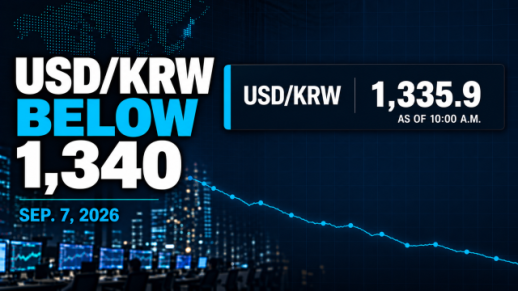 KRW/USD enters 1,330 range for first time in 23 months SEOUL, September 07 (AJP) - The South Korean won climbed to its strongest level against the greenback in nearly 23 months Monday as exporters rush to convert their dollar holdings for fiscal settlement. The USD/KRW exchange rate traded at around 1,335.9 won as of 10 a.m. The pair entered the 1,330 range for the first time since Oct. 4, 2024, when the exchange rate traded between 1,331 and 1,335 won before closing daytime trading at 1,333.7 won. The won's advance stood out against a firmer U.S. dollar after stronger-than-expected U.S. employment data revived expectations that the Federal Reserve could raise interest rates this month. U.S. nonfarm payrolls increased by 162,000 in August, nearly three times the 56,000 increase economists had expected, while the unemployment rate held at 4.1 percent. Financial markets raised the probability of a quarter-percentage-point Fed rate increase at its Sept. 15-16 meeting to about 62 percent after the report, while the dollar and U.S. Treasury yields rose. Korea-specific dollar supply continued to offset those external pressures, with semiconductor exporters bringing in large amounts of overseas earnings as the country's export boom accelerated. South Korea's cumulative exports reached $709.4 billion in early September, already surpassing the record for the whole of 2025. Semiconductor exports surged 169.6 percent from a year earlier to $281 billion in the first eight months of this year. Exporter dollar selling has remained a major source of supply in the local foreign exchange market, although companies have also accumulated record dollar deposits as the won strengthened and some exporters delayed converting proceeds. Foreign equity inflows added support Monday as Korean semiconductor shares rallied, with foreign investors turning net buyers of the benchmark KOSPI in early trading. The won's rally also persisted despite authorities having absorbed about $20 billion of dollar proceeds repatriated from SK Hynix's U.S. American depositary receipt issuance through off-market transactions. The transactions reduced the amount of dollar supply that could have reached the spot market directly. The exchange rate had only entered the 1,340 range on Friday for the first time in about 14 months, as the won's appreciation accelerated. AJP Takeaways: - South Korea's won strengthened into the 1,330-per-dollar range for the first time in nearly 23 months, trading at 1,335.9 won as of 10 a.m. - Korean exporters continued to supply dollars to the local foreign exchange market as strong semiconductor exports increased overseas earnings available for conversion into won. - Federal Reserve rate-hike expectations rose after stronger-than-expected U.S. employment data, but Korea-specific dollar supply outweighed broader support for the U.S. currency. 2026-09-07 10:41:46
 -
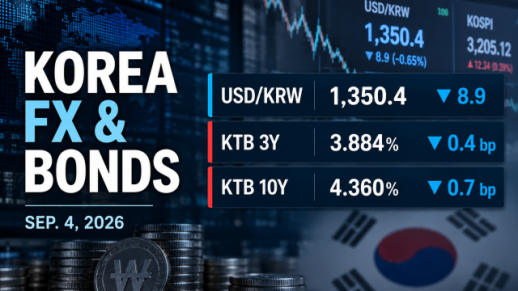 Won closes at 14-month high, bond yields little changed SEOUL, September 04 (AJP) - The South Korean won extended its rally to a 14-month high Friday, while government bonds ended little changed as investors stayed cautious ahead of U.S. employment data. The won strengthened 8.9 won from the previous session to close daytime trading at 1,350.4 per dollar, compared with Thursday's 1,359.3. The currency briefly entered the 1,340 range during the session, its strongest intraday level since early July 2025. Exporter dollar selling continued to support the won, while a firmer Japanese yen and reduced expectations for further Federal Reserve tightening added to the pressure on the dollar. The won has now gained for two straight sessions, falling 18.3 won against the dollar from Wednesday's daytime close. South Korean government bonds were largely steady after rebounding sharply in the previous session. The three-year government bond yield edged down 0.4 basis point to 3.884 percent, while the 10-year yield slipped 0.7 basis point to 4.360 percent. The five-year yield fell 1.7 basis points to 4.101 percent. At the longer end, the 20-year yield declined 2.0 basis points to 4.573 percent, while the 30-year yield edged up 0.1 basis point to 4.636 percent. The muted session followed Thursday's rally, when the three-year yield fell 4.2 basis points and the 10-year yield dropped 5.1 basis points as global bond yields retreated from recent highs. U.S. Treasury yields fell overnight after Federal Reserve Gov. Christopher Waller's comments eased expectations for an immediate rate hike, although investors avoided larger positions ahead of Friday's U.S. jobs report. The August employment report is expected to provide the next cue for U.S. rate expectations and global bond markets. 2026-09-04 17:08:18
 -
 Chip windfall finally arrives on the FX front SEOUL, September 04 (AJP) - The South Korean won is looking entirely different from the first half, closing at its strongest level in 14 months Friday as a swelling current-account surplus increasingly offsets heavy overseas equity investment and other capital outflows, giving authorities room to absorb a reported $20 billion in dollars from SK hynix's landmark U.S. share sale without reversing the currency's rally. The dollar fell 8.9 won to close Friday's daytime trading at 1,350.4 won at 3:30 p.m., after briefly entering the 1,340 range for the first time since early July 2025. The greenback has fallen about 13 percent from its July 1 close of 1,559.2 won, a sharp reversal from June, when it traded as high as 1,561 won. The won's strength also stands out against other major currencies. Over the period, the dollar index rose about 1.3 percent and the dollar gained 0.3 percent against the Japanese yen, suggesting Korea-specific forces have driven the won's rebound rather than a broad retreat in the U.S. currency. The turnaround is increasingly backed by Korea's external accounts. The country accumulated a current-account surplus of $233.09 billion in the first seven months of this year, nearly four times the $59.82 billion recorded in the same period of 2025, according to preliminary Bank of Korea data released Friday. The goods surplus alone widened to $234.28 billion from $69.35 billion a year earlier as booming semiconductor exports generated a growing stream of foreign-currency earnings. The scale is striking because the improvement has come despite powerful financial-account flows working in the opposite direction. Korean residents increased their holdings of overseas equities by $60.89 billion from January through July. At the same time, foreign investors reduced their holdings of Korean equities by a net $100.30 billion, according to the BOK. Taken together, the two equity flows represented roughly $161.2 billion of outward financial pressure — residents sending money into foreign stocks while overseas investors pulled money out of Korean shares. The figures do not translate mechanically into spot foreign-exchange demand because investments can be hedged and corporate export proceeds do not necessarily return immediately to Seoul. But they help illustrate how dramatically Korea's underlying foreign-currency balance has shifted. A current-account surplus approaching a quarter-trillion dollars has been large enough to coexist with exceptional portfolio outflows while the won has still appreciated sharply. Seoul policymakers spent much of the first half tapping foreign-exchange swaps with the National Pension Service and selling dollars to contain won weakness. The tide changed sharply in the second half. Exporter dollar selling remained heavy, while a softer U.S. currency and stronger Japanese yen provided additional support for the Korean currency. Rather than needing to supply dollars, authorities apparently gained room to absorb them. The Foreign Exchange Stabilization Fund, or FESF, bought about $20 billion of the $26.5 billion in dollar proceeds raised through SK hynix's American depositary receipt offering in July, Reuters reported Wednesday, citing a source with direct knowledge of the transaction. The reported purchases were conducted over the counter as SK hynix repatriated the proceeds, avoiding direct execution through the domestic spot foreign-exchange market. Neither the Ministry of Economy and Finance nor the Bank of Korea has confirmed the amount, timing, exchange rates or financial institutions involved. An off-market purchase allows SK hynix to obtain won without placing an equivalent dollar sell order in the Seoul spot market. The operation therefore removes potential dollar supply from the market and reduces appreciation pressure relative to a direct conversion rather than directly causing the won to weaken. Seen against Korea's broader external balance, however, the significance may be less about where the won would have traded on a particular day and more about authorities' increased capacity to absorb an unusually large dollar inflow without destabilizing the currency market. Friday's fall in the dollar-won rate, including its intraday move into the 1,340 range, shows that exporter supply and global currency forces can still dominate even after a transaction of this size. The reported $20 billion represents roughly three-quarters of SK hynix's ADR proceeds, about 4.5 percent of Korea's August-end foreign-exchange reserves and nearly 1.5 times the net $13.63 billion sold by authorities in the first quarter to limit won depreciation. The comparisons demonstrate the transaction's scale but do not establish that the entire amount was added to official reserves on a one-for-one basis. Foreign-exchange reserves rose by a record $14.33 billion in August to $442.28 billion, with the BOK citing increased foreign-currency deposits at financial institutions, investment income and valuation changes. Public data do not establish whether the reported SK hynix transaction contributed to the August increase or, if so, by how much. "The actual dollar-supply effect could continue through August or September," Kwon Ah-min, an FX analyst at NH Investment & Securities, told AJP in July. Kwon expected conversions to be staggered and said SK hynix would retain part of the proceeds in dollars to pay overseas equipment suppliers, making the flow more likely to cap rebounds in the dollar-won rate than produce a one-way won rally. "If the report is true, it would be difficult to say the large dollar-supply effect from the ADR has disappeared entirely," Lee Min-hyuk, an economist at KB Kookmin Bank, wrote in a report Friday. Lee said most of the funds would remain in government foreign-currency assets that could later be released for market stabilization, weakening the case for a dollar-won rebound caused by a supply gap after the ADR proceeds were exhausted. In short, the SK hynix dollar proceeds could become intervention firepower if the dollar-won rate reverses sharply higher. A larger stock of liquid dollars increases authorities' capacity to meet demand during renewed won weakness, although it cannot guarantee a particular exchange rate or offset persistent market forces. The BOK's balance-of-payments data also showed foreign equity investment in Korea increased by $5.98 billion in July, partly reflecting the ADR issuance. Korean residents, meanwhile, added $12.33 billion in overseas equities during the month. The reported transaction could offer a template for handling unusually large corporate inflows because an over-the-counter block trade can prevent a single conversion from disrupting a comparatively smaller spot market. The U.S. Treasury has said intervention should address excessive volatility or disorderly exchange-rate movements rather than maintain a preferred currency level. The exceptional size and one-off nature of the SK hynix proceeds would therefore be central to the policy rationale if authorities confirm the transaction. The AI chip windfall has become something close to an economic cure-all for Korea, powering growth despite geopolitical headwinds, swelling the country's fiscal buffers and finally giving the won long-delayed traction. AJP Takeaways - Korea's January-July current-account surplus surged to $233.09 billion, nearly four times a year earlier, creating a much stronger fundamental dollar buffer behind the won. - The won strengthened despite substantial equity outflows: residents added $60.89 billion in overseas stocks while foreign investors cut Korean equity holdings by $100.30 billion. - Authorities reportedly absorbed about $20 billion of SK hynix's ADR proceeds off market, preventing an unusually large corporate dollar sale from directly hitting Seoul's spot market. - The won's move to a 14-month high suggests Korea's swelling trade surplus, exporter dollar selling and global currency forces are outweighing both outbound investment demand and the removal of SK hynix's potential dollar supply. 2026-09-04 16:34:40
 -
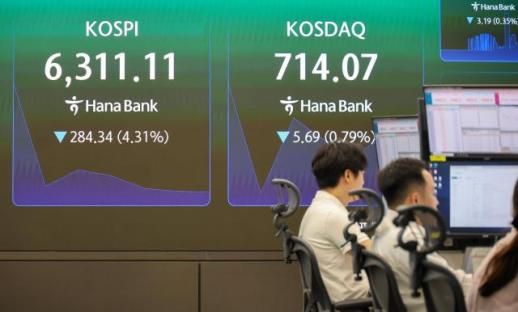 Seoul pushes back tougher delisting rules to July '27 SEOUL, September 04 (AJP) -South Korea will push back tougher delisting rules for the KOSPI and KOSDAQ to July 2027 from the scheduled January, delaying a planned increase in minimum market-capitalization thresholds as authorities seek to give the market more time to recover. The decision was made at a joint market review meeting chaired by Finance Minister Koo Yun-cheol on Friday, where officials also assessed rising bond yields, vulnerable borrowers and risks in the mutual finance sector. The market-capitalization threshold for delisting at the junior market was raised to 20 billion won ($14.4 million) from 15 billion won on July 1 and had been scheduled to rise again to 30 billion won in January 2027. The second increase will instead take effect in July 2027 as authorities said listed companies and the market needed more time to adjust. The same six-month delay will apply to the Kospi, where the threshold was raised to 30 billion won from 20 billion won in July and had been scheduled to increase to 50 billion won in January. Authorities will also allow companies that meet certain financial requirements to transfer to the Konex market without undergoing a liquidation trading period, reducing the disruption caused by delisting. Eligible companies must have been designated for administrative issues since July 1 after falling below the market-capitalization threshold. They must have posted operating profits in at least two of the past three years, or recorded a profit in one of those years while holding equity of at least 20 billion won. Companies with impaired capital will be excluded. The government said the same KONEX transfer rules will apply to eligible KOSPI-listed companies. Officials separately reviewed rising interest-rate pressure stemming from increased sovereign debt issuance, corporate bond sales by global artificial intelligence companies, expectations for policy rate hikes in major economies and renewed tensions in the Middle East. West Texas Intermediate crude rose to $91.30 per barrel on Sept. 3 from $69.50 at the end of June, adding to upward pressure on market rates. Authorities agreed to closely monitor South Korea's bond market and act to prevent an excessive increase in volatility. They said the financial health of vulnerable borrowers and the mutual finance sector remained broadly sound, but warned that a further sharp rise in interest rates could add to strains. The government will also proceed with support measures for vulnerable borrowers announced on Aug. 28. AJP Takeaways • South Korea will delay tougher Kospi and Kosdaq delisting thresholds by six months to July 2027 from January. The government said the postponement is intended to give listed companies and the broader market more time to recover. • Authorities also unveiled easier Konex transfer rules for some delisting candidates while stepping up monitoring of bond-market volatility and vulnerable borrowers. 2026-09-04 10:43:23
 -
 UPDATE: Korea's H1 C/A surplus second only to China *Updated with additional information and comments SEOUL, September 04 (AJP) - South Korea's current account surplus ranked second only to China's among major economies in the first half and will likely to keep up the rank rest of the year as July delivered the second-largest monthly surplus on record, the central bank said Friday. The July surplus came to $42.08 billion, down from June's record $49.73 billion but above $40 billion for a second month, extending the surplus run to 39 consecutive months, preliminary Bank of Korea (BOK) data showed. Yoo Seong-wook, head of the BOK's Financial Statistics Department, said Korea's first-half surplus of $191.01 billion trailed only China's and exceeded those of Germany, Japan and Taiwan. Official data for the same period put China's surplus at $379.4 billion, Germany's at the equivalent of roughly $124 billion, Taiwan's at $121.03 billion and Japan's at about $110 billion. The January-July surplus nearly quadrupled to $233.09 billion from $59.82 billion a year earlier and was already about 1.9 times the $123.05 billion recorded in all of 2025. The BOK last week raised its 2026 current account surplus forecast to $450 billion from $250 billion, citing stronger semiconductor exports and a wider goods surplus. Yoo said the annual surplus was likely to come broadly in line with the forecast if monthly surpluses averaged about $43.4 billion over the remaining five months, with the final outcome hinging largely on the semiconductor cycle. He said the won's recent appreciation would have only a limited impact on exports because the increase was being driven mainly by structural AI-related demand for semiconductors rather than exchange-rate competitiveness. The unresolved Middle East conflict remained another risk because higher prices for crude oil and other raw materials could increase Korea's import bill, Yoo said. The goods account logged its second-largest surplus of $40.43 billion as exports rose 65.3 percent from a year earlier to $100.45 billion, while imports increased 21.7 percent to $60.02 billion. Yoo said exports and the goods surplus often decline from June to July because companies tend to concentrate shipments in June when managing their first-half export performance. On a seasonally adjusted basis, the current account surplus declined 8.0 percent to $40.89 billion from $44.43 billion, compared with a 15.4 percent drop in the unadjusted figure. Customs-cleared exports reached $98.96 billion as information technology shipments jumped 140.6 percent and non-IT exports increased 18.3 percent. Semiconductor exports surged 176.3 percent to $41.17 billion, accounting for 41.6 percent of total customs-cleared exports. Raw material imports increased 29.1 percent on higher purchases of crude oil, gas and coal, while capital goods imports rose 36.7 percent on increased purchases of semiconductors and chipmaking equipment. Consumer goods imports fell 3.0 percent, marking their first decline in 15 months. The services account deficit widened to $1.97 billion from $1.29 billion as the travel balance swung to a $340 million deficit from a $440 million surplus. The BOK attributed the reversal to the peak summer travel season and increased outbound travel following the designation of Constitution Day as a temporary public holiday. The primary income surplus increased to $4.35 billion from $3.27 billion as the dividend income surplus reached $3.83 billion. Park Seong-gon, head of the BOK's Balance of Payments Team, attributed the increase mainly to higher dividend receipts following improved earnings at semiconductor companies' overseas sales subsidiaries. The financial account recorded its second-largest net asset increase of $40.32 billion. Foreign direct investment in Korea decreased by $780 million in July, reflecting reductions in intercompany trade credit and other transactions, according to the BOK. Foreign portfolio investment in Korean securities increased by $8.17 billion as equity investment rose by $5.98 billion and debt investment gained $2.19 billion, although bond inflows slowed as arbitrage incentives narrowed. Foreign equity investment turned positive for the first time in six months after falling by a record $31.61 billion in June. Yoo said the rebound reflected SK hynix's American depositary receipt issuance and reduced selling of domestically issued shares, adding that more data were needed to determine whether the improvement would continue. Despite the July rebound, foreign equity portfolio investment in Korea remained down a cumulative $100.30 billion in the first seven months. A $19.72 billion increase in foreign investment in Korean debt securities partly offset the equity outflow, leaving total foreign portfolio investment in domestic securities down $80.58 billion over the period. Korean residents increased their overseas equity investment to $12.33 billion from $7.53 billion in June, more than twice the foreign investment in Korean equities during July. Overall portfolio investment recorded a $5.40 billion net asset increase, while other investment posted a $27.56 billion increase as loan assets rose and borrowing liabilities declined. AJP Takeaways - South Korea's current account surplus reached $42.08 billion in July, the second-largest monthly figure on record, while its $191.01 billion first-half surplus trailed only China's among major economies. - The BOK expects the annual surplus to broadly meet its upgraded $450 billion forecast if monthly surpluses average about $43.4 billion over the remaining five months. - The BOK expects the won's appreciation to have a limited export impact because AI-related semiconductor demand remains the dominant driver, although the chip cycle and raw material costs remain key risks. - Foreign equity investment rebounded by $5.98 billion in July after six months of declines but remained down a cumulative $100.30 billion in the first seven months. 2026-09-04 08:04:57
 -
 Won hits 14-month high, Korean bonds rebound SEOUL, September 03 (AJP) - The South Korean won climbed to a 14-month high against the dollar Thursday, while government bonds rallied as global yields eased after a sharp selloff. The won ended daytime trading at 1,359.3 per dollar, strengthening 0.7 percent from Wednesday and marking its strongest close since July 2, 2025. It touched 1,355.9 during the session, the strongest intraday level since July 3 last year. Exporter dollar selling added to broader weakness in the U.S. currency, while a firmer Japanese yen also supported the Korean currency. The dollar index hovered around 99.3 shortly after the Seoul close. The yen strengthened to around 157 per dollar as expectations for tighter Bank of Japan policy and concerns over possible intervention supported the Japanese currency. The won held most of its gains despite continued foreign selling of Korean equities. Foreign investors remained net sellers on the KOSPI for a fifth straight session, while the benchmark index edged up 0.26 percent to 6,579.48. South Korean government bonds also strengthened across maturities, reversing part of the sharp rise in yields seen over the previous four sessions. The three-year Korean government bond yield fell 4.2 basis points to 3.888 percent, while the five-year yield dropped 4.9 basis points to 4.118 percent. The 10-year yield declined 5.1 basis points to 4.367 percent, according to final quotations from the Korea Financial Investment Association. Ultra-long maturities also rallied, though by less than shorter tenors. The 20-year yield fell 2.1 basis points to 4.593 percent, while the 30-year yield declined 2.2 basis points to 4.635 percent. The weaker performance at the ultra-long end widened the gap between the 10- and 30-year yields to 26.8 basis points from 23.9 basis points a day earlier. Korean bonds tracked an overnight recovery in U.S. Treasuries and further declines in global yields during Asian trading. The U.S. 10-year Treasury yield eased after weaker-than-expected private employment data, while Japanese government bond yields retreated from recent highs. U.S. private payrolls increased by 38,000 in August, below market expectations and reinforcing caution ahead of Friday's nonfarm payroll report. Oil prices also retreated during Asian trading after recent gains, easing some inflation concerns that had contributed to the global bond selloff. Foreign investors returned to the three-year Korean government bond futures market, buying more than 9,000 contracts after heavy selling over the previous five sessions. Thursday's rally offered some relief after the rapid repricing in global sovereign bonds. Still, the relative underperformance of Korea's 20- and 30-year maturities showed that investors remained cautious about taking duration risk at the ultra-long end. 2026-09-03 17:32:13
 -
 Korean FX authorities reportedly absorb $20 billion SK hynix funds SEOUL, September 03 (AJP) - South Korea's foreign-exchange authorities reportedly absorbed about $20 billion of SK hynix's U.S. share proceeds off market, while the won closed Thursday at its strongest level in about 14 months. The Foreign Exchange Stabilization Fund, or FESF, bought about $20 billion in dollars repatriated after SK hynix raised $26.5 billion through an American depositary receipt offering in July, Reuters reported Wednesday, citing a source with direct knowledge of the matter. The transactions were conducted over the counter rather than through the domestic spot foreign-exchange market, according to the report. Neither the Ministry of Economy and Finance nor the Bank of Korea provided a substantive response to AJP by publication time. Inquiries were repeatedly referred among internal departments at both institutions. The authorities did not confirm the reported amount, timing or execution of the transactions. Details including the intermediating financial institutions and exchange rates also remain unclear. The reported purchase represents roughly three-quarters of SK hynix's ADR proceeds. Absorbing the dollars outside the spot market would reduce the amount of corporate dollar supply reaching Seoul at once, limiting the risk of a sharp appreciation in the won from a single large transaction. Reuters said the purchases were intended to reduce foreign-exchange volatility and replenish foreign-currency holdings after earlier efforts to support the won. The won nevertheless strengthened sharply Thursday. The Korean currency closed daytime trading at 1,359.3 per dollar, 9.4 won stronger than Wednesday's close of 1,368.7, putting it near levels last seen in July 2025. Exporter dollar selling has remained a major source of supply, while a softer U.S. currency and a firmer yen have provided additional support in recent sessions. An FESF purchase outside the spot market would have reduced potential dollar selling and slowed the won's appreciation. Continued gains point to additional supply from exporters and shifts in global currency markets. SK hynix's $26.5 billion fundraising had drawn attention from currency traders for months because of uncertainty over how much of the proceeds would ultimately be converted into won. Direct conversion of such a large amount could create a strong one-way flow in Seoul, giving authorities an incentive to smooth the transaction outside the spot market. The report also comes as South Korea's foreign-exchange reserves recorded their largest monthly increase on record in August. Reserves rose $14.33 billion to $442.28 billion at the end of August, the BOK said Thursday. Foreign securities increased $7.07 billion to $387.07 billion, while foreign-currency deposits rose $7.17 billion to $30.30 billion. The BOK attributed the increase to larger foreign-currency deposits by financial institutions, investment income and an increase in the dollar value of assets denominated in other currencies. Publicly available information does not establish whether the reported SK hynix purchase contributed to the August reserve increase or, if it did, by how much. Foreign-exchange conditions have changed sharply since the first half of the year. The won weakened to around 1,550 per dollar in late June, prompting concern over rapid depreciation and demand for dollars. Large exporter and corporate dollar inflows now present a different challenge as the won moves in the opposite direction. Foreign-exchange authorities have generally described their role as limiting excessive volatility rather than defending a particular exchange-rate level. The reported transaction would fit that objective by reducing the market impact of an exceptional corporate dollar flow, although its size and execution remain officially unconfirmed. With the won closing Thursday at 1,359.3 per dollar, traders are watching how much exporter and corporate dollar supply remains and whether importer demand strengthens at firmer won levels. AJP Takeaways South Korean foreign-exchange authorities reportedly bought about $20 billion of SK hynix's $26.5 billion ADR proceeds through off-market transactions, keeping most of the potential dollar flow from reaching the Seoul spot market at once. The won nevertheless closed Thursday at 1,359.3 per dollar, 9.4 won stronger, pointing to additional support from exporter selling and broader global currency moves. Neither the finance ministry nor the BOK provided a substantive response to AJP, while available data do not establish whether the reported transaction contributed to August's record increase in foreign-exchange reserves. 2026-09-03 16:56:27
 -
 AI spending binge steepens Korea's bond curve SEOUL, September 03 (AJP) - As the race for AI supremacy sends government and corporate spending into the stratosphere, investors are demanding more to lend for decades — a shift showing up starkly in South Korea, where yields have risen progressively faster toward the long end of the government bond curve. The yield chart over the past year shows an increasingly steep repricing toward longer maturities. The 30-year yield has climbed the most, touching a record 4.751 percent in August, while shorter-dated yields remain below peaks reached during the global tightening shock of 2022. The pattern matters because the far end of the curve says more than where traders think the Bank of Korea will set interest rates over the next year or two. It reflects what investors demand to lock up money for decades amid rising capital needs, uncertainty over inflation and fiscal policy, and questions over who will absorb long-term debt. Korea adds a domestic wrinkle to that global story. Insurers, historically some of the country's most dependable buyers of ultra-long government bonds, have less structural need to keep accumulating them after reducing mismatches between long-term assets and liabilities under new accounting and capital rules. The combination is making Korean bonds cheaper, but not yet cheap enough to bring those long-term buyers back in force. Government bonds staged a modest recovery Thursday after a broad selloff a day earlier. The three-year Korean government bond yield fell 2.0 basis points from Wednesday's close to 3.910 percent in morning final quotations from KOFIA. The benchmark 10-year yield declined 3.7 basis points to 4.381 percent, while the 30-year eased 1.8 basis points to 4.639 percent. The pullback did little to change the broader picture. The three-year yield has risen about 96 basis points from 2.95 percent at the end of 2025, while the 10-year has climbed about 99 basis points from 3.39 percent. The move becomes much larger at the far end. The 30-year yield has surged about 138 basis points from 3.258 percent at the end of last year, reaching an all-time high of 4.751 percent on Aug. 18 before easing. The KOFIA chart makes the shift particularly visible. All four maturities have moved higher over the past year, but the spread between shorter and longer yields has widened as the selloff increasingly concentrates at the far end of the curve. That is different from a simple policy-rate shock. During the 2022 global tightening cycle, investors rapidly repriced expectations for aggressive rate increases by the BOK and U.S. Federal Reserve. The Korean three-year yield jumped 34.9 basis points in a single session on Sept. 26, 2022, to 4.548 percent, while the 10-year gained 22.3 basis points to 4.335 percent. The 10-year later reached 4.632 percent on Oct. 21, while the three-year stood at 4.495 percent. Today's three-year yield remains clearly below that period's peak. The 10-year has returned to similar territory, while the 30-year has gone further and set a record. The contrast suggests today's repricing is less concentrated on the next few BOK decisions and more heavily influenced by the price investors place on holding duration for decades. Kim Myung-sil, an analyst at iM Securities, said the recent market has been notable because yield increases have been concentrated at longer maturities rather than spread evenly across the curve. Supply and demand have played a larger role in the bear steepening than monetary policy alone, she said. Global borrowing gets more expensive Korea's move forms part of a much broader reassessment of long-term debt. Governments are spending heavily on defense, energy security and industrial policy, while the global AI race is demanding extraordinary investment in semiconductor plants, data centers, electricity generation, transmission networks and other infrastructure. Technology companies are simultaneously committing vast amounts of capital to AI computing capacity, adding private-sector demand for long-term financing to already-heavy public borrowing. Bond investors are being asked to provide more capital just as persistent inflation uncertainty has made them less willing to assume that interest rates will eventually return to the exceptionally low levels of the pre-pandemic era. That pressure has shown up most visibly in long maturities. The U.S. 10-year Treasury yield eased to around 4.78 percent in Asian trading Thursday after retreating from a multiyear high reached a day earlier. Japan's 10-year government bond yield fell 4.5 basis points to 2.965 percent after moving above 3 percent earlier this week for the first time since 1996. Korea and Japan, however, have experienced considerably larger increases this year than the United States. Korea's 10-year yield is about 99 basis points above its end-2025 level. Japan's has climbed roughly 89 basis points from 2.075 percent, compared with an increase of around 60 basis points in the U.S. 10-year Treasury from 4.18 percent. Japan matters well beyond its own market. For decades, low domestic yields encouraged Japanese banks, insurers and asset managers to send capital abroad in search of returns. Higher yields at home reduce that incentive, potentially weakening a major source of marginal demand for U.S. Treasuries and other overseas bonds. That in turn adds to the competition facing Korea. When U.S. and Japanese bonds offer increasingly attractive returns, Korean debt must compete harder for global capital, particularly at maturities where investors assume greater interest-rate and currency risk. Renewed Middle East tensions have intensified those pressures this week. Higher oil prices have revived concern that energy costs could keep inflation elevated, helping push government borrowing costs to multiyear or multidecade highs across several major markets before Thursday's partial recovery. Korea's traditional buyer retreats Global forces alone, however, do not explain why Korea's far end has moved so aggressively. The structure of domestic demand has changed. Korean insurers have traditionally been natural buyers of 20- and 30-year government bonds because their liabilities — particularly life insurance obligations — can stretch decades into the future. Ultra-long bonds allowed them to better match the duration of those liabilities with their assets. The introduction of IFRS 17 and the Korean Insurance Capital Standard, or K-ICS, in 2023 accelerated that adjustment. As insurers made progress in reducing their asset-liability duration mismatches, their need to continuously add ultra-long government debt weakened. That removes a buyer that historically purchased long bonds partly because of balance-sheet requirements rather than simply because yields looked attractive. The implication is straightforward: as structural demand weakens, prices may need to fall further — and yields rise further — before more price-sensitive investors step in. Tuesday's 30-year bond auction illustrated that tension. The government offered 2.5 trillion won ($1.8 billion) of 30-year bonds, 300 billion won less than the previous month's competitive offering. Bids totaled 5.417 trillion won, equivalent to 216.7 percent of the planned amount, and the full amount was awarded at 4.630 percent. The auction was comfortably covered but failed to generate lasting relief for the long end. That distinction matters. The issue is not whether an individual bond sale can attract enough bids, but the yield required for investors to absorb long-duration debt consistently. Bigger budget, but not a classic supply shock South Korea's fiscal expansion has added another layer of uncertainty, although the numbers make it difficult to blame the selloff on a straightforward flood of new government borrowing. The Cabinet this week approved an 820.9 trillion won ($600 billion) spending plan for 2027, up 12.8 percent from this year's original budget. The expansion comes as the government seeks to invest heavily in growth industries and support the economy, helped by booming semiconductor-related tax receipts. National tax revenue is projected at 584.4 trillion won. Despite the larger budget, the government plans to reduce Korean government bond issuance next year. Gross issuance is projected to fall to 222.8 trillion won from 225.7 trillion won, while net issuance is expected to decline more sharply to 96.3 trillion won from 109.4 trillion won. That makes today's selloff different from a conventional supply shock in which an announcement of sharply higher borrowing immediately overwhelms bond demand. What matters for the long end is broader. A 30-year investor is not merely assessing next year's bond issuance. The investor is taking a view on decades of future spending, tax revenue, inflation, economic growth and the amount of compensation required to accept the risk that those assumptions change. The surge in government and corporate spending worldwide therefore matters even when Korea itself is not immediately issuing more debt. President Lee Jae Myung acknowledged the higher cost of capital during a Cabinet meeting at the Blue House on Tuesday. "The rise in interest rates is unavoidable now," Lee said, urging fiscal policy to limit the burden on vulnerable households and prevent damage to growth potential. His remarks did not trigger the bond selloff. Global yields and pressure at Korea's long end were already building. Not another 1997 The scale of the increase has inevitably invited comparisons with previous periods of Korean financial stress, but the similarities are limited. During the 1997-98 Asian financial crisis, the three-year government bond yield averaged 12.26 percent in 1997 and 12.94 percent in 1998, according to National Assembly Budget Office data based on Bank of Korea statistics. A comparable 10-year benchmark did not yet exist. Those double-digit rates accompanied a collapse in external financing and severe currency stress. The 2008 global financial crisis produced another different pattern. Once recession and financial-stability risks overtook inflation concerns, aggressive policy easing ultimately pushed government bond yields lower. Neither dynamic describes today's market. The won closed Thursday's daytime trading at 1,359.3 per dollar, 9.4 won stronger than Wednesday's close of 1,368.7, despite the sharp rise in Korean bond yields a day earlier. That makes it difficult to characterize the bond selloff as a broad loss of confidence in Korean assets. Domestic inflation offers only a partial explanation as well. Consumer prices rose 3.1 percent in August from a year earlier, but the government estimated that inflation would have been around 2.5 percent without a temporary base effect caused by mobile-phone fee discounts a year earlier. Rather than a currency crisis or sudden domestic inflation shock, the market is increasingly pricing the cost of committing capital for a long period in a world where that capital is in greater demand. What matters next That makes the 20- and 30-year segments important gauges of whether the pressure is beginning to ease. Shorter yields could decline if investors become confident that the BOK's tightening cycle is approaching an end. The long end requires more. A sustained recovery would likely need some combination of stabilization in U.S. and Japanese long-term rates, greater confidence over Korea's long-run fiscal and inflation trajectory and stronger demand from insurers and other institutional investors. Adjustments to the government's ultra-long issuance mix could also help. Until then, falling bond prices alone may not be enough to bring traditional buyers back. The question facing Korea is increasingly not simply how high its central bank will take interest rates, but how much investors must be paid to finance an era of increasingly expensive ambitions — from AI and industrial policy to infrastructure and defense — for decades to come. AJP Takeaways Korea's three-, 10- and 30-year government bond yields have risen about 96, 99 and 138 basis points from end-2025 levels, with the selloff becoming more pronounced toward longer maturities. The rise reflects a broader global repricing of long-term debt as governments and companies compete for capital amid heavy spending on AI, infrastructure, defense and energy security. Weaker structural demand from Korean insurers has added pressure at the far end of the curve after new accounting and capital rules reduced their need to keep accumulating ultra-long government bonds. The selloff differs from past Korean financial crises: the won remains firm and external-funding stress is absent, pointing more to long-duration repricing than a broad loss of confidence in Korean assets. 2026-09-03 16:06:43
 -
 Korea's crypto access can strengthen stablecoin-FX link:BOK SEOUL, September 03 (AJP) - Wider corporate and foreign participation in South Korea's crypto market could allow dollar stablecoin demand shocks to pass more directly into foreign-exchange trading and the won, Bank of Korea researchers said Thursday. Kim Ji-hyun and Cho Sang-heum of the BOK's International Finance Research Team said in an Issue Note that the presence of global intermediaries can determine how closely stablecoin markets are linked with traditional FX markets. The researchers said regulatory changes that broaden participation by corporations and foreign investors could allow demand shocks in dollar stablecoins to trigger FX transactions and affect exchange rates more directly. Dollar stablecoins track the U.S. dollar, so buying them with a non-dollar currency such as the Korean won is economically similar to using that currency to purchase a dollar-denominated asset. Whether such demand translates into actual FX transactions, however, depends heavily on how the stablecoin market is structured. The researchers used the start of direct trading between selected fiat currencies and dollar stablecoins on Binance as an event marking the entry of global intermediaries into those markets. When direct fiat-stablecoin trading is available, professional market makers can supply stablecoins in exchange for local currency. They can then sell that currency for dollars in the FX market to manage the resulting currency mismatch. The study divided the linkage into two channels. Price integration occurs when stablecoin prices converge toward spot exchange rates, while shock transmission occurs when stablecoin demand generates FX transactions and affects exchange rates. An analysis of 12 currencies, including the euro, Turkish lira and South African rand, from 2019 through 2025 showed that direct Binance trading reduced dollar stablecoin premiums by about 0.33 to 0.38 percentage points. The researchers also found that stablecoins flowed from Binance into local markets when premiums on local exchanges rose above those on Binance. They said the pattern showed that access to global liquidity helped narrow pricing gaps. Greater price integration came alongside stronger transmission of stablecoin demand into foreign-exchange markets. Before direct trading was introduced, the relationship between dollar stablecoin premiums and movements in the corresponding currency against the dollar was not statistically meaningful. After trading support began, higher stablecoin premiums were associated with depreciation of the local currency, according to the study. A comparison between Korea and Brazil illustrated the difference. In Korea, a one-standard-deviation increase in Google searches for Bitcoin, used as a proxy for crypto investment demand, raised the dollar stablecoin premium by about 0.85 percentage point. The effect on the won-dollar exchange rate was not statistically meaningful. In Brazil, where direct trading between the real and dollar stablecoins was available on Binance, the same shock raised the stablecoin premium by about 0.11 percentage point. The real weakened by about 0.12 percent against the dollar, showing a clearer transmission into the FX market. Korea currently has a different market structure because Binance does not support direct won-dollar stablecoin trading and corporate and foreign participation in the domestic crypto market remains restricted. Those restrictions limit the role of global intermediaries that can access both stablecoin and FX markets. As a result, stablecoin demand pressures in Korea tend to be absorbed more through local crypto prices than through the exchange rate, the researchers said. The median premium on won-denominated dollar stablecoins since 2022 stood at 1.67 percent despite Korea's relatively high degree of capital-market openness. That was close to 1.86 percent in Ukraine and 1.80 percent in South Africa, where capital controls are considerably stronger. The researchers said broader participation in Korea's crypto market could strengthen the link between dollar stablecoins and the FX market. They called for digital-asset regulation to be considered alongside efforts to internationalize the won and deepen the country's FX market, saying greater participation and liquidity could improve the market's capacity to absorb shocks. AJP Takeaways Wider corporate and foreign participation in Korea's crypto market could strengthen the transmission of dollar stablecoin demand into FX trading and the won. Direct fiat-stablecoin trading on Binance reduced stablecoin premiums by 0.33 to 0.38 percentage points while strengthening transmission into exchange rates. The researchers said digital-asset reforms should be considered together with won internationalization and deeper FX liquidity. 2026-09-03 13:24:56
 -
 Korea FX reserves gain record Aug, BOK drops ranking table SEOUL, September 03 (AJP) -South Korea's foreign exchange reserves stretched in monthly record of $14.33 billion in August amid record-setting trade surplus streak and a stronger won, according to the Bank of Korea which quietly ended a 25-year practice of publishing the country's global reserve ranking. Foreign reserves stood at $442.28 billion at the end of August, up from $427.95 billion a month earlier, the central bank said Thursday. The increase was the largest since the BOK began compiling the data in 1971, surpassing the previous monthly record of $14.29 billion set in May 2009. Reserves rose for a third consecutive month and reached their highest level since May 2022. The BOK attributed the increase to a sharp rise in foreign-currency deposits by financial institutions, investment income and an increase in the dollar-converted value of assets denominated in other currencies. A BOK official said banks appeared to have placed more surplus foreign currency at the central bank after it began paying interest on excess foreign-currency reserves earlier this year. The jump also came after South Korean foreign-exchange authorities reportedly bought about $20 billion in dollars repatriated by SK hynix following its $26.5 billion American depositary receipt offering in the U.S. in July. The purchases were made through the Foreign Exchange Stabilization Fund, jointly managed by the finance ministry and the BOK, as authorities sought to limit currency-market volatility and rebuild foreign-exchange buffers, according to Reuters account. The BOK and finance ministry declined to comment on the transaction. South Korea also posted a record $34.75 billion trade surplus in August as exports surged 68.7 percent from a year earlier to $98.25 billion, led by another record-setting semiconductor shipments. By asset type, securities holdings, the largest component of the reserves, increased $7.07 billion from July to $387.07 billion. Deposits rose $7.17 billion to $30.30 billion. Special drawing rights, or SDRs, increased by $60 million to $15.77 billion, while South Korea's reserve position at the International Monetary Fund rose by $30 million. Gold reserves remained unchanged at $4.79 billion because the BOK values its gold holdings at acquisition cost rather than current market prices. The central bank made no additional gold purchases in August after recently announcing plans to resume purchases by acquiring domestically produced physical gold for export. Despite three consecutive monthly gains, reserves remain below their record $469.21 billion reached in October 2021. The FX data this month accompanied a notable change in the BOK's monthly report. For the first time in 25 years, the central bank removed a table comparing South Korea's reserves with those of other major economies and showing the country's global ranking. The BOK had provided the international comparison since February 2001, when foreign reserves were closely watched as a measure of South Korea's recovery from the 1997-98 Asian financial crisis. Thursday's release omitted the table without prior notice or an explanation in the report. Asked about the change, a BOK official said international rankings can fluctuate for reasons unrelated to a country's underlying external soundness, making them less meaningful as an indicator. South Korea's ranking has swung sharply this year. The country ranked ninth globally at the end of 2025 before slipping to 10th in January and 12th in February. It fell as low as 13th in May before rebounding three places to 10th in June. The BOK has long published foreign reserve data as an indicator of the country's capacity to meet external payment needs and respond to volatility in the foreign-exchange market. The bank denied that it removed the table to avoid negative headlines if Korea's ranking were to fall again since the underlying data remain publicly available through the IMF and individual central banks. AJP Takeaways • South Korea's foreign exchange reserves rose by a record $14.33 billion in August to $442.28 billion, the largest monthly increase since records began in 1971. • Foreign-currency deposits increased by $7.17 billion, while securities holdings rose $7.07 billion. • The BOK removed South Korea's global reserve ranking from its monthly release for the first time in more than 25 years, saying the ranking was not a meaningful gauge of external soundness. 2026-09-03 08:53:27