

Journalist
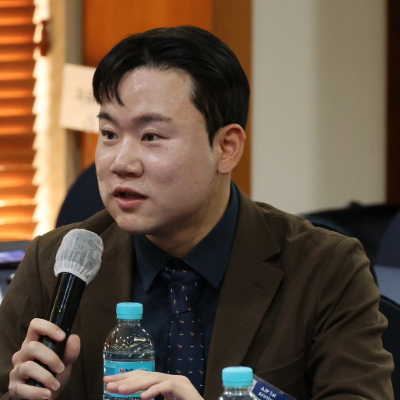
Lee Jung-woo이정우
cannes2030@ajupress.com
ReporterMinistry of Unification & North Korea, Politics, Foreign Affairs
I studied philosophy in college, and sociology and journalism in graduate school. I cover North Korea, South Korean politics, foreign affairs and films. I enjoy Nordic cinema, Indian cuisine and Japanese detective novels. I have a cat and like bright, acidic coffee.
"Were it left to me to decide whether we should have a government without newspapers, or newspapers without a government, I should not hesitate a moment to prefer the latter."
"Were it left to me to decide whether we should have a government without newspapers, or newspapers without a government, I should not hesitate a moment to prefer the latter."
Latest by Lee Jung-woo
-
 AI touts in Korean teens' hands are a growing worry for parents SEOUL, June 24 (AJP) - Gambling used to be a taboo word in South Korea. Real-money betting is prohibited in online games, as are casinos, bingo and lotteries for most citizens. But illegally, online gambling is proliferating — and increasingly invading classrooms. The episode in Netflix's hit drama "Teach You a Lesson," in which an ordinary high school student becomes addicted to gambling, destroys his family life and is eventually pulled into a criminal ring to repay debts, is hardly an exaggeration. In reality, the touts are no longer human. They are AI-driven advertisements, proxy sites and incessant pop-up attacks that relentlessly target teenagers' smartphones. "Teenagers are easily attracted by lotteries and dreams of sudden wealth," said Jeong You-seon, a counselor who has worked at both middle and high schools in Seoul. Apparently harmless fruit-matching game often serves as the gateway. In academically competitive districts, gambling may remain confined to a smaller group of students. In some vocational schools, however, it can spread much more widely. "People watch these stories on television dramas and think they are fictional," Jeong said. "They are not. They are based on reality." One former student she counseled became so consumed by online gambling that he began directing other students to earn points and money for him. He borrowed cash from friends and stole money from home to continue betting. His case is hardly unusual. In a recent self-reporting campaign run by the National Police Agency, nearly 300 teenagers came forward in just one month. One high school in Gangwon Province recorded 48 self-reported cases, while another in the same province reported 20. Gangwon is home to the country's only casino open to Korean nationals. Among the students was a 15-year-old boy in Incheon who told authorities he had accumulated about 30 million won ($19,500) in gambling debt. He assaulted his mother after she refused to repay 4 million won and later attempted suicide. In another extreme case, a 17-year-old school dropout in North Jeolla Province repeatedly ran away from home and broke into vehicles to finance his gambling habit. Over 14 months, he deposited about 16 million won into online gambling sites. The cases offer a glimpse into what experts increasingly describe as one of the most underrecognized threats facing South Korean adolescents: the rapid spread of online gambling through smartphones, social media and gaming platforms. Police data show the average teenage self-reporter had gambled for about a year and wagered roughly 3 million won. The highest reported amount reached 60 million won. Boys accounted for 93 percent of those who came forward. The problem extends well beyond high schools. Four in 10 self-reporters were middle school students. A survey by the Seoul Metropolitan Police Agency last year of nearly 35,000 students found that 2.1 percent had gambling experience, up from 1.5 percent a year earlier. More strikingly, one in five students said they had witnessed gambling among their peers. The age of first exposure is also falling. Fifth grade in elementary school emerged as the most common starting point, replacing the first year of middle school in the previous survey. Most gambling now takes place online. Students reported participating in esports betting, online instant-win games and illegal internet casinos, with nearly two-thirds using smartphones as their primary device. For Bhang Soo-young, a psychiatrist at Nowon Eulji University Hospital and director of the Nowon District Comprehensive Addiction Management Center, the statistics merely confirm what she already sees in her clinic. "The problem is much bigger than most people realize," Bhang said. "Many teenagers believe everyone around them is gambling. Once they think all their friends are doing it, gambling starts to feel normal." She said adolescents are particularly vulnerable because they are drawn to the promise of easy money without the effort associated with part-time work or traditional employment. Some of the teenagers she treats have accumulated debts that would overwhelm many adults. "I have seen cases where debts reached 150 million won," she said. "Families initially try to repay the money, but eventually they can no longer keep up." As debts mount, gambling often spills into other forms of delinquency and crime. Teenagers may begin extorting classmates, stealing or carrying out online scams in an attempt to recoup losses, Bhang said. In many cases, authorities first discover gambling only while investigating another crime. "Students are often not caught because of gambling itself," she said. "They are caught because they committed another offense, and gambling turns out to be the reason." Researchers and counselors warn that gambling addiction may be particularly damaging during adolescence, when the brain is still developing. Bhang compared the neurological effects of severe gambling addiction to those observed in drug addiction, citing impaired impulse control, attention and decision-making. "The attraction can be as powerful as what drug addicts describe," she said. Police investigators say the typical adolescent gambler falls between the ages of 14 and 18. "We are currently investigating cases involving a high school student who gambled more than 10 million won and a middle school student who gambled more than 1 million won," said a Seoul police officer who handles juvenile gambling cases. The consequences often extend far beyond financial losses. According to the Seoul police survey, some students funded gambling through extortion, fraud and school violence. Others relied on unauthorized microloans known as "proxy loans," an illegal lending practice widely advertised on social media. The arrangements often involve less than $100 but carry exorbitant fees and penalties that can exceed legal interest-rate limits many times over. Because many teenagers lack financial literacy and are reluctant to seek help from parents or authorities, they become easy targets for exploitation. Police extended the voluntary reporting program through the end of August and are encouraging teenagers and parents to come forward without fear of punishment. The battle won't likely be an easy one as the danger will always be literally at hand. A survey released Tuesday by Democratic Party lawmaker Kim Young-ho, 98.1 percent of parents across Seoul, Incheon and South Gyeongsang Province wanted some restrictions on smartphone use by minors. The majority also cited smartphones increase children's exposure to harmful content (97.5 percent). For a generation raised on games, the line between play and betting is disappearing — and by the time parents, schools, and society notice, the addiction may already be entrenched. 2026-06-24 16:33:00
-
 KOSPI crashes nearly 10 percent amid broad Asian retreat SEOUL, June 23 (AJP) - South Korea’s benchmark KOSPI crashed nearly 10 percent, far outpacing declines in Japan and China as investors rushed to unwind positions after record-setting streaks. The KOSPI fell 9.99 percent or record 910.71 points to 8,203.84, instantly wiping out gains of last seven trading sessions. The junior KOSDAQ plunged 7.94 percent to 891.52. Foreign and local institutions offloaded more than 4 trillion won worth on the KOSPI while retailers scooped them up with purchases of more than 8 trillion won. A dual circuit breaker, a temporary cool-off, was triggered both markets. The Korea Exchange suspended trading on the main bourse for 20 minutes starting at 2:33:43 p.m. after the KOSPI remained down more than 8 percent from the previous session’s close for one minute. It marked the fourth circuit breaker on the KOSPI this year and the 10th in history. The sharp decline was attributed to weakness in U.S. technology stocks and the spread of global risk-off sentiment to the domestic market. Overnight, the Nasdaq Composite fell 1.32 percent and the Standard & Poor’s (S&P) 500 Index declined 0.37 percent. Investor sentiment weakened as profit-taking emerged in artificial intelligence-related stocks and concerns grew over a potential outflow of AI talent. SK hynix fell 12.47 percent to 2.555 million won ($1,660), while Samsung Electronics dropped 12.31 percent to close at 310,000 won. SK hynix extended No.1 title on KOSPI. Its market capitalization stood at about 1,820 trillion won ($1.18 trillion), surpassing Samsung Electronics’ roughly 1,812 trillion won. SK Square, the third-largest company by market capitalization, declined 7.01 percent to 1,832,000 won, while Samsung Electro-Mechanics, ranked fifth by market capitalization, fell 10.68 percent to 1,990,000 won. Hyundai Motor, the sixth-largest company by market capitalization, dropped 12.05 percent to 511,000 won. The largest one-day decline in KOSPI history was the 12.06 percent plunge recorded on March 4, 2026, following the outbreak of the U.S.-Iran war. The second-largest drop was the 12.02 percent fall on Sept. 12, 2001, immediately after the Sept. 11 terrorist attacks. It was followed by an 11.63 percent decline on April 17, 2000, during the collapse of the dot-com bubble, and a 10.57 percent fall on Oct. 24, 2008, at the height of the global financial crisis. In Japan, the Nikkei 225 fell 3.55 percent to 69,788.38. Kioxia Holdings, Japan’s largest company by market capitalization and a NAND flash memory manufacturer, plunged 15.10 percent to 92,290 yen ($571.3). SoftBank, the fourth-largest company by market capitalization, fell 10.09 percent to 6,513 yen. Toyota Motor, the second-largest company by market capitalization, declined 1.29 percent to 2,706 yen, while Mitsubishi UFJ Financial Group, ranked third by market capitalization, fell 1.98 percent to 3,276 yen. China’s Shanghai Composite Index was down 1.51 percent at 4,100.35 as of 4 p.m. 2026-06-23 16:28:56
-
 North's Kim vows stronger nuclear force, denounces Seoul's sub push SEOUL, June 23 (AJP)-North Korean leader Kim Jong-un reiterated the state ambition to expand as a nuclear-arms power while denouncing South Korea's push on homegrown nuclear-powered submarine, state media reported Monday. The Korean Central News Agency (KCNA) on Tuesday said the Workers’ Party of Korea held an enlarged plenary meeting of its Central Committee from June 20 to 22 to review progress on decisions adopted at the party’s ninth congress and discuss future policy priorities. According to KCNA, Kim declared that North Korea would continue to “expand and strengthen” its nuclear forces and fully exercise its status as a nuclear weapons state. The report said plans related to nuclear technology would be accelerated and that the country would continue efforts to develop military assets capable of surpassing global standards. The meeting also reiterated North Korea’s policy of treating South Korea as its “most hostile state” and called for strict adherence to the ruling party’s principles for confronting Seoul. KCNA directly criticized recent South Korea-U.S. security cooperation, including the sixth meeting of the Nuclear Consultative Group, a bilateral framework aimed at strengthening extended deterrence against North Korean threats. The North’s state media accused Washington and Seoul of pushing the Korean Peninsula closer to nuclear conflict through military planning involving both nuclear and conventional forces. It also criticized what it described as efforts by South Korea to acquire nuclear-powered submarines and expand military capabilities in cooperation with the United States. Kim additionally ordered continued work on strengthening border fortifications along North Korea’s southern frontier and constructing new naval bases to support the country’s fleet operations, KCNA said. The comments came as Seoul pursues plans to develop and build a nuclear-powered submarine using domestic technology. A South Korean Foreign Ministry official said June 9 that discussions with U.S. counterparts had proceeded on the understanding that the submarine would be built in South Korea and that Washington had not raised objections to the plan. The official said South Korea had shared details of its submarine project with the United States and that both sides agreed the capability would contribute to the alliance’s defense posture and support Seoul’s efforts to take a leading role in defending the Korean Peninsula. South Korea last month unveiled a basic development plan stating that the submarine would be designed and constructed domestically to ensure greater self-reliance in acquisition, maintenance and long-term operations. Questions remain, however, over whether the allies can reach agreements on broader nuclear fuel issues. The Foreign Ministry official noted that discussions on expanding South Korea’s authority to enrich uranium and reprocess spent nuclear fuel under the bilateral nuclear cooperation agreement would require further negotiations. Under the revised U.S.-South Korea nuclear agreement, Seoul must obtain Washington’s consent for uranium enrichment below 20 percent and for spent fuel reprocessing, limiting its ability to independently produce nuclear fuel for civilian reactors. 2026-06-23 09:55:26
-
 Military reform plans could weaken defense capabilities, critics warn SEOUL, June 22 (AJP) - Critics on Monday warned that plans to merge South Korea's military academies and dismantle the Defense Counterintelligence Command (DCC) could weaken the military readiness at a time of growing security challenges in the region. The criticism came at a forum on international security and changing patterns of warfare held at the National Assembly in Seoul and hosted by Rep. Han Ki-ho, a four-term lawmaker of the main opposition People Power Party (PPP) who is also the former chairman of the National Assembly's defense committee and retired three-star army general. Han used the forum to argue that the Lee Jae Myung administration's defense policies undermining South Korea's military preparedness. The forum took place shortly after the government announced plans to dissolve the DCC and redistribute its functions among multiple organizations. Defense Minister Ahn Gyu-back said the proposed reform is intended to prevent excessive concentration of power following the command's alleged role during disgraced former President's Dec. 3 declaration of martial law in 2024. Han sharply criticized the government's plan to integrate military academies and relocate the Korea Military Academy from Seoul to Jangseong in South Jeolla Province. "The ultimate goal of the Lee administration is not to integrate military academies but to eliminate them," Han claimed. "If the Korea Military Academy is moved from Seoul to Jangseong, who would apply?" He argued that integrating the academies would amount to "completely overturning" the military system and warned that the government was pursuing a broader ideological transformation of the armed forces. Han said South Koreans had become accustomed to peace after decades without war on the Korean Peninsula. "The current government takes peace for granted," he said, arguing that peace has been maintained through public resolve and the U.S.-South Korea alliance. Han also criticized ongoing discussions about transferring wartime operational control (OPCON) from Washington to Seoul, saying a future conservative government would scrap the transition altogether. A major portion of the forum focused on the future of warfare and the implications for South Korean security. Tak Sung-han, a research fellow at Hanyang University's Institute for National Strategy, warned that future conflicts would increasingly depend on artificial intelligence, drones and robotic systems, making stable energy supplies a critical component of military power. "Securing sufficient and stable military power will be essential for national security," Tak said, arguing that electricity would become a decisive strategic resource as AI-enabled weapons systems proliferate. Tak described chronic energy shortages as one of North Korea's greatest structural weaknesses. He said North Korean electricity generation remains below 1990 levels and that the country's heavy dependence on hydropower leaves it vulnerable to seasonal fluctuations. "Electricity shortages are the North's biggest weakness across its economy, military and regime," Tak said. He argued that South Korea's greatest danger would come during the opening phase of any future conflict with North Korea. "If war breaks out, the greatest security crisis for South Korea will emerge in the initial stage of the conflict," Tak said. Because South Korea is a democratic society, he said, it would face greater challenges than North Korea in rapidly transitioning to a wartime footing. As a result, improving survivability and resilience during the early stages of war should become a national priority. Tak called for accelerated military modernization through advanced technologies, enhanced surveillance of North Korean military activities and stronger coordination with the U.S. "We must prepare for the possibility of a broader international conflict by strengthening the alliance with the U.S. while managing relations with China, Russia and Japan," he said. Another speaker, Park Yong-han of the Korea Institute for Defense Analyses, focused on the strategic consequences of intensifying U.S.-China competition and expanding cooperation among North Korea, China and Russia. Park said rivalry between Washington and Beijing was increasingly extending beyond military affairs into technology, economics and supply chains, creating new sources of instability throughout the Indo-Pacific region. "The possibility of worsening instability in the Indo-Pacific is becoming increasingly difficult to avoid," Park said. He warned that intensifying strategic competition could accelerate military buildups, deepen bloc politics and increase the risk of crises around Taiwan. Park also pointed to growing trilateral cooperation among North Korea, China and Russia since 2022, including diplomatic coordination, military exchanges and economic cooperation. "North Korea, China and Russia are pursuing different interests, but they have found common ground in responding to the changing international environment," he said. Still, Park argued that the partnership faces significant constraints because of historical mistrust and differing strategic priorities. Regarding OPCON transfer, Park described the issue as one of the most important challenges facing the alliance. "Strengthening South Korea's independent capabilities and maintaining alliance effectiveness must be pursued simultaneously," he said. Park said Seoul should continue strengthening its surveillance and reconnaissance assets, missile defense systems and strategic command structure while maintaining close coordination with Washington. "The core of South Korea's security lies in developing the alliance and self-reliant defense in a complementary manner," he said. Several PPP lawmakers also broadly criticized the current administration's security policies. Rep. Na Kyung-won said the administration was moving "backward" on defense and alliance issues. "When you look at whether Lee is moving in the right direction, everything is going backward," Na said. "It even runs counter to the fundamental values of the alliance." She also criticized what she described as an attempt to abolish a military drone unit before reversing course. "We are a powerless opposition party, but we will closely watch the Defense Ministry under the Lee Jae Myung government," she said. Rep. Han Dong-hoon said the government was projecting overconfidence in security affairs. "is engaging in a kind of bluff while making neighboring countries uneasy," Han said. "You can bluff in other areas, but you cannot bluff in national defense and security." Rep. Sung Il-jong expressed concerns that policies to dismantle the military academy system and an unrealistic, premature wartime operational control transfer could weaken the alliance with the U.S. 2026-06-22 17:41:48
-
 Lee's senior aide pick deepens ruling party divide amid sinking ratings SEOUL, June 22 (AJP) -South Korean President Lee Jae Myung's appointment of a conservative-leaning former prosecutor as senior presidential secretary for civil affairs is exposing growing fissures within the ruling camp at a time when both the president and his party are facing slipping public support. Lee on Sunday named Han Chan-sik, a lawyer at Kim & Chang and a former senior prosecutor, to the powerful post overseeing public officials and legal affairs. The presidential office said Han would help strengthen accountability across the civil service and advance the administration's prosecutorial reform agenda, including plans to establish a new major crimes investigation agency and a separate public prosecution office. The appointment, however, immediately sparked criticism from Lee's liberal support base and members of the ruling camp. As chief prosecutor in Seoul, Han led the investigation into the so-called environment ministry blacklist scandal under the administration of former President Moon Jae-in. The probe resulted in the indictment of former Environment Minister Kim Eun-kyung and former presidential aides Song In-bae and Shin Mi-sook. The case made Han a controversial figure among some progressive activists and loyalists of the ruling Democratic Party of Korea, who viewed the investigation as politically damaging to a previous liberal administration. Online communities broadly supportive of the ruling camp, including Ddanzi Ilbo and Clien, were flooded with posts criticizing the appointment on Sunday. Critics have also highlighted Han's family ties to the late Choi Byung-ryul, a former leader of the Grand National Party, the predecessor of the main opposition People Power Party. Choi played a leading role in the National Assembly's 2004 impeachment of former President Roh Moo-hyun, a move that triggered a political backlash and was later overturned by the Constitutional Court. The infighting is unfolding alongside a noticeable deterioration in Lee's public support. A Realmeter poll released Monday showed Lee's approval rating falling for a fifth consecutive week. Support for Lee's handling of state affairs dropped 4.8 percentage points from the previous week to 46.7 percent, marking the first time his approval rating has fallen below the 50 percent threshold since taking office. The survey of 2,517 adults was conducted between June 15 and 19. Realmeter said growing criticism over internal power struggles within the ruling party and disputes surrounding party leadership issues had contributed to negative public sentiment. A separate Realmeter survey conducted June 18-19 among 1,001 voters found the conservative PPPP leading the DP in support for a second consecutive week. The PPP recorded 42.3 percent support, compared with 40.1 percent for the DP. Ruling party lawmakers largely expressed respect for the president's appointment. "It is not particularly desirable to draw a line against someone because he is someone's son-in-law or son," said Rep. Min Byung-deok of the DP. "As a senior member of the ruling party, I respect the president's personnel appointment," said a four-term lawmaker from the same party. 2026-06-22 11:19:34
-
 Many analysts see Iran, not Washington, as the strategic winner of the war SEOUL, June 18 (AJP) - President Donald Trump hailed the U.S.-Iran memorandum of understanding as a diplomatic victory that would prevent Tehran from obtaining nuclear weapons and restore stability to global energy markets. Many international relations scholars and security analysts see it differently. Several experts interviewed by AJP said the 109-day conflict ultimately strengthened Iran's strategic leverage, exposed limits to American military power and accelerated shifts already underway in the global order. "The U.S. lost the war," said Jim Piazza, a political scientist at Pennsylvania State University. "It was unable to achieve its stated goals. Iran likely emerges from the war in a stronger strategic position." For many analysts, the war's most important lesson was not military but economic. Iran demonstrated its ability to weaponize the Strait of Hormuz, through which roughly one-fifth of global oil shipments pass. Paul Hare, a former British ambassador and veteran British diplomat, said Tehran had acquired a durable source of leverage. "The Iranians now have a permanent optional lever — pressure on the Strait of Hormuz," Hare said. William Reno, a political scientist at Northwestern University, agreed. "Iran learned how to use its proximity to the Strait of Hormuz as a geopolitical weapon," he said. The memorandum has added to those concerns because it guarantees toll-free passage for only 60 days. "The days of free passage may be over," Hare warned. Supporters of the agreement argue Washington secured its principal objective by obtaining Iran's renewed commitment not to develop nuclear weapons. Critics, however, say the memorandum merely postpones difficult decisions. Under the agreement, both sides have 60 days to negotiate sanctions relief, nuclear restrictions, verification mechanisms and broader security arrangements. Several analysts suggested Tehran may now see its leverage over global shipping routes as a more effective deterrent than a nuclear arsenal. "Iran might even give up the nuclear program, slowly, since having the Strait weapon is much more useful to them," said Daniel Green of the University of Delaware. Tom Vaughan, a lecturer in international security at the University of Leeds, expressed a similar view. "I would not be surprised if Iran now agreed to give up its nuclear program," Vaughan said. "It now has a much better deterrent in its back pocket — the threat to close the Strait again." China and Russia emerge as indirect beneficiaries Neither intervened militarily, yet both watched closely as the United States became increasingly entangled in a costly regional conflict that exposed limits to American military power. "China and Russia have gained enormously," said Hare. William Reno, a political scientist at Northwestern University, went further. "China is the ultimate strategic winner in this war, less for anything China has done and more for the improvement of its position in relative terms," he said. Thomas Berger of Boston University said rising energy prices and weakening confidence in American influence could benefit both countries. "Russia is clearly a beneficiary of this development," Berger said. Several analysts also noted that China continued purchasing Iranian oil throughout the conflict, helping sustain Tehran economically despite sanctions and blockades. Another blow to the postwar order Many experts said the war accelerated the erosion of the international order built after 1945 around American leadership, alliance networks and rules governing the use of force. Douglas Becker, a professor of international relations at the University of Southern California, said the conflict weakened efforts to strengthen international legal constraints on military action. "The real loser in the war is a global order that sought to restrict the use of force without proper authorization," Becker said. Karoline Postel-Vinay of Sciences Po reached a similar conclusion. "That war is yet another sign that the post-1945 international order, and the idea of a post-1989 liberal order, are gone," she said. Jim Piazza of Pennsylvania State University warned that the conflict could also weaken long-standing principles such as freedom of navigation. If countries eventually negotiate separate arrangements with Iran for access through the Strait of Hormuz, he said, Tehran's strategic importance could rise substantially. Lessons for East Asia For South Korea and other East Asian economies, the war underscored how quickly a Middle East conflict can become an economic shock thousands of kilometers away. William Grimes of Boston University said disruptions to fuel, fertilizer and industrial supply chains would likely accelerate efforts to strengthen economic security. "This is likely to accelerate existing moves to improve economic security through stockpiling, restoring, friend-shoring and related measures," Grimes said. Several experts said governments across the region would increasingly prioritize supply-chain resilience, strategic reserves and alternative energy sources. Tom Vaughan of the University of Leeds said the crisis could even speed up the global transition toward renewable energy. "This war has reminded us of the extreme vulnerability of fossil fuel supply chains," he said. Fragile peace Despite optimism surrounding the memorandum, few experts believe peace is guaranteed. The agreement remains a framework rather than a final settlement, leaving disputes over sanctions, nuclear verification, regional security arrangements and the future status of the Strait of Hormuz unresolved. Daniel Green of the University of Delaware offered one of the starkest warnings. "I would be really surprised if the war does not return in the next six months, or even six days," he said. For many analysts, that may be the clearest takeaway. The memorandum may have stopped the shooting, but it has not ended the conflict. 2026-06-18 17:53:27
-
 Michelle Steel confirmed as US Ambassador to Seoul SEOUL, June 18 (AJP) - Rep. Michelle Steel was confirmed by the U.S. Senate on Wednesday as ambassador to South Korea, filling a diplomatic post that has been vacant for more than a year. The Senate approved Steel's nomination by a vote of 55-39, completing the confirmation process a little more than two months after President Donald Trump nominated her on April 13. Steel will formally take up the position after receiving her commission from Trump and completing diplomatic procedures with the South Korean government including obtaining agrément, the host country's formal approval of an ambassador. Wednesday's confirmation ends a vacancy that has lasted since former ambassador Philip Goldberg left the post in January 2025. Since then, the U.S. Embassy in Seoul has been led by a chargé d'affaires. Steel, a Republican and Korean American, served two terms in the U.S. House of Representatives after previously serving as a member of the Orange County Board of Supervisors in California. She was first elected to Congress in 2020 and won reelection in 2022 before losing her seat in the 2024 election. Born in Seoul in 1955, Steel, whose Korean name is Park Eun-joo, spent part of her childhood and adolescence in Japan before immigrating to the U.S. in 1975. During her Senate confirmation hearing, Steel recounted her family's journey to the U.S. Her parents, who were born in what is now North Korea, fled south during the Korean War before eventually settling abroad. She also used a Korean-language proverb, saying, "After hardship comes happiness," to describe her life story. Steel will become the second Korean American to serve as U.S. ambassador to South Korea, following Sung Kim, who held the position from 2011 to 2014. She will also be the first Korean-American woman to serve as the top U.S. diplomat in Seoul. Her appointment comes as Washington and Seoul continue to coordinate closely on security, economic and regional issues amid evolving challenges in Northeast Asia. 2026-06-18 11:23:39
-
 Washington's new trade agenda poses fresh challenges for Seoul SEOUL, June 17 (AJP) - Seoul should closely monitor Washington's evolving trade strategy and swiftly implement South Korea's trade deal with the U.S. agreed last fall, said an ex-trade chief on Wednesday. Speaking at a forum at the National Assembly in Seoul, former Trade Minister Jeong In-kyo also warned that the U.S.' annual trade report is increasingly being used as a platform for future enforcement actions beyond tariffs. "The National Trade Estimate (NTE) report has essentially become a document that organizes the justifications for future actions against trading partners," Jeong said. "Even if countries reach agreements with the U.S., the report contains grounds that could be used for additional measures later." The forum, titled "America's New Trade Agenda — Is Korea Prepared?," focused on implications of the U.S. Trade Representative's NTE report and recent investigations under Section 301 of the U.S. Trade Act. Jeong, who previously headed South Korea's trade negotiations office under the Ministry of Trade, Industry and Energy, said the character of the NTE report has changed significantly under U.S. President Donald Trump's trade agenda. According to Jeong, the report has evolved from a traditional catalog of foreign trade barriers into a broader framework supporting Washington's efforts to reshape global trade rules and tighten economic pressure on China. He said this year's report expanded to more than 500 pages and included substantially more material on digital regulations and other non-tariff barriers. "The core objective of the current trade strategy is the construction of a comprehensive containment network against China," Jeong said. He added that Washington is particularly focused on preventing Chinese exports from entering the U.S. market through third countries. Jeong argued that South Korea should seek to conclude an Agreement on Reciprocal Trade, or ART, with the U.S. as quickly as possible. Countries that reach such agreements may face lower tariff rates than those that do not, he said. The forum was moderated by Rep. Kim Gunn of the main opposition People Power Party (PPP), who served as secretary of the National Assembly's Foreign Affairs and Unification Committee during the first half of the 22nd Assembly. A career diplomat before entering politics, Kim previously served as South Korea's ambassador to the U.K. and chief negotiator on North Korea's nuclear issue under disgraced former President Yoon Suk Yeol. A second presentation by Lee Joo Hyoung, a professor at the University of Seoul Law School, examined the legal foundations and policy implications of Section 301 investigations. Lee said recent developments stem partly from judicial scrutiny of presidential tariff authorities in the United States, prompting policymakers to rely more heavily on other trade enforcement tools. She described Section 301 as one of Washington's most flexible trade instruments because investigations can be expanded, revised and even reopened after being formally concluded. "The original purpose of Section 301 is not punishment itself but creating leverage for negotiations," Lee said. Lee noted that the Office of the U.S. Trade Representative recently launched investigations examining forced labor practices, structural overcapacity and supply-chain issues among major trading partners. She said South Korea has drawn particular attention from U.S. officials over digital platform regulations and labor-related issues. U.S. officials have repeatedly raised concerns that proposed Korean digital regulations could disproportionately affect American technology companies. She cited comments by U.S. Trade Representative Jamieson Greer indicating that Washington could consider Section 301 actions if it determines that discriminatory regulations exist. Lee pointed to growing U.S. scrutiny of forced labor concerns, including cases linked to South Korea's salt-production industry. The issue gained prominence after U.S. Customs and Border Protection imposed a Withhold Release Order on products from a salt farm in South Jeolla Province over allegations of forced labor. The U.S. Embassy in Seoul visited Taepyung Salt Farm in August last year after U.S. authorities imposed an import hold on its products, inspecting workers' contracts, living quarters and labor conditions. She called the move "unusual," noting that it is rare for a foreign government to conduct investigations beyond its jurisdiction. She said the U.S. was less focused on the Shinan salt farm case itself than on broader efforts to prevent goods linked to forced labor in China from entering the U.S. market. The USTR's 2026 National Trade Estimate Report newly identified forced labor in salt production and illegal fishing issues as trade-related concerns involving South Korea, while also elevating scrutiny of the country's digital regulations and competition policies. 2026-06-17 17:35:30
-
 Lee pledges greater role in global development at G7 summit SEOUL, June 17 (AJP) - South Korean President Lee Jae Myung called for broader access to artificial intelligence (AI)-related technologies for developing countries during a session of the Group of Seven (G7) summit in France on Tuesday. He also urged a new model of international development cooperation that combines aid, private investment and technology-sharing. Speaking at the first expanded session of the summit in Évian-les-Bains, Lee said many developing countries remain unable to fully benefit from the opportunities created by the rapid rise of AI. "The AI revolution is both a new challenge and an opportunity for growth for humanity, yet many developing countries do not have sufficient access to these opportunities," Lee said, according to Cheong Wa Dae. The session, held under the theme of "Forging New Partnerships and Rebuilding International Solidarity," brought together leaders of G7 member states, invited partner countries, World Bank President Ajay Banga and African Development Bank President Sidi Ould Tah. They discussed ways to respond to growing needs driven by climate change, global conflicts, food and health crises and rising debt burdens, while addressing constraints on public financing. Lee argued that traditional aid-centered development models should evolve toward partnerships that mobilize private capital alongside official development assistance. "As development aid budgets for least-developed countries are shrinking, private investment should help open new paths to growth," Lee said. He cited a program by the Korea International Cooperation Agency (KOICA) in Indonesia, where support for 12 local startups in agriculture, energy and environmental sectors helped attract $50 million in private investment from an initial US$1 million grant. Lee also promoted South Korea's vision of a "Global AI Basic Society," aimed at ensuring that the benefits of AI development are shared widely across countries. "The outcomes of AI technological development should be shared by all countries so that they can grow together," he said. Emphasizing that development assistance should ultimately improve people's lives, Lee pointed to a vocational training school in Ethiopia established jointly by KOICA and South Korean companies. He said the program has provided training in electrical engineering, electronics and information and communications technology, helping young people gain employment and entrepreneurial opportunities. Lee said South Korea would continue contributing to international development efforts based on its experience of transforming from an aid recipient into a donor nation. Following the session, summit participants adopted three documents on reciprocal international partnerships, cancer prevention and treatment, and Ebola response. South Korea expressed support for all three initiatives. Earlier in the day, Lee held bilateral talks with Canadian Prime Minister Mark Carney, where the two leaders agreed to strengthen cooperation in defense, security, energy and critical minerals. Lee said South Korea, a major defense exporter, was prepared to contribute to strengthening Canada's security capabilities based on mutual trust. Carney responded that Canada places importance on building closer ties with South Korea and agreed to continue discussions on expanding cooperation. The meeting comes as South Korea's Hanwha Ocean and Germany's Thyssenkrupp Marine Systems compete for Canada's next-generation submarine project, estimated to be worth up to 60 trillion won ($39.7 billion). The two leaders also agreed to expand cooperation on energy supply chains, including crude oil, liquefied natural gas and critical minerals, while exploring practical ways to contribute to regional and global peace and prosperity. Lee noted the longstanding ties between the two countries dating back to Canada's participation in the 1950-53 Korean War and said the two nations have become partners that can support one another in addressing shared challenges. 2026-06-17 11:19:02
-
 Beyond 'Teach You a Lesson': Why Korean teachers say real life can be more tragic SEOUL, June 17 (AJP) - Netflix's hit K-drama "Teach You a Lesson" may depict elite inspectors restoring order in dysfunctional schools, but teachers in South Korea say the most unsettling aspect of the series is not its violence. It is how accurately it captures their sense of abandonment. The methods may be exaggerated. The stakes, they argue, are not. In fact, real life is often more tragic. Unlike television, there is rarely a dramatic resolution when schools fail. Conflicts can end in prolonged legal battles, public humiliation, mental trauma and, in some cases, death. South Korea has witnessed several teacher deaths in recent years, most notably the 2023 death of a young teacher at Seoul's Seoi Elementary School that triggered nationwide protests and forced lawmakers to strengthen legal protections for educators. Yet many teachers say little has fundamentally changed. "The people who harass teachers and violate teachers' rights come at us with guns and knives. The least defense we have is a state-backed legal protection system." The speaker is an elementary school teacher in Incheon with a decade of classroom experience, describing what he sees as the reality of teaching in South Korea today. Like many teachers interviewed by AJP, he had watched every episode of "Teach You a Lesson," a series that imagines an extraordinary government agency empowered to intervene when schools descend into chaos. For many educators, however, the drama's popularity is less surprising than revealing. "I would suggest that the remarkable popularity of 'Teach You a Lesson' be understood as a symptom rather than as a foundation for policy," said Eom Moon-young, a professor in the Department of Education at Seoul National University. "The fact that a fictional Teacher Rights Protection Bureau resonates so powerfully reflects the profound sense of powerlessness many teachers now experience." Eom said the show's success reflects frustrations that have accumulated for years. Teachers increasingly report verbal abuse, physical threats, relentless complaints from parents and allegations of child abuse stemming from routine disciplinary actions. While South Korean society has become more attentive to children's rights over the past two decades, many educators say institutional protections for teachers have failed to keep pace. The current debate cannot be separated from the trauma of Seoi Elementary School. In July 2023, a young teacher at the Seoul school died by suicide after reportedly suffering severe stress related to parental complaints and student disciplinary issues, triggering nationwide outrage and mass rallies by teachers. Lawmakers later passed a package of reforms commonly known as the "Five Teacher Protection Laws," intended to strengthen legal safeguards for educators. Yet many teachers say the burden remains unchanged. One elementary school teacher in Sejong City said the fifth episode of the drama, which depicts a teacher driven to despair by relentless parental harassment, was the most memorable. "The education minister in the drama says he will take responsibility for everything," he said. "What stays with me is that the real education minister does not do that. Watching it gave me comfort." "The law has to change first." Another elementary school teacher from Daegu with 26 years of experience said the same episode felt less like fiction than a documentary. "I was deeply moved by the episode based on the Seoi Elementary case," he said. "It made me think they had researched reality very well. Everything that happened in that episode happens in real life. It is extremely common." Teachers also described a steady stream of parental complaints that they say has become increasingly intrusive. The Incheon teacher recalled one example involving a swimming lesson. A child who was afraid of water chose to remain poolside rather than enter the water. After photographs were shared with parents, one parent questioned why the child's swimsuit appeared dry. When the teacher explained that forcing the child into the pool could have created safety risks, the parent responded: "Then why did the child go to the swimming pool at all? Shouldn't the child experience the water?" Teachers also reported receiving messages about children's clothing, demands to report how many spoonfuls of lunch a child consumed, requests to monitor emotions after school and repeated phone calls outside working hours. One veteran middle school teacher in Seoul said the problem has steadily worsened. "For 28 years, things have continued to get worse," he said. "There are more parental complaints now. Many families have only one child, and parents often become overprotective. Even when their child is wrong, they side with the child." The fear of speaking up remains pervasive. According to a nationwide survey by the Korean Federation of Teachers' Associations, 36.6 percent of teachers reported infringements on educational activities last year. Yet only 3.8 percent sought formal proceedings before teacher rights protection committees, while 93.3 percent never filed complaints at all. Nearly 30 percent cited fears of retaliation, including false child-abuse allegations. Many teachers argue that even when investigations ultimately clear them of wrongdoing, the process itself can be devastating. A single allegation may trigger police investigations, child welfare inquiries, media attention and months of uncertainty. For many educators, that may be the most important lesson hidden inside the drama. The appeal of "Teach You a Lesson" is not that audiences are longing for vigilante justice or a return to corporal punishment. It is that teachers are searching for something far more basic: the reassurance that they will not have to fight these battles alone. The drama may exaggerate its methods. But for many teachers, real life is often more tragic because there is no Na Hwa-jin arriving at the end — only educators hoping that the next classroom conflict will not become another national tragedy. 2026-06-17 09:56:42