

Journalist
Park Sae-jin박세진
swatchsjp@ajupress.com
Assistant EditorForeign embassies in Seoul & Geopolitics, Diplomacy, Policy
Experienced journalist and editor at AJU PRESS specializing in multilingual news. I cover international diplomacy, geolpolitics, and policy, consistently delivering highly accurate, compelling reporting for a worldwide audience.
"Reporting the facts. Shaping the narrative. Every second counts."
Latest by Park Sae-jin
-
 Kazakhstan pushes factory contracts to unblock utility overhaul SEOUL, July 29 (AJP) - Kazakhstan's government has set a September 1 deadline to break a logjam in the industrial side of its largest infrastructure program, a 13 trillion tenge effort to rebuild the country's aging heating, power and water systems by 2029. Prime Minister Olzhas Bektenov told a cabinet meeting that work to conclude potential offtake contracts for new and expanded production facilities under the national project "Modernization of Energy and Utilities Sectors" must accelerate, Kazakhstan's state-operated Qazinform News Agency reported Tuesday. Off-take contracts commit a buyer to purchase a set volume of output in advance, which is what allows a manufacturer to borrow against future revenue and build the plant in the first place. Without them, the factories the program is meant to create do not get financed. "This issue has been repeatedly discussed but remains unresolved. The Ministry of Industry and Construction must enhance oversight and coordination," Bektenov said. He also instructed the ministry to add architectural, urban planning, and construction catalog codes to the manufacturers' register within two weeks. The pressure is pointed because domestic production is not a side benefit of the program. It is one of its four stated directions. Officials have identified 2,786 product lines worth 2.24 trillion tenge that could be supplied from inside Kazakhstan, and assembled a pool of 220 Kazakh plants and 669 qualified companies to handle design work and equipment supply. President Kassym-Jomart Tokayev has said more than 200 new production facilities should launch within two years. The program itself dates to December 2024, when the government approved the national project for the period through 2029. Tokayev signed the enabling law on July 17, 2025, and it took effect 12 days later. Of the 13 trillion tenge total ($27.3 billion), some 6.8 trillion tenge is directed at repairing and building 86,000 kilometers of utility networks, and roughly 6.2 trillion tenge at power generation. More than 1 trillion tenge was allocated this year alone, according to Tokayev. The targets are specific. Wear on heating networks is to fall from 53 percent to 40 percent, on electricity networks from 62 percent to 45 percent, on water supply from 39 percent to 34 percent, and on wastewater systems from 54 percent to 40 percent. Emergency breakdowns are to drop by 20 percent. The energy ministry expects generation capacity to grow by 7.3 gigawatts, lifting total national output to 32.6 gigawatts, though official statements have counted the underlying generation projects differently, sometimes as 15 new plants plus 14 modernizations, sometimes as 29 projects in total. What forced all of this was one winter. On November 27, 2022, a failure at the thermal power plant in Ekibastuz, a mining city in Pavlodar region, cut heat to much of the town while outside temperatures sat near minus 30 degrees Celsius. Authorities declared a state of emergency. Residents went days without heating, pipes and radiators froze and burst, and the regional governor was dismissed. Weeks earlier, more than 20,000 people in the northeastern town of Ridder had lost heating in a similar accident. A review by the energy ministry that December put numbers to what everyone already suspected. The average thermal power plant in Kazakhstan was 61 years old. About 76 percent of them had been running for more than half a century. Average wear on core equipment stood at 66 percent. Deputy Prime Minister Kanat Bozumbayev, who heads the project office, has said the work will concentrate on regions where network wear exceeds 65 to 70 percent. Financing comes from domestic and international financial institutions, banks, the state budget and shareholder contributions, with the government subsidizing interest rates on loans taken by utility companies to keep the repair campaign from landing directly on household tariffs. Targeted assistance for utility bills stays in place for low-income households. Bektenov also pressed the industry and energy ministries to speed up the unified digital platform Smart Turmys. Industry and Construction Minister Yersayin Nagaspayev told the same meeting the first modules would enter pilot operation in the fourth quarter, running a single subscriber registry, digital accounting of utility payments and monitoring of electricity, gas, heat and water consumption. Kazakhstan aims for full metering of utility infrastructure in cities of republican and regional significance by 2029. 17 pilot renovation projects were funded under the national project by 2025, worth 31.7 billion tenge. 2026-07-29 10:10:14
-
 Algal blooms speed plastic breakdown into microplastics SEOUL, July 29 (AJP) - The algal blooms that turn rivers and lakes green every summer do more than cloud the water. They also make discarded plastic crumble faster, accelerating the point at which a plastic bag or wrapper starts shedding microplastics, according to research from Korea Advanced Institute of Science and Technology. The finding matters because the two problems have been managed as separate ones. Water authorities treat blooms as a nutrient pollution issue and plastic waste as a solid waste issue, and the research shows the first speeds up the damage caused by the second. Blooms are also becoming more frequent worldwide as warming water and fertilizer runoff push more nutrients into freshwater systems. Korea Advanced Institute of Science and Technology (KAIST) announced the results Wednesday. The work was led by Myung Jae-wook, a professor in the Department of Civil and Environmental Engineering, with doctoral student Kim Young-ju as first author, and was carried out with three researchers at Hong Kong University of Science and Technology. Plastic that ends up in a river does not sit there inertly. Within days, bacteria and algae colonize its surface and build a living film, an environment researchers call the plastisphere. Scientists already knew this film influences how pathogens spread and how microplastics travel through water. What nobody had established was what happens to that film when a serious bloom hits. To find out, the team built miniature ecosystems in the laboratory using freshwater collected from a pond on the KAIST campus in Daejeon, then added low-density polyethylene film, the flexible plastic used in shopping bags. Blooms were induced by seeding the water with Microcystis aeruginosa, a cyanobacterium commonly used as a model for harmful freshwater blooms, and by adjusting light and nutrient levels. The team then tracked the plastic surfaces for 42 days, analyzing the microbial film, the makeup of the community living in it and the genes those organisms carried. Under bloom conditions, cyanobacteria and a wide range of ordinary bacteria multiplied together and produced a thicker, more complex film than in normal water. Organisms that secrete exopolysaccharides, the sticky substances that bind microbes to each other and to surfaces, increased sharply. The film held on tighter and grew heavier. That shift changed what the plastic itself went through. Bacteria carrying genes for enzymes involved in oxidizing and breaking down plastic, including alkane hydroxylase, copper oxidase and esterase, became more abundant under bloom conditions. Infrared spectroscopy showed a rise in oxidized chemical groups on the plastic surface, and scanning electron microscopy revealed a denser pattern of fine cracks. Both are signs that the material was becoming brittle, the stage before it fragments into microplastic particles. No single plastic-eating microbe was responsible. The researchers attributed the acceleration to the whole community, photosynthetic bacteria and ordinary bacteria working as a layered network, which widens the picture of how plastic degrades in real water bodies rather than in controlled tests with one strain. The study also compared polyethylene with polylactic acid, a plant-based plastic marketed as biodegradable, and found different bacterial groups dominating on each surface. "This research is meaningful in that it looked at plastic pollution and algal blooms not as separate problems but as one environmental problem in which each affects the other," Myung said. "As climate change makes blooms more frequent, I expect this will serve as important evidence for building integrated environmental management strategies that consider water quality management and waste plastic management together." The paper appeared in the journal Water Research on May 25. (Reference Information) Journal: Water Research Title: Eutrophication drives taxonomic and functional trajectories in plastic-associated biofilms DOI: 10.1016/j.watres.2026.126183 2026-07-29 09:47:16
-
 Kookmin University leads 22.2 billion won bio materials project SEOUL, July 29 (AJP) - A Seoul university better known for design and management has landed one of the year's larger national biotechnology awards, taking the lead role in a government project to mass-produce high-value biological materials that currently exist only in trace amounts in nature. Kookmin University said Tuesday that a research team headed by Park Yong-cheol, a professor in its Department of Convergence Bioengineering, was selected as a new recipient under the advanced bio materials development program, part of the first round of 2026 bio-health research and development projects overseen by the Ministry of Trade, Industry and Resources (MOTIR) and supported by the Korea Planning and Evaluation Institute of Industrial Technology (KEIT). The project runs through 2030 with a total budget of 22.2 billion won ($15.1 million), consisting of 15.9 billion won in government funding and 6.3 billion won from participating institutions. The award places Kookmin at the center of a 17-member consortium of companies and research bodies, an unusual position for a university whose research profile in industrial biotechnology has grown quickly over the past several years. Park was selected in April for a separate core research grant from the National Research Foundation of Korea for work on precision fermentation using the food yeast Candida utilis. He received a ministerial award for research and development in biochemistry in 2022 and founded BioCraft, a brewing yeast company, in 2020. Advanced biomaterials refer to substances made from living organisms, natural raw ingredients or bioprocess technology, with applications in medicine, chemicals, food and cosmetics. The project targets three of them: exosomes derived from microbes, high-purity vitamins and microbial lutein. All three are difficult and expensive to obtain at scale by conventional extraction, which is why the research aims to produce them inside engineered microorganisms instead. Kookmin manages the overall project while three companies run the subprojects. Bio-FD&C leads work on bio production processes and commercialization for multifunctional beauty materials based on microbe-derived exosomes. Ace Biopharm handles mass production of high-purity vitamins through microbial processes and their development into functional products. Daebong LS runs the third subproject, covering biomanufacturing processes and commercialization technology for lutein produced by industrial microbes. The research combines several approaches. The team plans to develop ultrafast microbial design methods built on synthetic biology and biofoundry platforms, fermentation and purification processes based on precision fermentation, and manufacturing process technology drawing on big data and deep learning. The goal is a production base for materials that occur naturally in only small quantities, along with a support system linking production through to finished products. "This project is a large-scale research and development task in which 17 companies and institutions participate, linking production of high-function bio materials through to commercialization," Park said. "Based on synthetic biology, biofoundry and precision fermentation technology, we will develop technology that can support mass production and industrialization of advanced bio materials." 2026-07-29 08:22:57
-
 Samarkand hosts Uzbekistan's first sister cities forum SEOUL, July 29 (AJP) - Uzbekistan has added another international gathering to Samarkand's growing calendar, hosting the country's first International Sister Cities Forum in the ancient Silk Road city on July 24 and 25, the latest step in a deliberate campaign to make Samarkand the country's face to the world. The forum opened with a scientific and practical conference titled "Brother Cities: A New Model of Sustainable Development and Public Diplomacy," which drew experts, city officials, diplomats and academics from about 20 countries, according to the Uzbek Embassy in Seoul. Participants joined in person and online, alongside representatives of foreign embassies in Uzbekistan, international organizations and local universities. The choice of venue was no accident. Since hosting the Shanghai Cooperation Organisation summit in September 2022, where leaders including Chinese President Xi Jinping and Russian President Vladimir Putin adopted more than 40 documents, Tashkent has steadily positioned Samarkand as its premier stage for international events. The city welcomed the UN World Tourism Organization General Assembly in 2023, backed by a purpose-built congress and hotel complex, Silk Road Samarkand, and an international airport terminal opened in 2022 that cut travel friction for foreign delegations. The sister cities forum extends that strategy from head-of-state summitry down to the municipal level, where Uzbekistan is betting that city-to-city ties can deliver trade, investment and tourism results that national diplomacy alone cannot. The conference was organized around a plenary session and three thematic tracks. The first covered trade, economic and investment cooperation between partnered cities and regions, with discussions on industrial cooperation, export expansion and support for small and medium-sized businesses. The second addressed science, education, technology and innovation, including partnerships between universities and research centers, joint research projects, academic exchanges and the sharing of smart city and digital governance experience. The third treated tourism as a strategic tool for the sister city network, focusing on joint tourism projects, new routes and the international promotion of Uzbekistan's historical and cultural heritage. Beyond the conference, the two-day forum program included panel discussions, roundtables and signing ceremonies for memorandums and cooperation agreements between sister cities, according to Uzbekistan's Dunyo news agency. The embassy said initiatives and proposals put forward at the conference would feed into new joint projects in economics, education, innovation, tourism and cultural cooperation between partnered cities. The conference brought together participants from about 20 countries, with the full forum running through July 25. 2026-07-29 08:00:05
-
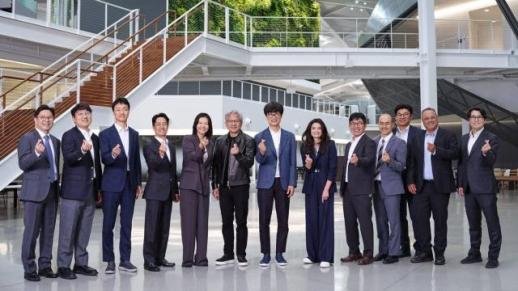 Korean firms strike $950 billion chip deals with US big tech SEOUL, July 25 (AJP) - South Korean companies and American technology giants will pursue semiconductor cooperation worth a combined $950 billion over the next five years, the presidential Blue House said Saturday, putting a price on the summit President Lee Jae Myung convened in San Francisco a day earlier. Kim Yong-beom, the presidential policy chief, gave the figure at a briefing at the press center in San Francisco, breaking down the results of the San Francisco AI Summit across the three pillars of the government's Three Mega Projects: semiconductors, AI data centers and physical AI. The total comes to about $950 billion (1,375 trillion won). The commitments are frameworks rather than signed orders. The Blue House said the announced scale covers memorandums of understanding and long-term cooperation plans, with actual investment and supply to follow as contracts are executed and projects proceed. Even so, the scale is difficult to overstate. Spread over five years, $950 billion works out to about $190 billion a year, close to the entire annual revenue of either Nvidia or Samsung Electronics, and the total nearly doubles the roughly $520 billion the two Korean chipmakers pledged in June toward new domestic fabrication plants. The largest single piece belongs to SK. The group will pursue long-term supply cooperation for advanced memory chips with Nvidia and other global technology companies worth $750 billion over five years, the Blue House said. That figure resolves a number that had hung over the summit since Friday, when Nvidia chief executive Jensen Huang told Lee that a partnership with SK Group would reach $500 billion. No documentation followed his remark. The official tally now puts SK's memory cooperation half again higher, with Huang's figure apparently representing the Nvidia portion of a wider multi-buyer arrangement. Samsung Electronics signed a memorandum of understanding with Broadcom covering $200 billion over five years, spanning advanced memory supply and foundry cooperation to manufacture AI chips. The agreement pairs Samsung's contract chipmaking business with the company designing custom AI processors for several of the world's largest cloud operators. In data centers, Korean and global companies will pursue investment cooperation on roughly five gigawatts of AI data center capacity running about two million graphics processing units. For scale, the government had secured 260,000 advanced GPUs as of this spring, and its first-phase national plan targets eight gigawatts. SK Telecom agreed with Nvidia on support for building and expanding AI data centers of up to two gigawatts, with priority allocation of Nvidia's latest Vera Rubin systems, and will pursue investment in a gigawatt-class domestic AI data center project with Anthropic. Naver signed a strategic investment agreement with Nvidia and an infrastructure supply contract with the global investment firm Brookfield to build an AI factory complex worth a combined $10 billion. In physical AI, Hyundai Motor Group and Nvidia will jointly build what they call a robot reference platform, a standardized base for developing and validating AI robots that universities and startups can build on. The Blue House also said an autonomous vehicle foundry plan was announced with Waymo, without giving details. Samsung SDS signed a strategic partnership with Anthropic to jointly develop new AI markets and train AI engineers. The results land two days after Kim told foreign correspondents the figures companies were preparing could exceed the 4,700 trillion won ($3.2 billion) headline attached to the June investment package, and they close the loop the summit opened. Lee's San Francisco AI Declaration on Friday promised that South Korea would anchor the global AI supply chain while serving as the place where the technology is put to work first. Saturday's tally is the first accounting of what that pitch brought back. "This San Francisco AI Summit was a venue for combining South Korea's semiconductor competitiveness and its AI infrastructure, model and physical AI capabilities with the technology and capital of global big tech, to build an investment and cooperation ecosystem across the full AI stack," Kim said. "It carries meaning as the starting point of a global project that will lead the world's AI industry." 2026-07-25 15:20:25
-
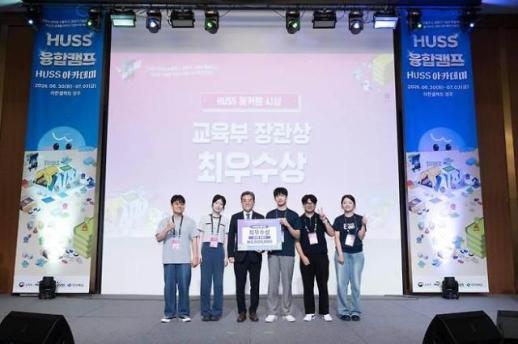 Kookmin students take top prize at HUSS hackathon SEOUL, July 25 (AJP) - Kookmin University students helped win the top prize and two other awards at a national hackathon that asked humanities and social science students to solve social problems with artificial intelligence. The 2026 HUSS Convergence Camp Insight hackathon ran from July 1 to 3 at the Sono Calm resort in Gyeongju, backed by the Ministry of Education and the National Research Foundation of Korea and organized by the council of the Humanities Utmost Sharing System (HUSS), a government program that trains humanities and social science students to work across disciplinary lines. About 430 students and program officials took part in the hackathon, with students from different universities and majors grouped into five-member joint teams to propose solutions to social problems. A total of 55 teams entered. Around 20 advanced through a written preliminary round to the final presentations, where 10 teams took prizes: one top prize carrying the award of the deputy prime minister and education minister, four excellence prizes from the National Research Foundation chairman, and five encouragement prizes from the HUSS council chair. Kookmin students stood on three of those teams, including the one that won it all. The top team, Onsaemiro, included Yang Seung-eon of Kookmin's Department of Political Science and International Relations and Lee Tae-ho of the Department of AI, Big Data and Management. The team proposed ORIGIN, a platform that screens AI-generated traditional culture content for distortion before it spreads. The service analyzes such content for likely historical and cultural errors, then runs it past heritage practitioners and experts before issuing certification. Yang researched distortion cases and the surrounding regulations, defined the problem and built the presentation. Lee tested the feasibility of the solution and shaped a business model aimed at government agencies and public institutions. Kim Yun-seo of the School of Management Information Systems joined the excellence prize team Daumi, which proposed Dahda, an AI-based indoor evacuation navigator for visually impaired people. The service uses Wi-Fi fingerprinting and Bluetooth beacon technology to guide users to the nearest emergency exit during a fire and relays their location inside the building to rescue teams, with voice and vibration guidance tailored to different types of disability. Kim designed and developed the application prototype and handled its interface design. Hyun Yun-su of the School of Management Information Systems and Choi So-yul of Kookmin University Business School (KIBS) joined the encouragement prize team Poporiner, which proposed Daol, a legal and administrative support service for migrant workers offering individual visa schedule management, administrative information and expert consultations in users' native languages. The two managed the team, planned the service and led the research behind its main functions. The results gave Kookmin students a hand in solutions spanning cultural content credibility, disaster safety and support for vulnerable groups, the mix of AI technique and humanities grounding the HUSS program was built to produce. The university's HUSS office said it would keep expanding hands-on education that turns that grounding toward real social problems, working through inter-university cooperation and global partnerships. 2026-07-25 14:59:36
-
 UNESCO expands Korean tidal flats World Heritage listing SEOUL, July 25 (AJP) - The mudflats where the world's rarest sandpiper refuels twice a year got bigger on the map that matters most. The UNESCO World Heritage Committee on Saturday approved a major expansion of Getbol, Korean Tidal Flats, adding four coastal wetlands and bringing South Korea's only natural World Heritage property on the mainland to six components stretching along the country's southwestern and southern coasts, the Ministry of Foreign Affairs said. The decision, taken at the committee's 48th session in Busan, adds the tidal flats of Yeosu, Goheung and Muan in South Jeolla Province and Seosan in South Chungcheong Province to the property inscribed in 2021. It is a boundary modification rather than a new inscription, so South Korea's World Heritage count stays at 17. According to the announcement, issued jointly by the Ministry of Foreign Affairs (MOFA) and the Korea Heritage Service, the committee found that the expanded property meets criterion (x), the natural heritage standard covering the most important habitats for conserving biological diversity, and cited its value to migratory waterbirds and marine life across the Yellow Sea ecosystem. The approval was expected. The International Union for Conservation of Nature (IUCN), the committee's advisory body on natural sites, recommended the expansion on June 5, and properties arriving with a positive recommendation are rarely turned back. The session itself is a first for South Korea, which has never hosted the committee since joining the World Heritage Convention in 1988. Getbol is the Korean word for tidal flats, the vast plains of mud and sand that the Yellow Sea's tides expose and drown twice daily. The sea's shallow basin and large tidal range have built some of the widest flats on Earth, fed by sediment from rivers on both the Korean and Chinese coasts. What looks like empty mud is among the most productive ecosystems known. UNESCO's records for the property count about 2,150 species, including 857 kinds of macrobenthos, the clams, crabs, worms and snails living in and on the sediment, along with mud octopuses, fiddler crabs and 47 invertebrate species found nowhere else. That buried abundance is what makes the flats matter far beyond South Korea. They sit at the waist of the East Asian-Australasian Flyway, the migration corridor running from breeding grounds in Siberia and Alaska to wintering grounds as far south as Australia and New Zealand, used by an estimated 50 million waterbirds. For long-distance migrants, the Yellow Sea is the critical refueling stop in both directions, and the food packed into its mud is the fuel. The flyway is considered the most threatened of the world's major bird migration routes, largely because so much of the Yellow Sea coastline has been reclaimed for farmland, ports and industry over the past half century. The property provides habitat for 118 migratory bird species, among them eight globally threatened species found only on this flyway. The spoon-billed sandpiper, a bird small enough to sit in a palm with a bill flattened like a spatula, is the starkest case. It is critically endangered, with the wild population estimated in the hundreds, and it cannot complete its migration without the Yellow Sea flats. The endangered black-faced spoonbill, far eastern curlew, great knot and spotted greenshank depend on the same mud, as do the hooded crane, Saunders's gull and Chinese egret. The expansion also deepens a rare piece of cross-border conservation. China won World Heritage status for its own Yellow Sea coast in 2019, with the migratory bird sanctuaries along the Yellow Sea-Bohai Gulf, and the two listings now protect stopover habitat on both shores of the same sea, used by the same birds in the same weeks of the year. Saturday's result closes a condition attached to the original listing, and the history behind that condition is less tidy than the celebration suggests. When Getbol first came before the committee in 2021, IUCN recommended deferral, judging that the four nominated flats at Seocheon, Gochang, Shinan and Boseong-Suncheon did not cover enough of the habitat to justify inscription. South Korea overcame the recommendation on the committee floor. An amendment tabled by Kyrgyzstan drew the co-signatures of 13 of the 21 member states, and the property was inscribed by consensus, with MOFA describing the outcome at the time as the result of active diplomatic engagement with the World Heritage Centre and committee members. The inscription came with a recommendation to expand the property in a second phase. The government initially aimed higher than what was delivered on Saturday. When the 2021 listing was secured, the heritage authorities announced a Phase 2 plan covering nine additional sites, and the committee's own recommendation named candidates including Incheon, Hwaseong and Gunsan alongside the four that made it. The flats that dropped out along the way include some of the most ecologically prominent and the most contested. Ganghwa's flats near Incheon, a designated natural monument and the best-known breeding ground of the black-faced spoonbill, were left out of the nomination, as were the Incheon, Hwaseong and Gunsan flats, all of them under heavier reclamation and development pressure than the sites that went forward. Environmental groups made the gap explicit while the committee was sitting. On July 20, campaigners including the Incheon and Hwaseong branches of the Korean Federation for Environmental Movement held a press conference outside BEXCO, the Busan convention center hosting the session, calling for a third phase covering Incheon, Hwaseong, Gunsan and Busan. Their argument tracks the science: a flyway is a chain of stopovers, and protecting some links while leaving others exposed protects the birds only part of the way. IUCN's approval in June pointed in the same direction, recommending that South Korea continue analyzing additional flats with potential heritage value and keep building local community support, alongside sustaining traditional fishing and gathering practices and strengthening cooperation with other flyway countries. The Korea Heritage Service, led by administrator Heo Min, said the expansion was the joint work of MOFA, the Ministry of Oceans and Fisheries under Minister Hwang Jong-woo, local governments and the Getbol World Heritage Promotion Team, and confirmed international recognition that the 2021 recommendations had been faithfully carried out. The service said it would continue working with the ministries, local governments and communities to preserve the property's value and build a base for sustainable use. The committee session in Busan runs through July 29. 2026-07-25 12:54:42
-
 Nvidia puts SK partnership at $500 billion SEOUL, July 25 (AJP) - A partnership between SK Group and Nvidia will reach $500 billion, Nvidia chief executive Jensen Huang said in San Francisco on Friday (local time), naming a sum larger than everything the chipmaker sold in its last full fiscal year. He said it in the future tense during a meeting with President Lee Jae Myung at a hotel downtown. The two companies would announce the partnership that day, he said, and the scale reached $500 billion (733 trillion won). As of Saturday morning in Seoul, no press release, regulatory filing, or statement from either company had put the figure on paper. The running blog Nvidia maintained through the summit carried a joint research lab with a Korean university and a note about a dinner in Woodside, California. It made no mention of $500 billion. The number is worth measuring against the company that named it. Nvidia reported revenue of $215.9 billion for the fiscal year that ended in January, a record, up 65 percent from the year before. The figure Huang attached to SK Group is more than twice that. It sits close to the roughly $520 billion Samsung Electronics and SK hynix jointly committed last month to new fabrication plants in southwestern South Korea, and it matches the headline value of Stargate, the data center program OpenAI announced last year. What the money covers, over what period, and whether it represents new business or a value placed on an arrangement that already exists were all left undisclosed. The last question is the live one. Nvidia and SK announced an expanded partnership in Seoul on June 8, and it was not small. SK hynix signed a multiyear technology agreement to co-develop memory for Nvidia's Vera Rubin AI supercomputers, Vera central processing units, RTX Spark personal computers and Jetson Thor robotics platforms. SK Telecom agreed to build a full-stack AI cloud on Nvidia's DSX platform, aimed at gigawatt-scale AI factories. SK Group chairman Chey Tae-won said at the time that cooperation with Nvidia, until then centered on memory supply, was being raised to the level of the whole group. Huang did not say on Friday whether the $500 billion is separate from that framework or a price now attached to it. Around the headline figure sat a list of commitments that reached across most of South Korean industry. SK hynix and Samsung Electronics would work with Nvidia on chip design and memory design, Huang said. Naver would receive a large investment, and he described the company as South Korea's leading cloud provider, saying the partnership would support its expansion at home and abroad. With Hyundai Motor Group, Nvidia would jointly develop a self-driving Genesis vehicle and work on robotics. With LG, he said, the two companies are developing power generation systems for use in factories and in homes. Two of the announcements concern where the research happens rather than what gets built. Nvidia is starting what Huang called an AI frontier lab in South Korea, and he said leading company researchers plan to relocate from California to work there. Nvidia and the Korea Advanced Institute of Science and Technology (KAIST) announced a joint AI research lab on Friday at the Kim Jaechul Graduate School of AI on the university's Seoul campus, a $300 million commitment over an initial five years that includes $50 million a year in computing resources, funding for at least 10 researchers annually and internships for each of them. Nvidia describes it as the first joint AI lab between a Korean university and any global technology company. Aju Press reported the terms on Friday. Huang tied that work to something larger. Nvidia is cooperating with KAIST to build what he called Korea AI, he said, and plans to develop a Korean large language model in South Korea, for South Koreans. Partnerships now run from conglomerates to startups to research organizations, he added, and span AI chips, physical AI and infrastructure. Physical AI is the government's term for machines that carry the technology off the screen, robots and vehicles and factory equipment that sense their surroundings and act on them. It is one of the three pillars of the investment package Lee announced on June 29, alongside semiconductors and AI data centers. Blue House policy chief Kim Yong-beom told reporters on Thursday that more than half of the roughly eight gigawatts of first-phase AI data center capacity the government has planned is expected to take firm shape during the two-day visit. He declined to give values ahead of company announcements, and said the presidential trip had acted as a catalyst, helping close negotiations between South Korean and American companies that had run on for months. Lee used the meeting to press for more. South Korea intends to become the country that leads the world on artificial intelligence and on putting AI to actual use, he said, asking Nvidia to take an active role. The government spent the past year preparing before launching the Three Mega Projects, he added, and is now building a society and a state with AI at the center. The exchange was friendly. Lee told Huang he had watched broadcasts of the Nvidia chief eating fried chicken and drinking beer in Seoul more than once and had been sorry to miss it. Huang said the energy he felt in South Korea, from fried chicken through to grilled pork belly, had been remarkable, and credited Lee's stated goal of building an AI native nation with giving the country momentum. Lee picked up a phrase Huang had used and returned it. Calling this an AI golden age is exactly right, he said, and the country is now entering the beginning of it. "Under the president's leadership, Korea has achieved a great deal over the past year," Huang said. "It would not be an exaggeration to call this truly South Korea's golden age." 2026-07-25 11:44:11
-
 President Lee pitches South Korea as AI testbed SEOUL, July 25 (AJP) - The country that makes most of the world's memory chips now wants to be the first country to put artificial intelligence to work everywhere else. President Lee Jae Myung carried that argument to San Francisco on Friday, delivering what his office named the San Francisco AI Declaration to a room holding the chief executives of Nvidia, OpenAI, Anthropic and Broadcom. The declaration made two promises at once. South Korea would keep AI chips moving to global buyers under any conditions, and it would open its own factories, cities and public offices as the ground where the technology gets proven in use. The first promise rests on market position. Samsung Electronics and SK hynix together account for roughly 80 percent of global sales of high-bandwidth memory, the chips stacked alongside the graphics processors that run large AI models, according to the Korea Economic Institute of America. The second rests on a domestic program that has no clear equivalent anywhere else. Both trace back to the package the government calls the Three Mega Projects, announced on June 29 at the presidential Blue House, the presidential office in Seoul, when Samsung and SK Group committed a combined 4,755 trillion won ($3.2 trillion) to semiconductors, AI data centers and physical AI, the government's term for robots and other machines that carry the technology off the screen. Adding pledges from GS, Naver and others, the Blue House put the total near 5,000 trillion won. "South Korea will rise as an irreplaceable core country in the global AI supply chain," Lee said in his address. He grounded that in memory manufacturing, saying the country would serve as a trusted production base for AI chips and as a supply chain partner, and pointed to a shift already underway from a single cluster near Seoul toward production sites spread across the provinces. Then he moved to the part other governments cannot easily copy. South Korea would become a global AI testbed and production platform, he said, a place where the technology runs not only in laboratories and on screens but on factory floors, inside cities and across logistics networks. He asked the executives in front of him to choose the country as the stage where their technologies and ideas turn into working products fastest. That claim leans on a program Lee has pushed since taking office in June 2025, which his government calls an AI Basic Society. The premise is that access to AI belongs closer to a public utility than to a consumer product. Lee put it plainly at the Blue House in December, telling SoftBank chairman Masayoshi Son that AI should become basic infrastructure the way water, sewerage and roads are, available to every citizen, company and organization at least at a working level. The legislative piece arrived on January 22, when South Korea's framework act on the development of AI took effect after a one-year grace period. It pairs rules for higher-risk applications with state support for adoption. The European Union legislated first but has delayed its high-risk provisions, which leaves South Korea as the first country actually applying a comprehensive AI law in full. Lee cited it from the stage. "South Korea will build a society where no citizen is left behind even in the AI era," he said. "We call this an AI Basic Society." The programs underneath are specific and close at hand. Bae Kyung-hoon, deputy prime minister and minister of science and information and communication technology, told a ministry briefing at the Blue House on July 16 that a free AI service for the entire population, branded AI for All, would launch in December. He said at the same session that South Korea was capable of building a model in the class of Mythos, the frontier system from Anthropic, whose chief executive sat in the San Francisco audience eight days later. Kim Yong-beom, the policy chief at the Blue House, sharpened the argument on July 21. Access to AI should now be treated as a basic right, he said, and the state should hand citizens a domestically built system at no cost, both to pull users away from foreign services and to accumulate the demand and data a home market needs to grow on its own. He drew a line between that and cash welfare. Guaranteeing everyone a minimum amount of computing, in his framing, adds to what a person can produce rather than to what they can spend. A second program would place an AI agent inside public administration, identifying the benefits and permits a citizen qualifies for and filing the applications on their behalf. Kim argued that the state absorbing the risk of first adoption is what opens the larger market, since AI has still not moved into the places where people currently exercise judgment and carry responsibility, among them hospital consulting rooms, classrooms and government offices. Money and hardware have followed. The government tripled AI spending this year to 10.1 trillion won from 3.3 trillion. It has secured 260,000 advanced graphics processors, helped by a priority supply commitment Nvidia chief executive Jensen Huang made at the Asia-Pacific Economic Cooperation summit in Gyeongju last October. A presidential committee on national AI strategy, chaired by Lee, launched in September 2025 with a contribution to a global AI Basic Society written in as one of three policy pillars. The gap that remains is wide. Stanford University's Institute for Human-Centered AI , in an index published in April, counted five notable AI models from South Korea, third in the world but far behind 50 from the United States and 30 from China. The same report ranked South Korea first for AI patents per 100,000 people for a second consecutive year, a pattern that fits a country better at applying technology than at inventing the frontier version of it. Lee's pitch in San Francisco was, in effect, that the first skill is worth buying. The response from the room was warm. Altman had met Lee at a hotel in downtown San Francisco earlier on Friday, where Lee asked him to take a larger role in the Three Mega Projects. Altman told him the effort the South Korean government was making on AI placed the country among the most important in the world, and said he hoped leaders elsewhere would follow Lee's example on investment and policy. Wide access to enough high-quality AI mattered greatly, he added, and he pointed to the Korean projects as the kind of program that delivers it. Lee had opened that meeting by telling Altman that South Koreans were pleased and hopeful he had taken an interest and decided to invest while the country reorganizes its industries around AI. Smiling, he added that he had been making good use of ChatGPT. Concrete numbers were promised but not disclosed. Kim said on Friday that the summit would produce confirmed customers for large-scale AI data center construction, and that Samsung Electronics and SK hynix had each agreed new long-term supply contracts for specified chips. At a briefing for foreign correspondents the previous day, he said the figures the companies were preparing to announce could exceed the June headline. That headline deserves reading closely. Of Samsung's 2,655 trillion won, 2,030 trillion is committed to the existing Pyeongtaek and Yongin clusters, leaving 625 trillion for the new sites in the Honam, Chungcheong and Yeongnam regions. The government has said investment outside the capital region comes to about 1,600 trillion won. The totals bundle new commitments together with capital plans the companies had already set, and both depend on power and water arriving on schedule at sites where neither is guaranteed. The government-backed summit was held at the Midway, an arts and events venue in San Francisco, and drew about 150 people, including researchers, investors and startup founders. Samsung Electronics executive chairman Lee Jae-yong, SK Group chairman Chey Tae-won, Hyundai Motor Group executive chair Chung Eui-sun and Naver co-founder and board chair Lee Hae-jin attended alongside Huang, Altman, Amodei and Broadcom president and chief executive Hock Tan. Lee put the combined corporate value of the companies represented at more than 20,000 trillion won, about $13.6 trillion. San Francisco is the first stop on an 11-day trip that continues to Brazil, Chile and Argentina before a stopover in Frankfurt. In his closing remarks, Lee reached for a larger frame. AI , he said, is like a new fire that humanity has discovered, and responding to what cannot be avoided is something South Korea has proved good at. The country is not yet 100 years past colonial rule and started again from the total destruction of war, he noted, reaching industrialization and then democracy in a short span. He then tied the economic argument to South Korean politics. Economic questions and democracy run together, he said, because both demand that things be rational, transparent, fair and predictable. He cited what he called the turmoil of about two years ago as proof of the country's democratic capacity, a reference to the martial law declaration of December 2024 and the impeachment that followed. "Until now, South Korea has been chasing the advanced countries," Lee said. "Now we intend to stand a step ahead and take the path of becoming a model for everyone." He asked the global companies in the room to work with the country at the threshold of what he called the AI golden age. "I dare say you will never be disappointed." 2026-07-25 10:55:14
-
 Kazakhstan plans TV debates for Kurultay elections SEOUL, July 24 (AJP) - Kazakhstan will broadcast televised debates between political parties nationwide ahead of the August 23 elections to the Kurultay, the country's new single-chamber parliament, as the Central Asian nation prepares for its first vote under a constitution adopted this spring. The plan was announced at a meeting of the Central Election Commission, Kazakhstan's state-run news agency Qazinform reported Friday. Lyazzat Suyindik, a member of the Central Election Commission (CEC), said media outlets are entitled to host such events as long as they comply with electoral law, and that discussions are underway to stage inter-party debates on the 24KZ channel. Three more broadcasters, Jibek Joly, Qazaqstan, and Channel 7, have applied to carry the debates. Suyindik said media and online platforms must publish their rates and conditions for carrying paid campaign material by July 18, five days before official campaigning begins, and submit the information to the CEC. Parties fielding candidate lists may pay for their appearances in televised programs, including the debates, from their electoral funds. The election will be a milestone in the most sweeping overhaul of Kazakhstan's political system since independence in 1991. Voters will fill all 145 seats of the Kurultay, a unicameral legislature that replaces the two-chamber parliament of the Mazhilis and the Senate. Deputies will serve five-year terms and be elected entirely through nationwide party lists. The Kurultay was created by a new constitution that Kazakhstanis approved in a referendum on March 15, with nearly 90 percent voting in favor on a turnout of 73 percent, the highest for any national vote since 2019. President Kassym-Jomart Tokayev signed the constitution into force two days later, and it took effect on July 1. The document rewrote roughly 84 percent of the 1995 constitution, abolishing the Senate, restoring the office of vice president for the first time since 1996, and establishing the Halyk Kenesi, or People's Council, a presidentially appointed consultative body with the right to propose legislation. The constitutional rewrite is the latest stage in a reform drive Tokayev has pursued since deadly unrest shook the country in January 2022. That year he pushed through constitutional amendments limiting presidents to a single seven-year term, and in 2023 he called early elections to the Mazhilis under a restored mixed electoral system. In September 2025 he went further, declaring it was time to part with what he called the super-presidential form of government, and proposed the transition to a unicameral parliament. The referendum, originally floated for 2027, was moved up to March this year. The government presents the changes as democratic modernization that streamlines lawmaking and strengthens parliamentary oversight, and the new charter grants the Kurultay meaningful powers, including overriding presidential vetoes, initiating referendums, consenting to key appointments, and expressing no confidence in the government. Some analysts abroad have questioned how far the reforms shift the balance away from the presidency, noting that presidential bills could receive priority treatment in the new chamber. The Organization for Security and Co-operation in Europe, which observed the March referendum, is due to field an observation mission for the August vote, and its assessment will be an early test of how the new system is received internationally. Public interest in the election appears high. A telephone survey by the Kazakhstan Institute of Public Development found that 70.3 percent of citizens plan to vote in the Kurultay elections, Qazinform reported. 2026-07-24 15:23:52