

Journalist
Park Sae-jin박세진
swatchsjp@ajupress.com
Assistant EditorForeign embassies in Seoul & Geopolitics, Diplomacy, Policy
Experienced journalist and editor at AJU PRESS specializing in multilingual news. I cover international diplomacy, geolpolitics, and policy, consistently delivering highly accurate, compelling reporting for a worldwide audience.
"Reporting the facts. Shaping the narrative. Every second counts."
Latest by Park Sae-jin
-
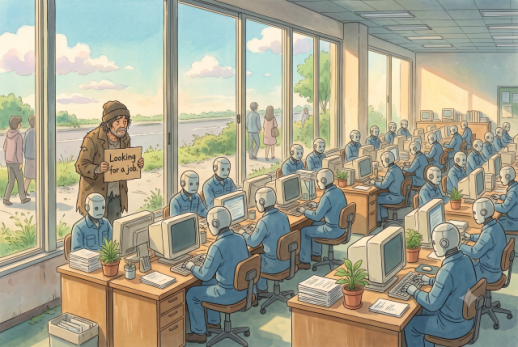 AI to cut 256,000 jobs annually in S. Korea: Report SEOUL, July 22 (AJP) - Artificial intelligence is expected to eliminate roughly 256,000 jobs a year in South Korea within a decade, a report released by the Korea Development Institute showed Wednesday. AI will concentrate pressure on professionals, office workers and sales staff rather than on the manual work that earlier waves of automation displaced. The scale is easier to read against what the institute expects the labor market to do otherwise. In its outlook published earlier this year, the Korea Development Institute (KDI) projected that the number of employed people in South Korea would rise by about 170,000 in each of 2026 and 2027. The AI effect, as estimated, is larger than that annual gain. Nam Chang-woo, a senior research fellow at the state-funded institute, released the findings on July 22 in a report on the macroeconomic effects of AI. The estimated losses amount to 2.1 percent of the employed population as of 2024. The figure comes from a two-step calculation. The researchers first identified jobs exposed to AI automation 10 years from now, then estimated how many of those would be replaced outright, applying quasi-elasticity coefficients drawn from job losses in earlier rounds of production automation. Exposure grows sharply over the period. At present, the share of the economy where AI automation is commercially viable stands at 1.4 percent measured by jobs and 1.8 percent measured by revenue. Within 10 years, the report puts those figures at 8.1 percent and 10.5 percent. The report is not uniformly negative. KDI estimated that the spread of generative AI would raise South Korea's total factor productivity by 1.5 to 3.5 percent over the coming decade, or 0.15 to 0.35 percentage points a year. Total factor productivity measures output gains that cannot be explained by adding more workers or more capital, and economists treat it as the closest available proxy for how efficiently an economy uses what it already has. That figure reflects a multiplier effect. Productivity gains in sectors heavily exposed to AI spread through the rest of the economy by way of supplier and buyer linkages rather than staying where they originate. At the level of individual companies, the effect is larger and more immediate. Combining corporate financial statements with data on AI adoption, KDI estimated that introducing AI raised revenue per permanent employee by about 20 percent, a result the report describes as statistically significant. Wage inequality between occupations is expected to narrow slightly or hold steady as measured by the Gini coefficient. The reason is not that lower-paid workers gain. It is wage compression, with pay growth slowing in the high-wage occupations that AI reaches first. KDI recommended that the government act as a facilitator, drawing in the complementary private investment that AI requires while limiting the employment shock and distributional damage that come with it. In the short term, the report called for expanded support for job redesign and retraining in highly exposed occupations. It also urged the government to lower the entry barrier for small and midsize firms by operating public cloud services and shared GPU centers, and to build a data-sharing platform. Over the longer term, KDI proposed spreading labor-complementing AI solutions through public services and establishing sector-by-sector AI governance frameworks. "We need to run a tripartite consultative body of labor, management and government centered on highly exposed professional occupations to discuss job transitions and wage systems," Nam explained, adding that the social safety net should be strengthened, including by closing the gaps in unemployment benefits that will widen as AI increases non-standard work. 2026-07-22 14:06:58
-
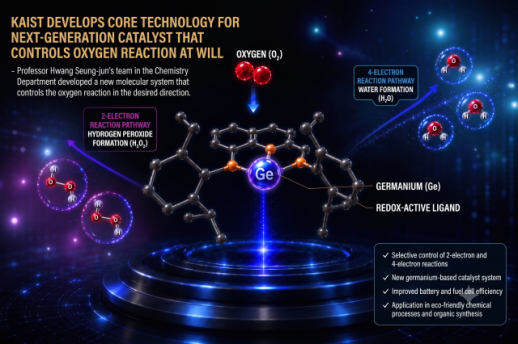 KAIST germanium system switches oxygen reaction pathways SEOUL, July 22 (AJP) - A new molecular system developed in South Korea can be instructed how many electrons to hand over to oxygen, a switch that decides whether a reaction ends in water or hydrogen peroxide and that sits at the center of fuel cell performance, battery chemistry and cleaner industrial manufacturing. Until now, that kind of control has belonged almost entirely to transition metals such as iron, cobalt and nickel. Fuel cells depend on the four-electron route, which turns oxygen into water and releases the most energy. Plants producing hydrogen peroxide want the two-electron route and nothing else. Steering a reaction cleanly down one path rather than the other has been one of the standing problems in catalyst design. The Korea Advanced Institute of Science and Technology (KAIST) said Wednesday that a team led by Hwang Seung-jun, an associate professor in its Department of Chemistry, has demonstrated a single molecular system that can be switched between the two routes on demand. The work appeared online in the journal Chem on July 6. The switch runs on germanium, an element that was not supposed to be capable of this. Germanium sits in the same column of the periodic table as silicon, among what chemists call the main-group elements, the ordinary elements outside the transition metals. Transition metals dominate catalysis because their electron shells let them absorb and release several electrons at a time. Main-group elements normally manage two at most, which is why they have been treated as poor substitutes for reactions involving oxygen. Hwang's team got around that by pairing germanium with a redox-active ligand, a surrounding molecular framework that stores electrons and passes them back and forth. The ligand works as a reservoir. Instead of asking the germanium atom to supply everything on its own, the whole molecule shares the load, and four-electron chemistry becomes possible. Turning the four-electron pathway off proved to be a matter of blocking two electrons at the source. The researchers reacted the germanium compound with iodomethane, attaching a methyl group to the germanium center. That single change shut down the four-electron route and left the reaction running selectively on two electrons. The same platform, structurally modified, produced a different product. Along the way, the team managed to isolate a germanium intermediate that ordinarily forms and disappears within the reaction. The isolated species showed a rare property. A single germanium atom acted as both an electron donor and an electron acceptor, behavior chemists describe as ambiphilic, and it gave the researchers direct evidence of how the switching works rather than an inference from the final products. The compound turned out to do more than react with oxygen. At room temperature and without light, it stripped chlorine and bromine atoms from organic molecules carrying halogens on neighboring carbons, restoring the carbon-to-carbon double bond and regenerating alkenes, the feedstock chemicals behind everything from pharmaceuticals to plastics. That reaction is usually driven by heat or additional processing steps. It also did not occur in the phosphorus version of the same molecule, which has an equivalent electron count, indicating that germanium is not simply a heavier stand-in for phosphorus but has chemistry of its own. "This research shows that catalytic reactions that depended on transition metals can also be achieved with main-group elements such as germanium," Hwang said. He added that he expects the approach to be applied broadly in developing next-generation catalysts for cleaner and more efficient chemical processes, as well as in improving battery and fuel cell performance. The first authors were KAIST postdoctoral researchers Kim Sung-gyu and Oh Jin-rok, with Choi Dae-eui, a combined master's and doctoral student at Pohang University of Science and Technology, where Hwang taught until this year. The National Research Foundation of Korea funded the work through the Ministry of Science and ICT and the Ministry of Education, with additional support from the Samsung Science and Technology Foundation. (Reference Information) Journal/Source: Chem Title: Germanium ligand redox cooperativity: A key to ambiphilicity and switchable two- and four-electron transfer Link/DOI: https://doi.org/10.1016/j.chempr.2026.103127 2026-07-22 10:48:44
-
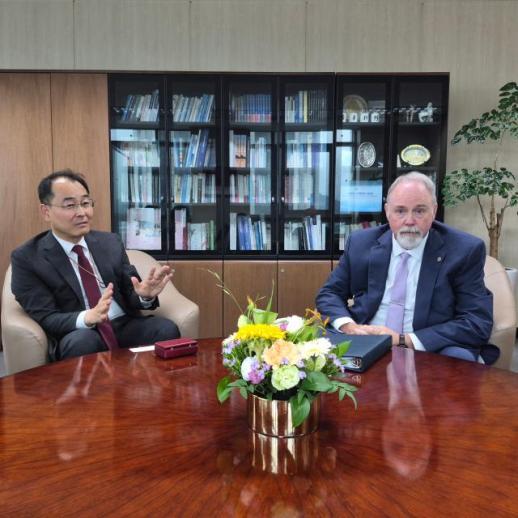 MOFA presses US on immigration harm to Koreans SEOUL, July 22 (AJP) - South Korea's Ministry of Foreign Affairs has asked the United States to ensure Korean nationals do not suffer unintended harm from American immigration enforcement, raising the issue directly with a senior State Department official in Seoul on Tuesday, ten months after a Georgia factory raid that saw more than 300 Korean workers detained and flown home. Park Jong-han, Deputy Minister for Economic Affairs at the Ministry of Foreign Affairs (MOFA), requested a meeting with Jason Evans, US Under Secretary of State for Management, according to a ministry statement released Wednesday. Park asked for American attention and support so that Korean nationals face no "unintended damage or unjust infringement of their rights" in connection with US immigration policy. The language was not chosen casually. "Unjust infringement" is the same phrase President Lee Jae Myung used in September 2025, after US Immigration and Customs Enforcement (ICE) agents raided the Hyundai-LG battery plant construction site near Savannah, Georgia, and detained roughly 475 workers, among them more than 300 Koreans, some led away in handcuffs and leg chains. It was the largest single-site workplace enforcement operation in the history of the US Department of Homeland Security, and it ended with MOFA negotiating the workers' release and a chartered Korean Air jet bringing them home. The raid turned a long-simmering visa problem into a diplomatic wound. Korean companies have committed hundreds of billions of dollars to US manufacturing, yet the engineers and technicians needed to build and launch those plants have no dedicated visa category. Many have entered on short-term business visas or visa waivers that sit uneasily with hands-on installation work, an ambiguity that ICE treated as illegality in Georgia. A bill to create an E-4 visa reserved for Korean professionals, similar to what Australians already hold, remains parked in the House Judiciary Committee. Lee pressed visiting US senators on the issue as recently as this spring. The enforcement climate has only hardened since President Donald Trump began his second term. His executive orders mandate what US Citizenship and Immigration Services describes as strict screening and vetting of foreign nationals seeking entry or immigration benefits, and arrest quotas reported to reach 3,000 a day have pushed agents toward large workplace operations of the kind that swept up the Korean workers. Evans was a fitting audience for the complaint. The undersecretary for management, a career diplomat sworn in shortly after the Georgia raid in September 2025, oversees the State Department's administrative machinery, including the consular bureau that issues visas. Park also told Evans that active people-to-people exchange between the two countries deepens mutual understanding and serves as a core driver sustaining a future-oriented alliance, according to the ministry. MOFA said the government plans to keep strengthening cooperation with Washington across various fields, including personnel exchanges, through the two countries' diplomatic channels. 2026-07-22 09:57:51
-
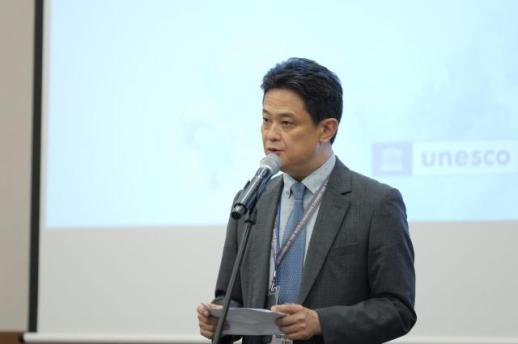 UNESCO adopts heritage strategy for climate-hit island states SEOUL, July 22 (AJP) - UNESCO's World Heritage Committee adopted a new strategy on Tuesday to help small island nations protect cultural and natural heritage that climate change is steadily destroying, a group of countries that hold some of the planet's most distinctive sites but barely register on the World Heritage List, South Korea's Ministry of Foreign Affairs said Wednesday. The scale of the gap is stark. The 39 small island developing states that have joined the World Heritage Convention account for one fifth of its membership, yet together they hold just 37 of the 1,248 sites on the list, about three percent, according to UNESCO's World Heritage Centre. Three of them, Nauru, Niue and Timor-Leste, have no inscribed site and no candidate list at all. Tuvalu shows what is at stake. The Pacific nation of nine coral atolls, where the highest point sits less than five meters above the waves, has watched the sea around it rise at twice the global average over the past 40 years. Half of its capital is projected to flood by 2050, and more than 5,000 residents, nearly half the population, have applied for a climate migration visa to Australia. Last year Tuvalu submitted its first-ever World Heritage bid, an unprecedented attempt to inscribe the cultural landscape of an entire nation, its meeting halls, taro pits and sacred sites, before the ocean claims them. The World Heritage Strategy for Small Island Developing States (SIDS), adopted during the committee's 48th session in Busan, is meant to close that gap. It sets out an eight-year plan to strengthen the capacity of island governments to nominate, manage and defend their heritage. The strategy answers a problem that has been raised for years. SIDS, a group of countries scattered across the Caribbean, the Pacific and the Atlantic and Indian Oceans, were recognized by the United Nations as a distinct category of developing nations in 1992. They face the sharpest edge of climate change while running some of the world's smallest governments. Niue has a population of about 1,300. Tuvalu's entire land area is 26 square kilometers. That smallness is why they have long been overlooked. Getting a site onto the World Heritage List requires years of technical work, nomination dossiers, comparative studies, management plans, that small island bureaucracies rarely have the staff or money to produce. International heritage funding and expertise have tended to flow toward larger developing countries with more sites, more institutions and more diplomatic weight, leaving island states at the back of the queue even as their heritage faces the most immediate threats. To mark the strategy's launch, South Korea's Ministry of Foreign Affairs and the UNESCO World Heritage Centre held a joint side event at the BEXCO convention center in Busan on July 21, bringing together around 10 representatives of island states, including panelists from Mauritius, the Maldives, the Cook Islands and Cuba. Participants discussed climate resilience, governance, policy development and community participation, the pillars of the strategy's implementation, along with ways to strengthen partnerships over the eight-year rollout. Lim Sang-woo, the ministry's Ambassador for Public Diplomacy, welcomed the adoption in his opening remarks. "SIDS possess outstanding cultural and natural heritage, yet they face numerous challenges, including climate change," Lim said. "I hope this event allows diverse views on protecting heritage in the SIDS region to be shared and lays the groundwork for practical cooperation." The strategy's adoption came during the first World Heritage Committee session ever hosted by South Korea, which joined the convention in 1988. Around 3,000 delegates from 196 member states are gathered in Busan from July 19 to 29 to decide new inscriptions and conservation policy. On the session's opening day, the committee adopted the Busan Declaration, a separate consensus document calling for international collaboration to become a guiding principle of heritage protection as climate change, armed conflict and rapid development strain sites worldwide. For Tuvalu, the timing is not academic. If current trends hold, projections show 95 percent of its land flooded by routine high tides by 2100. 2026-07-22 09:27:30
-
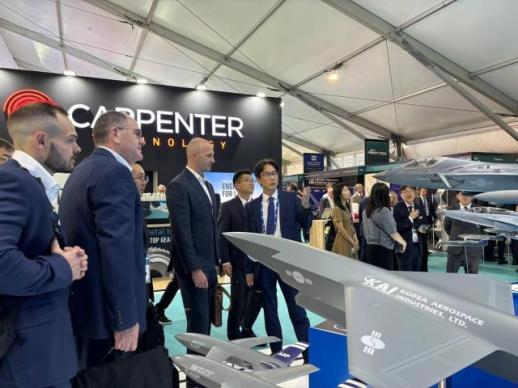 KAI pitches TF-50 for British trainer contract SEOUL, July 21 (AJP) - South Korea's aerospace contractor Korea Aerospace Industries is pitching its TF-50 trainer jet for a Royal Air Force competition that has not yet formally launched, using this week's Farnborough International Airshow in Britain to make its case against rivals with a significant head start. Korea Aerospace Industries (KAI) said Tuesday it is showcasing next-generation air combat systems and aerospace solutions at the airshow, running July 20 to 24, as part of a push into the global market. The event, marking its fortieth edition this year, has drawn 1,500 companies from 41 countries. The Royal Air Force needs to replace its aging Hawk trainer fleet, a requirement the British government's 2025 Strategic Defence Review made explicit, and the Ministry of Defence has committed £360 million ($483.5 million) toward the overhaul, funding that will also cover new aircraft for the Red Arrows aerobatic display team. But the competition to decide which jet gets that money has not formally launched, and KAI is one of several contenders rather than the clear favorite. The leading bid appears to come from Boeing, teamed with BAE Systems and Saab, offering the T-7A Red Hawk with final assembly built in Britain, an advantage that matters because the Defence Review called for the replacement to prioritize British industrial workshare. Leonardo's M-346 and Turkish Aerospace's Hürjet are also in contention. A homegrown design from the British startup Aeralis had been floated as well, but that company has since gone into administration. KAI is instead betting on pedigree. The T-50 family, of which TF-50 is a variant, was designed from the outset as a derivative of the world's favorite jet fighter, the F-16, sharing similar wing geometry, a single-engine layout and cockpit architecture developed with Lockheed Martin, at roughly eighty percent of the F-16's physical size. Air forces that already fly the F-16 have tended to favor it for exactly that reason, since pilots trained on the T-50 family can move into F-16 cockpits with comparatively little relearning. Britain does not fly the F-16, relying instead on the Typhoon and the F-35, so that particular argument carries less direct weight in London than it has in markets where the T-50 family has found buyers. That footprint has grown considerably. The T-50 and FA-50 family now operates in seven countries with roughly 210 aircraft in service, and close to 290 once contracted and in-production units are counted, KAI's largest export presence in its aircraft class. Poland, Indonesia, Malaysia, Iraq, Thailand and the Philippines all fly variants of the jet, and the aircraft is battle-proven, having flown combat missions for the Philippine Air Force during the 2017 Battle of Marawi and, more recently, for Thailand's air force during its December 2025 border conflict with Cambodia. The Philippines has continued expanding its fleet, signing a $700 million deal last year for 12 additional FA-50 Block 70 jets on top of the 12 already in service, bringing its total toward 24 aircraft with deliveries underway. KAI is pairing the TF-50 pitch with FA-50, the light attack variant of the same airframe, aimed more broadly at expanding the company's footprint across Europe. Beyond the trainer competition, KAI used the airshow to lay out a broader vision of where South Korea's combat aircraft ambitions are headed. The company presented an artificial intelligence-based logistics and support system it described as central to future warfare, then put its KF-21 Boramae, a homemade 4.5-generation fighter jet, at the center of its display, flanked by unmanned combat aircraft, a multipurpose drone and a micro synthetic aperture radar communication satellite, framed together as a single manned-unmanned combat network rather than standalone platforms. On the rotary wing side, KAI showed its marine attack helicopter, light armed helicopter and next-generation medium utility helicopter, outlining its concept for how each would be used in future operations. Throughout the run of the airshow, KAI is meeting with senior military officials and executives from partner companies across Europe, the Middle East, Africa and the Americas, marketing its aircraft on NATO interoperability and delivery speed. The company also plans to deepen partnerships with GE, Safran and Martin-Baker, key suppliers of engines, avionics and ejection seats across its aircraft lines. 2026-07-21 17:48:16
-
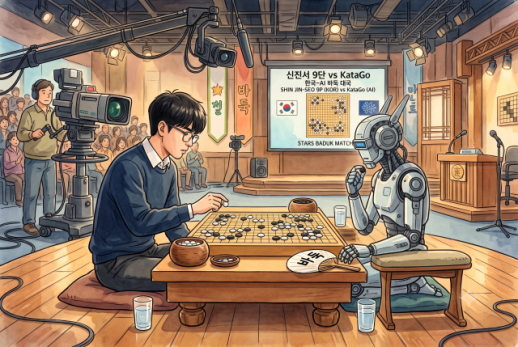 Shin Jin-seo beats KataGo, echoes Lee Se-dol's AI win SEOUL, July 21 (AJP) - Nine years ago, a South Korean Go master sat across a board from a machine that was not supposed to be beatable. On March 13, 2016, in the fourth game of a five-game match against Google DeepMind's AlphaGo in Seoul, Lee Sedol became the only human ever to defeat that particular artificial intelligence, snapping three straight losses along the way. He would go on to lose the fifth game and the series overall, four games to one. But that one win, built around a move at position 78 so unexpected that Go commentators later nicknamed it the "divine move," became one of the defining moments in the early public understanding of what AI could and could not do. Lee retired from professional play in 2019, saying that even the best human could never again claim the top spot in Go, calling AI "an entity that cannot be defeated." Nine years later, another South Korean player picked up where Lee left off, and went further. Shin Jin-seo, the world's top-ranked Go player since 2019 and, at 26, the sport's most dominant active figure, defeated KataGo, one of the strongest Go-playing AI systems in the world, in the deciding third game of a three-game match held Tuesday in Seoul. Since turning professional at age 12 as the youngest player ever to do so in South Korea, Shin has built a career defined by consistency rather than single dramatic upsets. He has held the world number one ranking by rating points continuously since 2019 and has won nine major international titles, including three LG Cups and the 2023 Ing Cup, one of Go's most prestigious world championships. Shin won two games to one, closing out the series with an 11.5-point victory after 221 moves and roughly three hours and twenty minutes of play. The event, called the SSEN and KED Go Match, was staged at a KED TV studio in central Seoul. KataGo is a free, open-source Go program built by American developer David Wu and first released in 2019, three years after AlphaGo's match against Lee. Unlike AlphaGo, which was developed and run internally by Google DeepMind on proprietary hardware, KataGo was designed to reach superhuman strength through self-play alone, learning purely by playing itself millions of times rather than studying human game records, and to do so on far more modest computing power. It has since become one of the most widely used Go engines in the world, adopted by players and researchers alike for its ability to estimate territory and score in addition to simple win probability. The margin of victory, in some ways, was less remarkable than the terms under which it happened. AlphaGo played Lee in 2016 with no handicap at all, meeting him as a true equal on the board. KataGo, by 2025 standards a far more advanced program, needed to give Shin a two-stone head start just to play him even, and still lost the match. Most Go experts had expected Shin would be doing well to win a single game. Instead, he won two. The symbolism was not lost on the Go world. Where Lee's 2016 win stood as a lone flicker of resistance in an otherwise total defeat, a single game salvaged from a series he had no real chance of winning, Shin's performance nine years later looked more like an argument that the gap between human and machine, while still real, had not closed in the AI's favor alone. If anything, the fact that KataGo needed a handicap to stay competitive suggested developers themselves have come to treat an unhandicapped human loss as close to a foregone conclusion, making Shin's win with a head start a different kind of statement than Lee's had been. Shin's road to the win was not smooth. He lost the opening game after being caught off guard early, then rallied to take the second and third. In the deciding game, playing with the two-stone advantage, he entered with a projected win probability of 99 percent, a number that had collapsed dramatically late in each of the two earlier games, at move 70 in game one and move 160 in game two, as KataGo clawed back territory. This time, Shin held that 99 percent probability from start to finish. He had said before the match that he intended to avoid heavy fighting and win on territory instead, a more conservative approach than his usual style. He kept that promise. KataGo opened game three differently than it had the first two, taking an unfamiliar corner point that left Shin thinking for roughly two minutes before he responded. From there, both sides settled into a quiet, territorial contest with little direct confrontation. By move 80, Shin had begun pressing KataGo's white stones and building a large formation of black territory stretching from the upper side of the board toward the center, a foundation that held for the rest of the game. Shin played with five hours on the clock plus one 30-second overtime period. KataGo, running without an overall time limit, was required to move within 20 seconds each turn on a dedicated system built from four Nvidia RTX 3090 graphics cards hosted on the Tygem online Go server. Because KataGo is software, its moves were physically placed on the board by a human proxy, Lee Dan-bi, a professional with the Korea Baduk Association. For the win, Shin received 250 million won, about $169,000, including his match fee, along with a luxury Genesis G90 sedan as a victory prize. 2026-07-21 15:27:22
-
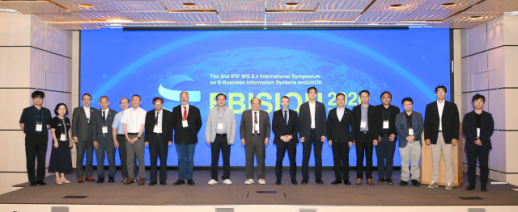 KMU hosts global ICT security symposium, signs 10 partnerships SEOUL, July 21 (AJP) - Kookmin University wrapped up a three-day international symposium on information security and e-business in Seoul earlier this month, walking away with 10 cooperation agreements signed with universities and a company abroad, the university said in a statement on Tuesday. The event, called EBISION 2026, was the second symposium held under Working Group 8.4 of the International Federation for Information Processing (IFIP), a nonprofit that coordinates ICT research across more than 100 countries. It ran from July 8 to 10 and pulled in researchers and industry officials from 11 countries. Over the three days, presenters delivered 91 papers, 50 as oral talks and the rest as posters, and more than half came from outside South Korea. Kookmin University (KMU)'s Yoo Il-sun chaired the symposium. He is a professor in the university's Department of Information Security, Cryptology and Mathematics and also directs its Global ICT Convergence Security Innovation Research Center. At the opening ceremony, President Jeong Seung-ryul told attendees that international joint research and closer industry-academia ties would be needed to keep up with AI-driven digital transformation and advances in quantum technology. Son Jin-sik, the university's vice president for planning, also attended. Six of the 10 agreements were memorandums of understanding, a firmer commitment to work together, and four were letters of intent, an earlier-stage signal that two sides plan to collaborate. Kookmin signed memorandums with National Taiwan University, Asia University, Tunghai University and National Sun Yat-sen University in Taiwan, plus King Mongkut's University of Technology North Bangkok in Thailand and the electronics maker Delta Electronics. The letters of intent went to the Technical University of Denmark, the National Technical University of Athens, the University of Murcia in Spain and Sweden's Luleå University of Technology. The university also used the symposium to talk with Yokohama National University about launching a dual-degree program. Yokohama's vice president, Junji Shikata, was in Seoul to receive the IFIP WG 8.4 Distinguished Lecturer Award, and officials from both schools discussed student exchanges and joint teaching and research while he was there. Keynote and invited sessions featured researchers tied to several of the partner institutions. Delta Electronics chief technology officer Tei-Wei Kuo spoke on AI-driven digital transformation, and Nicola Dragoni of the Technical University of Denmark and Antonio F. Skarmeta of the University of Murcia covered cyber threat intelligence. Manos Varvarigos, a vice president at the National Technical University of Athens, presented on next-generation network architecture and security for high-performance computing. Eight companies took part in an industry session, including KT, Japan's ZenmuTech, China's Sangfor and Taiwan's AI DataBrushing, each giving technical presentations and live demonstrations. KT laid out what it calls a four-layer network security framework built for the AI and quantum era. "Researchers and industry figures in e-business information systems and ICT convergence security shared their main findings and technology trends at this symposium," Yoo said. "We will build on the memorandums and letters of intent signed during the event to develop concrete international joint research and industry-academia projects." 2026-07-21 11:07:16
-
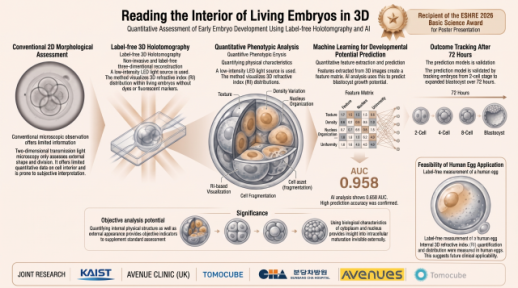 KAIST embryo scan technique wins global fertility science award SEOUL, July 21 (AJP) - A South Korean research team has developed a way to look inside living eggs and embryos in three dimensions without damaging them, a technique fertility specialists say could sharpen how doctors choose which embryos to implant during in vitro fertilization. The Korea Advanced Institute of Science and Technology (KAIST) said Tuesday that the work won the Basic Science Award for Poster Presentation at the European Society of Human Reproduction and Embryology (ESHRE) 2026 annual meeting, held in London from July 5 to 8. The prize goes each year to the single strongest basic-science poster at the world's largest reproductive medicine conference, which drew more than 10,000 participants. Judges shortlisted five finalists from the submitted abstracts, then decided the winner after live poster presentations and questioning. The winning research came from a team led by Park Yong-keun, a physics professor at KAIST, with postdoctoral researcher Lee Chung-ha presenting the findings in London. The team paired time-lapse imaging, which follows living cells continuously without harming them, with a three-dimensional scanning method to predict early on whether an egg or embryo is likely to develop. The success of IVF often comes down to picking the right embryo. Doctors now rely mainly on two-dimensional microscope images, weighing shape, size and how the cells divide to judge which embryos have the best chance of implanting. Because those embryos may later be transferred into a patient, doctors cannot use dyes or fluorescent markers that could alter or damage them, which leaves embryologists dependent on visual judgment calls that are hard to standardize. Park's team turned to a technique called holotomography, which measures how light bends as it passes through a cell to build a three-dimensional map of its inner structure, all without staining or otherwise disturbing the living tissue. The method also captures the refractive index, a reading of how densely packed and what kind of material sits inside a cell, letting researchers spot fine internal differences that ordinary imaging misses. Testing the approach on mouse embryos, the team found that embryos less likely to reach the blastocyst stage, the point at which a fertilized egg has divided enough to prepare for implantation in the uterus, tended to show a more uneven spread of refractive index inside their cytoplasm. Tracing that unevenness in mouse eggs, the researchers linked the brightest, highest-refractive areas to lipid droplets, the small fat-storing structures scattered through the cytoplasm. The team then tried the same imaging and analysis on human eggs, not to predict how they would develop but to confirm the method could work at all beyond a mouse model. It did. The researchers captured three-dimensional refractive index maps of human eggs and put numbers to the same textural patterns, some of which again traced back to lipid droplets. But not every feature matched across species. Mouse and human eggs differ in size and internal makeup, so similar-looking optical signatures may not carry the same biological meaning. The researchers called the human trial a feasibility check rather than a proven predictive tool, and cautioned that markers developed in mice should not be applied directly to human eggs. The project brought together KAIST's physics department, the fertility center at CHA Bundang Women's Medical Center under professor Kim Ji-hyang, the London fertility clinic Avenues and Tomocube, a holotomography equipment maker Park co-founded. Findings from the mouse embryo and mouse egg studies have been posted as preprints and are under peer review at international journals. "This award matters because it recognizes the academic value of a new approach that lets us analyze living eggs and embryos in three dimensions, quantitatively, without damaging them," Park said. "We are now validating the method using human cells, and we will keep developing it into an objective, accurate evaluation technology that can help raise the success rate of infertility treatment." (Reference Information) Journal/Source: Preprint Title: Label-free 3D subcellular phenotyping of mouse embryos by holotomography enables early prediction of blastocyst formation Link/DOI: https://doi.org/10.1101/2024.05.07.592317 Journal/Source: Preprint Title: Holotomography reveals biophysical remodeling of mouse oocytes during post-ovulatory aging Link/DOI: https://doi.org/10.64898/2026.06.18.733271 2026-07-21 09:41:05
-
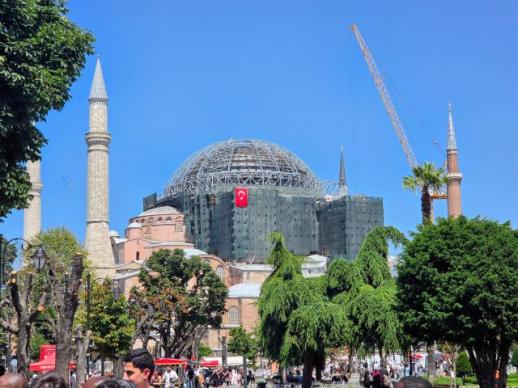 Five centuries of standing in between makes Türkiye indispensable SEOUL, July 20 (AJP) - There is a reason the only direct peace talks between Russia and Ukraine in four years of war have happened in one city, and that city is Istanbul. Earlier this month, NATO leaders gathered in Ankara for the first summit the alliance has ever held in the Turkish capital. The choice of venue was not a courtesy. It was an acknowledgment that the country long treated as the alliance's difficult southeastern flank has become something closer to its hinge. To understand why, it helps to look past the headlines and at a much older habit. Türkiye has spent most of its history as the country in between. Istanbul was the capital of Christian Byzantium for a thousand years before it became the seat of the Islamic caliphate for nearly five hundred more. Hagia Sophia has been a cathedral, a mosque, a museum, and a mosque again, and the city has somehow absorbed each conversion without losing itself. The Ottoman Empire governed Greeks, Armenians, Jews, Arabs, and Slavs under a system that let each community keep its own courts, schools, and houses of worship. When Spain expelled its Jews in 1492, the sultan sent ships to collect them. None of this was modern liberalism. It was something more durable: the practical knowledge that a state straddling two continents survives by holding differences together rather than resolving them. That knowledge came at a price, paid mostly at home. The republic that Mustafa Kemal Atatürk built from the empire's ruins has spent a century arguing with itself about what it is: secular or religious, European or Middle Eastern, democratic or strong-handed. The argument has repeatedly turned violent. The military overthrew governments in 1960, 1971, and 1980, and pressured another from office in 1997. In July 2016, a faction of the armed forces bombed the parliament and fired on citizens. 253 people died stopping them. I spent last week in Istanbul interviewing survivors of that night, and what struck me was not their anger but their vocabulary. A businessman who lost part of his foot to a bullet told me that everyone living on Turkish soil is his family. The purges that followed the coup swept up tens of thousands and drew lasting criticism from Europe, and the wound is not closed. A country that has nearly torn itself apart this many times does not romanticize division. It learns to manage it. That learned reflex is now worth a great deal, because Türkiye's neighborhood is on fire on two sides. To the north, the war in Ukraine grinds into its fifth year. Ankara has armed Kyiv with drones, closed the Turkish straits to warships, and affirmed Ukraine's territorial integrity, while refusing to join sanctions on Moscow and keeping its channels to the Kremlin open. Western capitals once called this fence-sitting. They call it something else now that it has produced the grain deal that fed markets across Africa and Asia, the largest prisoner exchanges of the war, and the only venue both sides will accept. Just last week, Türkiye's foreign minister stood in Kyiv proposing a truce covering the Black Sea and energy infrastructure, an interim step no other government is positioned to broker. To the southeast, this year's war between Israel, the United States, and Iran left Türkiye in a position no other NATO member occupies: alliance air defenses shot down Iranian ballistic missiles crossing Turkish airspace even as Ankara kept talking to Tehran. The radar at Kürecik in eastern Türkiye is the front line of Europe's missile defense against Iran. Remove Türkiye from the map, and Europe's early warning starts a thousand kilometers further west. The European Union has kept Türkiye's membership application frozen for decades, with reasons ranging from principled to reflexive. Yet the continent now finds it needs the country it would not admit. America's rethinking of its security guarantees has left Europe rearming in a hurry, and the arithmetic is uncomfortable. Türkiye fields NATO's second-largest army, will command the alliance's rapid reaction force from 2028, and has grown its defense exports from under $2 billion a decade ago to a projected $11 billion this year, with its drones already embedded in European arsenals. In Ankara, alliance members announced more than $50 billion in new procurement and pledged roughly $80 billion in military support for Ukraine in 2026. Brussels still debates whether to open its new defense programs to a non-member it does not fully trust. Ankara warns that a European security architecture built without Türkiye will protect less of Europe. On the evidence of the past four years, the warning is hard to dismiss. Critics have a sharper word for all this balancing, transactionalism, the accusation that Ankara simply sells its position to every side. I would suggest the older word is better. What looks like playing both sides is, in the long Turkish habit, openness, the refusal to let any single identity, bloc, or patron claim the whole country. A state that contained Orthodox Christians and Sunni Muslims for five centuries does not find it strange to host Russians and Ukrainians at the same table. A society that argues perpetually about religion and secularism is not scandalized that the world disagrees with itself too. This openness has hard limits, and Türkiye's own citizens know them best; the decade since the coup has tested civil liberties at home even as flexibility flourished abroad. But the leaders of the Western alliance, having just left Ankara, might consider that the ally they have found hardest to categorize is valuable for precisely that reason. In a world splitting into camps, somebody has to stand in between. Türkiye has had five hundred years of practice. 2026-07-20 16:03:27
-
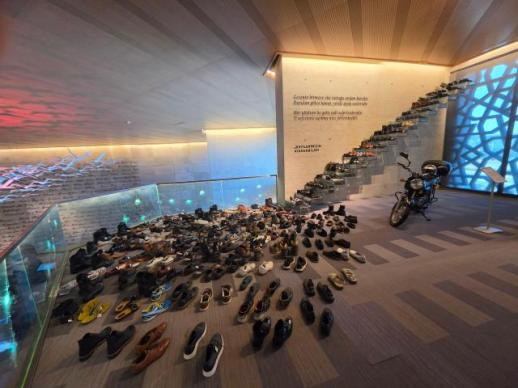 Türkiye's coup resisters carry wounds, no regrets SEOUL, July 20 (AJP) - Ten years after a faction of the Turkish military tried to seize power on the night of July 15, 2016, the civilians who poured into the streets to stop it still carry the marks of that night, in bone, in memory, and in the quiet routines of family life. Mehmet Emin Ertaş, a 47-year-old businessman, is missing the metatarsal bone in his right foot, taken by a bullet as he ran toward soldiers firing on the crowd. Elvan Alkılıç, a 36-year-old housewife, spent the night at home with a three-month-old baby while her husband was shot through the arm and head on the Bosphorus bridge. Both spoke to Aju Press on July 17 at the July 15 memorial museum in Istanbul, days after Türkiye marked the 10th anniversary of the failed coup. The attempt was the bloodiest in modern Turkish history. Rebel soldiers blocked the Bosphorus bridge, fighter jets bombed the parliament building in Ankara, and tanks rolled through Istanbul. President Recep Tayyip Erdoğan, reached by video call on live television, urged citizens into the streets. Thousands went. By morning the coup had collapsed, and the government counted 253 dead, most of them civilians. Their names were read aloud at this year's anniversary ceremony. The Turkish government blames the coup on followers of Fethullah Gülen, a cleric who lived in self-imposed exile in the United States from 1999 until his death in Pennsylvania in October 2024. Ankara designates his movement a terrorist organization under the name FETÖ, short for Fethullahist Terrorist Organization, and has purged tens of thousands of suspected members from the military, judiciary, and civil service since 2016. Gülen denied any role in the coup until his death, and his followers reject the designation. Ertaş was at home with his wife and three children when the shooting began. He does not describe hesitating. "If I do not have a country, my life is not important either," he said. "We are a nation in love with freedom. As the Turkish nation, we either have our freedom, or we have no life." What he saw on the street stays specific. A friend beside him was shot in the leg and fell. Another man was shot in the chest, and the crowd laid a Turkish flag on his back after he died. A third was killed by a shot through the left eye, and a fragment struck Ertaş in the face. He kept running, he said, reciting the Islamic declaration of faith, a flag draped over his own back, until a bullet found his foot about 15 meters from the soldiers' line. "I don't have my right foot's metatarsal bone," he said. "But I have my Crescent and Star flag." The wound made Ertaş a gazi, the Turkish honorific for one wounded in the service of the nation, a status the state extended to civilians hurt resisting the coup. It comes with a pension, healthcare, and public honor, and it carries deep historical weight; Mustafa Kemal Atatürk, the republic's founder, bore the same title. Its counterpart is şehit, or martyr, the one who dies. "I wanted to be a martyr, but I was granted the status of a gazi," Ertaş said. "May God never show us those days again." The title sits oddly on him, and he knows it. Ertaş never served in the military. He paid 30,000 liras under Türkiye's paid exemption system, which allows some men to skip conscription. "I think I am the only one who did not go to the military but became a gazi," he said. He refuses to call the men who fired on the crowd soldiers at all. "They were thieves who stole military uniforms," he said, using the word Mehmetçik, the affectionate Turkish term for the common soldier, to describe what the putschists were not. "When the state needs it, we are all Mehmetçik." Asked about foreign criticism that Türkiye's punishment of the plotters has been too harsh, Ertaş did not soften. Turkish courts have handed down hundreds of life sentences in mass trials since 2016, and some Western governments and rights groups have said the crackdown swept up people with no connection to the coup. "My personal conviction is that anyone who betrays their own country, wherever they are in the world, whoever they are, should be executed in the first degree," he said. Türkiye abolished the death penalty in 2004 as part of its bid to join the European Union, and no coup convict has faced execution. Alkılıç experienced the night from the other side of the door. Her husband Ahmet, an architect who stands 1.93 meters tall, left their Istanbul home after the first reports of tanks in the streets. Her own relatives were away at a summer house, leaving her alone with three children, the youngest three months old. "I said, please don't go," she recalled. "He said, don't worry, I will come back. But my phone's battery is dead, don't be scared. I said okay, but I already had a bad feeling." Ahmet reached the Bosphorus bridge, where rebel soldiers had opened fire on the gathering crowd. In the second volley, a bullet passed through his arm and his head as he dove for cover. Thirty-four civilians were killed on the bridge that night, according to the indictment later filed against the soldiers there. The bridge has since been renamed the July 15 Martyrs Bridge. At home, Alkılıç knew none of this. When low-flying F-16s shook the house like an earthquake and her eldest son woke asking where his father was, she told him a small lie. "I said, son, go back to sleep, your dad went to buy baby formula for your sibling," she said. "He went to sleep like that." Ahmet survived, but the first five months were the hardest. The head wound took his speech. "He could not speak. My husband was speaking like a baby," Alkılıç said. "It took one or two years of our lives." He recovered and works again as an architect. The children are now 18, 14, and 10. What remains is physical memory: when fighter jets pass low near the airport, she said, her skin still prickles. Asked whether she ever wished she had stopped him, she said the family has settled the question differently. If it happened again, she said, they would not split up. "Now we all go out together," she said. 2026-07-20 13:49:54