

Journalist
Park Sae-jin박세진
swatchsjp@ajupress.com
Assistant EditorForeign embassies in Seoul & Geopolitics, Diplomacy, Policy
Experienced journalist and editor at AJU PRESS specializing in multilingual news. I cover international diplomacy, geolpolitics, and policy, consistently delivering highly accurate, compelling reporting for a worldwide audience.
"Reporting the facts. Shaping the narrative. Every second counts."
Latest by Park Sae-jin
-
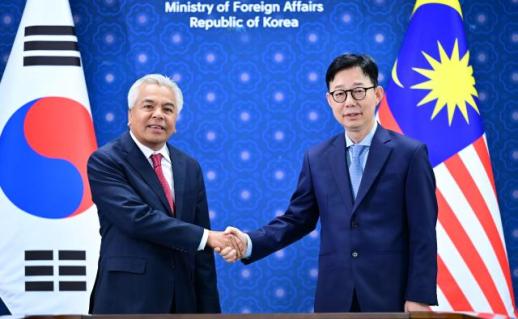 S. Korea, Malaysia deepen energy cooperation after Hormuz shock SEOUL, July 09 (AJP) - South Korea and Malaysia agreed to strengthen energy security cooperation, from stable liquefied natural gas supplies to potential nuclear power collaboration, as Seoul works to shore up supply lines battered by this year's war in Iran and the closure of the Strait of Hormuz. The stakes for South Korea are hard to overstate. The country routes about 70 percent of its crude oil imports through the strait, and the effective blockade that began in late February left 26 South Korean-flagged vessels stranded in the Persian Gulf, sent the KOSPI to its worst single session on record and pushed the won to a 17-year low. Even after Iran and the United States announced a ceasefire on April 8, traffic through the strait has remained far below prewar levels. Malaysia, South Korea's second-largest LNG supplier, ships its gas across sea lanes that bypass the chokepoint entirely, which has turned a longstanding trade relationship into a strategic asset. That backdrop framed the 10th South Korea-Malaysia Policy Consultation, held Wednesday in Seoul between First Vice Foreign Minister Park Yoon-joo and Amran Mohamed Zin, secretary general of Malaysia's Ministry of Foreign Affairs. Agreeing that disruptions to global energy supply chains have made reliable partners more important than ever, the two sides committed to keeping LNG and petroleum product trade stable and to pursuing strategic cooperation, including on nuclear power, according to South Korea's Ministry of Foreign Affairs. The relationship runs both ways: South Korea is the second-largest buyer of Malaysia's refined petroleum products. Trade was the other forward-looking item. The two vice ministers said they are working closely toward signing a bilateral free trade agreement within the year, expecting the pact to expand trade and lay the institutional groundwork for cooperation in new industries, including artificial intelligence and digital technology, halal products, green industry and biotechnology. Defense cooperation, meanwhile, keeps producing concrete results. Park pointed to Malaysia's adoption of the FA-50 light combat aircraft in 2023 and its purchase of the Haegung ship-based interceptor missile in April, and the two sides noted that a joint defense industry committee is being pursued this year on the foundation of an existing defense cooperation memorandum. Both deals carry weight beyond their price tags. The FA-50 contract, signed in February 2023 between Malaysia's Ministry of Defence and Korea Aerospace Industries, covers 18 aircraft for about $920 million and ranks among the largest defense acquisitions in Malaysian history. The Korean jet beat out India's Tejas, Pakistan's JF-17, Russia's MiG-35 and Türkiye's Hurjet in the tender, marking the fourth Southeast Asian aircraft sale for Korea Aerospace Industries (KAI) after Indonesia, the Philippines and Thailand. First deliveries are due this year, with the Royal Malaysian Air Force expecting six aircraft by the end of 2026 instead of the four originally planned, and KAI has said a follow-on order for 18 more is likely. The Haegung deal, though smaller at $94 million, was a milestone for South Korea's missile industry. Signed at the Defence Services Asia exhibition in Kuala Lumpur on April 22, it marked the first overseas export of the ship-to-air interceptor, developed from 2011 under the state-run Agency for Defense Development and mass-produced by LIG Nex1, now LIG Defense & Aerospace, since 2019. Designed to shoot down incoming anti-ship missiles and aircraft, Haegung will arm the Royal Malaysian Navy's new littoral mission ships being built by Turkish shipbuilder STM. Park described Malaysia as a longtime friend and strategic partner, and called for cooperation that ordinary citizens in both countries can feel. Amran stressed people-to-people exchange through tourism and education, saying he hopes more South Koreans will visit during Visit Malaysia Year 2026. Travel between the two countries has been growing: about 330,000 Malaysians visited South Korea last year, up from 240,000 in 2023, while about 460,000 South Koreans traveled to Malaysia, according to the Korea Tourism Organization. Park asked for Malaysia's support in concluding a mutual driver's license recognition agreement within the year to make visits easier. The two sides also exchanged views on the Korean Peninsula and regional affairs. Park thanked Malaysia for its cooperation as ASEAN chair last year and asked for continued support in implementing Seoul's vision for a comprehensive strategic partnership with the bloc. Amran expressed support for the South Korean government's policy and efforts for peaceful coexistence on the Korean Peninsula, and the two agreed to maintain close communication for regional peace and stability. 2026-07-09 08:50:11
-
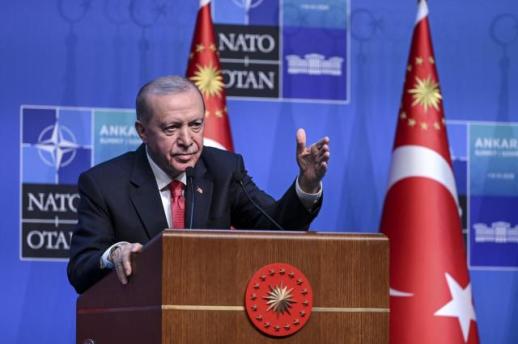 Türkiye emerges stronger from Ankara NATO summit SEOUL, July 09 (AJP) - Türkiye closed out the first North Atlantic Treaty Organization summit ever held in its capital on Wednesday with its standing in the alliance visibly enhanced, as President Recep Tayyip Erdogan pointed to progress on F-35 fighter jets, a thaw in relations with Washington and a defense industry that he said now outpaces many allies. "We have successfully concluded our NATO summit, which we hosted in our country for the second time in 22 years and for the first time in our capital, Ankara," Erdogan said at a news conference after the two-day gathering at the Beştepe Presidential Complex. "This historic summit, which we hosted at a time when Euro-Atlantic security is being tested, has been conducted in a manner that will shape our common future." The summit itself produced substantial commitments. Allies pledged 70 billion euros, about $80 billion, in military equipment, assistance and training for Ukraine in 2026, and announced more than $50 billion in new procurements at the North Atlantic Treaty Organization (NATO) Summit Defence Industry Forum, according to the alliance. Members also agreed to a 27 billion euro investment to modernize fuel storage and pipeline infrastructure extending to the eastern flank, while European allies and Canada reported raising core defense spending by more than $139 billion since last year's summit in The Hague, a jump of nearly 20 percent. For the host, however, the most consequential developments came on the sidelines. Erdogan said US President Donald Trump has taken a "positive approach" toward delivering F-35 fighter jets to Türkiye, more than six years after Washington suspended the country from the program over its purchase of the Russian S-400 air defense system. Ankara has long argued that the two systems do not conflict and that its suspension violated the program's rules. "Mr. Trump actually has a positive approach toward Türkiye on the F-35 issue. Hopefully, when the F-35s are delivered to Türkiye, the whole world will say, 'America kept its promise,'" Erdogan said. Asked whether Washington had linked a possible F-35 sale to the S-400 issue, Erdogan declined to elaborate. "Keep watching us," he replied. The Turkish president also said US sanctions against Ankara are no longer being enforced. "At the moment, the United States is not applying any sanctions against us. To a large extent, they have been lifted," he said, adding that senior Turkish officials including the defense minister, foreign minister and chief of the general staff had confirmed this firsthand. Momentum extended to Türkiye's flagship domestic aircraft program. Erdogan said Trump expressed support for the sale of F110 jet engines, manufactured by General Electric, to power the KAAN fighter jet, an indigenous program launched in 2016 to reduce reliance on foreign military equipment. The Trump administration has reportedly notified Congress of a proposed engine sale valued at more than $700 million. The two leaders also discussed joint naval construction, including frigates, corvettes and submarines, which Erdogan said Turkish shipyards are fully capable of building. "It was a very, very productive meeting," Erdogan said of his talks with Trump, noting that the US president "left the press conference very happy." He added that Trump responds within 24 hours whenever Ankara reaches out. Erdogan framed the warming ties as recognition of the capabilities Türkiye built largely on its own. He said the country never enjoyed the post-Cold War peace dividend that many European states did, instead contending with regional crises and terrorism for decades. "There were times when we were left alone and treated unfairly. Therefore, we often had to rely on our own capabilities," he said. "Today, in terms of defense spending, military capabilities and the defense industry that underpins them, we are well ahead of many allies." The numbers back up an expanding role. Türkiye commands NATO's second-largest land army and has anchored the alliance's southeastern flank for decades. Turkish F-16s will deploy to Estonia in August as part of NATO's Air Policing mission, Ankara will lead the Kosovo Force until September 2026 and the country is scheduled to command the NATO Response Force in 2028 and 2029. Addressing alliance leaders, Erdogan said Türkiye has taken steps to raise defense spending to 3.5 percent of gross domestic product before 2030 and ranks among the world's top 10 countries in defense production and export capacity, according to the Embassy of Türkiye in Seoul. He singled out drone maker Baykar as proof of that rise. "They are receiving very serious orders from around the world and continue to do so. This shows that our unmanned aerial vehicles and armed drones have found acceptance globally," Erdogan said. He also promoted the Steel Dome, Türkiye's integrated air defense project, saying it strengthens both national and alliance defenses. "If others have different domes, we also have the Steel Dome," he said. Erdogan pressed allies to remove what he called lingering barriers to defense trade within the alliance. "Although some obstacles to defense industry trade among allies have decreased, they still exist. These restrictions must be removed as soon as possible, without conditions," he said. In his address to alliance leaders, he warned that excluding non-European Union allies from European defense cooperation would create an artificial division within Europe, and at his press conference, he repeated that EU defense initiatives must complement NATO rather than duplicate it. He brushed aside criticism of a potential F-35 sale from Israeli Prime Minister Benjamin Netanyahu and Greek Prime Minister Kyriakos Mitsotakis. "A country can buy and sell defense equipment. Türkiye is already producing these systems, and alongside producing them, it also has the right to buy them," he said. On Greece, however, he struck a conciliatory note, welcoming Mitsotakis' expressed desire to resolve maritime disputes in the Aegean Sea. "Let us sit down, talk and resolve the issue," he said. On Ukraine, Erdogan said the war has become one of attrition, "claiming tens of thousands of casualties every month," and renewed Türkiye's offer to host negotiations, having brokered earlier rounds of talks between Moscow and Kyiv in Istanbul. "There are no losers in a just peace. I would like to reiterate that we are ready to bring the parties together once again in Türkiye," he said. He also expressed support for Trump's vision for peace in Ukraine, according to the embassy. He said he repeatedly pushed Gaza onto the summit agenda, citing more than 73,000 Palestinian deaths, and pointed to nearly 5,000 deaths in Lebanon since March 2 from continuing Israeli attacks. "Our region can tolerate neither new tensions nor new conflicts. On the contrary, like air and water, humanity needs peace, tranquility and stability," he said. Türkiye stands ready to contribute to clearing mines in the Strait of Hormuz, he told alliance leaders. Erdogan met Trump as well as the leaders of Canada, Finland, France, Germany, Italy and the United Kingdom on the summit's sidelines, and Syrian President Ahmed al-Sharaa was also in Ankara. He said he would keep pressing European leaders on Türkiye's EU accession, telling German Chancellor Friedrich Merz that "making Türkiye wait for 53 years is an injustice." Türkiye will host two more major international gatherings this year: the 13th Summit of the Organization of Turkic States in Ankara on Oct. 29 and 30, and the COP31 United Nations climate summit in Antalya from Nov. 9 to 20. 2026-07-09 08:24:58
-
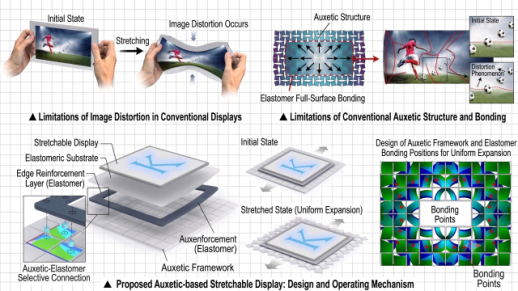 KAIST builds stretchable display that expands without image distortion SEOUL, July 08 (AJP) - South Korean researchers have developed a stretchable display platform that expands evenly in every direction when pulled, keeping text and images in their original proportions instead of squashing them, a problem that has held back screens designed to stretch like rubber. The Korea Advanced Institute of Science and Technology (KAIST) said Wednesday that a team led by Yoo Seung-hyup, a professor in its School of Electrical Engineering, developed the platform jointly with Moon Han-ul's team at Dong-A University in Busan. The work was published in the journal Nature Communications on June 10. Display makers have already moved screens from flat panels to foldable and rollable forms, and stretchable displays are widely seen as the next step. Samsung Display and LG Display have both shown stretchable prototypes in recent years. The obstacle is physical. The rubbery substrates that give a screen its stretch behave like any elastic sheet, narrowing in one direction when pulled in the other, so a stretched map or photograph ends up flattened and distorted. Engineers have tried to fix this with auxetic structures, mechanical frameworks that do the opposite of ordinary materials by growing wider as they are pulled longer. But bonding an auxetic frame across the entire surface of an elastic substrate created a new problem. The frame's individual cells rotate as they expand, and that twisting is transferred directly into the substrate, so while the screen's overall proportions are held, the letters and pictures inside it still warp. KAIST and Dong-A team's answer was to stop gluing the two layers together everywhere. Instead, the researchers calculated the specific points where the auxetic frame should connect to the substrate and bonded only there. With the connection sites chosen correctly, every region of the screen moves outward evenly from its own position, so the display expands uniformly from the smallest patch of pixels to the full panel. The team also introduced a way to measure the problem it was solving. Stretchable displays have typically been judged on how far they stretch and whether their circuits survive, not on how faithfully the image holds its shape. The researchers defined a statistical metric, the isotropic expansion factor, that scores how closely a stretched screen matches ideal uniform expansion, and used it to compare designs and find the least distorting configuration. To test the platform, the researchers printed text and images on substrates and stretched them repeatedly in both directions. Patterns on conventional substrates deformed in places, while those on the new platform held their shape. The team then built a working display by mounting an array of LEDs on the platform. The screen stretched 15 percent in each direction while current kept flowing and brightness held steady, and after repeated stretching cycles, brightness dropped by less than 2 percent. "For stretchable displays to be used as actual information display devices, they must not only stretch well but also preserve on-screen information accurately during stretching," Yoo said. "This platform enables uniform expansion from small areas of the screen to the entire display, and will serve as a key foundational technology for accelerating the commercialization of high-quality stretchable displays." The researchers said the design could eventually reach wearable devices, electronic skin, medical biosensor patches, soft robots and curved displays for cars and aircraft, applications where a screen must deform without garbling the information it shows. Commercialization will depend less on the display elements themselves than on manufacturing, they said, including processes for producing large auxetic frames uniformly, aligning and bonding them precisely to elastic substrates, and proving the connection points survive repeated pulling and touching. KAIST researchers Kim Su-bon and Kim Jun-ho led the study as co-first authors, with Yoo and Moon serving as co-corresponding authors. (Reference Information) Journal/Source: Nature Communications Title: Hybrid auxetic metamaterial platforms enabling multiscale isotropic expansion for distortion-free stretchable displays Link/DOI: https://bit.ly/4pbo4jB 2026-07-08 10:31:56
-
 South Korea, U.S., and Japan Form Alliance for Small Modular Reactor Exports South Korea, the United States, and Japan have joined forces to export small modular reactors (SMRs). The three countries, which have previously competed in nuclear power bids, are now collaborating to target the world's fastest-growing energy market.On July 7, during the NATO summit in Ankara, Turkey, South Korean Foreign Minister Park Jin, U.S. Secretary of State Marco Rubio, and Japanese Foreign Minister Toshimitsu Motegi signed a memorandum of cooperation (MOC) to enhance trilateral collaboration. The agreement focuses on deploying SMRs in third countries, starting with the Indo-Pacific region. According to the U.S. State Department, the U.S. will invest over $10 million in a program to technically support the introduction of nuclear power in Indo-Pacific nations.From the perspective of South Korea's nuclear industry, this agreement formalizes a trend that has been developing for months. Instead of competing directly with U.S. reactor design capabilities and Japan's industrial strengths, the countries will share roles.What makes SMRs so appealing to these nations? SMRs are smaller reactors that produce significantly less electricity than traditional large reactors, typically generating 300 megawatts or less compared to over 1,000 megawatts for larger plants. Developers argue that because SMR components can be manufactured in factories and assembled on-site, they can reduce construction time and initial costs. This contrasts with the frequent cost overruns that have plagued large nuclear projects in the West. However, the commercial viability of SMRs has yet to be proven, as no SMRs are currently operational in the West, with the first unit under construction in Canada.The strategic potential of this incomplete technology has been enhanced by artificial intelligence (AI). AI models require massive data centers that consume electricity around the clock. The International Energy Agency (IEA) projects that global data center electricity consumption will nearly double from 485 terawatt-hours in 2025 to 950 terawatt-hours by 2030, accounting for about 3% of total global electricity demand. A single large AI data center consumes as much electricity as 100,000 households. Meeting this continuous demand solely with wind and solar energy is challenging, and new gas power plants often face years of delays in connecting to the grid. This is why nuclear power, particularly SMRs that can be located next to data centers, is gaining attention.Big tech companies are already taking action. Google signed its first commercial SMR power purchase agreement with U.S. developer Kairos Power in October 2024, while Amazon and Microsoft are also investing in nuclear power. According to the IEA, the size of conditional power purchase agreements between data center operators and SMR projects has expanded from 25 gigawatts at the end of 2024 to 45 gigawatts currently. IEA Executive Director Fatih Birol stated, "Without energy, there is no AI," emphasizing that countries providing stable and affordable electricity will lead the way.The Ankara agreement aims for the three countries to jointly pursue this market. The South Korean Foreign Ministry stated that this cooperative framework seeks to reduce business development risks, achieve economies of scale, attract private investment, streamline licensing, and optimize supply chains. Partner countries will be required to meet high standards for nuclear safety and non-proliferation. Although not explicitly stated, the agreement is clearly aimed at countering Russia's Rosatom and China's state-owned nuclear companies, which have dominated nuclear exports to developing countries.The strengths of the three countries do not overlap. The U.S. leads in reactor design, Japan contributes through joint ventures like GE Hitachi Nuclear Energy, and South Korea has a supply chain centered around Doosan Enerbility, which has completed the Barakah nuclear power plant in the United Arab Emirates and supplies components and modules to U.S. SMR developers like NuScale Power.Industrial cooperation is already visible. Alongside the ministerial signing, the U.S. State Department announced an industry initiative involving GE Vernova, Hitachi, Samsung C&T, and SGE to deploy the SMR 'BWRX-300' across Europe. Samsung C&T, a construction subsidiary of the Samsung Group, formed a strategic alliance with GE Vernova Hitachi Nuclear Energy in October 2022 to jointly build this 300-megawatt reactor in global markets outside North America. Last week, this collaboration expanded further, with Polish developer SGE announcing plans to build 14 BWRX-300 units at three sites in the UK, with a project value of approximately $47 billion.This cooperative framework is particularly noteworthy given the intense competition that has existed. Korea Hydro & Nuclear Power has been embroiled in a nearly decade-long intellectual property dispute with U.S. firm Westinghouse. The contention centered on the technology roots of South Korea's flagship export reactor, the APR1400, casting a shadow over South Korea's export efforts. The two sides reached a comprehensive agreement in January 2025, but the terms were challenging. According to the Korea Herald, Korea Hydro & Nuclear Power agreed to purchase $650 million worth of equipment and services from Westinghouse for each reactor exported and pay $175 million in royalties, with bidding restrictions in place for the European Union, the UK, Japan, and Ukraine, excluding North America and the Czech Republic. This 50-year agreement also grants Westinghouse the right to verify the technological independence of South Korean companies before they bid on overseas projects, including SMRs.As a result of this agreement, Korea Hydro & Nuclear Power secured a contract for two large reactors in the Czech Republic worth $18.6 billion in June 2025, marking its first overseas nuclear project since 2009. However, the deal faced criticism domestically for being overly concessionary. The trilateral framework now offers a different calculation. If South Korea, the U.S., and Japan bid as a team instead of competing against each other, the burdens of licensing restrictions that have constrained South Korea's solo bids would lessen, making a combined proposal more appealing to potential buyers.Meanwhile, Korea Hydro & Nuclear Power is pursuing an independent path. It is developing its own design, the Innovative SMR (i-SMR), with the goal of obtaining standard design approval by the late 2020s. If successful, this would add another technological asset for South Korea to present in consortium bids.During the signing ceremony, Secretary Rubio linked the agreement to energy security, citing instability in the Strait of Hormuz, a critical route for Middle Eastern oil. He stated that the agreement would enable the three countries to advance their joint work on SMRs, calling the technology "the future of energy production in many ways." Minister Park noted that SMRs represent one of several areas where the three countries can collectively address common challenges.The first BWRX-300 is under construction at the Darlington site in Ontario, Canada, with a target completion date in the late 2020s. 2026-07-08 09:16:00
-
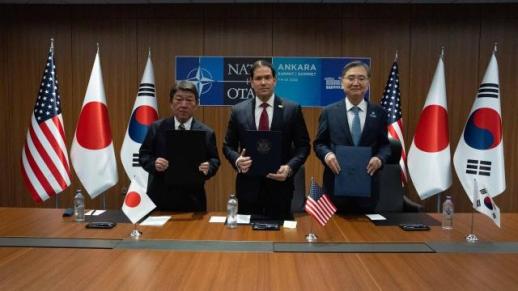 Seoul, Washington, Tokyo forge SMR export alliance SEOUL, July 08 (AJP) - South Korea, the United States and Japan signed an agreement on Tuesday to jointly export small modular reactors, turning three countries that have long competed for the same nuclear contracts into a coordinated bloc aimed at the fastest-growing corner of the global energy market. South Korea's Ministry of Foreign Affairs said in a statement on Wednesday that Foreign Minister Cho Hyun, U.S. Secretary of State Marco Rubio and Japanese Foreign Minister Motegi Toshimitsu signed the memorandum of cooperation (MOC) on the sidelines of the NATO summit in Ankara, Türkiye. The framework targets reactor deployments in third countries, starting with the Indo-Pacific region, and Washington is backing it with more than $10 million in new funding for a State Department program that provides technical support to Indo-Pacific countries adopting nuclear power, according to the department. For South Korea's nuclear industry, the deal formalizes something that has been taking shape for months, a division of labor with American reactor designers and Japanese industrial partners rather than a head-to-head fight against them. Small modular reactors are nuclear plants shrunk to a fraction of conventional size, typically generating up to 300 megawatts compared with more than 1,000 megawatts for a standard large reactor. Their components are built in factories and assembled on site, which developers say cuts construction time and the enormous upfront cost that has stalled large nuclear projects across the West. The technology remains largely unproven commercially. No small modular reactor is yet operating in a Western country, though the first is under construction in Canada. What has transformed the sector from a niche engineering project into a strategic priority is artificial intelligence. Training and running AI models require vast server farms that draw power around the clock, and the International Energy Agency (IEA) projects that electricity consumption by data centers will roughly double from 485 terawatt-hours in 2025 to 950 terawatt-hours in 2030, around three percent of global electricity demand. A single hyperscale AI data center can consume as much electricity as 100,000 homes. Wind and solar energy sources cannot supply that load alone because it never stops, and grid connections for new gas plants now face multi-year waits. Nuclear power, which runs continuously and emits no carbon, fits the profile, and small reactors can be placed near the data centers themselves. Technology companies have moved first. Google signed the first commercial SMR power purchase agreement with the American developer Kairos Power in October 2024, and Amazon and Microsoft have made their own nuclear commitments. The pipeline of conditional power purchase agreements between data center operators and small modular reactor projects has grown from 25 gigawatts at the end of 2024 to 45 gigawatts today, according to the International Energy Agency. IEA Executive Director Fatih Birol has said "there is no AI without energy" and that countries providing secure, affordable electricity will hold the advantage. The Ankara agreement is designed to capture that market as a bloc. According to South Korea's Ministry of Foreign Affairs, the framework aims to reduce project development risk, achieve economies of scale, attract private investment, streamline licensing and optimize supply chains, while holding partner countries to the highest standards of nuclear safety and nonproliferation. The unstated competitors are Russia's Rosatom and China's state nuclear companies, which have dominated reactor exports to developing countries by bundling state financing with construction. The three allies bring complementary pieces. American firms lead in reactor design, Japanese conglomerates supply heavy components and reactor technology through ventures such as GE Vernova Hitachi Nuclear Energy, and South Korean companies bring a construction record that delivered the United Arab Emirates' Barakah plant and a domestic supply chain anchored by Doosan Enerbility, which manufactures forgings and modules for American SMR developers including NuScale Power. The industrial side of the arrangement is already visible. Alongside the ministers' signing, the State Department announced an industry initiative among GE Vernova, Hitachi, Samsung C&T and SGE to deploy the BWRX-300 small modular reactor across Europe. Samsung C&T, the construction arm of the Samsung group, formed a strategic alliance with GE Vernova Hitachi Nuclear Energy in October 2025 to deploy the 300-megawatt reactor in global markets outside North America. Last week that partnership widened again when SGE, a Polish-led developer, unveiled plans for 14 BWRX-300 reactors across three sites in the United Kingdom with a team including Samsung C&T and Google Cloud, a project worth about $47 billion. The cooperative turn follows years of costly rivalry. Korea Hydro & Nuclear Power spent much of the past decade locked in an intellectual property dispute with Westinghouse Electric Company, the American firm whose technology underpins South Korea's flagship APR1400 reactor. The fight shadowed Seoul's export campaigns until the two sides reached a global settlement in January 2025. The terms were steep. Korea Hydro & Nuclear Power (KHNP) agreed to purchase $650 million in Westinghouse goods and services and pay $175 million in licensing fees for each reactor it exports, and accepted restrictions on bidding in North America, most of the European Union, the United Kingdom, Japan and Ukraine, according to the Korea Herald. The 50-year deal also gives Westinghouse the right to verify the technical independence of South Korean companies before they bid on overseas projects, including small modular reactors. That settlement cleared the way for KHNP to sign its $18.6 billion contract in June 2025 to build two large reactors in the Czech Republic, South Korea's first overseas nuclear plant order since 2009, but it also drew fierce domestic criticism as a lopsided concession. The new trilateral framework offers a different logic. If South Korean, American and Japanese firms bid together rather than against each other, the licensing restrictions that hem in solo Korean bids matter less, and the combined offer becomes harder for customers to refuse. KHNP is meanwhile developing its own domestic design, the i-SMR, with a target of completing standard design approval in the late 2020s, giving South Korea a technology of its own to feed into future consortium bids. At the signing ceremony, Rubio tied the agreement directly to energy security, pointing to instability around the Strait of Hormuz, the shipping chokepoint for Middle Eastern oil. He said the deal allows the three countries to move forward on joint work on small modular reactors, calling the technology "in many ways the future of energy generation." Cho said the SMR sector is one of many areas where the three countries can work together on shared challenges. The first BWRX-300 is under construction at Ontario Power Generation's Darlington site in Canada, with completion expected by the end of the decade. 2026-07-08 08:36:38
-
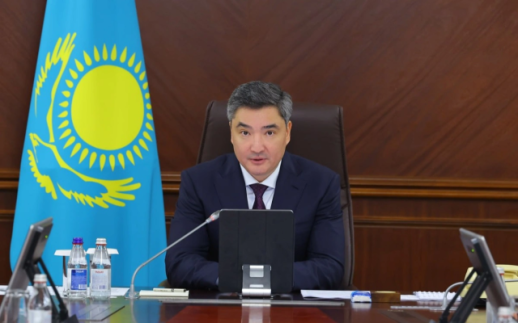 Kazakhstan tightens grip on flagship gas projects SEOUL, July 07 (AJP) - Kazakhstan has placed construction work at its three largest gas processing projects under weekly government monitoring, a step aimed at keeping the flagship developments on schedule as the country races to meet surging domestic demand and expand its role as a Eurasian energy supplier, the state news agency Qazinform reported Tuesday. The projects under watch sit at the heart of Kazakhstan's plan to lift marketable gas output to 34.6 billion cubic meters by 2030. Two plants at the giant Kashagan field in the Caspian Sea will process one billion and 2.5 billion cubic meters of gas per year, a facility at the Karachaganak field in the northwest will handle four billion cubic meters, and a plant in the western city of Zhanaozen will add 900 million cubic meters, according to Kazakhstan's Energy Ministry. QazaqGaz, the national gas company, has estimated the cost of the two Kashagan plants alone at up to $3.5 billion, and is building them jointly with UCC Holding of Qatar. Prime Minister Olzhas Bektenov issued the monitoring order at a government meeting on Tuesday, instructing the Energy Ministry, the Samruk-Kazyna sovereign wealth fund and QazaqGaz to track construction and installation work at the three sites every week. He tied the projects directly to Kazakhstan's energy security, its appeal to foreign investors and the quality of life of its citizens. "Economic growth is accompanied by steadily increasing demand for gas from both households and the industrial sector," Bektenov said. "We must ensure a long-term balance between the industry's resource capacity and the needs of the economy. Projects to expand gas transportation infrastructure, build gas processing plants, and extend gasification across the regions are being implemented consistently." The new plants are expected to increase commercial gas supplies for the domestic market and feed Kazakhstan's push into petrochemicals, an industry the government sees as a way to earn more from its hydrocarbons than raw exports allow. "These facilities are expected to increase commercial gas production for the domestic market and serve as key drivers of the petrochemical industry's development," Bektenov said, adding that gas infrastructure must be delivered on time to support new enterprises and strengthen the country's industrial base. The monitoring order reflects a broader campaign by Astana to turn its geography and resources into leverage. Kazakhstan, the largest economy in Central Asia, has invested heavily in the Trans-Caspian International Transport Route, known as the Middle Corridor, which carries goods and energy from Central Asia across the Caspian Sea and through the South Caucasus to Europe without passing through Russia. The route drew fresh attention in May when Turkish President Recep Tayyip Erdogan, visiting Astana, called it the present-day equivalent of the Silk Road and said Turkiye wanted to carry larger volumes of Kazakh oil to world markets, as KazMunayGas and Turkish state energy company TPAO signed agreements on joint oil and gas projects. The energy leg of that strategy is already moving. Kazakhstan is expanding its Caspian port of Aktau and plans to ship 2.2 million tons of oil through the Baku-Tbilisi-Ceyhan pipeline this year, while its parliament in March approved a green energy corridor with Azerbaijan and Uzbekistan that would send renewable electricity to Europe through cables laid on the Caspian seabed. At home, the government has paired export ambitions with a drive to connect more of its own people to gas. Gasification reached 62.4 percent of the population by the end of 2024, covering 12.6 million citizens, and the government has set a target of 12.8 million people this year, backed by 112.5 billion tenge in funding from the state budget and Samruk-Kazyna for 84 projects. Kazakhstan produced 59 billion cubic meters of gas in 2024 and plans to raise annual production to 74 billion cubic meters by 2030. 2026-07-07 19:28:04
-
 Hormuz oil shock splits Asian industry in two SEOUL, July 07 (AJP) - South Korea's factories just lived through the most violent oil shock in history, and the strange part is that the country posted record exports while it happened. The war in Iran and the closure of the Strait of Hormuz, the narrow waterway carrying about a fifth of the world's oil, did not hit Asian industry evenly in the first half of 2026. It split it. Semiconductors sailed through on artificial intelligence demand, automobiles took a glancing blow, and petrochemicals, the industry most directly chained to crude oil, came close to breaking. The numbers tell the story of a two-track economy. South Korea's exports hit a record $87.75 billion in May, up 53.2 percent from a year earlier, driven almost entirely by semiconductor shipments that soared 169.4 percent to $37.16 billion, according to trade data. In the same month, auto exports fell 5.9 percent, and the country's petrochemical crackers were running at minimum rates after a wave of force majeure declarations, the legal notices companies issue when events beyond their control make it impossible to honor contracts. How the same shock produced such different outcomes comes down to what each industry actually consumes, and the first half of this year amounted to a live experiment nobody wanted to run. The largest disruption in history The experiment began on Feb. 28, when the United States and Israel launched an air war against Iran. Tehran retaliated by effectively sealing the Strait of Hormuz with missile attacks, ship boardings, and sea mines. Tanker traffic collapsed. Brent crude rose about 65 percent in March alone, roughly $46 a barrel, the largest monthly gain ever recorded, before peaking above $188 in late April. Fatih Birol, who heads the International Energy Agency, called it the "largest supply disruption in the history of the global oil market." Global oil supply plummeted by 10.1 million barrels per day in March to 97 million, according to the International Energy Agency (IEA). For Asia, which took delivery of nearly 70 percent of the crude passing through the strait before the war, the pipeline to its industrial base had been cut. Petrochemicals take the direct hit Nowhere did that cut land harder than on petrochemicals, the industry that turns oil into the plastics, fibers, and chemicals inside nearly everything manufactured. Asian crackers, the giant plants that break down oil-derived feedstock into building blocks like ethylene, depend on the Middle East for 70 to 80 percent of their naphtha, and roughly 80 percent of Asia's seaborne naphtha imports came from the Gulf in 2025, according to data from the price reporting agency Independent Commodity Intelligence Services. When the strait closed, naphtha prices jumped from $776 per metric ton on March 6 to more than $1,000 within a week, according to Masanori Kawakami, a petrochemical industry expert based in Japan who spoke to Chemical and Engineering News. By mid-March, Independent Commodity Intelligence Services (ICIS) had counted 31 force majeure or sales allocation announcements across Asia and the Middle East. Roughly half of global polyethylene capacity was either offline or constrained by feedstock shortages at the peak and polyethylene prices surged 50 to 80 percent in some markets within three weeks, according to assessments cited by BIC Advisory Group. South Korea, which imports around 70 percent of its crude oil and half of its naphtha through the strait, watched its chemical sector buckle plant by plant. Yeochun NCC declared force majeure. LG Chem shut its No. 2 cracker at Yeosu and cut all of its naphtha-fed crackers to 60 percent minimum operating rates. The government responded by restricting naphtha exports and temporarily designating the feedstock a supply-chain security item, while officials discussed importing Russian crude and naphtha to stabilize supply, according to Reuters. The damage was regional, not just Korean. Mitsubishi Chemical cut ethylene output at its Kashima and Mizushima plants in Japan, a country that imports more than 60 percent of its naphtha, about 70 percent of it from the Middle East. A Shell joint venture cracker in Huizhou, China, shut down and suspended polyethylene shipments indefinitely. Formosa Petrochemical declared force majeure in Taiwan and ran its Mailiao crackers at around 70 percent. The IEA's April Oil Market Report found that petrochemical feedstocks showed the most immediate effects of the war of any product category, with LPG and naphtha demand falling 8 and 9 percent year on year in April, against declines of about one percent for transport fuels. The pain mattered more because South Korea's petrochemical industry entered the war already wounded, squeezed for years by Chinese overcapacity and thin margins. The feedstock shock did not create the crisis. It accelerated one that was already underway. Chips sail through on AI demand Semiconductors lived in a different world entirely. Chips are made from silicon, not oil, and the AI investment boom proved far stronger than any energy headwind. South Korean semiconductor exports reached $31.9 billion in April, up 173.5 percent from a year earlier and the highest figure ever recorded for that month, before setting the all-time record in May. The IEA itself noted that South Korea's economy remained resilient through the turmoil, buoyed by chip shipments that exceeded $30 billion for the first time in March. That is not to say chips were untouched. Fabs consume enormous amounts of electricity, and energy costs rose across the board. Statistics Korea reported that semiconductor production fell 10 percent month on month in May, but officials attributed the drop to production capacity reaching its limits and to shipment timing, not to the oil shock, and forecast a recovery in the second half as new fabs come online. The distinction matters: the one industry that stumbled statistically did so because it was running too hot, not because the war starved it. Autos caught in the crossfire Automobiles landed in between, hit hard enough to hurt but through so many channels at once that the oil shock is difficult to isolate. South Korean auto exports fell 5.5 percent in April and 5.9 percent in May, declines that trade data attributed partly to wartime shipping disruptions and partly to Korean carmakers shifting production to the United States in response to Washington's tariff policy. Hyundai Motor temporarily halted production of its Ray and Morning models in late March, though the immediate trigger was a fire at a parts factory in Daejeon that collided with the broader supply chain chaos, according to the Seoul Economic Daily. Domestic passenger car sales fell 3.4 percent in May as fuel prices climbed. There was also a quieter, second-order threat to the auto industry's future. Synthetic graphite, the material used in electric vehicle battery anodes, is made from petroleum coke, a byproduct of oil refining, and the World Economic Forum warned in April that refiners chasing high-value fuels during the price rally could tighten the supply on which battery production depends. The stress spread well beyond the three sectors. GS Caltex cut its daily crude refining volume from 800,000 barrels to 675,000, according to the Seoul Economic Daily. Airlines including Air Premia and Aero K suspended routes as jet fuel costs soared. The government rolled out a 26.2 trillion won extra budget, about $17 billion, to cushion the shock, and President Lee Jae-myung launched a public energy-saving campaign. A market that will not go back The acute phase has now passed. A fragile ceasefire between the U.S. and Iran took hold in April, and after weeks of contradictory claims about whether the strait was open, tanker traffic has partially resumed. Brent crude was trading at $72.45 per barrel on June 29, near pre-war levels and down from the wartime high above $188. The World Bank expects Brent to average $86 this year, assuming Middle East exports recover to near pre-war levels by the fourth quarter. But the market that South Korean industry now buys from is not the one it knew in January. Global inventories were drawn down sharply during the crisis, and importers across Asia are expected to rebuild stocks at a higher cost. Insurance premiums for Gulf transits remain elevated, mine risk lingers, and Tehran is pressing to convert its demonstrated leverage over the strait into lasting control over who passes through it, including a possible toll system. According to CNBC's report citing Nikos Petrakakos, managing director of investments at the shipping investor Tufton Investment Management, on June 29, shipping traffic through the strait remains nowhere near pre-war levels, and Iran's new position is unlikely to be surrendered. "I don't see Iran going back to where it was before," he said. 2026-07-07 13:44:22
-
Korea-India Future Association to Host Economic Cooperation Forum on July 21 Follow-up to President Lee Jae-myung's visit to India; discussion on cooperation and investment strategiesOpen to all interested in Indian business, investors, and the general publicThe Korea-India Future Association, led by Shin Bong-gil, will hold a special lecture on July 21 at the Seoul Club, featuring Lee Seong-ho, the South Korean Ambassador to India, and Cho Chung-jae, head of the Korea Institute for International Economic Policy (KIEP) Delhi office. The topic will be 'Korea-India Economic Cooperation and Investment Prospects.'This event follows President Lee Jae-myung's state visit to India in April and his summit with Indian Prime Minister Narendra Modi, during which the two countries reaffirmed their 'special strategic partnership' for the next decade. They also agreed to resume negotiations on the Comprehensive Economic Partnership Agreement (CEPA) and expand cooperation in strategic industries such as shipbuilding, AI, defense, and arms.Ambassador Lee Seong-ho will discuss 'The Current Situation in India and Korea-India Economic Cooperation,' providing insights into India's political and economic environment and the direction for expanding bilateral cooperation.Ambassador Lee, a seasoned diplomat with experience as the Economic Diplomacy Coordinator and head of the Economic Security Task Force at the Ministry of Foreign Affairs, was appointed as the South Korean Ambassador to India in October 2024 after serving as Ambassador to Italy in 2022.Following this, Cho Chung-jae will present on 'The Current Status and Outlook of Korean Investment in India,' covering the local investment environment, opportunities in key industries, and strategies for corporate entry.The Korea-India Future Association stated, "This will be a meaningful opportunity to hear directly about practical economic cooperation and ways to expand corporate entry following the summit. We welcome not only our members but also entrepreneurs, startups, researchers, and students interested in the Indian market and business to attend."The event will take place on July 21 from 2:00 PM to 4:30 PM at the Hall of Hallasan, Seoul Club in Jangchung-dong. 2026-07-07 10:20:00
-
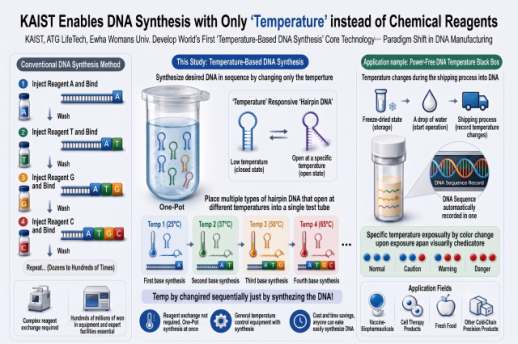 KAIST turns temperature into DNA synthesis tool SEOUL, July 06 (AJP) - Korean researchers have developed a way to build custom DNA strands using only changes in temperature, removing the chemical reagents and costly equipment that DNA synthesis has long required and potentially lowering the cost of work across drug development, diagnostics and synthetic biology. According to the Korea Advanced Institute of Science and Technology (KAIST) on Tuesday, the research team, led by the institute's Choi Yeong-jae, used the chemical reagent-free method to build a battery-free device called a "DNA temperature black box," which records the temperature history of a shipment without any power source. The work was carried out with ATG Lifetech and a team led by Ewha Womans University's Choi Han-sol. Conventional DNA synthesis builds a strand one base at a time, adding and then washing away chemical reagents at every step to link the four building blocks known as A, T, G and C. The process depends on automated synthesizers that can cost hundreds of millions of won and on dedicated laboratory facilities, a barrier that has kept custom DNA out of reach for many smaller labs and devices. The new approach, which the researchers named the Temperature Mediated Primer Exchange Reaction, or TEMPER, replaces that reagent swapping with heat. The team engineered hairpin DNA, folded molecules that spring open only within a set temperature range. By placing several types of hairpin, each tuned to a different temperature, into a single tube and then shifting the temperature in sequence, the researchers assembled a target DNA strand step by step without exchanging any solution. The significance, the team says, is that it changes the method of DNA synthesis itself, handing the control that chemical reagents once exercised over to temperature, a variable that is simple to adjust with standard equipment. The researchers describe it as the world's first platform to synthesize arbitrary DNA sequences through temperature alone. To show the technology could be put to use, the team demonstrated three applications in the paper: a writer for storing digital data in DNA, a color-changing temperature indicator, and the battery-free temperature logger. The DNA temperature black box is stored freeze-dried and begins working when a single drop of water is added. From that point it records when, by how much and in what order the temperature changed, writing that history directly into a DNA sequence. It also changes color once it crosses a set threshold, allowing a spoiled shipment to be spotted by eye. The team expects such a device to help monitor vaccines, biologic drugs, cell therapies and fresh food, where cold-chain handling determines quality. "This study is a world-first foundational technology that presents a new principle, that DNA can be synthesized using temperature alone rather than chemical reagents," Choi said in the announcement, in remarks translated from Korean. He said he expected the method to make DNA synthesis easier and cheaper, lowering the barrier to basic bioscience research and opening new industrial uses such as the battery-free black box. The study was published in Nature Communications on July 2. KAIST's Choi Jang-ho and GIST doctoral student Kim Jin-ho were co-first authors, with Choi Yeong-jae and Choi Han-sol as corresponding authors. (Reference Information) Journal/Source: Nature Communications Title: Programmable one-pot polymerase-mediated DNA synthesis via temperature control Link/DOI: https://bit.ly/4aAr8zY 2026-07-07 10:08:23
-
Kazakhstan Celebrates Capital Day Amid New Constitution Implementation Kazakhstan President Kassym-Jomart Tokayev delivered a congratulatory message to the public on July 6, coinciding with 'Capital Day,' emphasizing the significance of the new constitution that took effect on July 1. The new constitution is regarded as the most significant overhaul of Kazakhstan's political system since independence. The new constitution, referred to as the 'People's Constitution' by President Tokayev, was approved in a national referendum on March 15, with a turnout of approximately 73 percent and 87.15 percent in favor, according to the Central Referendum Commission of Kazakhstan. It replaces the 1995 constitution, abolishes the bicameral parliament, and establishes a 145-seat unicameral parliament called the 'Kurultai,' while also reinstating the vice presidency. In his congratulatory message reported by the state news agency Kazinform, President Tokayev linked the constitutional reform to Capital Day, describing Astana as a symbol of national independence and a city that determines the fate of the nation. Tokayev stated, 'Astana has been a driving force behind significant historical developments,' adding that 'our capital has achieved the status of a 'smart city' with the introduction of advanced administrative systems.' He noted that the enactment of the People's Constitution on the eve of Capital Day is symbolic, marking an event that opens a new and historic chapter for the nation and serves as a catalyst for modernizing key government and social institutions. The president also highlighted that the newly established constitutional law regarding the capital's status strengthens Astana's role as a political, administrative, economic, and cultural center. He mentioned that new parks, squares, and children's playgrounds have been developed for residents and visitors, and that Astana is enhancing its international standing as a venue for discussing regional and global issues. He emphasized that the capital will serve as a vivid example of responsible citizenship and the values of 'law and order,' as well as a new civic ethic based on the 'Other Kazakhstan' initiative. The 'Other Kazakhstan' initiative is a nationwide cleanliness and public culture campaign launched by President Tokayev in 2024. He expressed confidence that Astana will continue to prosper and stand at the forefront of building a 'just Kazakhstan.' Previously known as Akmolinsk, Astana became the capital of Kazakhstan in 1997 when the capital was moved from Almaty. From 2019 to 2022, it was also called Nur-Sultan, named after the first president, Nursultan Nazarbayev. Capital Day, celebrated on July 6, has been a national holiday since 2008. The constitutional transition is now moving to the next phase. The previous bicameral parliament held its final session on June 30, and elections for the new Kurultai are scheduled for August 23. The new parliament is expected to be inaugurated by September 1. * This article has been translated by AI. 2026-07-06 17:16:00