

Journalist
Park Sae-jin박세진
swatchsjp@ajupress.com
Assistant EditorForeign embassies in Seoul & Geopolitics, Diplomacy, Policy
Experienced journalist and editor at AJU PRESS specializing in multilingual news. I cover international diplomacy, geolpolitics, and policy, consistently delivering highly accurate, compelling reporting for a worldwide audience.
"Reporting the facts. Shaping the narrative. Every second counts."
Latest by Park Sae-jin
-
 AJP Factbox: What are soft robots? Soft robots are built from materials about as soft as human tissue, letting them bend, stretch and squeeze where rigid machines cannot, and researchers are testing them in fields from surgery and rehabilitation to underwater work and exploration. In the latest example, researchers at KAIST, the South Korean science and technology university, and the California Institute of Technology described a beetle-inspired soft robot in Science Advances that walks, picks up small objects and reports what it touches to an operator who steers it by bending a finger. 2026-10-13 11:16:24
 -
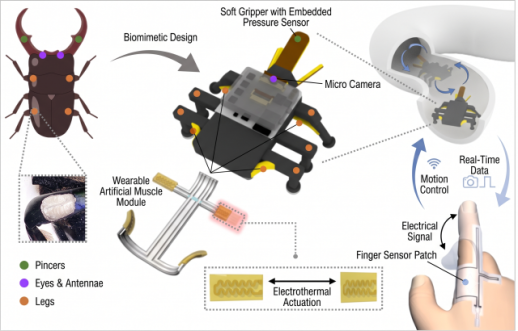 Soft beetle robot shows operator what it touches SEOUL, October 13 (AJP) - A soft robot modeled on a beetle can walk, pick up small objects and report back what it sees and how firmly it is gripping, while a person steers it by bending a finger. Researchers at KAIST, the South Korean science and technology university, and the California Institute of Technology (Caltech), working with a team at Singapore's Nanyang Technological University, described the robot, called BeetleBot, in the journal Science Advances in August. KAIST announced the work on Tuesday. The robot is roughly the size of a real beetle, according to the paper. Soft robots are built from flexible materials that bend and stretch instead of rigid metal, which lets them squeeze into places hard machines cannot. The parts that make them move, the parts that let them sense and the controls that guide them usually come as separate and often bulky hardware. That has made it hard to fit all three into a small body. The team started with the insect itself. They studied how a beetle's leg muscles and joints move together and copied that layout in the robot's legs. The artificial muscles are 3D-printed from a liquid crystal elastomer, a rubbery plastic that shrinks when heated. Small electric heaters warm each muscle on cue. By firing the muscles in different parts of each leg independently and in sequence, the researchers made the robot walk forward and turn. At the front, a soft gripper copies the pincer-like jaws a beetle uses to seize food. When its artificial muscles contract, the gripper closes on an object. A pressure sensor inside registers the contact, because pressing on it narrows the gap between internal electrodes and changes its electrical signal. The operator wears a stretchy sensor patch on one finger. Bending the finger stretches the patch and changes the electrical resistance of the carbon nanotubes inside, microscopic tubes of carbon that conduct electricity. The system reads those changes as one of four commands, walk forward, turn left, turn right or grab, and sends them to the robot over Bluetooth. A small camera on the robot shows the operator what lies ahead, and the gripper's sensor reports whether it has made contact. The operator uses both to choose the next gesture. Commands travel out to the robot and sensor data travels back, a two-way loop the researchers describe as the core of the design. In demonstrations, an operator guided BeetleBot around obstacles to a target object, which the robot gripped and carried away. The researchers expect the design to lead to remote-controlled robots that can inspect narrow spaces people cannot reach and retrieve small objects from them. They said the combined muscle and sensor technology could also be adapted for soft grippers and medical and rehabilitation aids. Kim Sang-ouk, a professor in KAIST's Department of Materials Science and Engineering, led the work with Caltech's Wei Gao as co-corresponding author. Kim said the study broadened the potential uses of soft robots by linking "the movement of artificial muscles, sensing and user control into a single system." The first author, Kim In-ho, earned his doctorate at KAIST and built the robot while working as a postdoctoral researcher at Caltech. He is now an assistant professor of chemistry at Sungkyunkwan University. "Going forward, we aim to increase the actuation speed and energy efficiency of the artificial muscles and advance control technology that uses sensory information, so that it can develop into a soft robot able to work in a variety of environments," he said. KAIST said wider uses, such as environmental surveys and industrial equipment inspection, would also require changes to how the robot is powered and verification of its performance in real working environments. Journal/Source: Science Advances Title: BeetleBot: An integrated bioinspired soft robot for multimodal sensing and adaptive interaction Link/DOI: 10.1126/sciadv.aeg8849 2026-10-13 11:06:44
 -
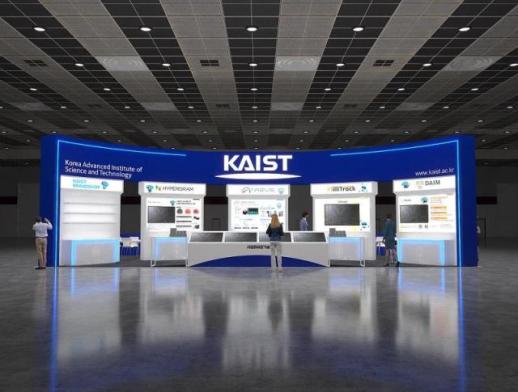 KAIST takes lab-to-market push to Korea Electronics Show SEOUL, October 12 (AJP) - Research from KAIST laboratories, from thin noise-blocking structures to a robot that clears obstacles out of its own path, goes on offer to manufacturers in Seoul this week as the university tries to move more of its lab work into products. KAIST said Monday it will hold the 2026 KAIST Tech Fair on Tuesday, the opening day of the Korea Electronics Show at COEX. The Korea Electronics Association, which organizes the four-day show, expects 500 exhibitors and 70,000 visitors across two exhibition halls. At the fair, six research teams will present technologies they want companies to license or develop further with them. Researchers will explain how each one works and which industries could use it, then take questions directly from corporate attendees. Bae Choong-sik, a mechanical engineering professor, was named KAIST's 18th president in June, filling a post that had sat empty for 16 months. He has placed the commercialization effort under the banner "Beyond Laboratory." "What KAIST means by 'Beyond Laboratory' is that outstanding research results do not stay in the lab but carry through to real value for industry and society," Bae said in a statement. He said he hoped the fair would connect KAIST's technology with what industry needs and lead to "concrete cooperation such as technology transfer and joint research." The briefing runs Tuesday afternoon on the KES Stage in Hall B. Each presentation lasts 15 minutes, followed by five minutes of questions. Most soundproofing works by adding weight and thickness. Jeon Won-ju, a professor of mechanical engineering, will present structures built to cut noise and vibration while staying thin and light. Yoon Sung-eui, a professor in KAIST's School of Computing, will show a self-driving robot that uses its arm to push aside obstacles blocking its route and keeps moving. Wireless chargers transfer power through magnetic coils, and the hardware adds weight to whatever carries it, from phones to electric vehicles. Lee Chang-woo, a researcher in Professor Jang In-gwun's lab at the Cho Chun Shik Graduate School of Mobility, will present a design method for charging components that are lighter and more efficient. Yoo Hong-ki, also a mechanical engineering professor, developed an optical imaging technique that uses light to produce sharp three-dimensional images of the inside of tissue across a wider range of depths. Kim San-ha, from the same department, will present an antibacterial metal filter that can be washed and reused many times rather than thrown away. The sixth technology, from chemical and biomolecular engineering professor Kim Shin-hyun, is a material covered in microscopic dome-shaped structures that reflect light to display a range of colors and images. Alongside the briefing, KAIST will run one-on-one sessions in the KES Lounge in Hall B. Companies that registered in advance will be matched with research teams to discuss adopting a technology, joint research and further development toward a commercial product. Four startups founded by KAIST faculty will exhibit in a KAIST pavilion in Hall A for the full run of the show, through Oct. 16. Daim Technology will show simulation software and control systems that coordinate many robots at once for unmanned factories. MilliTrack will present precise location tracking and spatial mapping for industrial sites. A2US built its air and water purification products on a technique that uses electricity to spray water as an extremely fine mist. Hypergram pairs AI with hyperspectral imaging, which captures many bands of light beyond what the human eye or an ordinary camera can see. The combination lets factories spot contamination and surface defects that would otherwise go unnoticed. The pavilion also lays out how KAIST takes research from discovery through patenting, licensing and startup formation. It is on the show's official VIP tour route. Companies that want to attend the briefing or book a consultation can apply in advance through the website of KAIST's technology licensing office. 2026-10-12 19:35:54
 -
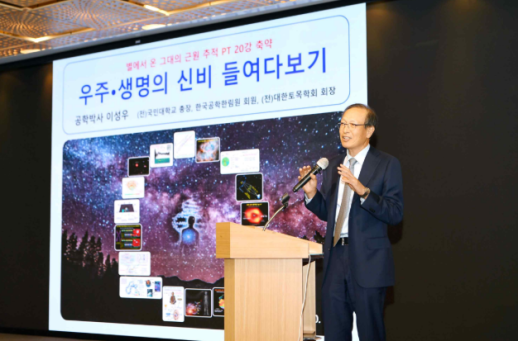 Former Kookmin president traces human body back to dying stars SEOUL, October 12 (AJP) - Most of the atoms in the human body were forged inside stars that burned out long before Earth existed, a former Kookmin University president told students in Seoul on Oct. 8. Stars make heavier elements by fusing lighter ones in their cores. When the largest stars run out of fuel and explode as supernovas, they scatter oxygen, carbon, nitrogen and iron into space, where the material is drawn into new stars, planets and, eventually, living things. Hydrogen, the most common atom in the body, is the main exception. It dates to the Big Bang itself. Lee Sung-woo, the ninth president of Kookmin University (KMU), made the case in a talk titled "Looking into the Mysteries of the Universe and Life," the 672nd session of the school's Thursday Special Lecture series. Lee is a civil engineer by training. He graduated from Seoul National University in 1974, earned a doctorate in civil engineering at the University of Southern California and became the first KMU president from a science or engineering background when he took office in March 2008. Speaking in the university's academic conference hall, he started with the body. Oxygen and the other materials that make up living things were created in space, he told students, before turning to DNA, the molecule that carries genetic instructions, to explain how those materials keep an organism alive. Human life, he said, is the product of the universe's long history and the slow evolution of matter. Understanding the universe and life is therefore a way of understanding human existence. He then walked through the observations that built the modern picture of the cosmos. Edwin Hubble showed in the 1920s that the Milky Way is one galaxy among countless others, and his work led to the discovery that the universe is still expanding. Lee used black holes, supernovas and the cosmic microwave background, the faint afterglow of the Big Bang that still fills space, to trace roughly 13.8 billion years of cosmic history. Set against that scale, humans are insignificant beings, little more than dust, he said, according to the university's account of the lecture. Scientific inquiry into the universe, he added, leads people to look back on their own existence and to stand humbly before nature. The final part of the talk turned to threats to life on Earth. Lee described past mass extinctions caused by asteroid impacts and climate swings driven by shifts in Earth's orbit and the tilt of its axis. He warned that global warming and shrinking glaciers are now raising sea levels and altering ocean currents, changes he said could endanger ecosystems and human survival. He also discussed the possibility of life beyond Earth and the missions searching for it. No evidence of life anywhere other than Earth has yet been found. Lee closed by urging students to draw fresh insight from scientific discovery and use it to contribute to society. KMU launched the Thursday Special Lecture in 1994. The university says it was the first regular course at a South Korean university built on weekly talks by outside speakers, and that it has run longer than any other. About 680 speakers from politics, society, science and the arts have taken its podium, including the late President Roh Moo-hyun, Cardinal Stephen Kim Sou-hwan, writer Yoo Si-min, film director Park Chan-wook, former National Assembly Speaker Chung Sye-kyun and former U.S. Ambassador to South Korea Mark Lippert. 2026-10-12 18:38:18
 -
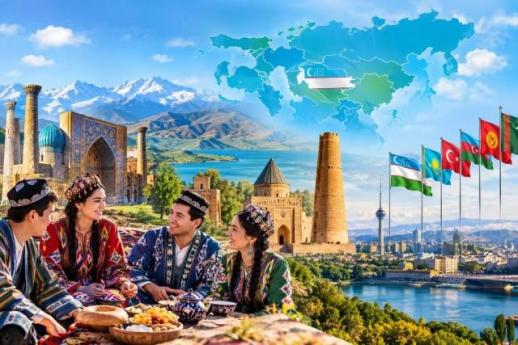 OP-Ed: Uzbekistan bets on Turkic world tourism Editor's Note: The following opinion article is contributed by the Embassy of Uzbekistan in the Republic of Korea. In recent years, tourism has become one of the strategic areas of development in the Republic of Uzbekistan, playing an increasingly important role in the economy, as well as in strengthening international ties, cultural exchange, and public diplomacy. In this context, the development of cooperation in the field of tourism with brotherly countries that are members of the Organization of Turkic States (OTS) is of particular importance to us. These ties go beyond purely strategic interests, as they are based on common historical and cultural roots, spiritual closeness, shared traditions, and worldviews. Since Uzbekistan joined the Organization of Turkic States in 2019, we have seen a steady positive dynamic in cooperation in the tourism industry. A platform for regular dialogue between relevant departments has been formed, and joint projects are being implemented to help create a common tourism space. One of the most significant steps in this regard was the creation of the OTS Tourism Council, which coordinates efforts to develop joint routes, exchange experiences, improve service quality, and develop tourism infrastructure. The establishment of the Unified Tourist Route "The Great Silk Road" is one of the key projects demonstrating tangible cooperation. The route unites the most important cultural and historical centers of the Turkic civilization - from Samarkand, Bukhara, and Khiva to Baku, Almaty, Bishkek, and Ankara. Tourists traveling along this route have a unique opportunity to get acquainted with the rich heritage, architectural monuments, traditions, and national cuisine of our countries. Uzbekistan occupies a special place in this route as a territory where many world-renowned monuments of Turkic culture are concentrated. In recent years, large-scale work has been carried out to restore cultural heritage sites, modernize infrastructure, and improve logistics for guests. Training professional personnel for the tourism industry is yet another priority area of our cooperation. Uzbekistan actively cooperates with universities in Türkiye, Kazakhstan, Azerbaijan, and other OTS countries on student exchanges, internships, seminars, and joint research. Our goal is to equip tourism professionals with modern approaches to management, marketing, and digital technologies. Such cooperation strengthens not only professional ties but also cultural understanding between nations. Measures aimed at facilitating the visa regime deserve special attention. Thanks to bilateral agreements between Uzbekistan and the OTS countries, visa-free travel has been implemented, which has contributed to a significant increase in tourist flow between the states. In the future, the introduction of a single electronic visa is being considered, which will simplify the process of traveling to several countries of the Turkic world within one tourist package. We also support the initiative to create a common digital platform for tourists, featuring information on routes, booking services, reviews, and a calendar of cultural events. Participation in international exhibitions and forums remains an important part of promoting joint tourism potential. Uzbekistan actively showcases its offerings at tourism fairs and proudly hosts such events. As such, the Forum of Tourism Ministers of the OTS member states in Samarkand was a landmark event that provided an opportunity to discuss pressing issues facing the industry and develop long-term strategic guidelines for further cooperation. All this primarily contributes to a constant increase in the flow of tourists from the member states of the Organization. Thus, over the past year, the total number of tourists arriving from the OTS region exceeded 6.15 million people. The Turkic world has every reason to become one of the most attractive and sustainable tourist destinations in Eurasia. The richness of history, cultural diversity, natural beauty, and hospitality of our peoples form a unique offer in the global tourism market. Uzbekistan is ready to continue to play an active role in the development of this common goal, initiate new projects, strengthen institutional ties, and promote the formation of a single tourism space of the Turkic states. 2026-10-12 14:48:37
 -
 Failing Army servers await Assembly budget decision SEOUL, October 11 (AJP) - The South Korean army is experiencing a surge of server failures in its front-line commander network, but the government has cut every won the military requested for next year to start replacing the aging hardware. The Army Tactical Command Information System, known as ATCIS-II, logged about 400 server failures last year, compared with about 10 in 2020, according to military documents on the system’s upgrade project provided by the office of Sung Il-jong, a main opposition People Power Party lawmaker. The system lets commanders share the battlefield picture in real time, including operational orders and the positions of friendly and enemy forces. It supports them through each step of spotting a threat, deciding how to respond and striking. When a server goes down and that information arrives late, a headquarters can be slower to read the situation of its subordinate units and to pass down orders. The Army first fielded a computerized tactical command network in 2004. Work on its second upgrade, which replaced both hardware and software, began in December 2018 at a cost of 103 billion won, and the Defense Acquisition Program Administration announced in June 2020 that the first production units had gone to some front-line corps. Those servers are now wearing out just as repair options disappear. Maintenance service support for them ended late last year, and critics inside and outside the military have called for steps to ensure broken servers can be restored quickly. The Ministry of National Defense put 4.998 billion won ($3.7 million) in its 2027 budget request for an upgrade project that covers new servers, wireless LAN and videoconferencing licenses. The full amount was removed when the government drew up its budget proposal, citing "insufficient available funds and consideration of project priorities." If the money is not restored, the start of the project and the server replacements themselves are likely to slip one after another. The first units to receive the system would be the first to feel the delay. That puts the Army's I Corps, which guards the western stretch of the border with North Korea north of Seoul, at the front of the line. Its ATCIS servers were fielded in 2019 and 2020 and are scheduled for replacement in 2028 and 2029. The military said the system faces no direct operational limits for now. A military official said the replacement program swaps servers according to their equipment life cycle so the command system runs reliably, with a total budget of 45 billion won over 2027 to 2030. "We are cooperating with relevant agencies during the National Assembly's deliberations to secure the budget needed to launch the project next year," the official said. The government's proposal is now before the National Assembly, which must pass next year's budget by Dec. 2. Under the Constitution, lawmakers cannot raise an expenditure item or add a new one without the government's consent. 2026-10-11 19:12:28
 -
 Korean banks had AI hacking warning weeks before data breaches SEOUL, October 11 (AJP) - Weeks before hackers used artificial intelligence tools to steal customer data from seven South Korean financial firms, the sector's security agency had walked those firms' security staff through a similar AI attack on a domestic lender, according to documents the agency submitted to a lawmaker. The breaches began in late September. They exposed data on about 40,000 Yegaram Savings Bank customers and about 25,000 Shinhan Bank customers. KB Kookmin Bank, Hana Bank, BNK Busan Bank, Welcome Savings Bank and Hyundai Capital also confirmed leaks. Woori Bank and NH NongHyup Bank said they blocked intrusion attempts. The Financial Security Institute (FSI) submitted the material to Han Chang-min, who leads the Social Democratic Party and sits on the National Assembly's National Policy Committee. Han's office disclosed it Sunday. The documents show the agency described the earlier attack at a Sept. 17 seminar attended by about 160 security officers. Staff from four of the firms later breached attended, along with officials from Shinhan's holding company. An AI agent is software that carries out a chain of tasks on its own after a single instruction. In the September case, the attacker told an agent built on the Chinese model DeepSeek to scan the financial sector for servers running Oracle WebLogic, software behind many corporate websites and apps. The next day, the agent exploited a flaw that let outsiders run commands on one company's server and planted a web shell there. A web shell is a small malicious program that gives an intruder a back door. The company, identified only as Company A, stopped the intruder as they moved toward other internal servers, just before more malicious code could be downloaded. The FSI urged companies to keep constant watch over their internet-facing systems. "Once- or twice-a-year assessments will not catch it," the presentation said. "Constant measurement and verification are needed." The wider campaign came within two weeks. U.S. cybersecurity firm CrowdStrike said in an Oct. 7 report that the attacker used ARTEX, an open-source penetration-testing tool developed in China. Tools like it are meant to let companies probe their own defenses, and ARTEX hands much of that work to AI agents. The copy of ARTEX that CrowdStrike examined ran on DeepSeek V4.1-Flash, and the attacker used Anthropic's Claude Code and other AI models in separate sessions. Files left on the attacker's servers, one of them in Hong Kong, showed the attacker asking Claude where stolen South Korean data is sold. CrowdStrike assessed with moderate confidence that the attacker is a Chinese speaker motivated by money. It has not linked the activity to any known hacking group. The targets were also different. Company A was breached through an unpatched product from an outside vendor. In the later campaign, the attacker went after services the banks ran themselves, including one bank's loan inquiry page for brokers and another's mobile work app for employees, CrowdStrike said, citing industry reports. ARTEX's developer, known on GitHub as Autumn-27, said Oct. 8 that the tool "will no longer be updated" and would go closed source because it had been misused. The change does not affect versions already released. Han blamed the companies themselves. "This leak of personal information at financial companies was caused by their failure to properly manage vulnerabilities that had already been stressed again and again," he said. He added that lawmakers would examine at the audit whether the companies responded properly before and after the breaches, and would hold them accountable. The chief executives of South Korea's five largest commercial banks are scheduled to testify about the breaches at the National Assembly's audit of the Financial Supervisory Service on Oct. 19. AJP Takeaways - The Financial Security Institute walked about 160 financial-sector security officers, including staff from four of the seven firms later breached, through an AI-agent attack on a domestic lender at a Sept. 17 seminar, according to documents it submitted to Social Democratic Party leader Han Chang-min. - CrowdStrike said in an Oct. 7 report that the attacker behind the breaches used ARTEX, a Chinese-developed open-source penetration-testing tool running on DeepSeek, along with Anthropic's Claude Code, and assessed with moderate confidence that the attacker is a Chinese speaker motivated by money. These findings come from CrowdStrike's report, not the lawmaker's documents. - Han Chang-min blamed the companies for failing to manage vulnerabilities that had been flagged again and again, ahead of an Oct. 19 National Assembly audit where the heads of South Korea's five largest commercial banks are scheduled to testify. 2026-10-11 15:11:12
 -
 Weak won lifts BOK's reserve earnings to record SEOUL, October 11 (AJP) - South Korea's central bank earned a record 16.9 trillion won ($12.6 billion) from managing its foreign assets in 2025, helped by a weaker won that raised the value of its overseas earnings, data showed Sunday. The total was up 32 percent from 12.8 trillion won in 2024, according to data the Bank of Korea (BOK) submitted to People Power Party lawmaker Lee Jong-wook, who sits on the National Assembly's finance committee. The BOK holds its foreign assets in dollars and other currencies but keeps its books in won. When the won weakens, the same foreign earnings convert into more won. In its 2025 annual report, published in March, the BOK said a higher won-dollar exchange rate and rising securities prices drove the increase. The figure counts only realized income. That covers interest on bonds and deposits, dividends and gains from selling securities, minus management costs. How much of the record came from the currency and how much from investment performance cannot be measured from the outside. The BOK does not disclose its rate of return or the total size of its foreign assets. It says publishing the total would expose the scale of the government's foreign exchange stabilization fund and its capacity to intervene in the currency market, and that attention to short-term returns could undercut its priority on keeping reserves safe and liquid. The earnings now carry weight beyond the central bank's balance sheet. Under the tariff agreement reached with Washington last year, South Korea committed $200 billion in cash investment in the United States, capped at $20 billion a year. The BOK has told lawmakers that the assets it puts toward that commitment will not exceed the returns on its foreign holdings. The money moves through the Korea-U.S. Strategic Investment Corporation, a public agency created under a law passed in March. The BOK and the foreign exchange stabilization fund entrust assets to the corporation, which sends them to the United States. The first transfer, $2.4 billion, went out last month for the first project, a gas-fired power plant in Encinal, Texas. Returns have swung widely over the past decade. They stayed in the 8 trillion won range from 2016 to 2018 and rose to 13.8 trillion won in 2021. They then collapsed to 3.9 trillion won in 2022 and recovered to 4.9 trillion won in 2023 before the jump in 2024. The BOK has also handed more of its portfolio to outside managers. Externally managed assets made up 25.5 percent of its foreign assets at the end of 2025, up from 18 percent at the end of 2016. Of the 74.5 percent it ran directly, cash and cash-like assets accounted for 10.6 percent of the total, the highest share in a decade. South Korea's foreign exchange reserves stood at $440.56 billion at the end of September, down $1.72 billion from a month earlier. The BOK attributed the drop to lower foreign currency deposits from financial institutions, the transfer of assets to the investment corporation and a lower dollar value for its non-dollar holdings. It said the amount and timing of further transfers had not been decided. AJP Takeaways - The Bank of Korea earned a record 16.9 trillion won ($12.6 billion) from managing its foreign assets in 2025, up 32 percent from 12.8 trillion won in 2024, citing a higher won-dollar exchange rate and rising securities prices. - The Bank of Korea does not disclose its rate of return or the total size of its foreign assets, so the share of the record that came from the weaker won rather than from investment performance cannot be measured from the outside. - The Bank of Korea has told lawmakers that the assets it puts toward South Korea's $200 billion cash investment commitment to the United States, capped at $20 billion a year, will not exceed the returns on its foreign holdings, and a first transfer of $2.4 billion went out last month. The return figures come from BOK data submitted to People Power Party lawmaker Lee Jong-wook, while AJP added the U.S. investment funding details and September reserve figures from separate BOK disclosures. 2026-10-11 14:05:49
 -
 N. Korea marks party anniversary quietly as Kim stays silent SEOUL, October 11 (AJP) - North Korea marked the 81st anniversary of its ruling Workers’ Party of Korea on Saturday with a stadium performance instead of a military parade, and leader Kim Jong-un let the day pass without a speech or written message, state media reported Sunday. The Korean Central News Agency (KCNA) and Rodong Sinmun, the party’s newspaper, reported that Kim watched the show at Pyongyang Indoor Stadium with his wife, Ri Sol-ju, and their daughter, and expressed satisfaction with the performers. Neither carried any remarks from him. A year ago, the scene in Pyongyang was very different. For the 80th anniversary, Kim reviewed a military parade in Kim Il-sung Square with Chinese Premier Li Qiang, Russian Security Council Deputy Chairman Dmitry Medvedev and To Lam, general secretary of Viet Nam’s Communist Party, at his side. He addressed both the parade and a mass celebration held on the eve. In 2024, a year without a milestone, Kim still marked the occasion. He published a commemorative article in Rodong Sinmun and hosted a banquet where Russian Ambassador Alexander Matsegora sat as his personal guest. North Korea dates the party’s founding to Oct. 10, 1945, and saves its largest celebrations, including parades, for anniversary years ending in zero or five. This year’s program featured songs praising the party, vocal music, dance, acrobatics, gymnastics and a military band, and closed with the national anthem. Members of the Presidium of the party’s Politburo, senior government officials, Pyongyang residents and members of foreign diplomatic missions in the capital filled the audience, according to KCNA. The day before, Presidium members and other senior officials visited the Kumsusan Palace of the Sun, the mausoleum that holds the bodies of Kim’s grandfather, state founder Kim Il-sung, and his father, Kim Jong-il. A flower basket was laid in Kim Jong-un’s name, but the reports did not say he attended. In a separate dispatch, KCNA said party officials toured the Party Founding Museum, without giving a date. Rodong Sinmun ran a front-page editorial on Saturday crediting the party with the Kanggon, a new 5,000-ton destroyer commissioned last month, and a housing development in Pyongyang’s Hwasong district. Lao President Thongloun Sisoulith sent Kim a congratulatory message, and Kim replied with thanks, KCNA said. Pyongyang’s most pointed words of the week came from Kim’s sister, Kim Yo-jong, director of the party’s General Affairs Department. In statements carried by KCNA on Thursday and Friday, she rejected Seoul’s plan to send medical equipment to the North. She said that, “by the mandate of the head of state,” North Korea would “more clearly turn away from and ignore the human scum of South Korea.” South Korea’s Ministry of Unification disclosed the aid plan on Wednesday, listing 1,431 items in 166 categories, including CT scanners, X-ray machines and ambulances. The ministry said it had not yet discussed with Pyongyang how the equipment would be delivered. 2026-10-11 12:18:20
 -
 Starbucks regains top spot in Korea after Tank Day scandal SEOUL, October 11 (AJP) - Card spending at Starbucks in South Korea climbed back to first place among coffee chains in September, five months after a promotion that recalled the bloody 1980 crackdown in Gwangju set off a nationwide boycott. Starbucks Korea took in an estimated 121.08 billion won ($90.1 million) in credit and debit card payments last month, according to Mobile Index, a data service run by IGAWorks, released Sunday. That was up 4.3 percent from August and marked a third straight monthly gain since spending hit bottom at 100.39 billion won in June. However, the coffee franchise has not fully recovered. September spending was still 9.9 percent below April, the last full month before the controversy. Rival coffee shop brand A Twosome Place slipped 6.4 percent to 110.5 billion won. It had outsold Starbucks every month from May through August, the first time it had done so in at least three years. The trouble began on May 18, the anniversary of the Gwangju Uprising. To promote a line of "Tank" tumblers, the Starbucks Korea app labeled the day "Tank Day" and ran a slogan that read "Tak! on the desk," using a Korean word for the sound of something striking a hard surface. In May 1980, residents of Gwangju rose up against martial law imposed by army general Chun Doo-hwan, who had seized control of the military months earlier. Troops backed by tanks retook the city after 10 days, and a state truth commission later counted 166 people killed. Chun, who became president that year, was convicted of mutiny and treason in 1996. The slogan echoed the 1987 death of Seoul National University student Park Jong-chul in police custody. Police first claimed that Park collapsed when an investigator slammed the desk. It later emerged that he had been tortured, and the cover-up helped fuel the protests that won direct presidential elections. The uprising has also long been a target of distortion. Chun's government branded it a riot. For decades, far-right commentators claimed that North Korean special forces had incited it, a theory the truth commission said in its 2024 final report had no basis. Many consumers read the campaign against the politics of the man at the top. Starbucks Korea is operated by SCK Company, which is 67.5 percent owned by E-mart, the flagship retailer of Shinsegae Group, led by Chairman Chung Yong-jin. In late 2021 and early 2022, Chung repeatedly posted "Myeolgong," a Cold War slogan meaning "eradicate communism," to his Instagram account. Shares of Shinsegae Inc. fell 6.8 percent on Jan. 10, 2022, at the height of that dispute. President Lee Jae Myung said in a post on X on the evening of May 18 that those responsible should face "moral, administrative, legal and political responsibility." Kim Tae-chan, vice president of an association of people wounded in the uprising, pointed to Chung's past remarks and suggested the promotion might have been deliberate. Shinsegae said Chung had not known about the campaign. Customers posted videos of themselves smashing Starbucks mugs, deleted the app and asked for refunds on gift vouchers. Weekly card spending at the chain fell by a third between the week before the anniversary and the last week of May. Some right-leaning internet users answered with a counter-campaign, posting their Starbucks purchases tagged "myeolgong." Chung dismissed Starbucks Korea CEO Son Jung-hyun and the executive in charge of the promotion on the night of May 18, and apologized in person at a press conference on May 26. The chain suspended its summer launches and promotions, then began bringing back new products and customer benefits in stages from July. Card data captures only part of Starbucks' business. Mobile Index estimates exclude cash, gift vouchers, mobile payment services and the prepaid Starbucks Card, which the chain's customers use heavily. On reported revenue, the gap between the two rivals is far wider. SCK Company posted 3.24 trillion won in revenue last year, more than five times A Twosome Place's 582.4 billion won. AJP Takeaways - Starbucks Korea took in an estimated 121.08 billion won in credit and debit card payments in September, retaking first place among South Korean coffee chains from A Twosome Place, which had led every month from May through August after the May 18 "Tank Day" promotion that recalled the 1980 Gwangju crackdown. - Shinsegae Group Chairman Chung Yong-jin, whose 2021 and 2022 "destroy communism" Instagram posts led a representative of people wounded in the uprising to suggest the promotion might have been deliberate, dismissed the Starbucks Korea CEO on May 18 and apologized at a May 26 press conference, though the group said he had not known about the campaign. - IGAWorks' Mobile Index figures show September card spending at Starbucks Korea still 9.9 percent below April, the last full month before the controversy, a comparison AJP drew from earlier monthly Mobile Index releases rather than from the September data alone. 2026-10-11 10:15:42