

Journalist
Park Sae-jin박세진
swatchsjp@ajupress.com
Assistant EditorForeign embassies in Seoul & Geopolitics, Diplomacy, Policy
Experienced journalist and editor at AJU PRESS specializing in multilingual news. I cover international diplomacy, geolpolitics, and policy, consistently delivering highly accurate, compelling reporting for a worldwide audience.
"Reporting the facts. Shaping the narrative. Every second counts."
Latest by Park Sae-jin
-
 N. Korea calls UN human rights report fabrication SEOUL, October 03 (AJP) - North Korea rejected the United Nations' latest report on its human rights record on Saturday. It also warned that it would not tolerate the same treatment under the next secretary-general. The report was submitted by Secretary-General António Guterres to the 81st session of the United Nations (UN) General Assembly and released Friday. It found that human rights conditions in North Korea had continued to worsen, and that authorities had expanded their use of advanced technology to tighten surveillance and control over residents. It urged North Korea to investigate and punish those responsible for abuses. The report covered the period between June 1, 2025, to May 31, 2026. North Korea's Foreign Ministry responded a day later. In a statement carried by the state-controlled Korean Central News Agency (KCNA), a ministry spokesperson accused Guterres of submitting a report "consisting entirely of vicious slander and smear propaganda by hostile forces." The ministry said it "resolutely condemns and rejects" the report "in the strongest terms." The spokesperson called the report "a typical product" of an anti-North Korea human rights campaign by "hostile forces led by the United States." The document was "conspiratorial in content, stereotyped in form and illegal in its very reason for existence," the statement said. The ministry then turned to Guterres himself, whose second five-year term ends Dec. 31. During his tenure, the spokesperson said, the UN had become an unequal and undemocratic body that served the exclusive interests of certain countries and minority groups. Looking past Guterres, the ministry said North Korea "will never tolerate in the slightest" the "prejudiced and provocative practice of politicizing human rights issues" continuing under the next secretary-general. The UN Security Council is now in the process of choosing his successor. "For us, human rights are national sovereignty, an absolute sovereignty that cannot be surrendered under any circumstances," the spokesperson said. The statement warned that anyone who damages North Korea's "dignity and system" and "touches the interests of the people" would be committing "a grave act of sovereignty infringement" and "will bear due responsibility." The UN report also raised concern over arbitrary detention. It named three South Korean missionaries held in the North, Kim Jung-wook, Kim Kook-kie and Choi Chun-gil, whose cases appear in reports by the UN Working Group on Arbitrary Detention. It also named Kim Cheol-ok, a North Korean defector whom China forcibly returned to the North in October 2023. Kim Jung-wook had been working with North Korean defectors in Dandong, China, before North Korean authorities arrested him in October 2013. Kim Kook-kie and Choi Chun-gil were arrested in October and December 2014, respectively. In June 2015, both were sentenced to life imprisonment with hard labor. AJP Takeaways - North Korea's Foreign Ministry on Saturday rejected a UN report on its human rights record, released Friday under Secretary-General António Guterres, and said it "will never tolerate in the slightest" the practice of politicizing human rights continuing under the next secretary-general. - António Guterres, whose second term as UN secretary-general ends Dec. 31, submitted the report to the UN General Assembly, finding that North Korea's human rights conditions had continued to worsen as authorities used advanced technology to tighten surveillance and control over residents. - Kim Jung-wook, Kim Kook-kie and Choi Chun-gil, South Korean missionaries named in the report, were arrested by North Korea in 2013 and 2014, and Kim Kook-kie and Choi Chun-gil were sentenced in June 2015 to life imprisonment with hard labor. AJP added these details from earlier public reporting, and they were not part of the UN report summary or the North Korean statement. 2026-10-03 15:57:19
 -
 Prime Minister Han pledges inclusive 'AI Basic Society' SEOUL, October 03 (AJP) - South Korea's prime minister pledged Saturday to build what the government calls an "AI Basic Society," presenting the country's rapid adoption of artificial intelligence as a modern way to honor the ideal on which the nation was founded. The government has put money behind that goal. The Ministry of Science and ICT has proposed spending 9.4 trillion won ($6.96 billion) on AI next year, up 84.3 percent from 2026, as part of a record 29.6 trillion won budget request. That AI sum accounts for 57 percent of all government AI spending planned for 2027, and the plan still needs approval from the National Assembly. Prime Minister Han Seong-sook spoke at a ceremony at the Sejong Center for the Performing Arts in central Seoul, marking National Foundation Day. The holiday, known in Korean as Gaecheonjeol, celebrates the legendary founding of Gojoseon, the first Korean kingdom, by Dangun in 2333 B.C. "The world now stands in the middle of the fastest and broadest change in history," Han said. She promised that the government would build the AI Basic Society step by step, so that this change "becomes a force that leaves no one out and benefits everyone." Han tied that promise to Hongik Ingan, a phrase from the Dangun founding story that means "broadly benefit humankind." The ideal is written into South Korea's basic education law as the purpose of schooling. She paired it with jaese ihwa, a related phrase about governing the world through reason. South Korea should use "the power of a high culture" to widen empathy and solidarity, Han said, and take the lead in sharing "our experience, technology and cultural capabilities" as humanity faces common challenges. That, she said, is how the spirit "that has carried on in our history and culture for a long time" is put into practice today. AI has been central to Han's agenda since she took office July 1. A former chief executive of Naver, South Korea's largest internet portal, she was nominated in June by President Lee Jae Myung, whose office said her business and ministerial experience made her the right person to complete the country's AI transition. At her inauguration the next day, she pledged to extend a work-use AI system, then being piloted in four ministries, to every ministry by year-end. Han also said the government would focus more on improving livelihoods, naming housing stability, jobs and financing for low-income households, "so that people can feel the results in their lives." AJP Takeaways - Prime Minister Han Seong-sook pledged on National Foundation Day to build an AI Basic Society that leaves no one out, tying the goal to Hongik Ingan, the founding ideal of broadly benefiting humankind. - The Ministry of Science and ICT has proposed spending 9.4 trillion won ($6.96 billion) on AI in 2027, up 84.3 percent from this year and 57 percent of all planned government AI spending, pending National Assembly approval. The figures come from the ministry's budget proposal, not from Han's speech. - Prime Minister Han Seong-sook, a former Naver chief executive who took office July 1, pledged at her inauguration to extend a work-use AI system then piloted in four ministries to every ministry by year-end. 2026-10-03 13:10:27
 -
 N. Korea fires missile after Seoul demands DMZ mine apology SEOUL, October 03 (AJP) - North Korea fired a ballistic missile into the East Sea on Saturday. The launch came three days after South Korea demanded an apology for a land mine blast that injured three of its soldiers inside the demilitarized zone between the two Koreas. The Joint Chiefs of Staff said it detected the missile at around 6:30 a.m. after it was launched from the Wonsan area on the North's east coast. Military authorities were still analyzing its range and specifications. It was North Korea's 15th ballistic missile launch this year and its first in 13 days. "Our military has strengthened surveillance and vigilance in preparation for additional launches, while South Korea, the United States and Japan are closely sharing information on the North Korean ballistic missile and maintaining full readiness," the Joint Chiefs of Staff (JCS) said. In the days before the launch, Pyongyang rebuffed Seoul twice. It denied responsibility for the mine, and it dismissed an offer of talks. On Sept. 30, Lt. Gen. Kang Hyun-woo, the JCS director of operations, read a statement blaming a North Korean mine for the injuries. He demanded an apology and responsible measures from Pyongyang. He also called on the North to stop at once what it calls its border fortification work. The blast occurred Sept. 21 in the demilitarized zone (DMZ). The site lay south of the Military Demarcation Line, the de facto border, in a western sector guarded by the army's 25th Infantry Division. North Korea has been reinforcing fences, building barriers and laying mines along the line since 2024. The work began after leader Kim Jong-un declared in late 2023 that the two Koreas were hostile states. Pyongyang now treats the line as a national border. Kim's sister Kim Yo-jong answered the same day. She is director of the General Affairs Department of the Workers' Party of Korea. In a statement, she called the South Korean military's account "an obvious self-staged farce" and insisted that North Korean soldiers "have never once crossed the border." She issued a second statement Friday. On Thursday, in his Armed Forces Day address, President Lee Jae Myung had pledged to keep taking steps to lower military tensions. Kim called that speech a "self-staged clown show." She also brushed off Unification Minister Chung Dong-young's proposal for inter-Korean talks as "a delusion not even worth answering and one-sided grumbling." North Korea's previous ballistic launch was on Sept. 20. That day it fired two short-range missiles from the Wonsan area, three hours apart. Two days later, it said the launches had tested the Hwasongpho-11Ma-1, an upgraded version of its Hwasong-11Ma hypersonic missile. The Hwasong-11Ma pairs the KN-23, North Korea's main short-range ballistic missile, with a warhead shaped as a hypersonic glide vehicle, which glides toward its target and can maneuver irregularly along the way. The design combines a ballistic missile's speed with a cruise missile's low flight altitude, which makes it harder for missile defense systems to intercept. AJP Takeaways - North Korea fired a ballistic missile from the Wonsan area into the East Sea at around 6:30 a.m. on Saturday, its 15th ballistic launch this year, three days after South Korea's Joint Chiefs of Staff demanded an apology for a Sept. 21 land mine blast in the DMZ that injured three South Korean soldiers. - Kim Yo-jong, director of the General Affairs Department of the Workers' Party of Korea, called the South Korean military's account of the mine blast "an obvious self-staged farce" on Sept. 30 and on Friday dismissed Unification Minister Chung Dong-young's proposal for inter-Korean talks as "a delusion not even worth answering and one-sided grumbling." - North Korea has been reinforcing fences, building barriers and laying mines along the Military Demarcation Line since 2024, after leader Kim Jong-un declared in late 2023 that the two Koreas were hostile states. AJP added this background, which was not part of the Joint Chiefs of Staff announcement or the North Korean statements. 2026-10-03 10:22:27
 -
 Trump threatens to double Korea's bill over Alaska LNG holdout SEOUL, October 03 (AJP) - South Korea's bill will double unless it agrees soon to fund a natural gas project in Alaska, U.S. President Donald Trump warned Friday (local time). The threat came two days after he announced a Korean commitment that Seoul says it never made. Seoul's position is that neither the decision to invest nor the amount has been settled. The Alaska project would come out of the $350 billion investment package South Korea pledged last year in return for a cut in U.S. tariffs on its goods from 25 percent to 15 percent. Under that deal, a project must be commercially viable before Seoul commits money to it. At the White House, President Trump rejected a reporter's suggestion that his announcement had been premature. He said South Korean representatives had been present when the project was discussed. If South Korea did not want to take part, he said, that was fine with him, because he would simply charge South Korea more. When the point was raised again, President Trump told reporters to pass along the message that the amount would double if South Korea did not agree soon. He did not say what would double. President Trump made the original announcement Wednesday in the Oval Office. He unveiled the first projects under the $200 billion strategic investment portion of the package there, and said part of the money South Korea paid for lower tariffs would go into an Alaska pipeline. Commerce Secretary Howard Lutnick put South Korea's share at more than $50 billion. Industry Minister Kim Jung-kwan said Thursday that he had lodged a strong objection with Lutnick over an announcement that went beyond what the two sides had agreed. He said the agreed text on Alaska ran to three sentences and committed Seoul only to begin a review, subject to commercial viability. The joint fact sheet released with the announcement names a gas-fired power plant in Encinal, Texas, as the first project. Construction of eight large nuclear reactors in the United States and the Alaska project are both left for further consultation. The Encinal plant will have 6.3 gigawatts of capacity and a total cost of $22.3 billion, according to the government's report to the National Assembly last month. The reactor program is framed at about $120 billion. The Alaska project would pipe natural gas about 1,300 kilometers from fields on the state's North Slope to Nikiski on the southern coast. There it would be cooled into liquid and shipped to buyers in Asia. Cost estimates start at about $44 billion, and much of the pipeline route crosses permafrost. Kim told lawmakers last November that the project was high risk and would have difficulty meeting the commercial viability standard Seoul was seeking for its U.S. investments. The dispute comes a month before the U.S. midterm elections on Nov. 3. In Alaska, Republican Sen. Dan Sullivan is seeking a third term against former Democratic Rep. Mary Peltola. Earlier that day, President Trump announced a second project on Truth Social. "I am thrilled to announce the Republic of Korea Deal keeps getting BETTER! 8.4 Billion Dollars for an enhanced Oil Recovery Project," he wrote. The post did not say where the project was, who would run it, or who would pay for it. Enhanced oil recovery extracts crude that ordinary pumping leaves behind, usually by injecting carbon dioxide, gas or water into an aging oilfield. An industry ministry official said the project was not part of the bilateral strategic investment agreement and that Seoul had sent an inquiry to Washington. At the Ministry of Foreign Affairs, Spokesperson Park Doo-soon said at a regular briefing Thursday that the government understood the Alaska announcement as a statement of the U.S. position. Park said Seoul hoped "security consultations and various other issues" would move forward through close communication between the two countries, building on the consensus between their leaders. Those consultations cover South Korea's plan to build nuclear-powered submarines and its push for expanded rights to enrich uranium and reprocess spent nuclear fuel. Both items were written into a joint fact sheet the two countries released last November, and talks on them stalled while the investment terms were being negotiated. A foreign ministry official said the formal investment announcement was expected to lead to a schedule for the security talks. Talks on revising the South Korea-U.S. nuclear cooperation agreement have not met since their first round in June. AJP Takeaways - U.S. President Donald Trump warned Friday that South Korea's bill would double unless it agreed soon to fund an Alaska natural gas project, without saying what would double, two days after announcing a Korean commitment that Seoul says it never made. - Industry Minister Kim Jung-kwan said he lodged a strong objection with Commerce Secretary Howard Lutnick, who had put South Korea's Alaska share at more than $50 billion, and said the agreed text commits Seoul only to begin a review subject to commercial viability. - Park Doo-soon, spokesperson for South Korea's Ministry of Foreign Affairs, said Seoul hopes security consultations covering nuclear-powered submarines and uranium enrichment and reprocessing will move forward, while talks on revising the South Korea-U.S. nuclear cooperation agreement have not met since June. This detail comes from the ministry's Thursday briefing, not from the White House exchange. 2026-10-03 09:51:49
 -
 Kazakhstan opens honorary consulate in Daejeon SEOUL, October 02 (AJP) - A satellite company in South Korea's central city of Daejeon became home to Kazakhstan's newest diplomatic post on Friday, with its chairman serving as the Central Asian country's honorary consul. Ambassador Asset Issenali presented the consular patent to Lee Sung-hee, chairman of CONTEC Space Group, at a ceremony at the company. Lee was formally appointed on May 12 to a five-year term covering Daejeon, South Jeolla Province and Jeonbuk State. The opening came about two weeks after President Kassym-Jomart Tokayev's state visit to South Korea. In talks with President Lee Jae Myung on Sept. 15, the two presidents raised ties to a "future-oriented comprehensive strategic partnership," which Issenali said covers fields such as artificial intelligence, future mobility and the space industry. "We are cooperating even in space now," the ambassador said in his welcoming remarks. He cast the new office as more than a formality. "An honorary consulate is not simply an office or a new sign on a door. It should become a practical bridge between two nations, between two business societies, between people," Issenali said. Turning to Lee, he promised the full support of the Kazakh government. "You have me, you have the embassy, you have the staff of the embassy, you have the entire foreign ministry, and I can say that you are now a Kazakh diplomat," he said. Lee told AJP after the ceremony that he would focus on industrial cooperation. His first project targets Kazakh students in his district. He plans to invite those studying at Daejeon universities, including Woosong University, Hanbat National University and Chungnam National University, to hear their concerns and offer internships at CONTEC and its affiliate AP Satellite, along with links to jobs within the group and at its Korean partners. Thanking the Kazakh government for its confidence in him, Lee said, "I will devote my utmost effort to living up to that trust and to contributing to the continuous friendship and cooperation between Korea and Kazakhstan." The appointment grew out of CONTEC's work on Kazakh government projects, which put Lee in regular contact with the country's deputy prime minister, a vice minister, the head of its space agency and its ambassador in Seoul. "The idea was to strengthen cooperation in space, especially the space industry, a little more through me," Lee said. "With that in mind, the ambassador proposed it first." Lee traced the relationship to a space event in Uzbekistan in 2022, where he met members of Kazakhstan's Aerospace Committee and staff from Ghalam, a Kazakh space company. CONTEC signed its first contract in Kazakhstan in 2024 and has since supplied products and services to the country's space agency and national projects. Issenali said Lee signed a deal with Ghalam and Kazakhstan's AI ministry during President Tokayev's visit. Lee founded CONTEC in 2015 after years as a researcher at the Korea Aerospace Research Institute, the state-funded body that develops South Korea's satellites and rockets. The company receives data from satellites and launch vehicles through 17 ground stations in 11 countries, processes the imagery and sells analysis built with AI. CONTEC Space Group has four companies. Two of them are listed, CONTEC and AP Satellite, a maker of satellites and satellite phones based in Seoul's Geumcheon district. On Sept. 14, Kazakh Deputy Prime Minister Zhaslan Madiyev visited the group's Seoul facility. There, he and Lee discussed CONTEC investing in Ghalam, building a satellite component hub in Kazakhstan to serve Central Asia, the Middle East and Europe, and setting up a Kazakh subsidiary. 2026-10-02 15:36:08
 -
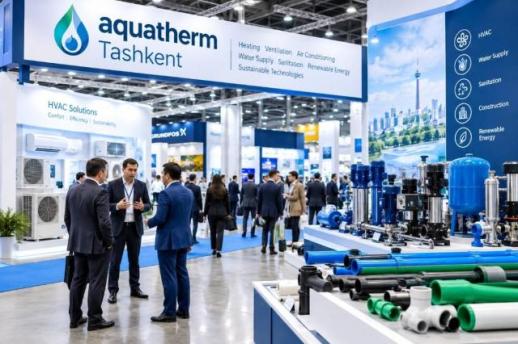 Aquatherm Tashkent 2026 draws over 200 firms from 11 countries SEOUL, October 01 (AJP) - A trade fair for heating and water systems opens in Tashkent next week. For the first time, it will include a section on wastewater treatment, as Uzbekistan faces a growing shortage of usable water. The National News Agency of Uzbekistan reported in August that the country's water deficit could reach 7 billion to 15 billion cubic meters by 2030. The agency said as much as 80 percent of Uzbekistan's water comes from rivers shared with neighboring countries. It also said up to 36 percent is lost in unlined irrigation canals. The fair, Aquatherm Tashkent, is in its 14th edition. It runs from Oct. 6 to 8 at the Uzexpocentre National Exhibition Complex. According to the organizers, more than 200 companies and brands from 11 countries will take part. The organizers said the wastewater section responds to water shortages, population growth and aging infrastructure. They also cited industrial and municipal wastewater polluting rivers and lakes. The fair covers heating, ventilation and air conditioning equipment, known in the industry as HVAC. It also covers water treatment, sewage systems, gas supply, pipes and valves, plumbing, and fittings for swimming pools and saunas. The organizers describe it as the only trade show in Uzbekistan that covers the full range of these building systems. Exhibitors come from Belarus, China, Germany, Iran, Italy, Kazakhstan, Poland, Russia, South Korea, Türkiye and Uzbekistan. Among the brands taking part are Bosch and its heating brand Buderus, air conditioner makers Daikin and Haier, and Uzbek building materials company Akfa. The organizers said equipment will be shown across a range of price segments, including affordable options for a wide range of buyers. The fair is organized by international exhibition company Iteca Exhibitions and its partner ICA Eurasia Group. It has official support from Uzbekistan's Ministry of Construction and Housing and Communal Services. The organizers expect equipment manufacturers, distributors, installers, property developers and engineering designers to attend. Representatives of construction firms and utility companies are also expected. Official delegations seeking modern water, heating and ventilation systems will attend as well. Over the three days, the program will include expert presentations, professional skills competitions and hands-on master classes. According to the organizers, Aquatherm is an exhibition brand owned by the Austrian company Wiener Messe und Congress. 2026-10-01 16:58:09
 -
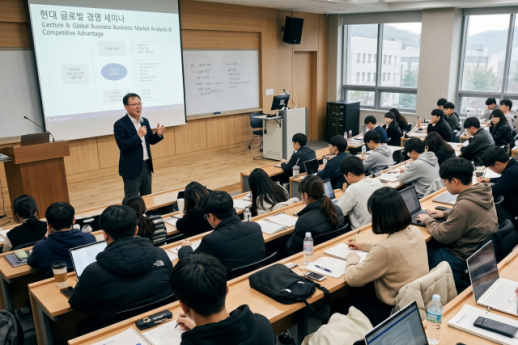 Kookmin ties humanities majors to sales, marketing jobs SEOUL, October 01 (AJP) - Humanities and social science students at Kookmin University are getting career training built around specific jobs such as sales, marketing and planning. The Seoul university is trying to help them overcome a hiring gap that has followed liberal arts graduates for years. In South Korea's latest national survey, humanities graduates had the lowest employment rate of any field. Among people who finished school in August 2023 or February 2024, 61.1 percent of humanities graduates had found work, against an average of 69.5 percent. The figures come from the Ministry of Education's graduate employment survey, released Dec. 29, 2025, with the Ministry of Data and Statistics and the Korean Educational Development Institute. Social science graduates did better at 69.0 percent. That still trailed the 70.4 percent rate for engineering and the 79.4 percent rate for medicine. South Korean students have long joked about the gap with the word "Munsonghamnida." It is a clipped form of a phrase meaning "sorry for being a liberal arts major," and it has become shorthand for the job struggles of humanities graduates. Kookmin said the core problem is that a humanities degree does not map neatly onto a job title. Its answer is to help students show employers how what they learned connects to the skills a company actually needs. The university said in a statement on Thursday it has moved away from one-size-fits-all career lectures. Instead, counselors at its University Job Plus Center, part of a government-backed network of campus career offices, find out what students want through one-on-one sessions. The center passes those needs to individual colleges, which turn them into extracurricular programs tailored to students' majors and target jobs. On Sept. 15, the College of Social Sciences ran a workshop called "Branding Myself Through a Portfolio." The university said it designed the session because portfolios are increasingly used in hiring for jobs that draw many humanities and social science graduates, such as marketing, advertising planning, service planning and television production. A working marketing designer led the session. Students learned how to turn their experience and skills into a single story, and how to plan a portfolio and use visuals to make it easier to read. Kookmin is also pitching sales and sales management as a path for liberal arts students. An introductory course set by the career center for the second half of the 2026 academic year moves step by step from what the job involves to real-world cases, customer management and job-search strategy. The course splits its advice by field. Engineering students are pointed toward technical sales, and arts and sports students toward sales jobs in industries tied to their majors. Humanities students get job-by-job strategies and road maps for applying to sales roles across a range of industries, regardless of what they studied. Over the 2026 summer break, the university ran an online marketing program taught by an industry practitioner. It covered how different social media platforms work and how to plan advertising and branding, with the stated aim of giving aspiring marketers hands-on judgment rather than theory alone. Kookmin pointed to Shin Hyo-jin, a graduate of its School of Korean Language and Literature, as an example of the approach working. She now works at Asung Daiso, which runs the Daiso discount store chain. Shin settled on sales as her goal early in her studies, the university said. Through a bank's student ambassador program and CoREP, Kookmin's hands-on career program, she worked on projects that involved selling real products and producing measurable results. According to the university, those projects became central material in her job applications. What set her apart was showing in concrete terms what she had done to prepare for the job, rather than the name of her major. Kookmin, founded in 1946, marks its 80th anniversary this year. It plans to expand its job-focused career support and tie it to entrepreneurship, which the university describes as its practical educational philosophy. It also plans to break down the boundaries between coursework, extracurricular programs and industry partnerships so that students can apply what they learn to real problems. "As the lines between industries and jobs disappear, what students need is not to limit their potential to a single major, but the ability to connect their strengths to a range of jobs," President Jeong Seung-ryul said. 2026-10-01 16:27:00
 -
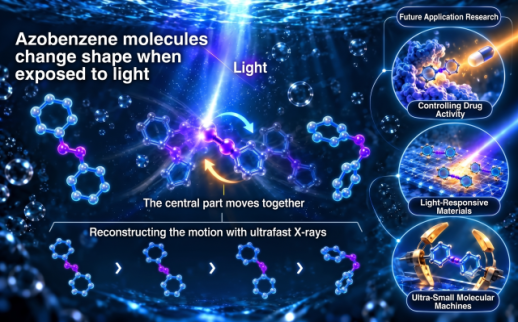 KAIST team films how light flips azobenzene switch SEOUL, October 01 (AJP) - Researchers in South Korea used ultrafast X-rays to film a light-driven molecular switch as it flipped, capturing a motion that chemists have argued over for nearly 50 years. The molecule, azobenzene, changes shape by moving its central hinge like a pair of bicycle pedals while its two bulky rings stay nearly still, a team from KAIST and the Institute for Basic Science reported Wednesday in the journal Nature. The researchers resolved the atomic structures of two in-between forms that last only picoseconds, or trillionths of a second. Azobenzene is one of the best-known molecular switches in chemistry. It consists of two benzene rings, each a ring of six carbon atoms, linked by a bridge of two nitrogen atoms. In its resting form, the rings sit on opposite sides of the bridge and the molecule is stretched out. When it absorbs light, the rings can swing to the same side and the molecule bends, without gaining or losing a single atom. That behavior has made azobenzene a standard building block in photopharmacology, a field that aims to turn drugs on and off with light. It has also been studied for materials that change shape under light and for machines built at the scale of single molecules. Chemists have long known the molecule's shape before and after the switch. What happens in between was far harder to establish, because the intermediate structures vanish almost as soon as they form. Competing explanations filled the gap. Some researchers argued that the rings rotate around the nitrogen bridge, others that the molecule bends within its own plane in a motion called inversion, and others that several parts twist together in what is known as a hula twist. Spectroscopy experiments, which track how molecules absorb light, and quantum chemistry calculations pointed in different directions. The team, led by Ihee Hyotcherl, a KAIST chemistry professor who directs the Institute for Basic Science (IBS) Center for Advanced Reaction Dynamics, ran the experiment at the X-ray free-electron laser of the Pohang Accelerator Laboratory. The machine produces extremely short, intense X-ray pulses that can freeze a molecule's motion at a single instant. The researchers dissolved azobenzene in methanol, a simple alcohol, and set off the switch with a laser pulse. They then hit the solution with X-ray pulses at precise delays and recorded how the X-rays scattered, a technique known as time-resolved X-ray liquidography. The difficulty lay in finding the molecule's signal at all. Azobenzene is made only of carbon, nitrogen and hydrogen, light atoms that scatter X-rays weakly, and the surrounding methanol produced a much stronger signal that buried it. The team applied an analysis method that separated the faint molecular signal from the solvent background, the way a listener picks out a quiet voice in a noisy room. From those measurements, it reconstructed the molecule's motion as a sequence of structures. The reconstruction showed the switch unfolding in stages. A twist at the bond between carbon and nitrogen started the motion. Rotation around the central nitrogen-nitrogen bond then took over, and inversion played a significant role in the final stage. When the researchers traced the early changes using the smallest possible atomic movements, the two rings barely moved. Instead, the two sides of the nitrogen hinge moved in step with each other, the way bicycle pedals turn together. The team said the clear structures of the intermediates end the long debate over the mechanism and capture early motions that earlier spectroscopy studies had missed. The pedal motion also answers a long-standing question. Rotation plays a major part in the switch, yet the reaction runs at nearly the same speed even when the surrounding liquid becomes thicker and more resistant to motion. Swinging the two large rings would mean pushing aside a great deal of liquid, much like turning a large piece of furniture in a narrow hallway. By the team's analysis, the pedal-like motion reduces the volume of solvent the molecule sweeps through in the early stage by about 80 percent compared with moving the rings alone. The study does not make any azobenzene-based drug or material work better, and the experiment observed the molecule in methanol only. KAIST said the work's value lies in showing the path the molecule actually takes, which researchers can use as a reference when designing light-responsive materials and molecular machines. Kim Jung-min and Ki Ho-sung, both KAIST graduates now at IBS, were co-first authors. All authors belonged to KAIST's chemistry department and the IBS center when the research was carried out. Time-resolved X-ray liquidography had been difficult to apply to organic molecules without heavy atoms, whose weak signals are easily drowned out by the solvent. The team said the azobenzene study extends the technique to such molecules in solution. "This study is an achievement that reveals the path azobenzene takes to change its shape after receiving light," Ihee said in a statement released by KAIST on Thursday. "By advancing methods for observing the motion of fast-reacting organic molecules, we expect it to contribute to understanding the working principles of various light-responsive molecules." Journal/Source: Nature Title: X-ray liquidography decodes complex motions in azobenzene isomerization Link/DOI: https://bit.ly/4iZlKv5 2026-10-01 09:09:01
 -
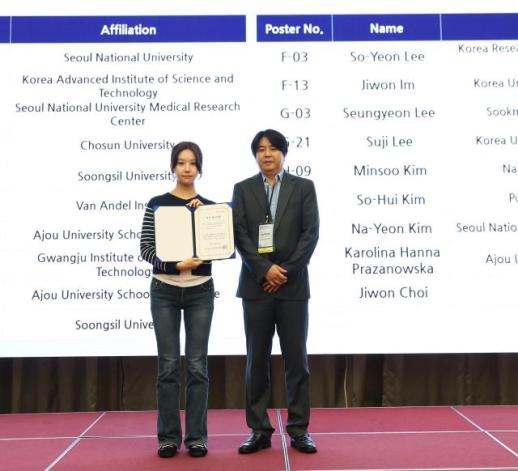 Sookmyung student wins KOGO award for AI omics work SEOUL, September 30 (AJP) - A graduate student at Sookmyung Women's University won an excellent poster award at South Korea's leading genomics conference for research on an artificial intelligence platform that helps scientists find drug targets in vast sets of biological data, the prominent university in Seoul said Wednesday. Lee Seung-yeon, a master's student in the university's Department of Biological Sciences, received the award on Sept. 5 at the Korea Genome Organization's 35th international annual conference, Sookmyung said. She is advised by Professor Yoon Suk-joon. The Korea Genome Organization (KOGO) holds the conference each year to share the latest research in genomics and bioinformatics, the field that uses computing to make sense of biological data. Lee's poster was titled "Biological intelligence for target, biomarker and mechanism discovery from omics data." The research introduced Q-omics, an AI-based platform built to mine omics data. Omics refers to large-scale measurements of a cell's molecules, such as every gene it carries or every protein it makes. A single study can produce millions of data points. According to the university, Q-omics lets researchers analyze that data without running complex computational work themselves. It is designed to identify therapeutic targets, the genes or proteins a drug can act on, and biomarkers, the measurable signs in the body that indicate disease or how a patient responds to treatment. The core of the work is how the AI model learns. The researchers built a biological ontology, a structured catalog of what genes are known to do and how those functions relate, directly into the model's learning structure. Earlier approaches focused on analyzing genes one at a time. Q-omics instead learns the functional relationships among genes within their biological context, the university said. From that, it can map the gene interactions and functional modules, groups of genes that work together, that appear in a specific disease. Sookmyung said it expects the approach to help find target genes and biomarkers for treating disease, predict how patients respond to drugs, and explain how diseases develop and progress. Defaults applied since the open items were not settled: Lee Seung-yeon as the romanization and Department of Biological Sciences as the department name, taken from Yoon's published affiliation. Swap either if Sookmyung uses something different. 2026-09-30 14:38:46
 -
 Trump calls Kim friend, cites large nuclear arsenal SEOUL, September 30 (AJP) - A day after insisting Iran "cannot have a nuclear weapon," United States President Donald Trump called North Korean leader Kim Jong-un a friend on Tuesday and acknowledged his "pretty large nuclear capacity," claiming the nuclear regime could be contained as long as he was in power. On Aug. 19, Trump claimed North Korea had "57 very powerful nuclear weapons," without citing the source of the claim while then-South Korean defense minister Ahn Gyu-back gave lawmakers a higher estimate of 80 to 120 weapons. Speaking to reporters on the White House driveway after a luncheon with technology executives in the East Room. the U.S. president blamed his predecessors for failing to stop North Korea's weapons program, then turned to his personal ties with Kim. "He's a friend of mine. He likes Trump," he said, adding later, "And I like him." After acknowledging that Kim "does have a pretty large nuclear capacity," he offered an assurance. "As long as I'm around, he's going to be fine," President Trump said. His assurance about Kim repeated one he gave last month. On Aug. 19, while touring a new helipad on the South Lawn, President Trump told reporters, "I know Kim Jong-un very well, and he's going to be fine as long as we have a smart president." He also said he would meet Kim before the end of the year. Those remarks came three days after he ordered the Pentagon to "substantially reduce" Ulchi Freedom Shield, the annual combined military exercise between South Korea and the United States. The drills had been scheduled to run 11 days from Aug. 17. They ended after five. Pyongyang answered with mixed signals. In a statement carried by state media on Aug. 20, Kim Yo-jong, the North Korean leader's sister, said she was "not aware" of President Trump's claim that he was in contact with Kim. She called the drill reduction "unworthy of comment" but said Kim had "good memories and feelings" about President Trump personally. Trump did not mention North Korea in his Sept. 22 address to the United Nations General Assembly in New York. He devoted parts of that speech to Iran, Cuba and Venezuela. He is scheduled to travel to Shenzhen, China, for the Asia-Pacific Economic Cooperation summit on Nov. 18 and 19, after accepting an invitation from Chinese President Xi Jinping. President Trump and Kim have met three times. They met in Singapore in June 2018, in Hanoi in February 2019 and at Panmunjom on the inter-Korean border in June 2019, and none of those meetings produced an agreement to curb North Korea's nuclear program. AJP Takeaways - President Donald Trump called North Korean leader Kim Jong-un a friend at the White House on Tuesday, acknowledged his "pretty large nuclear capacity," and said Kim would be fine as long as Trump is around, a day after insisting Iran "cannot have a nuclear weapon." - President Trump made a nearly identical pledge on Aug. 19, when he put North Korea's arsenal at "57 very powerful nuclear weapons" and said he would meet Kim before the end of the year, three days after ordering the Pentagon to substantially reduce the Ulchi Freedom Shield exercise with South Korea. - South Korean Defense Minister Ahn Gyu-back gave lawmakers a higher estimate of 80 to 120 North Korean nuclear weapons on Aug. 20, the same day Kim Yo-jong, the North Korean leader's sister, said in state media that she was "not aware" of President Trump's claimed contact with Kim. Both details were added by AJP from the public record beyond the original wire report. 2026-09-30 11:07:28