

Journalist
Park Sae-jin박세진
swatchsjp@ajupress.com
Assistant EditorForeign embassies in Seoul & Geopolitics, Diplomacy, Policy
Experienced journalist and editor at AJU PRESS specializing in multilingual news. I cover international diplomacy, geolpolitics, and policy, consistently delivering highly accurate, compelling reporting for a worldwide audience.
"Reporting the facts. Shaping the narrative. Every second counts."
Latest by Park Sae-jin
-
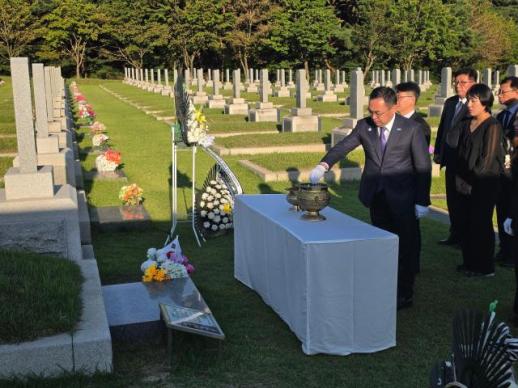 Kazakh minister honors independence hero Hong Beom-do SEOUL, September 16 (AJP) - Kazakhstan's culture minister burned incense on Wednesday at the grave of Hong Beom-do, the Korean independence commander who died in exile in Kazakhstan. The visit came a day after he signed an agreement with South Korea to preserve sites linked to the Korean independence movement. Arman Kyrykbayev, Kazakhstan's Minister of Culture and Information, signed the memorandum of understanding on Sept. 15 with Kwon Oh-eul, South Korea's Minister of Patriots and Veterans Affairs. The signing took place at Cheong Wa Dae in Seoul, with President Lee Jae Myung and Kazakh President Kassym-Jomart Tokayev looking on. At their summit the same day, Lee told President Tokayev that the return of Hong's remains in 2021 had deepened trust between the two countries. Kyrykbayev is in South Korea as part of President Tokayev's state visit. On arriving at Daejeon National Cemetery, about 160 kilometers south of Seoul, he went first to the Memorial Tower and burned incense. He then moved to Hong's grave in the cemetery's third section for independence patriots and burned incense there as well. At the grave, Na Chi-man, Deputy Minister for Patriots and Veterans Culture Policy at the Ministry of Patriots and Veterans Affairs, thanked Kazakhstan for its role in bringing Hong home. He said the ministry would keep caring for the grave and would also look after the Hong Beom-do Memorial Park in Kyzylorda, the Kazakh city where Hong had been buried. Na called Hong "a symbol of friendship between Kazakhstan and the Republic of Korea." "May the spirits of the ancestors be pleased," Kyrykbayev replied. He said Hong's heroic deeds should serve as an example of patriotism for "all the youth of the Korean people, and not only Koreans, but youth of other nations as well." He described the visit as part of President Tokayev's official program. "Within this framework, of course, we pay homage to such sacred figures," he said, and wished on behalf of President Tokayev and the Kazakh people that "the friendship and brotherhood between our two countries continue to flourish." Kyrykbayev spoke to AJP in Kazakh that Hong had fought for his homeland's freedom and later came to Kyzylorda along with many other Koreans, living and working there until his death. "On one hand, it is paying tribute to the past," he said of the return of Hong's remains. "On the other hand, it signifies how both Koreans and we Kazakhs love our history, our people, and our homeland." He then cited a Kazakh saying that calls for honoring the past. "Great historical figures like him will continue to further strengthen the friendship between our two countries," he said. Hong is one of the most revered figures in South Korea's struggle against Japanese colonial rule, which lasted from 1910 to 1945. In Kazakhstan, he became a symbol of identity for a Korean community that Soviet authorities had uprooted and sent to Central Asia. He was born into a poor family in 1868, in Pyongyang, by his own account, and lost both parents as a child. He joined the army in Pyongyang as a young man and later made his living as a hunter in the mountains of northern Korea. In September 1907, Japan issued a law to confiscate guns held by civilians, including hunting rifles. That November, Hong gathered fellow hunters into a militia and began attacking Japanese troops in guerrilla raids across the northern provinces. The fight cost him his family. Japanese authorities seized his wife to pressure him into surrendering, and she died in prison after torture. His eldest son was later killed in battle. After Japan annexed Korea in 1910, Hong moved his base to Manchuria and the Russian Far East. In June 1920, as commander of the Korean Independence Army, he led an ambush against a Japanese battalion at Fengwudong, known in Korean as Bongo-dong, in northeastern China. It was the first large-scale victory by Korean independence forces. That October, his troops fought alongside Kim Jwa-jin's units in the Battle of Qingshanli, another defeat for the Japanese army. Hong later settled in the Soviet Far East, where he led Korean farming communities, and joined the Soviet Communist Party in 1927. In 1937, Soviet leader Joseph Stalin ordered the forced relocation of 171,781 ethnic Koreans from the Far East to Central Asia. Hong, then 69, was among them and was sent to Kazakhstan. In Kyzylorda, he worked as a guard at the Korean Theater and later at a rice mill. He died there on Oct. 25, 1943, at age 75, two years before Korea won its independence. The deported Koreans and their descendants in the former Soviet Union call themselves Koryo-saram. For about 40 years, the Korean community in Kyzylorda tended Hong's grave and kept it as a place to honor him. After Kazakhstan gained independence in 1991, both South Korea and North Korea sought his remains. Pyongyang argued that he belonged in his birthplace. Seoul pressed the case at the presidential level, and Kazakhstan agreed. The remains arrived at Seoul Air Base on Aug. 15, 2021, South Korea's Liberation Day, escorted by six fighter jets. Two days later, Hong was posthumously awarded the Republic of Korea Medal, the highest grade of the Order of Merit for National Foundation, at a ceremony President Tokayev attended. President Tokayev also handed over Hong's death certificate and his letter of resignation from the Korean Theater. In November 2023, South Korea's veterans ministry opened a memorial park on the site of Hong's former grave in Kyzylorda. Hong was buried in Daejeon on Aug. 18, 2021, 78 years after his death. The funeral wreath combined carnations, Kazakhstan's flower of mourning, with chrysanthemums, South Korea's. Soil from his grave in Kyzylorda, which President Tokayev had brought to Seoul, was mixed with Korean soil and scattered over his coffin. AJP Takeaways - Kazakhstan's Minister of Culture and Information Arman Kyrykbayev burned incense at the Memorial Tower and at the grave of Korean independence hero Hong Beom-do at Daejeon National Cemetery on Sept. 16, a day after signing an agreement with South Korea to preserve independence movement sites. - Kwon Oh-eul, South Korea's Minister of Patriots and Veterans Affairs, signed that memorandum of understanding with Kyrykbayev at Cheong Wa Dae on Sept. 15, with President Lee Jae Myung and Kazakh President Kassym-Jomart Tokayev looking on. - Kyrykbayev said the return of Hong's remains in 2021 was both a tribute to the past and a sign that Koreans and Kazakhs love their history, their people and their homeland. He made the remarks in Kazakh at the grave in response to a question from AJP. 2026-09-16 18:15:16
 -
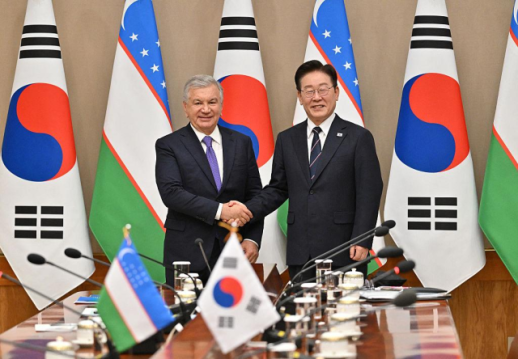 Op-Ed: Uzbekistan in new industrial architecture of C5+1 Editor's Note: The following opinion article was contributed by the Embassy of Uzbekistan in Seoul. The first "Central Asia-Republic of Korea" Summit in Seoul gives the C5+1 format a more substantive economic dimension. The new agenda focuses on industrial modernization, infrastructure, critical minerals and energy, human capital development, and private-sector participation. An important institutional basis for this work is provided by a dedicated consultative mechanism of industry ministers, aimed at maintaining regular sectoral dialogue, identifying joint initiatives, and developing a list of priority projects. In this way, the national industrial priorities of Central Asian countries have an opportunity to be aligned with the technological and investment capabilities of the Republic of Korea at the level of specific production chains. Technology, infrastructure, financing, and markets come together here as an integrated system for implementing major joint initiatives. The potential of this model is particularly evident in the case of Uzbekistan. Relations between Tashkent and Seoul have held the status of a special strategic partnership since 2019, while the accumulated volume of direct Korean investment in Uzbekistan's economy has exceeded USD 8 billion. In January–June 2026, bilateral trade approached USD 1 billion, increasing by 11.5 percent. Behind these figures lies an already established technological foundation for the partnership. Joint centers are operating in Uzbekistan in the textile industry, rare metals and alloys, agricultural machinery, and e-government, while cooperation in chemical technologies and construction is also developing. This network creates sustainable channels for the transfer of engineering solutions, practical knowledge, and production experience. The accumulated foundation makes it possible to focus Uzbekistan's C5+1 agenda on further developing processing, localization, technological upgrading, and the production of high-value-added goods. At the same time, the regional format expands the range of potential partners and connections between enterprises of Central Asian countries and Korean businesses. One of the most promising areas is related to critical minerals. Cooperation covers the entire technological chain - geological exploration, processing, refining, and the development of value-added production. Under such a model, Central Asia's mineral resource base becomes a starting point for deepening technological ties and creating new industries within the region. Uzbekistan already has a concrete foundation in this area. The Uzbek-Korean Scientific and Technological Center for Rare Metals and Alloys is operating in the country. Its potential makes it possible to develop cooperation in materials science, processing technologies, research, and specialist training, with prospects for their further industrial application. The development of more sophisticated industries simultaneously increases infrastructure requirements. Within the C5+1 agenda, this area includes energy, industrial complexes, transport and logistics, urban infrastructure, as well as the entire life cycle of major projects - from planning and construction to modernization and operation. For investors, this means the opportunity to consider an industrial site together with the necessary energy, engineering, and logistics solutions. Uzbek-Korean cooperation already has a financial foundation for implementing projects of this scale. The cooperation program between Uzbekistan and the Economic Development and Cooperation Fund of the Republic of Korea (EDCF) for 2024~2027 has been established at USD 2 billion. At the same time, a new portfolio of initiatives is being developed, and financing mechanisms without state guarantees and on the basis of public-private partnerships are being explored. The expansion of available financial instruments creates greater space for commercially viable projects, private capital, and long-term partnerships between companies. This is particularly important for industrial and infrastructure cooperation with long investment cycles, where the financing structure largely determines the possibilities for project implementation and subsequent expansion. As production becomes increasingly technologically sophisticated, requirements for skilled specialists also grow. The development of professional skills and human capital is among the priorities of the C5+1 industrial mechanism. Uzbekistan already has a practical foundation in this area: four vocational education centers established with the participation of the Korea International Cooperation Agency are operating in Tashkent, Fergana, Shakhrisabz, and Samarkand, while another center is under construction in Urgench. Further development of this model largely moves to the company level. It is here that technologies and accumulated knowledge are transformed into new production facilities, while sectoral priorities become investment decisions and commercial products. Therefore, the private sector, financial institutions, and research organizations play an important role in C5+1 industrial cooperation. The development of a list of priority projects gives this work practical consistency. Such an instrument makes it possible to link promising areas with specific partners and sources of financing and to support their advancement between meetings of the industrial mechanism. Uzbekistan is entering the new regional architecture with a substantial practical foundation: many of its elements are already functioning within bilateral cooperation with Korea. Investment is combined with technological centers, financial programs, a specialist training system, and experience in implementing complex projects. C5+1 makes it possible to bring this foundation to a broader level by connecting the national capabilities of Central Asian countries through new production linkages. This is where the main economic potential of the Seoul Summit for Uzbekistan lies. The special strategic partnership with the Republic of Korea is gaining a regional dimension through deeper processing, technological localization, new production facilities, and access of finished products to new foreign markets. The accumulated Uzbek-Korean experience is becoming one of the practical elements of the industrial architecture of C5+1, strengthening Uzbekistan's role in the Republic of Korea's technological and industrial partnership with Central Asia. The views and opinions expressed in this article are solely those of the contributor and do not necessarily reflect the editorial position, analysis, or views of AJP, its editors, or its parent organization. AJP publishes contributed opinion pieces from governments, diplomatic missions, experts, and other external contributors as part of its commitment to presenting diverse international perspectives. Publication does not constitute endorsement of the opinions or factual claims contained in the article. 2026-09-16 15:19:23
 -
 Korea, Kazakhstan sign oil, nuclear fuel deals and upgrade ties SEOUL, September 15 (AJP) - South Korea and Kazakhstan agreed Tuesday to cooperate on Kazakh crude oil supply and nuclear fuel, as the two countries raised their relationship to a Comprehensive Strategic Partnership at a summit in Seoul. The agreements build on an economic relationship that is already substantial. Trade between the two countries topped $3 billion last year, and total South Korean direct investment in Kazakhstan has passed $12 billion, Kazakh President Kassym-Jomart Tokayev told business leaders in Seoul the same day. After talks between President Lee Jae Myung and President Tokayev, the two governments signed 13 documents covering energy, nuclear power, intellectual property, forestry, urban development and historical preservation. Under a basic arrangement on crude oil cooperation, the two sides will work together on supplying Kazakh crude, geological exploration and the development of oil and gas fields. They also agreed to prepare for and respond to disruptions in global oil supply, and to cooperate on petrochemical research and workforce training. The South Korean government said the arrangement would strengthen practical, mutually beneficial cooperation across the value chain of Kazakhstan's oil sector, from oil field development to petrochemicals. The two countries also expanded cooperation on nuclear power through two memorandums of understanding. Under the first, they agreed to conduct joint research on nuclear power plants and small modular reactors, which are compact reactors built largely from factory-made parts and designed to be deployed faster than conventional plants. The agreement also covers the exchange of nuclear industry policy information, technical support on nuclear and radiation safety, and training and exchanges for scientists and engineers. Seoul said the memorandum created a framework for cooperation across the full cycle of nuclear power and expected it to support South Korean companies seeking to enter new nuclear power projects in Kazakhstan. The second memorandum centered on fuel. The two sides will work to secure stable nuclear fuel supply chains, share experience on nuclear programs and safety, and cooperate on nuclear research and workforce development. Kazakhstan is the world's largest producer of uranium, the raw material for nuclear fuel. The South Korean government said closer supply chain ties with Kazakhstan would strengthen the country's energy security and extend nuclear cooperation between the two nations into every area of the field. Other memorandums cover battery energy storage systems, power grid stabilization, the development and modernization of transmission and distribution networks, and clean hydrogen and ammonia supply chains. They also include commitments to a friendly, transparent and predictable investment environment and to joint research on renewable energy. Beyond energy, the two countries agreed to cooperate on the permanent preservation and management of sites in Kazakhstan linked to the Korean independence movement against Japanese colonial rule, along with joint academic research on those sites. Gen. Hong Beom-do, a commander in the armed struggle against Japan, died in Kyzylorda, Kazakhstan, in 1943, and his remains were returned to South Korea in 2021. The remaining memorandums address intellectual property protection and the prevention of counterfeit goods, forest restoration and climate response, and urban development. At the opening of the Kazakhstan-Korea Business Roundtable in Seoul, President Tokayev told executives from both countries that Astana and Seoul had built their relations over three decades on mutual respect, trust and friendship. "Today, Korea is among Kazakhstan's largest trade and investment partners," he said. "We highly value the productive presence of major Korean companies and will continue to strengthen this positive trend." President Tokayev said bilateral trade could double through joint efforts by the two governments and their companies. He praised Korean investors as "among the most determined and courageous leaders in investment" and pointed to the scale of their presence in his country. "More than 1,000 companies with Korean capital operate in our country, including Samsung, Kia, Hyundai, Lotte, Doosan Enerbility and Shinhan Bank," President Tokayev said. He described his trip as a chance to build on past gains. "This visit provides a good opportunity to consolidate the progress achieved and give new impetus to bilateral cooperation," President Tokayev said. AJP Takeaways - South Korea and Kazakhstan upgraded ties to a Comprehensive Strategic Partnership on Sept. 15 and signed 13 documents, led by a crude oil arrangement that includes joint preparation for global oil supply disruptions and two nuclear memorandums covering reactor research and stable nuclear fuel supply chains with the world's largest uranium producer. - Kazakh President Kassym-Jomart Tokayev told Korean and Kazakh executives at the Kazakhstan-Korea Business Roundtable in Seoul that bilateral trade, which topped $3 billion last year, could double, and said more than 1,000 companies with Korean capital, including Samsung, Kia and Hyundai, operate in his country. - Gen. Hong Beom-do, an independence commander who died in Kyzylorda, Kazakhstan, in 1943, is part of the history behind a new agreement to preserve Korean independence movement sites in Kazakhstan, background that AJP added beyond the South Korean government's list of signed documents. 2026-09-15 20:20:21
 -
 Aju News Corporation Signs Media Cooperation Agreement with Kazinform Media organizations from South Korea and Kazakhstan have agreed to exchange articles and videos and collaborate on content creation. This agreement was reached just hours before a meeting between the leaders of the two countries.Aju News Corporation signed a memorandum of understanding on September 15 at its headquarters in downtown Seoul with the TV and Radio Complex, a state-owned enterprise under the Kazakhstan presidential office. Chairman Kwak Young-gil and Kazinform President Raushan Kazhibayeva signed the agreement. The TV and Radio Complex oversees Kazinform, the national news agency of Kazakhstan, and the international broadcasting channel Zhibek Zholy.Aju News Corporation publishes news in Korean and English through its AJP platform and is part of Aju Media Group, which also provides news in Chinese, Japanese, and Vietnamese.The agreement coincides with a busy diplomatic week, as Kazakhstan President Kassym-Jomart Tokayev is visiting South Korea as a state guest. A summit with President Lee Jae-myung is scheduled for the afternoon of the signing day. On September 16, President Lee will host a summit with the leaders of Kazakhstan, Kyrgyzstan, Tajikistan, Turkmenistan, and Uzbekistan in Seoul, where the six nations are expected to adopt the 'Seoul Declaration' outlining a framework for long-term cooperation.Under the agreement, both companies will exchange news content while ensuring proper attribution. They will also collaborate on content creation and open their respective correspondent networks upon request. The scope of cooperation includes employee training, internships, distribution of domestic and international media, and support for production equipment. Costs incurred will be determined through separate contracts, and the agreement does not impose financial burdens on either party.Kazhibayeva emphasized that this agreement is not just a bilateral matter. She stated, "This agreement will serve as a gateway to Central Asian countries and open new avenues for cooperation between media companies."Kazinform has reporters across all 17 regions of Kazakhstan and operates offices in Russia, China, Turkey, Europe, Azerbaijan, Uzbekistan, Kyrgyzstan, and Jordan. Its headquarters in Astana publishes articles in Kazakh, Russian, English, Chinese, and Uzbek.The agency began in August 1920 as a regional branch of the Russian telegraph agency and has undergone several name and ownership changes since then. In 2022, it became part of the TV and Radio Complex under the presidential office, and the following year, it was restructured into its current state-owned enterprise form. The operating costs of its affiliated media are funded by the national budget.Kazhibayeva has led the organization since April 2022, previously serving as an advisor to the Prime Minister of Kazakhstan and head of the Ministry of Defense's public relations office.Chairman Kwak highlighted the importance of bridging the gap between the peoples of the two nations. He remarked, "The relationship between Korea and Kazakhstan has a long history, but there remains a significant gap between our peoples. Through this cooperation agreement, Aju News Corporation and Kazinform aim to connect our two countries and bring our peoples closer together."The ties between the two nations predate their diplomatic relations established on January 28, 1992. According to the Ministry of Foreign Affairs, there are 119,542 ethnic Koreans living in Kazakhstan, most of whom are descendants of Koreans forcibly relocated to Central Asia from the Soviet Far East in 1937. Next year marks the 90th anniversary of this forced relocation, and the government plans to increase Korean language and cultural education in the region.* This article has been translated by AI. 2026-09-15 16:12:10
 -
 Two hearts drive Kazakhstan - Almaty and Astana In 1997, when the government announced it was moving the capital, the reaction abroad was skeptical. The site chosen sat in the middle of the steppe and held fewer than 300,000 people. Countries that relocate a capital usually see one of two outcomes. The old capital loses its energy, or the new one hardens into a town of civil servants. Kazakhstan avoided both. The two cities split the work, and together they generate roughly 35 percent of national gross domestic product. Almaty took commerce and talent. It drew $8.58 billion in gross foreign direct investment last year, more than twice Astana's total, and services account for 85.9 percent of its gross regional product. South Korean manufacturers landed there too. Hyundai Motor assembles cars at a plant in Almaty with local partner Astana Motors, at an annual capacity of 80,000 vehicles. Kazakhstan is South Korea's largest trading partner in Central Asia, with two-way trade of $5.5 billion in 2023. Astana took a different route. Rather than chase what Almaty had, it built what did not exist. The Astana International Financial Centre (AIFC), which opened in 2018, carved out a zone where English common law applies instead of national law, with its own court, regulator and exchange. For a foreign investor, that settles in advance which court rules if a contract goes wrong. Registered companies reached 6,014 by midyear, 45 percent of them with foreign investors, and capital mobilized since opening stands at $26.3 billion. In the Global Financial Centres Index in March, Astana placed 65th worldwide and first across Eastern Europe and Central Asia. Almaty ranked 99th. The gap describes a division rather than a hierarchy. Astana laid a legal channel through which foreign capital can enter with confidence, and Almaty holds the market where that capital is put to work. Equity market capitalization at the Kazakhstan Stock Exchange in Almaty stood at about $76 billion at the end of last year. South Korean firms work the transport side too. SK Ecoplant and the Korea Expressway Corporation built the Almaty ring road with a Turkish contractor. Air Astana flies Incheon to Almaty daily, Asiana Airlines resumed the route in March, and Korean Air begins flying it on Dec. 17. The town on the steppe has passed 1.5 million residents. Astana added more than 110,000 people last year alone, a rise of 7 percent, and now produces about $37.6 billion in output a year. 2026-09-15 16:00:00
 -
 Aju, Kazinform in media deal amid Korea-Central Asia Summit SEOUL, September 15 (AJP) - A South Korean media company and Kazakhstan's state news agency agreed on Tuesday to share and jointly produce news content, opening a direct channel between the two countries' newsrooms hours before their leaders were to meet in Seoul. The memorandum of understanding was signed at Aju News Corporation's headquarters in central Seoul by Chairman Kwak Young-kil and Raushan Kazhibayeva, who directs the Republican State Enterprise "TV & Radio Complex of the President of the Republic of Kazakhstan." The complex owns Kazinform International News Agency, the country's official wire service, along with the Jibek Joly television channel. Aju News Corporation publishes AJP in English alongside its Korean-language news operations and is part of Aju Media Group that publishes news in other languages including Chinese, Japanese and Vietnamese. The signing came during the heaviest week of diplomatic traffic between the two countries in years. President Kassym-Jomart Tokayev is in Seoul on a state visit and was scheduled to hold bilateral talks with President Lee Jae Myung on Tuesday afternoon. On Wednesday, President Lee Jae Myung hosts the first Korea-Central Asia Summit with the leaders of Kazakhstan, Kyrgyzstan, Tajikistan, Turkmenistan and Uzbekistan, where the six governments are expected to adopt a Seoul Declaration setting out a long-term partnership framework. Under the terms of the agreement, the two organizations will exchange news content and credit each other as the source, produce material together, and open their correspondent networks to each other on request. It also covers staff training and internships, distribution of each other's output at home and abroad, and the sharing of production equipment. Costs for any of that work would be set in separate contracts, and the memorandum itself creates no financial obligation on either side. Kazhibayeva framed the deal as an opening to the wider region rather than a bilateral arrangement. "This agreement will become a gateway for Central Asian countries, opening doors to new cooperation between media companies," she said. AJP Takeaways - Kazinform Director Raushan Kazhibayeva signed a memorandum of understanding with Aju News Corporation Chairman Kwak Young-kil in Seoul on Sept. 15 under which the two organizations will exchange and co-produce news content, credit each other as the source, open their correspondent networks on request, and cooperate on staff training, distribution and production equipment, with no financial obligation created by the document itself. - Kazinform operates as part of a state enterprise supervised by Kazakhstan's presidential office that also owns the Jibek Joly television channel, is financed from the state budget, and runs correspondents in all 17 of Kazakhstan's regions plus bureaus in Russia, China, Türkiye, Europe, Azerbaijan, Uzbekistan, Kyrgyzstan and Jordan. - South Korea's foreign ministry counts 119,542 ethnic Koreans living in Kazakhstan, most of them Koryo-saram descended from those deported from the Soviet Far East in 1937, an anniversary the government plans to mark next year by expanding Korean language and culture programs in the region. AJP drew those figures and plans from foreign ministry data and government announcements rather than from the signing itself. Kazinform runs correspondents in all 17 of Kazakhstan's regions and maintains bureaus in Russia, China, Türkiye, Europe, Azerbaijan, Uzbekistan, Kyrgyzstan and Jordan. It publishes in Kazakh, Russian, English, Chinese and Uzbek from its headquarters in Astana. The agency traces its founding to August 1920, when it began as a regional branch of the Russian Telegraph Agency, and it has operated under several names and owners since. In 2022 it was folded into the presidential television and radio complex, and the following year the complex was reorganized into the state enterprise that holds it today. Its outlets are financed from the state budget. Kazhibayeva has led the complex since April 2022. She served as an adviser to Kazakhstan's prime minister and headed the public relations department at the country's Defense Ministry before taking the post. Kwak turned to the distance between the two publics rather than between the two governments. "South Korea and Kazakhstan go back a long way, but a wide gap still separates the two peoples. I hope this agreement closes that gap and brings them closer," Kwak said. Those ties predate the establishment of diplomatic relations on Jan. 28, 1992. Kazakhstan is home to 119,542 ethnic Koreans, according to South Korea's foreign ministry, most of them Koryo-saram descended from Koreans deported from the Soviet Far East to Central Asia in 1937. Next year marks the 90th anniversary of that forced resettlement, and the South Korean government has said it plans to expand Korean language and culture programs in the region to mark it. 2026-09-15 15:57:21
 -
 Korea courts Uzbekistan on minerals before Central Asia summit SEOUL, September 14 (AJP) - Critical minerals, high-speed rail and defense exports drove the opening round of South Korea's Central Asia summit week on Monday. President Lee Jae Myung received Uzbek President Shavkat Mirziyoyev at Cheong Wa Dae, the first of five regional leaders arriving in Seoul. Hours earlier, the industry ministry had convened the first Korea-Central Asia industry ministers' meeting at a hotel in central Seoul. The industry chiefs of Kazakhstan, Kyrgyzstan, Tajikistan, Turkmenistan and Uzbekistan sat at one table for the first time. The six governments agreed to build supply chains covering the full cycle from mining and smelting through materials processing to finished goods, pairing Central Asian lithium and rare earths with South Korean processing technology, the ministry said. Uzbekistan is one of the larger resource holders in that group. It ranks as the world's fifth-largest uranium producer, with output estimated at 4,000 tonnes in 2024 by the World Nuclear Association, and its state producer Navoiyuran reported 7,000 tonnes last year. Korean buyers have been in that market before. Korea Electric Power Corporation agreed in 2008 to buy 2,600 tonnes of Uzbek uranium over six years for about $400 million. Lee opened the talks by pointing to the length of the relationship. He said the two countries had built a very solid partnership since establishing diplomatic relations in 1992, and called Uzbekistan an invaluable friend and a core partner, the only country in Central Asia that holds a special strategic partnership with South Korea. That designation dates to April 2019, when then President Moon Jae-in traveled to Tashkent and signed a joint declaration raising the relationship above the strategic partnership level the two sides had held until then. No other Central Asian capital carries the label. "From transport infrastructure, health care and climate crisis response to critical mineral supply chains, artificial intelligence, digital and the defense industry, we will be able to widen the horizon of mutually beneficial cooperation and drive the engines of future growth together," Lee said. The two governments signed 13 agreements and memorandums of understanding after the talks. The Export-Import Bank of Korea and Uzbekistan's investment, industry and trade ministry agreed to jointly identify projects across the six sectors Tashkent has designated as national strategic industries. Those include critical minerals, data centers, smart cities, pharmaceuticals and biotechnology, and an industrial park reserved for Korean companies, with project and commercial financing attached. Separate memorandums covered the introduction of eight high-speed trainsets and the creation of Uzbekistan's national genome and biobank center. The two sides also signed an expanded defense industry cooperation contract, a treaty on the transfer of sentenced persons, and a protocol revising the framework agreement on grant aid. Further documents dealt with border enforcement against counterfeit goods, tourism, agricultural technology transfer, AI in manufacturing, medical product regulation, and digital forest restoration aimed at the desertification of the Aral Sea basin and the water disputes that cross Central Asian borders. One of the education memorandums will add Korean as a formal subject in the national academic olympiad the Uzbek government runs, which Cheong Wa Dae expects to lift the standing of the language among students there. Mirziyoyev answered with an economic compliment and a commercial number. He called South Korea a shining community that achieved an economic miracle in a short span of time and said Uzbekistan holds a special affection for the country. More than 700 Korean companies operate in Uzbekistan through joint ventures, he said, with Korean investment still expanding and Korean technology shared across electronic government, education, information technology, agriculture and health care. The Uzbek president traced the relationship considerably further back. A mural showing a Samarkand ruler receiving envoys from Goguryeo, the kingdom that controlled the northern Korean Peninsula and much of Manchuria until 668, proves that the shared history of the two countries is rooted in the Silk Road era, he said, dating the painting to the 10th century. The work he referred to is the Afrasiab cycle, uncovered in 1965 during road construction on the mound of pre-Mongol Samarkand and now held in a museum on the site. Scholars date it to the middle of the seventh century, most often to between 648 and 651. Its western wall shows King Varkhuman receiving delegations from Tang China, Chach, Chaghaniyan and, in the reading long favored by Korean historians, Goguryeo. Some specialists dispute that identification. Lee devoted part of his remarks to the ethnic Korean community in Uzbekistan. "Uzbekistan is a very special country to our people, a place where as many as 200,000 Koryoin have made their lives," he said, using the term for the ethnic Koreans of the former Soviet Union. "Our people always keep a grateful heart toward the people of Uzbekistan, who embraced our compatriots warmly in difficult times," Lee said. Most of those families arrived in 1937, when Soviet authorities deported more than 170,000 ethnic Koreans from the Russian Far East to Central Asia in freight cars over a matter of weeks and left them on open ground in what are now Uzbekistan and Kazakhstan. Many died in the first winters, and their descendants form the largest Korean community in the region. Lee also argued that the uncertainty running through international affairs has raised the value of relationships built on trust, and said cooperation between the two countries would strengthen peace and stability in Eurasia and on the Korean Peninsula. Mirziyoyev responded in kind on the security question. Uzbekistan will continue to support the South Korean government's efforts to consolidate peace and security on the peninsula without wavering, he said, adding that the two countries have kept friendly relations through political ups and downs in both capitals. He also said he is watching Lee's drive to turn South Korea into a hub leading the fourth industrial revolution, and described the president as a leader with experience and a practical eye. The Uzbek president arrived on a state visit and was welcomed at Cheong Wa Dae with a formal ceremony in the afternoon, followed by a state dinner for about 50 guests from both countries. Lee meets the presidents of Turkmenistan and Kazakhstan on Tuesday and those of Tajikistan and Kyrgyzstan on Wednesday. He chairs the first Korea-Central Asia Summit later that day, where the six governments are to adopt a Seoul Declaration on the direction of their cooperation and raise a consultative channel that has run at the ministerial level to the level of heads of state. AJP Takeaways - Lee Jae Myung and Shavkat Mirziyoyev signed 13 agreements and memorandums at Cheong Wa Dae on Monday covering critical minerals, eight high-speed trainsets, expanded defense industry cooperation and a prisoner transfer treaty, opening three days of back-to-back summits with five Central Asian leaders. - Kazakhstan, Kyrgyzstan, Tajikistan, Turkmenistan and Uzbekistan sent their industry ministers to the first Korea-Central Asia ministerial meeting in Seoul the same day, where the six governments agreed to link Central Asian lithium and rare earths to South Korean smelting and materials processing across the full supply chain. - The World Nuclear Association ranks Uzbekistan as the world's fifth-largest uranium producer at roughly 4,000 tonnes in 2024, and Korea Electric Power Corporation contracted for 2,600 tonnes of Uzbek uranium in 2008 for about $400 million. Neither figure appeared in the summit materials and both were verified by AJP against World Nuclear Association data. 2026-09-14 20:43:36
 -
 ADB backs Korean minerals push in Central Asia SEOUL, September 14 (AJP) - The search for critical minerals in Central Asia picked up a lender on Monday, when the Asian Development Bank said it was ready to co-finance South Korean projects across the region, two days before the first Korea-Central Asia Summit opens in Seoul. The Asian Development Bank (ADB) is Uzbekistan's largest investor, with more than $15 billion in cumulative assistance, and agreed this year on an indicative country program worth $12.4 billion running from 2026 through 2030. Uzbekistan is where South Korea has concentrated its minerals effort. Deputy Prime Minister and Minister of Finance and Economy Koo Yun-cheol met ADB President Masato Kanda at the government complex in Seoul on Monday morning, in Kanda's first visit to South Korea since he took office. Koo heads a ministry reorganized out of the old planning and finance ministry in 2025, with budget authority moved to a separate agency reporting to the prime minister. Koo said cooperation with the bank on climate technology, artificial intelligence and critical minerals had to turn into "tangible results," and proposed widening it across Central Asia off the back of the summit and a separate bilateral meeting with Uzbekistan. On minerals, he argued that deeper work with Uzbekistan could build up local industry and secure supply for Korean manufacturers at the same time. Kanda said the bank stood ready to support cooperation between South Korea and Central Asia "through co-financing of major projects" and similar arrangements. Co-financing would put ADB capital alongside Korean money in individual mining and processing ventures, spreading the risk that has kept Korean firms cautious about the region. He added that he hoped the minerals work would lead to "concrete investment." Koo asked for help getting ADB's Center for AI Innovation and Development standing and operating quickly. Kanda launched the center in Samarkand in May, backed by a $20 million contribution from the South Korean government, and it is to be based in Seoul as a regional hub for AI adoption, with a target of training about 3 million people in digital and AI skills by 2035. Koo also proposed projects matching Korean technology and experience to demand for AI transition in developing countries, and asked the bank to take an active part in the global AI hub South Korea is building. Kanda said he expected the Seoul center to strengthen AI cooperation between the two sides. The energy discussion followed from the AI one. Koo said the expansion of AI industries has raised the importance of stable energy infrastructure, and suggested ADB draw on Korean generation, transmission and distribution technology and operating experience for its regional energy projects. The two also exchanged views on where ADB energy policy goes next now that the bank can support nuclear power. ADB amended that policy in November 2025 to remove its prohibition on financing nuclear investments and afterward signed an agreement with the International Atomic Energy Agency, though any financing remains subject to readiness assessments and no nuclear project has been approved. AJP Takeaways - Asian Development Bank President Masato Kanda told South Korea's deputy prime minister on Monday that the bank stood ready to back cooperation with Central Asia through co-financing of major projects and said he hoped the critical minerals work would lead to concrete investment. - Koo Yun-cheol asked the bank to get its Seoul-based Center for AI Innovation and Development operating quickly, to take an active role in the global AI hub South Korea is building, and to draw on Korean generation, transmission and distribution technology for its regional energy projects. - The Asian Development Bank is Uzbekistan's largest investor, with more than $15 billion in cumulative assistance and an indicative country program worth $12.4 billion for 2026 through 2030, and it launched the AI center in Samarkand in May with a $20 million South Korean contribution, with a target of training about 3 million people by 2035. Those figures come from ADB's own announcements rather than from the meeting. 2026-09-14 17:45:34
 -
 Korea exports AI statistics know-how to Kazakhstan SEOUL, September 14 (AJP) - The agency that counts Kazakhstan's people, prices and harvests signed an agreement Monday to rebuild how it does that work with South Korean help, putting artificial intelligence and government administrative records at the center of the effort. South Korea's Ministry of Data and Statistics (MODS) signed the memorandum of understanding with Kazakhstan's Bureau of National Statistics of the Agency for Strategic Planning and Reforms of the Republic of Kazakhstan at the government complex in Daejeon. Minister Ahn Hyung-jun and the bureau's head, Maksat Turlubayev, attended along with officials from both agencies. The signing came two days before the first Korea-Central Asia Summit opens in Seoul, and on the same day President Lee Jae Myung began a run of bilateral meetings with the five Central Asian leaders traveling to the capital. Under the agreement, the two agencies will work together on digitalizing the production of official statistics and share cases in which administrative records, big data and AI have been used to generate them. They also agreed to exchange statistical methodology and to hold training visits, bilateral meetings and seminars. MODS said it would pass on the innovations South Korea has built into its own statistical system and help Kazakhstan bring its statistics up to international standards. That alignment has been under way for years. Experts from the Organization for Economic Cooperation and Development (OECD), the United Nations Economic Commission for Europe, Eurostat and the European Free Trade Association have run a global assessment of Kazakhstan's national statistical system, and Turlubayev has represented the bureau at the OECD committee where the heads of national statistical offices meet. MODS took part in that committee's 23rd meeting in Paris in June, where the discussion turned on how the spread of AI is forcing changes in the way statistical quality is managed. Turlubayev has led the bureau since 2023 and has pushed Kazakhstan's official statistics toward AI and real-time analysis. He holds a master's degree in public administration from Seoul National University and began his career in Kazakhstan's economy ministry in 2008. In 2025 the bureau started using anonymized mobile operator records to track tourist movement, which it said made Kazakhstan the first country in the Commonwealth of Independent States to fold telecom data into official tourism figures. What South Korea brings is a statistical system built largely on records the government already holds, including a register-based census that leans on administrative data rather than door-to-door enumeration alone. Ahn has said the ministry is now building metadata that AI systems can read directly and introducing homomorphic encryption and synthetic data so analysts can work with sensitive records without exposing them. Ahn, who has led the ministry since it was elevated to report directly to the prime minister in October 2025, said the memorandum develops cooperation between the two countries into "tangible results in the data and statistics field." Kazakhstan is the third Central Asian statistical office to sign such an agreement with South Korea. Cooperation with Uzbekistan dates to a memorandum signed in 2011, followed by annual bilateral meetings, and MODS signed a similar agreement with the National Statistical Committee of the Kyrgyz Republic at the same Daejeon complex in August 2025. MODS said it is also working with the Asian Development Bank on development assistance aimed at strengthening statistical capacity across the region. The summit runs Sept. 16 and 17, weighted toward critical minerals, energy and supply chains, with AI, digital cooperation, climate response and water management added to a framework that has run at ministerial level since 2007. Turlubayev said Kazakhstan rates South Korea's record in building official statistics highly, and that he expected the memorandum to widen "practical cooperation" between the two agencies on data use and the development of statistical systems. 2026-09-14 17:03:46
 -
 Kazakhstan turns from steppe image to AI testbed SEOUL, September 14 (AJP) - Beggars at bus terminals and market stalls in Kazakhstan set out a coin tin and, beside it, a transfer number. Most people walking past do not reach for change. They open an app and send the money. The app is Kaspi, and almost everything in the country now moves through it. Order coffee in an Almaty café and nine of 10 customers take out a phone, because a QR code taped to the wall does the work a card terminal used to do. The same application handles utility bills, traffic fines, loans, flight bookings, property listings and driving licence renewals. Kaspi.kz became the first Kazakh company to list on the Nasdaq in January 2024. Its palm-recognition service, Kaspi Alaqan, opened in Almaty last December and registered more than 500,000 users in under three months, about a third of the city's adult population, according to the company's own results. None of that fits the picture most South Koreans carry of Kazakhstan, and closing that gap is why Kim Sang-wook spent two years writing a book about it. "Kazakhstan, Heart of Eurasia," published by DaWin Media on August 31, runs 324 pages and covers the steppe, the Soviet century, energy, diplomacy and the ethnic Korean community that has lived there since 1937. Its author has been in Almaty since 1995. "Kazakhstan reaches South Korean readers as steppe, nomads and yurts," he said. "I wanted to show an ultramodern state built on AI." The country is trying to build one. President Kassym-Jomart Tokayev signed a decree on June 9 approving Digital Qazaqstan, a national strategy running to 2029 that puts artificial intelligence into public administration, industry, logistics and energy, with investment estimated at $10.5 billion to $16.5 billion over three years. Kazakhstan has a minister for AI. South Korea does not. Kim argues that diplomacy is the more interesting story, and that it is older than the state. His book traces Kazakhstan's habit of never committing fully to one power back to the steppe, where tribes and alliances formed and dissolved, today's partner could be tomorrow's rival, and staying mobile was how people survived. What that left behind, he writes, was an instinctive wariness of strong central authority and a stubborn attachment to autonomy. That habit now has a name. Kazakhstan declared a multi-vector foreign policy early, keeping Russia close without being absorbed by it, opening to China, the United States and Europe at the same time, and refusing to sit in anyone's camp. "Kazakhstan's standing in the world runs well ahead of its economy," Kim said, and the comparison is not flattering to the economy. The International Monetary Fund puts Kazakhstan's output this year at about $360 billion, roughly a fifth of South Korea's. He does not soften the rest. "Authoritarian political culture from the Soviet period is still there," he said. What has changed since his two earlier books on the region, he said, is that Kazakhstan worked out what its size is for. The country is the ninth largest on earth, about 27 times the area of South Korea, and it sits between China and Europe. Astana has been modernizing roads and rail to serve the Middle Corridor, a route of some 4,250 kilometers of track plus a Caspian crossing that reaches Europe through Azerbaijan, Georgia and Türkiye without touching either Russia or Iran. That mattered less when he started writing. It matters more now that the U.S. and Israel began strikes on Iran on February 28 and Tehran closed the Strait of Hormuz. "Kazakhstan has become the giant of Central Asia," he said. The app in the coffee shop belongs to that story too. Vyacheslav Kim, who co-founded Kaspi.kz and chairs its board, was born in Almaty in 1969 into the Koryo-saram, the ethnic Koreans deported from the Russian Far East to Central Asia on Soviet orders in 1937. Forbes valued his holdings at $7.8 billion in May and ranked him the wealthiest person in the country. Kim Sang-wook arrived in 1995 to teach Korean at Almaty State University, and did not plan to stay. He cannot name the moment he decided to. Asked to try, he chose the year after the 1997 financial crisis, when a university senior of his was importing South Korean goods into a market where the collapsed won made every dollar go further, and got rich selling powdered coffee creamer to Kazakhs who took their tea with milk. Kim spent time with that family and their Koryo-saram business partners, and the country stopped feeling foreign. The senior urged him to quit teaching and go into business while the market was still opening. He said no, and is still teased about it. Three children were born and raised there. Instead, he founded a newspaper. Hanin Ilbo, started in 1999 with his own former students, has published in Korean in Kazakhstan ever since. The culture center came about by accident. Almaty provides office space to its minority communities, and when the city took back the room the Korean groups had been using and converted it into a courthouse, the replacement was too small for the choirs to rehearse in. Kim renovated the empty second floor of a building he owned, about 180 square meters, and handed it over. It now runs as an office, a rehearsal hall and a gathering place for older members of the community. "I may be the legal owner, but the people who use it are the real owners," he said. The Assembly of the People of Kazakhstan, a presidential body chaired by Tokayev, named him a goodwill ambassador in 2023, the first South Korean to hold the title. He describes the advantage of doing this work privately in practical terms. "I am on the ground, so I can reflect what is actually needed," he said. Last September he brought a Koryo-saram choir to South Korea for four performances over 10 days, at the National Assembly and in Ansan, Gwangju and Jeju, paid for by friends. The community he writes about is the subject of the book's longest argument. Kazakhstan divides historically into three zhuz, the tribal confederations that organized the steppe, and Kim places the Koryo-saram inside that structure rather than beside it. Deported to Kyzylorda with nothing, they turned empty ground along the Syr Darya into the leading rice-growing region in Central Asia. What happens next to them is less settled. Most have lost the language, he said, and Russian took its place. But the generation now coming up grew up on Korean drama and music, the way their Kazakh and Russian classmates did, and wants to study in Seoul. "They learn Korean before their parents think to teach them, because they want to," he said. "After 163 years, the number of Korean speakers hit bottom and started climbing again." AJP Takeaways - Kim Sang-wook, director of the Koryo Culture Center in Almaty and a resident of Kazakhstan since 1995, published "Kazakhstan, Heart of Eurasia" through DaWin Media on August 31, a 324-page account arguing that South Korean readers still picture the country as steppe, nomads and yurts when it is rebuilding itself around artificial intelligence. - Kaspi.kz, whose app handles payments, utility bills, traffic fines, loans, flight bookings and driving licence renewals across Kazakhstan, said its palm-recognition service registered more than 500,000 users in Almaty within three months of launching last December, about a third of the city's adult population, and the company listed on the Nasdaq in January 2024. - Forbes ranked Vyacheslav Kim, the Almaty-born co-founder and chairman of Kaspi.kz, as the wealthiest person in Kazakhstan in May with holdings valued at $7.8 billion, and he belongs to the Koryo-saram community deported from the Russian Far East in 1937. AJP confirmed his background and the Forbes ranking independently; neither appeared in the author's responses. 2026-09-14 15:33:53