

Journalist

Ryu Yuna류윤아
Julia37@ajupress.com
ReporterFinancial Supervisory Service (FSS) & finance, capital markets, Southeast Asian affairs
Yuna Ryu covers finance, capital markets and Southeast Asian affairs.
She is drawn to the questions that numbers raise and the stories that data alone cannot answer.
Prior to journalism, she worked at Hyundai Motor Company and the Singapore Chamber of Commerce, focusing on business strategy and international affairs. She has also hosted diplomatic receptions and international conferences as an MC.
Ryu holds a master's degree in Media and Communication from Korea University, where her research focused on neuroscience-based studies of media effects. "Beyond every statistic is a human story waiting to be heard."
Latest by Ryu Yuna
-
 Korean retail flow suggests stock frenzy may be fizzling out SEOUL, July 07 (AJP) — Korean individual deposits at brokerage houses are thinning fast while overseas stock buying is also losing momentum, suggesting the retail stock frenzy may have peaked and the firepower that has so far sustained the KOSPI against relentless foreign selling could be running out. Investor deposits — cash held in brokerage accounts for future stock purchases — fell to 112.21 trillion won ($76.7 billion) as of Monday, according to the Korea Financial Investment Association, down more than 6 trillion won from 118.26 trillion won on July 3 and the lowest level in nearly three months. The decline came despite a sharp return in retail buying. Individual investors purchased a combined net 3.47 trillion won worth of domestic equities and exchange-traded funds (ETFs) on July 6, including 2.68 trillion won on the KOSPI and 259.1 billion won on the KOSDAQ. Yet investor deposits continued to shrink, suggesting the buying was financed largely with existing market liquidity rather than fresh cash entering brokerage accounts. The outflow has been swift. Investor deposits have dropped more than 20 trillion won from 139.69 trillion won on June 4 and another 20 trillion won in just five trading sessions from 132.47 trillion won on June 29. The figures point to a widening disconnect between trading activity and market liquidity. Retail investors have resumed aggressive buying, but without a corresponding increase in cash parked at brokerages, indicating that existing funds are simply changing hands rather than new money entering the market. Earlier trading data pointed in the same direction. On July 3, individuals sold a net 2.56 trillion won worth of KOSPI shares and another 101.4 billion won of ETFs while buying a net 148.1 billion won on the KOSDAQ. Only part of that money moved overseas. According to Korea Securities Depository data, Korean investors bought $1.94 billion and sold $1.17 billion worth of foreign stocks on July 3, for net purchases of $773.72 million, or roughly 1.12 trillion won. U.S. stocks accounted for virtually all of the inflow, with net purchases totaling $777.77 million. That means less than half of the proceeds from KOSPI sales appears to have been redirected into overseas equities. Even after accounting for those purchases, more than 1 trillion won would ordinarily have remained in brokerage accounts. Instead, investor deposits continued to decline, suggesting some funds were leaving brokerage accounts altogether rather than being recycled within equity markets. The pattern indicates retail investors may be reducing overall risk exposure, with part of the cash likely moving into bank deposits, money-market funds or other lower-volatility assets. Signs of stress among leveraged investors also persisted. Outstanding unpaid stock settlement balances rose to 1.44 trillion won as of July 6 from 1.13 trillion won three trading days earlier, indicating that unsettled trading obligations continued to accumulate. Forced liquidations eased to 39.7 billion won from 56.4 billion won, while the ratio of forced selling to outstanding unsettled balances declined to 3.5 percent from 5.3 percent. Although immediate liquidation pressure moderated, the increase in unpaid balances suggests leveraged investors remain under strain. The market remained highly volatile Tuesday, with the benchmark KOSPI tumbling 4.91 percent to 7,656.31 and the KOSDAQ falling 1.87 percent to 831.23. Taken together, the latest data suggest the recent market rebound has relied more on recycled liquidity than fresh retail inflows. Until investor deposits begin rising alongside retail buying, the market's ability to absorb sustained foreign selling is likely to remain limited. 2026-07-07 17:45:22
-
 Investors take profit instead of celebrating Samsung Elec record Q2 SEOUL, July 7 (AJP) — South Korea's main bourse sank Tuesday along with chip giants as investors took Samsung Electronics' second-quarter earnings as a cue to take profits rather than celebrate the record performance. As of 11:00 a.m., the benchmark KOSPI had plunged 4.29 percent to 7,697.18. The junior KOSDAQ edged down 0.41 percent to 843.60. Samsung Electronics estimated second-quarter operating profit at 89.4 trillion won, a figure that could approach 10 trillion won excluding one-off bonus payments to employees. The astronomical result nevertheless stoked concerns that the AI-driven boom may be nearing its peak. The market bellwether fell 6.45 percent to 297,500 won in morning trading. No. 2 chipmaker SK hynix also lost nearly 6 percent to 2,209,000 won as investors pulled money from Seoul ahead of its $29 billion American depositary receipt (ADR) listing on the Nasdaq. The stock nevertheless remained a favorite among retail investors. On Monday, the KODEX SK hynix Single Stock Leverage ETF attracted 111.2 billion won in net purchases from individuals, the largest daily inflow among domestic ETFs, as they bet the stock still had room to rise after gaining U.S. market exposure. Defense shares also weighed heavily on the benchmark after Canada selected Germany's Thyssenkrupp Marine Systems (TKMS) over the Hanwha Ocean-led Korean consortium as the preferred bidder for its next-generation submarine program. Hanwha Ocean tumbled 22.57 percent to 89,900 won after the setback, while fellow bidder HD Hyundai Heavy Industries fell 3.95 percent. Most other blue-chip stocks also retreated, with SK Square falling 9.83 percent to 1,348,000 won, Samsung Electro-Mechanics down 8.59 percent to 167,100 won, Samsung Life Insurance losing 8.13 percent to 361,500 won, LG Energy Solution declining 6.77 percent to 330,500 won, Hyundai Motor dropping 6.57 percent to 469,000 won and Samsung C&T slipping 5.78 percent to 423,500 won. Meanwhile, brokerage firms said biotechnology shares could be re-rated as the government prepares to introduce a new classification system for the KOSDAQ market. Hana Securities said the system could help restore confidence among foreign and institutional investors, while premium stock classifications, technology transfer announcements and major medical conferences are expected to improve sentiment from the fourth quarter. The optimism was reflected in Tuesday's trading, with biotechnology shares outperforming the broader market. Alteogen rose 1.81 percent to 337,000 won, HLB gained 2.51 percent to 49,975 won and Abelbio jumped 4.77 percent to 94,500 won, helping support the KOSDAQ despite broader market weakness. Overnight, Wall Street closed higher as easing oil prices and optimism over the U.S. earnings season offset weakness in semiconductor shares. The S&P 500 rose 0.72 percent and the Nasdaq gained 1.12 percent, though the gains did little to lift sentiment in Seoul. Japan's Nikkei 225 fell 1.35 percent, mirroring the retreat in Seoul's chip sector. China's Shanghai Composite slipped 0.45 percent. Hong Kong's Hang Seng, however, bucked the regional trend, rising 0.31 percent. 2026-07-07 11:24:42
-
 Hot Stock: Hanwha Ocean nosedives 23% upon losing Canadian sub bid SEOUL, July 07 (AJP) — Shares of Hanwha Ocean plunged Tuesday after the South Korean shipbuilder failed to secure preferred bidder status for Canada's next-generation submarine procurement program, dashing investor hopes of winning one of the world's largest submarine export deals. The stock was trading at 89,900 won as of 9:50 a.m., down 22.57 percent from the previous session after triggering a volatility curb shortly after the market opened. Shares of HD Hyundai Heavy Industries, which partnered with Hanwha Ocean in the bid, also fell 3.95 percent to 560,000 won. Canadian Prime Minister Mark Carney announced Monday (local time) that Germany's Thyssenkrupp Marine Systems (TKMS) had been selected as the preferred bidder for the Canadian Patrol Submarine Project (CPSP), a program valued at about 60 trillion won ($43.6 billion) including procurement and 30 years of maintenance, repair and overhaul (MRO) services. Under the project, Canada plans to replace its four aging submarines with up to 12 new diesel-electric submarines by the mid-2030s. The Korean shipbuilder had promoted its 3,000-ton KSS-III submarine by highlighting its ability to deliver vessels on a relatively short timeline while offering long-term industrial cooperation and local MRO infrastructure in Canada. TKMS, however, strengthened its competing proposal by offering to prioritize Canadian deliveries ahead of submarines already scheduled for Germany and Norway. The South Korean shipbuilder had pitched its 3,000-ton KSS-III submarine, highlighting faster delivery, local MRO capabilities and broader industrial cooperation with Canada. TKMS, meanwhile, offered to prioritize Canadian deliveries ahead of submarines already scheduled for Germany and Norway. Industry analysts said the two finalists had been viewed as broadly comparable on technology and delivery capability, with geopolitical considerations ultimately tipping the balance. In a statement, Hanwha Ocean said it was disappointed by the outcome despite making every effort, adding that it had been unable to overcome "the NATO alliance barrier." The company said it accepts the result as its own shortcoming and remains committed to pursuing opportunities in the global naval defense market. "We will closely examine the challenges revealed through this competition, come up with clear solutions, and find a way for Korea's naval defense industry to make a greater leap in the global market," the company said. HD Hyundai Heavy Industries also struck an optimistic tone. "Although we are disappointed that our efforts did not result in success, the experience of competing as one Team Korea will serve as a solid stepping stone for K-defense to make a significant leap forward," the company said. Hanwha Ocean stands as the "reserve" supplier should negotiations between Ottawa and the German team that could take "six to 18 months" falter. 2026-07-07 10:23:10
-
 Even government bonds can bite, South Korea's regulator warns SEOUL, July 06 (AJP) — South Korea's financial regulator on Monday warned that even government bonds, long regarded by many retail investors as one of the safest investments, can generate significant losses if interest rates rise. The Financial Supervisory Service (FSS) issued the warning as part of its latest investor education campaign on common investment disputes after complaints increased from investors who suffered unexpected losses after buying low-risk bonds, including Korean government bonds, on brokerage recommendations. The FSS said that while government bonds carry little default risk, their market value can fall when interest rates rise, meaning investors who sell before maturity may incur losses. A 30-year government bond with a face value of 10,000 won that pays a 3 percent annual interest rate could lose about 17 percent of its market value if market interest rates rise by one percentage point, it said. The FSS also urged investors to be cautious about buying long-term bonds, saying they should consider whether they may need access to their money before the bonds mature. Investors who want to preserve their principal or who may need cash for unexpected expenses should be particularly careful. "The longer a bond's maturity, the more its price will fluctuate as market interest rates change," it said. The regulator further cautioned investors against relying solely on sales representatives' interest-rate forecasts when making investment decisions. It noted that market interest rates do not always move in line with the central bank's policy rate, meaning bond prices can still fall even when the central bank cuts rates. The FSS also urged investors to compare prices before buying bonds directly from brokerages, as transaction costs and dealer spreads can make those bonds more expensive than similar ones traded on the Korea Exchange. Exchange-traded bonds may offer lower prices, although they can be harder to buy because of limited liquidity. "We will continue to provide timely guidance on investment risks and strengthen investor protection where necessary," the FSS said. 2026-07-06 17:41:56
-
 Durability of Seoul's bull questioned as leverage exceeds retail trade SEOUL, July 06 (AJP) — As the KOSPI correction enters a third week, retail investors remain the primary buffer against relentless foreign selling, but much of their firepower is borrowed, raising questions about the durability of Seoul's record-setting bull market. Outstanding margin loans and stock-backed lending averaged a record 61.98 trillion won ($39.8 billion) per trading day during the April-June quarter, exceeding the combined average daily trading value of 52.5 trillion won on the KOSPI and KOSDAQ over the same period, according to Korea Exchange (KRX) data. Outstanding margin loans climbed 15.9 percent from the first quarter to a record 35.94 trillion won, while stock-backed loans — borrowing secured against shares investors already owned — remained virtually unchanged at 25.97 trillion won. The divergence suggests investors were increasingly borrowing to finance new stock purchases rather than tapping existing holdings for liquidity. The surge in leverage coincided with one of the most extraordinary rallies in the history of South Korea's equity market. The benchmark KOSPI surged past the 5,000 level for the first time in January, broke above 6,000 in February, raced through both 7,000 and 8,000 in May and surpassed 9,000 for the first time in June. The KOSPI has since retreated to just above the 8,000 mark as of Monday after weeks of record foreign selling. The first-half rally was fueled by optimism surrounding artificial intelligence and South Korea's memory-chip industry, led by Samsung Electronics and SK hynix. As prices climbed rapidly, fear of missing out drew more money into the market while early investors locked in profits, producing increasingly sharp swings in share prices. The Korea Exchange said volatility interruption mechanisms, or VIs — temporary two-minute auctions triggered when individual stocks move too sharply — were activated 29,357 times during the first half of the year, the highest number ever recorded for a six-month period. The previous record of 24,401 came during the first half of 2020, when markets were rattled by the COVID-19 pandemic. The KOSPI's average intraday volatility reached 3.30 percent during the first half, the second-highest level on record after 3.51 percent in the first half of 1998. Critics argue that retail trading has become increasingly speculative and selective since the launch of single-stock leveraged exchange-traded funds linked to Samsung Electronics and SK hynix, with the products' daily rebalancing amplifying market swings. In a written response to Park Sung-hoon of the main opposition People Power Party, the Bank of Korea said additional investment in single-stock leveraged ETFs could deepen market concentration because Samsung Electronics and SK hynix already account for more than half of the KOSPI's market capitalization. The central bank also warned that the daily rebalancing and arbitrage activities required by leveraged ETFs could intensify one-way trading and amplify price swings when investor sentiment shifts. The warning marked a notable shift from the Bank of Korea's June 24 Financial Stability Report, which had concluded that single-stock leveraged ETFs would likely have only a limited impact on overall market stability. Less than two weeks later, however, the central bank warned that the products could deepen market concentration and amplify volatility. Signs of overheating also appeared in regulatory data. The Korea Exchange designated 43 stocks as "investment risk" issues during the first half, compared with just two a year earlier. Investment warning designations rose to 379 from 35, while investment caution notices jumped to 2,944 from 271. The issue has also spilled into politics. Ahn Cheol-soo of the main opposition People Power Party on Sunday criticized single-stock leveraged ETFs linked to Samsung Electronics and SK hynix, saying their daily rebalancing had amplified market volatility and turned the KOSPI into a "casino." He called on regulators to consider delisting the products, noting that all 14 leveraged ETFs tied to the two chipmakers had posted negative returns over the past month, with losses reaching as much as 35.9 percent. He also urged President Lee Jae Myung to dismiss the country's top financial regulators over their approval of the products. For brokerages, however, the leverage boom has proved highly lucrative. Applying an assumed annual interest rate of 9 percent to average margin loans and 8.5 percent to stock-backed loans, securities firms are estimated to have generated about 1.36 trillion won in interest income from stock-related lending during the second quarter alone, up 8.7 percent from an estimated 1.25 trillion won in the first quarter. Nearly 60 percent of that increase came from the expansion of margin lending, underscoring that brokerages benefited primarily from investors taking on new debt. Outstanding margin balances have recently hovered around 38 trillion won as brokerages approach regulatory limits on total lending relative to their equity capital. Several major firms, including NH Investment & Securities and KB Securities, have recently raised capital to expand their lending capacity, suggesting margin financing could continue to grow if retail demand remains resilient. The figures point to a fundamental shift in Korea's bull market. It is no longer being driven solely by optimism over artificial intelligence or booming semiconductor earnings. Increasingly, it is being financed by borrowed money. 2026-07-06 16:52:09
-
 Asia markets mostly lower ahead of big news related to Korean chip giants SEOUL, July 06 (AJP) — Asian equities opened the week cautiously Monday, with investors awaiting a string of major developments for South Korea's semiconductor sector, including Samsung Electronics' earnings guidance and SK hynix's landmark U.S. listing. As of 10:50 a.m., the benchmark KOSPI slipped 0.58 percent to 8,033.76, while the tech-heavy KOSDAQ tumbled 3.60 percent to 837.32. Retail investors were the market's only net buyers, purchasing 1 trillion won worth of KOSPI shares. Foreign investors and domestic institutions sold a net 234 billion won and 812.1 billion won, respectively. Samsung Electronics traded little changed at 311,500 won after jumping nearly 5 percent earlier in anticipation of its second-quarter earnings guidance due Tuesday. SK hynix fell 3 percent to 2,355,500 won as investors shifted their focus toward its July 10 American Depositary Receipt (ADR) listing on Nasdaq. Consensus estimates currently place Samsung Electronics' second-quarter operating profit at 85.6 trillion won, while several brokerages expect earnings to exceed 90 trillion won. Meritz Securities on Monday raised its forecast to 90.1 trillion won from 85.2 trillion won and lifted its target price to 500,000 won from 420,000 won, saying the market has yet to fully reflect potential provisioning adjustments that could once again produce a sizable earnings surprise. Daishin Securities also said Samsung's earnings momentum has strengthened in recent months as analysts continued revising forecasts higher, reinforcing the stock's longer-term uptrend. SK hynix is set to list ADRs worth about $29 billion on Nasdaq on Friday, a transaction that could become the largest first-time share sale ever by a foreign company, surpassing both Alibaba's $25 billion U.S. debut in 2014 and Saudi Aramco's $25.6 billion IPO in 2019. A Nasdaq listing would make SK hynix eligible for inclusion in major U.S. equity indexes such as the Nasdaq-100, potentially attracting passive inflows from exchange-traded funds including Invesco QQQ, which manages more than $480 billion in assets. Defense shares also attracted heavy buying. Hanwha Ocean surged 11.97 percent to 119,700 won on expectation ahead of Canada's announcement of the preferred bidder for its submarine program later Monday. Investors are betting the Korean shipbuilder will prevail over Germany's ThyssenKrupp Marine Systems (TKMS) in the project, valued at up to 60 trillion won. Hanwha Ocean also continued to benefit from last week's selection as the preferred bidder for South Korea's next-generation destroyer program. Within the Samsung group, preferred shares of Samsung Electronics climbed 5.29 percent, Samsung C&T gained 5.42 percent and Samsung Life Insurance rose 3.79 percent. Samsung Biologics fell 1.90 percent, Samsung SDI lost 2.14 percent and Samsung Electro-Mechanics declined 2.71 percent. Other large-cap cyclicals also outperformed. Hyundai Motor rose 2.85 percent, Kia advanced 5.46 percent, HD Hyundai Heavy Industries gained 3.64 percent, Hyundai Mobis added 4.86 percent, Hanwha Aerospace climbed 1.19 percent and Doosan Enerbility edged up 1.86 percent. Financial shares extended recent gains, with KB Financial rising 2.88 percent and Shinhan Financial adding 2.14 percent. The KOSDAQ remained largely neglected as investors migrate to the KOSPI. Battery, biotech and semiconductor equipment shares broadly weakened, with Altogen, EcoPro BM, EcoPro, Jusung Engineering, Wonik IPS, Reno Industrial and ABL Bio all posting notable declines. HLB bucked the trend, rising 1.96 percent. The uneven performance underscored investors' continued concentration in large-cap blue chips—particularly semiconductor leaders and defense exporters—while growth-oriented sectors remained under pressure. Elsewhere in Asia, markets remained mostly flat. Japan's Nikkei 225 fell 0.34 percent as a firmer yen weighed on exporters, China's Shanghai Composite gained 0.38 percent and Hong Kong's Hang Seng Index slipped 0.21 percent. 2026-07-06 11:12:31
-
 Young South Koreans sour on Lee's housing policy SEOUL, July 03 (AJP) — More than half of young South Koreans are disgruntled with the current administration's housing policy amid sky-high rent prices. A survey released Friday by polling firm Korea Gallup showed that 46 percent of respondents viewed the President Lee Jae Myung administration's housing policy negatively, compared with 26 percent who viewed it positively. Negative sentiment was strongest among younger adults, with 56 percent of people in their 30s and 51 percent of those in their 20s giving the policy a negative rating, while positive ratings stood at just 15 percent and 17 percent, respectively. The findings mark a sharp reversal from four months earlier. Positive ratings of the administration's housing policy fell from 51 percent in March — the highest level since 2013 — to 26 percent, while negative ratings rose from 27 percent to 46 percent. For critics, the biggest complaint was the government's failure to curb rising home prices, cited by 21 percent of respondents. Another 10 percent pointed to tighter lending limits, while 8 percent said the policy imposed excessive regulation. Supporters, by contrast, cited the administration's efforts to stabilize home prices, at 14 percent. Restrictions on multiple-home owners followed at 13 percent, while 6 percent cited higher property taxes. Expectations for further price increases also remained firmly entrenched. 55 percent of respondents said home prices would rise over the next year, compared with 14 percent who expected them to fall and 21 percent who predicted little change. The outlook was especially pronounced among younger respondents, with 69 percent of those in their 30s and 68 percent of those in their 20s expecting housing prices to climb further. The survey also showed continued support for the country's jeonse system, a lease arrangement in which tenants pay a large lump-sum deposit instead of monthly rent. A majority of respondents (54 percent) said the system should be maintained, while 28 percent said it should be phased out. The survey was conducted between June 30 and July 2 through telephone interviews using randomly selected mobile phone numbers. It surveyed 1,005 adults aged 18 and older and has a margin of error of plus or minus 3.1 percentage points at a 95 percent confidence level. 2026-07-03 17:54:32
-
 From Starbucks to teen baseball, May 18 mockery carries a dear price SEOUL, July 03 (AJP) -Starbucks' May 18 controversy continues to reverberate across South Korea, with the country's largest coffee chain under Shinsegae Group paying for the blunder through a dent in sales while a Seoul high school baseball team is seeking forgiveness from a rival school in Gwangju after taunting its players with Starbucks-related slogans during a national championship game. The episode underscores the strict social boundaries surrounding the May 18, 1980 Gwangju Democratic Uprising, a defining milestone in South Korea's transition to democracy and one that remains highly sensitive in public life. According to the Gwangju Metropolitan Office of Education and the Seoul Metropolitan Office of Education on Friday, about 80 members of Paichai High School's baseball program — including players, coaches, parents and school officials — will visit Gwangju Jeil High School on July 6 to offer a formal apology. Gwangju Jeil is one of South Korea's most storied baseball schools and the alma mater of several former Major League Baseball players. Paichai's baseball team has been banned by the Korea Baseball Softball Association from playing at national tournaments for six months. The apology follows an incident during the National High School Baseball Championship in Seoul on Monday, when Paichai players shouted "Let's go to Starbucks" and "Tank Day" toward Gwangju Jeil players. The chants were widely interpreted as references to Starbucks Korea's controversial May promotion and as mockery of the Gwangju Democratic Uprising, with which the city is closely identified. The phrase "Tank Day" ignited nationwide criticism in May after Starbucks Korea used it to promote a tumbler discount event on May 18, the anniversary of the Gwangju Democratic Uprising. Critics said the wording evoked the military tanks deployed during the bloody suppression of pro-democracy demonstrators in 1980. Starbucks Korea subsequently issued a public apology, replaced its chief executive and introduced mandatory history education for all employees. The controversy has since spilled over into consumer spending. According to data released Friday by Mobile Index, a consumer analytics platform operated by Korean AI data company IGAWorks, estimated domestic credit and debit card spending at Starbucks fell to 100.39 billion won ($72.5 million) in June, down more than 20.8 billion won from May and the lowest monthly level since November last year. Monthly active users of the Starbucks mobile application also dropped sharply to 7.06 million in June from 8.19 million in May, a decline of about 1.13 million users, or 13.8 percent. Starbucks' share of users among food and beverage membership applications fell to 42.3 percent from 47.7 percent over the same period. The spending estimates exclude transactions made through cash, corporate transfers, gift certificates, digital wallets and in-app payment methods. 2026-07-03 16:21:23
-
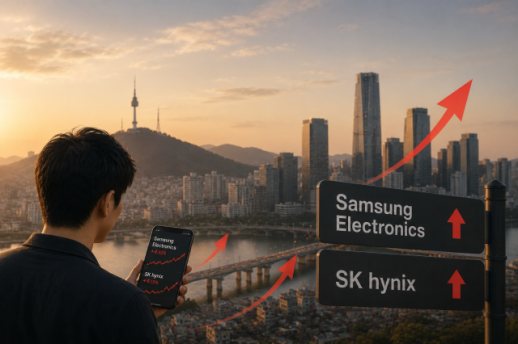 Stock investing in Korea now means buying Samsung and SK hynix SEOUL, July 03 (AJP) — The hotter South Korea's stock market becomes, the narrower it grows. Investing in Korean equities is now synonymous with owning Samsung Electronics or SK hynix. "People don't ask whether you own stocks anymore. They ask whether you own Samjeonnix," insurance planner Lee Min-joo said, referring to the Korean investor shorthand combining Samjeon (Samsung Electronics) and SK hynix. "Those two stocks dominate almost every conversation I have with clients." The country's two semiconductor giants now account for roughly half of the KOSPI's market capitalization, which stood at 6,504 trillion won ($4.18 trillion) on Friday. Their recent wild swings have dictated not only the direction of Seoul's benchmark index but also rippled through semiconductor-heavy markets from Tokyo and Taipei to Wall Street. The concentration reflects the AI-driven rally that has propelled Korean equities this year, drawing both first-time investors and seasoned traders into an increasingly crowded trade. By the end of last year, about one-quarter of South Korea's 50 million people owned stocks. With the KOSPI and its two largest constituents nearly doubling this year, market participants believe many more have since joined the rally. The enthusiasm has been even more pronounced in exchange-traded funds. According to ETF Check, a platform operated by financial market technology provider Koscom, the KODEX SK hynix Single Stock Leverage ETF attracted the largest retail inflows over the past month, with net purchases totaling 2.37 trillion won ($1.52 billion). It was followed by the KODEX Samsung Electronics Single Stock Leverage ETF, which drew 1.89 trillion won, the TIGER SK hynix Single Stock Leverage ETF with 1.45 trillion won, and the TIGER Samsung Electronics Single Stock Leverage ETF with 1.12 trillion won. The fifth most-purchased fund was the SOL AI Semiconductor TOP2 Plus ETF, an unleveraged product heavily weighted toward Samsung Electronics and SK hynix alongside several other major semiconductor stocks. It attracted 744.8 billion won in net inflows. Together, the five funds drew 7.57 trillion won in retail money over the past month, underscoring how heavily individual investors have concentrated their bets on the country's two dominant memory chipmakers. Yoon Jae-hong, an analyst at Mirae Asset Securities, said the trend reflects investors' growing preference for owning the industry's clear winners rather than diversified semiconductor portfolios. "As semiconductor stocks became increasingly driven by Samsung Electronics and SK hynix, investors began asking why they should own a broader semiconductor ETF when they could invest directly in the two market leaders," Yoon said. He added that investors seeking lower-risk exposure, particularly through retirement pension and tax-advantaged accounts where leveraged products are unavailable or less suitable, have increasingly turned to the SOL AI Semiconductor TOP2 Plus ETF. The shift is also evident in what investors are selling. The TIGER Semiconductor TOP10 Leverage ETF, which tracks a broader basket of Korean semiconductor companies with leverage, posted the largest retail outflow over the past month at 404.2 billion won. Its unleveraged counterpart, the TIGER Semiconductor TOP10 ETF, followed with net outflows of 204.4 billion won. Academics say the pattern also reflects the distinctive characteristics of Korean retail investors. Lee Jeong-hwan, a professor of economics and finance at Hanyang University, said leveraged ETFs naturally attract investors seeking short-term gains, contributing to higher trading turnover and greater market volatility. "The investment strategy itself is different," Lee said. "Many investors aim to make quick profits. They sell into rallies, cut losses quickly when prices fall and move in and out of positions much more actively." He added that Korean retail investors have long exhibited a stronger appetite for risk than their counterparts in many overseas markets. "Korean retail investors tend to have a stronger appetite for risk," Lee said, noting that the absence of a capital gains tax on most domestic stock trading lowers the cost of frequent transactions and encourages rapid-fire trading. That strategy has become increasingly painful as AI-related semiconductor stocks have entered a period of violent swings. Over the past month, the KODEX SK hynix Single Stock Leverage ETF has plunged 29.15 percent, from 31,100 won to 22,035 won. The KODEX Samsung Electronics Single Stock Leverage ETF has tumbled 40.03 percent, from 29,350 won to 17,600 won. Even the unleveraged SOL AI Semiconductor TOP2 Plus ETF has fallen 8.74 percent over the same period. The selloff has reignited debate over whether the AI-driven semiconductor rally is merely entering a period of consolidation or approaching the end of its explosive run. Some analysts argue the latest correction resembles earlier episodes triggered by concerns over China's DeepSeek AI model and this year's "Turbo Quant" rotation, in which quantitative funds rapidly unwound crowded AI trades before the sector eventually rebounded. The next major test may come within days. Investors are now awaiting Samsung Electronics' preliminary earnings on July 7, followed later this month by SK hynix's quarterly results, which are expected to offer the clearest indication yet of whether record AI memory demand remains strong enough to justify a market where investing in Korean stocks has become increasingly synonymous with betting on two chip giants. 2026-07-03 14:10:10
-
 AI panic sweeps Asia, hitting Seoul hardest SEOUL, July 02 (AJP) - South Korean stocks led Asia's selloff on Thursday as another wave of panic over artificial intelligence and semiconductor valuations rattled investors, dragging the benchmark KOSPI below the 8,000 mark and the junior KOSDAQ below 900. The benchmark KOSPI tumbled 7.89 percent to close at 7,648.09, its first finish below 8,000 in 15 trading sessions. The index opened down 4.46 percent at 7,933.10, briefly recovered above 8,100 during the session, but selling accelerated into the close, sending it to an intraday low of 7,616.33. The KOSDAQ extended its losses, falling 6.74 percent to 866.72, closing below the 900 level for the first time in four trading sessions. The rout followed another steep overnight decline in U.S. semiconductor shares, reinforcing concerns that the AI-driven rally that propelled global markets to record highs may be losing momentum. Chipmakers bore the brunt of the selling. Samsung Electronics plunged 9.06 percent to 286,000 won, SK hynix slumped 14.57 percent to 2.187 million won, SK Square dropped 13.20 percent to 1.525 million won and Samsung Electro-Mechanics fell 12.65 percent to 192,600 won. The weakness spread across much of the broader market. Samsung Electronics preferred shares fell 7.73 percent to 188,700 won, Samsung C&T lost 6.34 percent to 406,500 won, Hyundai Motor slipped 1.13 percent to 482,000 won and HD Hyundai Heavy Industries declined 4.07 percent to 590,000 won. Not all blue chips joined the selloff. KB Financial rose 4.10 percent to 165,000 won, Kia gained 2.61 percent to 145,200 won, LG Energy Solution advanced 1.72 percent to 354,000 won and Samsung Biologics edged up 0.72 percent to 1.406 million won. Hanwha Aerospace was another standout. The defense contractor climbed as much as 6.69 percent before ending the session up 2.29 percent at 1.116 million won after increasing its stake in Korea Aerospace Industries (KAI). Hanwha's combined holding in KAI rose to 11.21 percent, making it the aerospace company’s second-largest shareholder. Investors viewed the purchase as part of Hanwha's strategy to strengthen its position in South Korea's aerospace industry, while buying by the National Pension Service and expectations for robust overseas defense orders also supported the shares. The risk-off mood spread across much of Asia. Japan's Nikkei 225 fell 2.33 percent to 68,831.00 as semiconductor shares came under pressure, with chip-equipment maker Tokyo Electron dropping 5.6 percent. China's Shanghai Composite Index lost 2.03 percent to 4,028.90. Hong Kong, however, bucked the regional trend. The Hang Seng Index rose 0.42 percent to 22,977.00 after reopening from Wednesday's public holiday, supported by an 8.7 percent surge in Chinese electric-vehicle maker BYD following its second consecutive month of sales growth. 2026-07-02 16:40:13