

Journalist

Ryu Yuna류윤아
Julia37@ajupress.com
ReporterFinancial Supervisory Service (FSS) & finance, capital markets, Southeast Asian affairs
Yuna Ryu covers finance, capital markets and Southeast Asian affairs.
She is drawn to the questions that numbers raise and the stories that data alone cannot answer.
Prior to journalism, she worked at Hyundai Motor Company and the Singapore Chamber of Commerce, focusing on business strategy and international affairs. She has also hosted diplomatic receptions and international conferences as an MC.
Ryu holds a master's degree in Media and Communication from Korea University, where her research focused on neuroscience-based studies of media effects. "Beyond every statistic is a human story waiting to be heard."
Latest by Ryu Yuna
-
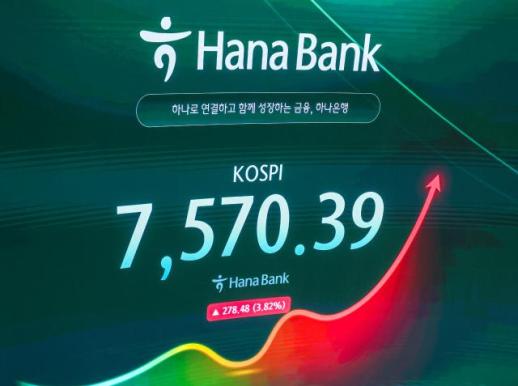 Seoul stocks soar as cooling U.S. inflation, chip optimism fuel broad rally SEOUL, July 15 (AJP) — South Korean stocks staged a powerful rebound Wednesday as softer-than-expected U.S. inflation and renewed optimism over the artificial intelligence semiconductor cycle triggered a broad-based buying spree led by SK hynix and Samsung Electronics. As of 9:57 a.m., the benchmark KOSPI surged 6.81 percent to 7,323.60, while the tech-heavy KOSDAQ jumped 5.39 percent to 826.24, recovering sharply after recent market volatility. The rally tracked overnight gains on Wall Street after U.S. inflation eased more than expected, tempering fears of further Federal Reserve rate hikes and reviving appetite for technology stocks. The Nasdaq Composite rose 0.90 percent and the S&P 500 gained 0.38 percent after the U.S. Consumer Price Index increased 3.5 percent in June from a year earlier, slowing from May's 4.2 percent and coming in below economists' expectations of 3.8 percent. Lower Treasury yields boosted risk appetite, particularly for semiconductor shares that continue to benefit from strong artificial intelligence investment. Leading the advance was SK hynix, whose U.S.-listed ADRs soared 27.29 percent overnight. Sentiment received an additional boost after Barclays initiated coverage with an Overweight rating and a $330 price target, arguing investors continue to underestimate the company's earnings potential as high-bandwidth memory prices strengthen and its leadership in AI memory widens. The upbeat outlook lifted semiconductor stocks globally. Nvidia climbed 4.06 percent, Micron Technology gained 4.92 percent, Sandisk advanced 5.01 percent and the Philadelphia Semiconductor Index rose 2.54 percent. The momentum quickly spilled into Seoul. SK hynix jumped 11.19 percent to 2,127,000 won, while Samsung Electronics gained 6.18 percent to 279,250 won. The rally extended throughout the broader SK and Samsung groups. SK Square, SK hynix's largest shareholder, surged 16.72 percent to 1,389,000 won. Samsung Electro-Mechanics climbed 9.37 percent, Samsung Electronics preferred shares rose 6.75 percent, Samsung Life Insurance gained 7.89 percent, Samsung C&T added 4.94 percent and Samsung Biologics advanced 2.92 percent. Cyclical sectors also joined the rally. Hyundai Motor rose 2.47 percent and Kia added 3.22 percent, while LG Energy Solution gained 4.50 percent. HD Hyundai Heavy Industries advanced 2.84 percent and Doosan Enerbility climbed 4.37 percent. Financial stocks posted comparatively modest gains, with KB Financial Group rising 1.00 percent and Shinhan Financial Group adding 2.21 percent. Investor sentiment also improved after U.S. President Donald Trump withdrew a proposal to impose transit fees on commercial vessels passing through the Strait of Hormuz, easing concerns over another escalation in Middle East shipping risks and raising hopes for renewed diplomatic negotiations. Attention is now turning to earnings from Dutch chip equipment maker ASML later Wednesday and Taiwan Semiconductor Manufacturing Co. on Thursday, with investors looking for fresh signals on the sustainability of AI-driven semiconductor demand. Elsewhere in Asia, Japan's Nikkei 225 gained 0.45 percent while Shanghai's Composite Index rose 1.4 percent. The Korean won strengthened sharply to 1,488.6 per U.S. dollar 2026-07-15 10:39:43
-
 SK hynix shares rally on bullish Barclays report despite ADR premium SEOUL, July 15 (AJP) -Shares of SK hynix zoomed higher at the opening bell in Seoul on Wednesday, recovering from this week's earnings and valuation-driven selloff after a bullish report from Barclays reignited optimism over the AI memory cycle. As of 9:30 a.m., shares of the Korean chipmaker were up 12 percent at 2,139,000 won, extending an overnight 27.3 percent rally in its Nasdaq-listed American depositary receipts (ADRs) and Tuesday's gain of more than 3 percent in Seoul. The rebound followed Barclays' initiation of coverage on SK hynix's newly listed ADRs with an Overweight rating and a $330 price target, implying about 70 percent upside from Tuesday's close. Analyst Simon Coles said the memory industry was entering a prolonged supply shortage as artificial intelligence investment continued to outpace supply growth, allowing SK hynix to maintain strong pricing power over the next several years. Barclays expects supply shortages to deepen through 2027 and remain tight into 2028, arguing that the market continues to underestimate both high-bandwidth memory pricing and SK hynix's earnings potential. The bank also said SK hynix could hold cash equivalent to more than 40 percent of its current market capitalization by the end of 2027, providing ample room for additional share buybacks that could further lift earnings per share. It dismissed concerns over China's memory industry as a near-term threat, saying Chinese DRAM would have only a limited impact on the global market unless major cloud service providers begin deploying it in AI data centers. The report helped lift sentiment after SK hynix shares came under pressure earlier this week on concerns that the stock had run ahead of fundamentals following its record ADR listing and the broader correction in AI-related semiconductor shares. The optimism was reflected even more strongly in New York, where SK hynix's ADRs continued to trade at a hefty premium over the Seoul-listed shares. The ADR closed at $193.92 overnight after surging 27.3 percent, putting it at roughly a 45 percent premium to the equivalent value of the common shares in Seoul. The gap has widened sharply from about 3 percent when the ADRs were priced at $149 last Friday. Analysts attributed the unusually large premium to limited arbitrage opportunities, as the ADRs cannot be freely converted into Korean-listed shares, allowing strong U.S. demand to drive prices higher. The premium has also been supported by the launch of options trading on the ADRs, opening the stock to a broader pool of institutional investors and hedge funds in the world's largest derivatives market. The Nasdaq debut has also sparked strong interest among Korean retail investors. According to brokerage industry data, about 84,000 Korean investors bought roughly 1.36 million ADRs worth 338.9 billion won ($245 million) through nine major domestic brokerages on the July 10 listing day alone. Including other brokerages, the number of investors is estimated to have approached 100,000, with holdings exceeding 400 billion won. Retail investors also continued buying SK hynix shares in Seoul, betting the U.S. listing would support a higher global valuation despite recent volatility. SK hynix raised $26.5 billion through its ADR offering, making it the second-largest equity issuance in U.S. market history after SpaceX and the largest ever by a foreign company. The strong recovery in both Seoul and New York suggested investors remain convinced that the AI-driven memory upcycle has further room to run despite recent concerns over valuations. 2026-07-15 09:37:42
-
 Retail Investors Rally to Save Stocks of Monami and Hansung Enterprises Amid Delisting Fears Retail investors have driven up the stock prices of Monami and Hansung Enterprises, two well-known brands in South Korea, in a bid to prevent their delisting from the KOSDAQ market. This surge comes as the Korea Exchange has significantly tightened its listing maintenance criteria, leading to increased concerns about companies falling below the market capitalization threshold.Within just two weeks of the new regulations taking effect, nine companies issued warnings about being designated as management items due to insufficient market capitalization, with five of them officially classified as such. Starting next month, companies with stock prices below 1,000 won will also face management item designations.In response, companies on the brink of delisting have attempted to defend their stock prices through share buybacks, capital increases, and asset sales. However, the market has seen volatile price fluctuations as selling pressure from delisting fears mixed with buying interest from those hoping to maintain listings.Interestingly, a paradoxical trend has emerged where individual investors are rallying to support long-familiar brands like Monami and Hansung Enterprises. This movement aims to boost their market capitalization above the delisting threshold. Some market observers describe this as a display of “patriotism” to protect South Korea's representative brands, while others view it as a form of self-defense against losses and a speculative gamble.Lee Jeong-hwan, a professor at Hanyang University’s Department of Economics and Finance, noted, “While there may be a genuine desire to save these companies, ultimately, investors are acting to minimize their losses. The term ‘support buying’ alone does not adequately explain this phenomenon.”Initially, the market anticipated that the stricter listing maintenance criteria would further dampen investor sentiment toward struggling companies. However, some individual investors have actively purchased shares of firms facing delisting, defying expectations.One notable example is Hansung Enterprises, known for its crabmeat products, which saw its market capitalization drop to 28.7 billion won due to rising raw material costs and declining profitability, falling below the new listing maintenance standard of 30 billion won. However, the stock price surged from 4,635 won on July 6 to 8,460 won by July 10, nearly doubling in about a week. The stock hit its daily limit on July 9 and 10, and as of 2:40 PM on July 14, it was trading at 10,730 won, up 26.83% from the previous day, nearing its upper limit of 10,990 won.The turnaround was not driven by financial performance or restructuring but rather by a social media campaign highlighting Hansung Enterprises’ charitable activities, including hosting concerts for Korean War veterans for nearly 25 years. This sparked a consensus that “such companies should not disappear,” leading to a rapid influx of retail investors, boosting its market capitalization to 52.5 billion won, surpassing the delisting threshold.A similar trend occurred with Monami, a popular pen brand in South Korea. Monami’s stock price jumped 62% from 1,318 won on July 6 to 2,145 won within a week. After nearing its daily limit, the stock continued to rise, reaching 2,510 won by 2:41 PM on July 14, up 17.02% from the previous trading day, and peaking at 2,780 won during the session. Its market capitalization increased from 24.9 billion won to 40.5 billion won, alleviating delisting concerns.Lee, a 36-year-old IT professional with experience studying in the U.S., shared, “I rarely go to stationery stores these days, but I recently bought a Monami three-color pen set online. It’s affordable and has a great writing feel, so I’ve always trusted it. I even brought Monami pens with me when I was in the U.S.”This affection for the brands was echoed in online investment communities, with comments like “a brand that has been with us for a long time” and “a company that must not disappear.”Hansung Enterprises expressed gratitude on its website on July 7, stating, “We appreciate the positive feedback and support we have received online and on social media. Since our first voyage in 1963, we have strived to produce ‘good food.’”Monami President Song Jae-hwa also expressed gratitude in a handwritten statement posted on the company’s official Instagram on July 10, saying, “Your support during this difficult time, when delisting was a possibility, has been a great source of strength. Monami, which has been part of South Korea’s history, will continue to stand strong by your side.”As stock prices soared, discussions around “support buying” heated up in online investment forums. One post stated, “Monami is a patriotic company. Let’s push it to 10,000 won by Liberation Day,” while another investor praised it as “a good company that also pays dividends.”However, skepticism remains. One investor pointed out, “There are limits to propping up stock prices using patriotism.” Another cautioned, “Delisting does not mean the company will disappear. Buy the products, not the stocks.”Another investor remarked, “Regardless of patriotism, I need to survive first,” reflecting the complex psychology of investors.This phenomenon recalls the 2019 “No Japan” movement, during which the stock price of Monami surged by 29.88% to close at 3,325 won on July 4, 2019, amid a boycott of Japanese products. The expectation was that domestic product consumption would increase. The following day, shares of Shinseong Trading, which operates the domestic clothing brand Topten, also surged by 26.6% due to anticipated benefits from Uniqlo’s decline.However, this rally differs from the past as it is driven more by the psychology of defending against delisting rather than actual performance. Professor Lee emphasized the need to reassess current regulations, stating, “If a market capitalization of 30 billion won can exempt a company from delisting, similar phenomena may recur, necessitating a more refined regulatory framework.”Conversely, Professor Yang Jun-seok of Catholic University highlighted the investors’ expectations, noting, “Those investing in such companies often hope that someone will acquire the company or that the government will provide support at the last moment. Even if that doesn’t happen, they often judge that the stock price has already fallen to a point where additional losses will not be significant, leading them to take risks.”Professor Yang compared this situation to the 2021 GameStop incident in the U.S., where retail investors on the Reddit forum WallStreetBets began buying shares to counteract hedge funds betting against the stock, leading to a massive price surge.Both cases illustrate how collective investor psychology can drive stock prices more than a company’s performance or intrinsic value. Professor Yang noted, “This is not so much normal investing as it is a strong reaction against short-sellers.”Online, some voices have taken a self-deprecating view of the situation, with one post stating, “While the world talks about AI, the Korean stock market is focused on crab meat and pen stocks,” highlighting the reality of the current market.Whether this “support buying” represents true patriotic investment or another form of speculation remains a topic of debate. For now, both Monami and Hansung Enterprises have alleviated their delisting risks, but it remains uncertain whether they can maintain their upward momentum once investor interest wanes.* This article has been translated by AI. 2026-07-14 17:48:00
-
 Stricter delisting rules rattle KOSDAQ-listed companies SEOUL, July 14 (AJP) - South Korea's tougher delisting rules are starting to shake up the stock market sooner than expected. Less than two weeks after the new delisting regulations took effect on the South Korean bourse earlier this month, several companies listed on the junior KOSDAQ have already been flagged as at risk of being placed on the Korea Exchange's watchlist. Under the regulations, which took effect July 1, companies whose market capitalization remains below 20 billion won (US$14.5 million) for 30 consecutive trading days must first issue a warning disclosure before they can be placed on the watchlist. As of Monday, nine companies had issued such warnings, with five of them already placed on the watchlist. To remain listed, those companies must keep their market capitalization above the threshold for at least 45 consecutive sessions within a window of 90 trading days. The regulations also strengthen monitoring of so-called "penny stocks," with companies whose shares close below 1,000 won for 30 consecutive sessions being placed on the watchlist. Many smaller companies are scrambling to remain listed under the tougher measures, with some turning to share buybacks, private placements and stake sales to boost their market values. Those efforts, however, have only fueled heightened volatility. Shares of KOSDAQ-listed electronics company Wellkeeps Hitech surged 71 percent over the past three sessions after it disclosed the risk of being placed on the watchlist, briefly pushing its market capitalization above 20 billion won last Friday. Its short-lived gains faded, with shares down 9.8 percent at 1,191 won as of early Tuesday afternoon. Anxiety has also spread to online forums for investors. On one online board on Naver, the country's largest portal, dedicated to the company, one user questioned whether the company had much of a business at all, leaving a post that read, "What does this company even do?" Another urged it to "learn from Hansung Enterprise," referring to the seafood company whose shares previously surged after retail investors piled in to help lift its market capitalization and save it from delisting. Gold&S, an education services company, also showed a similar pattern. After an initial rally following its disclosure, the stock fell for five straight trading sessions and was trading down 14.4 percent at 1,239 won as of early Tuesday afternoon. The sharp swings reflect a split between investors betting on a recovery and those avoiding stocks at risk of delisting. As delisting fears grow, shareholders of smaller listed companies are increasingly seeking advice from major law firms on measures such as reverse stock splits, capital reductions, potential lawsuits and ways to avoid legal disputes during delisting. Frustration among retail investors is also growing. Some blame companies for deteriorating to the brink of delisting, while others argue regulators introduced the stricter regulations too abruptly, leaving companies with little time to adjust. Debates have now moved beyond stock markets and online forums, with retail investors turning to the National Assembly’s petition platform to voice opposition to recent capital market reforms. A petition opposing tougher delisting rules had drawn nearly 3,000 signatures as of Tuesday, while another criticizing single-stock leveraged exchange-traded funds had gathered more than 31,000 signatures. They argue that shrinking liquidity and the abrupt implementation of stricter regulatory measures, which are intended to improve market health by weeding out vulnerable companies, are putting excessive pressure on smaller firms. 2026-07-14 16:41:01
-
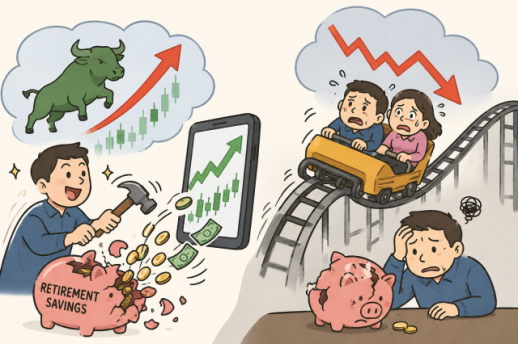 Koreans raid retirement savings to chase the stock bull SEOUL, July 14 (AJP) — South Koreans are dipping into pension and long-term funds to join the stock market rush, risking their retirement nest eggs as they chase short-term returns. The number of Koreans cashing out private retirement savings plans jumped 62.7 percent in the first five months of the year from a year earlier, while fund redemptions rose 47.3 percent, according to data submitted by the Financial Supervisory Service (FSS) and the Korea Securities Depository (KSD) released Tuesday by Rep. Song Eon-seok of the main opposition People Power Party. The data suggests many retail investors pulled money out of long-term savings to ride the stock rally despite the risks of a volatile market. Between January and May, 72,477 Koreans pulled out of their private retirement savings plans, up 62.7 percent from 44,554 a year earlier. Payouts from those early withdrawals rose 54.8 percent to 1.74 trillion won ($1.25 billion). Withdrawals from investment funds also accelerated. The number of fund redemptions rose 47.3 percent from a year earlier to 1.81 million during the January-May period, while the amount withdrawn surged 146.1 percent to about 2,786 trillion won. Song argued that the figures reflect expectations of further gains in the stock market, prompting many households to move money out of retirement savings plans and investment funds in search of higher returns. But a recent market correction, fueled by heavier foreign selling, a weaker won and the rapid expansion of single-stock leveraged exchange-traded funds, has left many of those investors nursing losses. "Many people cashed out retirement savings plans and redeemed investment funds to enter the stock market, only to find themselves caught in rising volatility that is now putting their retirement savings at risk," Song said. He urged the government to focus on building a stable and predictable investment environment rather than pursuing short-term measures to boost the stock market. As of 10:09 a.m. Tuesday, the benchmark KOSPI had recovered some of Monday's losses, rising 2.22 percent to 6,958.02 after the previous session's massive 8.95 percent selloff. The junior KOSDAQ, however, slipped 0.93 percent to 791.91. 2026-07-14 10:37:08
-
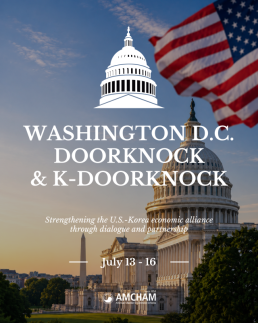 AMCHAM takes Korean delegation to Washington for annual doorknock SEOUL, July 14 (AJP)-The American Chamber of Commerce in Korea (AMCHAM) is leading a delegation of Korean companies to Washington this week for its "K-Doorknock" program, aimed at helping businesses expand into the U.S. market and address a range of pending trade, investment and regulatory issues between the two countries. The initiative will make its debut during AMCHAM's annual Washington Doorknock mission, which runs from July 13 to 16 and brings business leaders together with U.S. policymakers to discuss issues affecting the U.S.-Korea economic relationship. K-Doorknock gives Korean companies investing in the United States a dedicated channel to engage directly with senior government officials, lawmakers and industry leaders as bilateral investment continues to grow. Led by AMCHAM Chairman and CEO James Kim, the delegation includes senior executives from Dunamu, Hangang Asset Management, HKI America Inc, Hyundai Motor Group, LG Group, and SoluM. Representatives from Bayer, Corning, Kim & Chang, Novelis and Pfizer are also joining the delegation. During the four-day visit, the delegation is scheduled to meet officials from the White House, the Office of the U.S. Trade Representative (USTR), the Department of Commerce, the Department of State and the National Security Council (NSC), as well as bipartisan members of Congress, the U.S. Chamber of Commerce, leading think tanks and policy experts. The visit comes amid evolving trade and regulatory issues, including a proposed 12.5 percent U.S. tariff on imports from South Korea under a Section 301 investigation into forced-labor import restrictions and broader discussions over the regulatory environment for companies operating in both markets. The chamber said the meetings will focus on strengthening bilateral investment, advancing regulatory cooperation, promoting innovation and deepening economic cooperation between the two countries. "Washington Doorknock has long been one of AMCHAM's defining initiatives and an important platform for strengthening economic ties between Korea and the United States," Kim said. "K-Doorknock represents the next evolution of that mission. As investment between our two countries continues to grow in both directions, AMCHAM is committed to supporting Korean companies expanding in the United States, just as we have long supported American companies doing business in Korea." Kim said the bilateral relationship has evolved beyond trade and is increasingly driven by two-way investment, advanced technology, resilient supply chains and closer public-private cooperation. "We look forward to engaging with our partners in Washington to advance practical solutions that strengthen competitiveness, encourage investment and create new opportunities for growth in both countries," he said. This year’s mission is part of AMCHAM’s Freedom 250 initiative marking the 250th anniversary of U.S. independence. The chamber plans to issue a post-mission summary after the delegation returns, outlining key meetings, policy discussions and potential areas of cooperation. 2026-07-14 09:29:40
-
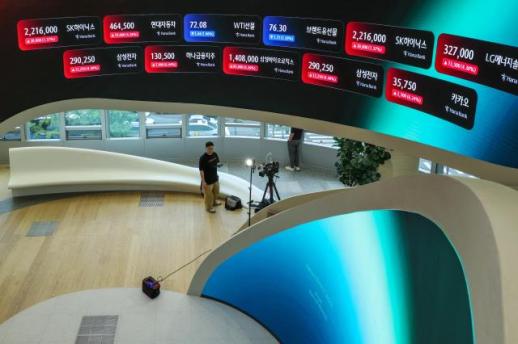 Seoul bourse enters a technical bear phase SEOUL, July 14 (AJP) -South Korean stocks has entered a technical bear market on Tuesday after the benchmark KOSPI fell nearly 30 percent from its June peak above the 9,000 mark, as a brutal selloff in semiconductor shares deepened on renewed concerns that the artificial intelligence boom may be nearing an earnings peak. The benchmark KOSPI plunged 8.95 percent to close at 6,806.93, its lowest level in 48 trading sessions and the fourth-largest one-day point decline on record. The tech-heavy KOSDAQ lost 4.55 percent to 799.36. The selloff followed Monday's record collapse in SK hynix shares and spread overnight to Wall Street, where SK hynix's Nasdaq-listed American depositary receipts slid another 9.3 percent after their spectacular debut last Friday. The weakness rippled across the broader U.S. semiconductor sector, with Micron Technology falling 4.3 percent, Intel losing more than 6 percent, Sandisk tumbling 12.6 percent, while Nvidia, AMD and Marvell Technology also retreated as investors reassessed lofty AI valuations. The combined decline erased much of the optimism surrounding SK hynix's landmark U.S. listing, which had been expected to broaden the company's global investor base and reinforce Korea's position at the center of the AI memory supply chain. Instead, investors shifted their focus from the historic capital raising to slowing earnings momentum. SK hynix's Korean shares crashed 15.37 percent to 1.845 million won on Monday, marking the steepest one-day decline in the company's history after having already retreated sharply from their record high. The ADRs closed at $152.35 overnight, extending the correction after Friday's Nasdaq debut. Samsung Electronics also slid 10.7 percent in Seoul, leaving the country's two semiconductor bellwethers down roughly 32 percent and 38 percent, respectively, from their recent peaks. The correction officially pushed the KOSPI into what market convention defines as a technical bear market, with the index falling about 28 percent from its intraday high of 9,385.59 reached on June 19 to Tuesday's intraday low near 6,780. Trading was halted for 20 minutes after the Korea Exchange activated a market-wide circuit breaker at 1:28 p.m., the 13th such suspension in history. More strikingly, seven circuit breakers have now been triggered this year alone, reflecting unprecedented volatility fueled by concentrated semiconductor bets and the proliferation of single-stock leveraged exchange-traded funds. The unwind has been particularly painful for retail investors who had crowded into leveraged products tracking Samsung Electronics and SK hynix during this year's AI-driven rally. All 14 leveraged ETFs linked to the two companies fell to record lows. KODEX SK hynix Leverage ETF has now lost more than 66 percent from its late-June peak, while TIGER Samsung Electronics Leverage ETF has shed nearly 60 percent from its June high. Online investment communities were flooded with posts from individual investors reporting losses reaching hundreds of millions of won, with many lamenting that leveraged ETFs had become "gambling rather than investing." Market strategists said the correction reflects a combination of profit-taking after one of the world's strongest equity rallies, mounting concerns that semiconductor earnings may have peaked, and external shocks including renewed geopolitical tensions in the Middle East that lifted oil prices and global bond yields. Analysts also noted that the Korean market has become unusually dependent on a handful of AI-related stocks. According to Eugene Investment & Securities, Samsung Electronics and SK hynix accounted for more than 78 percent of the KOSPI's gains during the first half of the year. As a result, the correction in those two names has translated into market-wide volatility far exceeding that seen in Japan or Taiwan, where chip shares have also weakened but broader indexes have remained relatively resilient. Adding to investor caution are growing doubts over second-quarter earnings. Korea Investment & Securities recently lowered its operating profit forecasts for SK hynix by incorporating the impact of long-term supply agreements, trimming this year's and next year's earnings estimates by 9 percent and 11 percent, respectively. It now expects second-quarter operating profit to come in about 8 percent below market consensus. The ADR listing itself may also have contributed to the reversal. While SK hynix's U.S. shares initially surged after listing, analysts said much of the optimism had already been priced into the Seoul-listed shares before the debut, prompting investors to lock in profits once the long-anticipated event had passed. Despite the sharp correction, strategists stopped short of calling for a prolonged bear market. Many argued that valuation has become considerably more attractive after the rapid decline, although a sustained recovery will depend on whether upcoming earnings from major global chipmakers can restore confidence in AI demand. 2026-07-14 08:33:25
-
 Financial watchdog urges asset managers to improve transparency SEOUL, July 13 (AJP) - Financial watchdog Financial Supervisory Service (FSS) on Monday urged asset managers to improve disclosure practices by providing clearer information on voting rights and strengthening internal controls. It also called for an end to misleading or exaggerated advertisements for exchange-traded fund (ETF) to better protect investors. In a meeting with the head of the Korea Financial Investment Association and CEOs of 20 asset management firms, FSS chief Lee Chan-jin stressed the need for greater transparency in how fund managers vote on corporate matters including board appointments, executive pay, mergers and dividend policies on behalf of investors. The meeting followed an FSS review, which found that many firms still used formulaic disclosures, giving investors little insight into how key company decisions were actually made. The review showed that asset managers have become more active in exercising shareholder voting rights. The voting rate for public and private funds has improved from 79.6 percent in 2024 to 91.6 percent in 2025 and 91.8 percent this year. The proportion of votes cast against management proposals also increased to 8.2 percent from 5.2 percent over the same period. Despite the improvement, the regulator said the quality of disclosures remained weak. Of the 285 asset managers reviewed this year, 121, or 42.4 percent, relied on generic explanations such as "little impact on shareholder interests" and "no harm to shareholder rights" instead of explaining the reasons behind their votes, making it difficult for investors to understand the basis for those decisions. Asset managers need to improve these voting procedures and provide clearer disclosures so investors can properly assess whether voting decisions are appropriate," Lee said. He also warned against misleading or exaggerated advertising in the country's fast-growing ETF market, saying investors often rely heavily on promotional materials when selecting products. Lee urged firms to ensure the accuracy of information through an internal review process, while working with liquidity providers to keep ETF market prices closely aligned with their net asset values. Industry participants also raised concerns over excessive product competition, saying the industry should voluntarily limit the launch of ETFs that closely replicate competitors’ products to create a healthier market. Lee also called on asset managers to channel more capital into promising companies and emerging industries, creating a cycle in which investment supports business growth and generates returns for investors. The FSS said it plans to hold workshops in July and August for asset managers responsible for related disclosures to share information and provide examples of practices. Meanwhile, Samsung Asset Management, NH-Amundi Asset Management and VIP Asset Management, three of the country's leading fund managers, were cited as examples of best practice in this year's review. 2026-07-13 18:00:31
-
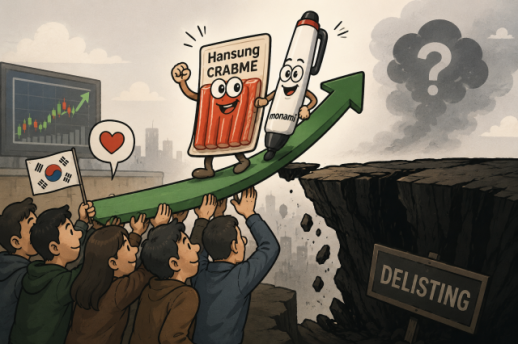 Patriotic retail investors on buying spree to rescue beloved brands from delisting SEOUL, July 13 (AJP) - In a market usually driven by earnings, valuations and future prospects, some South Korean retail investors are making room for something more sentimental: trying to save the companies they grew up with. From a beloved penmaker to a well-known seafood brand, individual investors have rushed to buy shares of struggling companies facing possible delisting. Their buying spree has sent stock prices sharply higher as they try to save familiar brands from disappearing from the market. But the buying spree has also raised a broader question: Is it an act of loyalty to iconic South Korean companies or simply shareholders trying to avoid losses? Experts say it may be a mix of both, exposing an unintended effect of the Korea Exchange's tougher delisting rules. "Many investors are likely buying shares not only to support the company but also to protect their own investment from losses," said Lee Jeong-hwan, a professor of economics and finance at Hanyang University. The phenomenon emerged after the Korea Exchange earlier this month introduced tougher listing guidelines, under which companies listed on the main KOSPI market with shares trading below 1,000 won or a market capitalization under 30 billion won (US$21.7 million) can face delisting reviews. Rather than abandoning struggling companies, however, many individual investors have done the opposite - buying shares to push their market values above the threshold. The clearest example was Hansung Enterprise, a seafood processor best known for Crabme, one of South Korea's best-selling crab-flavored seafood products. Its shares surged 100 percent last week, making it the top-performing stock in the market. The stock climbed from 4,635 won to 8,460 won in just about a week, hitting the daily 30 percent price limit in two consecutive sessions on Thursday and Friday. The rally showed little sign of slowing on Monday. As of 2:40 p.m., shares were up 26.83 percent at 10,730 won after earlier touching the daily limit of 10,990 won. Hansung had been struggling with rising raw-material costs and weakening profitability, leaving the company at risk of delisting after its market capitalization slipped to 28.7 billion won, below the Korea Exchange's new requirement. The turnaround began not with an earnings surprise or a restructuring announcement, but with posts on online investor forums. Users shared stories about the company's long-running charitable activities, including hosting annual concerts for Korean War veterans for roughly 25 years, prompting some retail investors to buy its shares to support a company they believed deserved another chance. Within days, buying accelerated. Hansung's market capitalization climbed to 52.5 billion won, lifting the company back above the delisting threshold. A similar story unfolded at Monami, one of the country's best-known stationery brands, whose inexpensive ballpoint pens have been a fixture in classrooms, offices and homes for decades. The stock climbed 62 percent during the week, rising from 1,318 won on July 6 to 2,145 won after nearly hitting the daily trading limit on two consecutive sessions. The rally extended into Monday, with the shares up another 17.02 percent at 2,510 won as of 2:41 p.m., after touching an intraday high of 2,780 won, just below the daily price limit of 2,785 won. The rally also lifted its market capitalization from 24.9 billion won to 40.5 billion won, helping the company avoid the immediate risk of delisting. For many investors, it was about preserving a familiar brand. "I hardly ever go to stationery stores anymore, but I still bought a Monami three-color pen online not long ago," said Lee K.M., a South Korean IT professional in his 30s who studied in the U.S. "It's cheap, writes well and is one of those reliable Korean products that has always been around. I even carried Monami pens with me when I lived in the U.S." His sentiment appeared to resonate with many retail investors, several of whom described Monami as one of those familiar brands that had quietly endured for decades. Hansung thanked the unexpected support. "We sincerely appreciate the encouragement and support we have received through online communities and social media," the retailer said in a statement posted on its website, pledging to continue producing "quality food products" as it has since its founding in 1963. Song Jae-hwa, the CEO of Monami, also posted a handwritten message on the company's official Instagram account on July 10. "Your trust and support have given us tremendous strength during a time when Monami faced the possibility of delisting." The rallies quickly evolved into a broader debate across online investing communities over whether investors were preserving Korean brands or simply fueling another speculative trade. On Naver's stock message board, one investor wrote, "Monami is a patriotic company. Let's send it to 10,000 won by Liberation Day," while another described it as "a good company that even pays dividends." Others were far more skeptical. "There are limits to using patriotism to manipulate a stock," one investor wrote. Another investor wrote: "Delisting doesn't mean the company disappears — just buy its products instead," arguing that consumers should support the companies through purchases rather than by driving up their share prices. One investor summed up the debate: "Patriotism or not, I have to survive first." The episode revived memories of South Korea's 2019 boycott of Japanese products, when patriotic consumption spilled into the stock market. On July 4, 2019, Monami's shares surged 29.88 percent to close at 3,325 won, hitting the daily trading limit as investors bet consumers would shift away from Japanese stationery brands. The following day, Shinsung Tongsang, operator of homegrown casualwear brand Topten, jumped as much as 26.6 percent intraday on expectations that the boycott would also benefit domestic apparel makers at the expense of Japanese rivals such as Uniqlo. Unlike those gains, however, the latest rallies have been driven not by expectations of stronger sales but by investors' attempts to keep companies above the Korea Exchange's minimum market-capitalization requirement. Lee of Hanyang University, said the buying was a predictable response from shareholders facing potential losses, but he said the episode also raised questions about the exchange's new delisting rules. "If a brief rise in the share price is enough to lift a company back above the 30 billion won threshold, similar episodes could continue," he said. "That suggests the listing standards need to be refined." Yang Jun-sok, a professor of economics at the Catholic University of Korea, offered a more market-driven explanation. He said distressed companies often attract speculative buying from investors hoping for a last-minute rescue through an acquisition, government support or another turnaround. "In many cases, investors buy because they believe someone else will eventually rescue the company through an acquisition or financial support," Yang said. "Even if that doesn't happen, they may think the shares have already fallen so much that the downside is limited." He compared the episode to the 2021 GameStop frenzy in the U.S., when retail investors on Reddit's WallStreetBets forum piled into shares of the struggling video-game retailer. The buying was driven less by confidence in the company's business than by a desire to inflict losses on hedge funds that had heavily shorted the stock. The stock soared from $17.25 at the start of January to as high as $483 on Jan. 28, forcing many short sellers to buy back shares to limit their losses and driving prices even higher. "That wasn't a normal investment either," Yang said. "Many participants were motivated to punish short sellers for betting against the company." Whether the recent rallies reflect genuine support for familiar Korean brands or simply another speculative trade remains open to debate. One widely shared online post captured that skepticism with a sarcastic remark: "This is what the Korean stock market has come to — we're talking about pen stocks and imitation-crab-stick stocks while the rest of the world is talking about artificial intelligence." Regardless of investors' motives, however, the episode has already exposed an unexpected consequence of the country's tougher delisting regime. Rules intended to weed out weak companies instead encouraged some shareholders to rally around them. For now, the buying spree has bought both companies more time. Whether it represents a new form of patriotic investing or simply shareholders trying to protect themselves from losses remains open to debate. The bigger question is whether the momentum can continue once the initial excitement fades. 2026-07-13 15:51:30
-
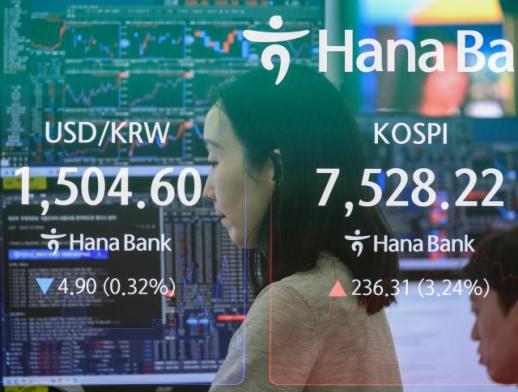 KOSPI falls below 7,000 as chip stocks nosedive SEOUL, July 13 (AJP) - South Korean stocks plunged sharply on Monday afternoon, with the benchmark KOSPI falling below the 7,000 level for the first time in more than two months as heavy selling in semiconductor heavyweights triggered another market-wide selloff. As of 1:30 p.m., the KOSPI was trading at 6,880.97, down 7.96 percent, while the junior KOSDAQ fell 4.33 percent to 801.20. The KOSPI's drop below 7,000 marked its first breach of the level since May 4, extending a steep correction after the index had climbed to record highs earlier this year. Semiconductor heavyweights led the decline as investors continued to unwind positions following last week's listing of SK hynix's American depositary receipts (ADRs) and took profits after months of AI-driven gains. Samsung Electronics fell 9.21 percent to 258,750 won, while SK hynix plunged 13.35 percent to 1,889,000 won. SK Square tumbled 15.19 percent, Samsung Electro-Mechanics slumped 17.99 percent, and Samsung Electronics preferred shares dropped 9.01 percent. Samsung Life Insurance lost 6.46 percent. Not all blue chips declined. LG Energy Solution rose 1.23 percent, while KB Financial Group gained 0.70 percent, outperforming the broader market. Earlier in the session, the Korea Exchange activated a sell-side sidecar, the 35th such activation this year and the sixth this month. 2026-07-13 13:43:40