

Journalist

Ryu Yuna류윤아
Julia37@ajupress.com
ReporterFinancial Supervisory Service (FSS) & finance, capital markets, Southeast Asian affairs
Yuna Ryu covers finance, capital markets and Southeast Asian affairs.
She is drawn to the questions that numbers raise and the stories that data alone cannot answer.
Prior to journalism, she worked at Hyundai Motor Company and the Singapore Chamber of Commerce, focusing on business strategy and international affairs. She has also hosted diplomatic receptions and international conferences as an MC.
Ryu holds a master's degree in Media and Communication from Korea University, where her research focused on neuroscience-based studies of media effects. "Beyond every statistic is a human story waiting to be heard."
Latest by Ryu Yuna
-
 Seoul tanks again, so who pays for the leverage party? SEOUL, July 02 (AJP) - A gambler should know the risks. Reckless leveraged bets often end badly. But when a debt-fueled stock frenzy unravels and defaults pile up, South Korea faces a familiar question: who should bear the cost — individual investors or regulators? Another painful correction hit the Seoul stock market, which until just a week ago had appeared almost invincible after an extraordinary 18-month rally. The KOSPI tumbled nearly 8 percent on Thursday, while the KOSDAQ fell almost 7 percent, a brutal hangover for the junior market just a day after its subdued 30th anniversary. The KOSPI closed at 7,648.09, down about 16 percent from its June 22 peak of 9,114.55. Even so, it remains roughly 90 percent higher than at the start of the year and more than double its level of 3,075.05 a year earlier. Such spectacular gains naturally attracted profit-taking from foreign investors and savvy short sellers. Those left nursing the biggest losses, however, are often the latecomers gripped by fear of missing out, many of whom entered the rally with borrowed money. According to the Korea Financial Investment Association (KOFIA), involuntary stock liquidations triggered by margin calls totaled 969.9 billion won ($623 million) in June, the largest monthly amount this year. That brought forced selloffs during the first half to 3.15 trillion won ($2.03 billion). The monthly figures illustrate how leverage accelerated as the rally gathered pace. Forced liquidations totaled 216.6 billion won in January and 248.3 billion won in February before jumping to 558.5 billion won in March, when Middle East tensions rattled global markets. They eased to 264.2 billion won in April, then surged again to 794.6 billion won in May before reaching June's record. Yang Jun-sok, an economics professor at the Catholic University of Korea, said the latest wave of forced liquidations should be viewed partly as a "learning process" for investors rather than simply a problem requiring government intervention. "The problem is moral hazard," Yang said. "If people are protected from losses every time, they will take even greater risks in the future." The spike in margin calls followed one of the most volatile months in the market's recent history. During June, the KOSPI swung 1,991 points between an intraday low of 7,394.46 and a high of 9,385.59. Just one trading day after closing above 9,000 for the first time, the benchmark plunged 9.99 percent, repeatedly triggering market stabilization measures, including sidecars and circuit breakers. The Korea Exchange activated 10 sidecars — five on buy orders and five on sell orders — while three circuit breakers were triggered during the month. The VKOSPI volatility index climbed to 97.78 on June 24, its highest level since the 2008 global financial crisis. The turmoil has also renewed scrutiny of investor safeguards. A recent review of the country's 10 largest brokerage mobile trading platforms found that nine allow investors to place stock orders exceeding their available cash balance without requiring them to explicitly opt into unpaid settlement trading. Toss Securities, one of the country's newer online brokerages, was the only firm that blocks such orders by default. Under South Korea's unpaid settlement system, investors can buy stocks by paying only part of the purchase price upfront and settling the remaining balance two business days later. If they fail to make the payment on time, brokerages automatically liquidate the shares to recover the outstanding balance. Brokerages argue that the system allows experienced investors to trade more efficiently. Critics, however, say the default setting lowers the psychological barrier to leveraged investing by enabling investors to place larger orders without fully appreciating that they are effectively borrowing money. Yang said brokerages ultimately transfer the risks of leveraged trading to investors, making financial literacy all the more important. He added that investors in more mature markets, such as the United States, generally have a better understanding of investment risks, while South Korea still has room to improve. "It's like saying too many students received D's, so let's give them more A's, B's and C's instead," he said. "Then no one has an incentive to study." Government intervention, Yang argued, should be reserved for situations where market losses threaten the broader financial system. Otherwise, allowing investors to bear the consequences of their own decisions, painful as that may be, ultimately creates healthier markets over the long run. 2026-07-02 16:39:47
-
 KOSPI falls below 8,000 as Wall Street chip rout spills over SEOUL, July 2 (AJP) - South Korean stocks suffered another heavy selloff on Thursday, with the benchmark KOSPI plunging more than 5 percent in early trading, falling below 8,000 points. The decline followed an overnight rout in U.S. semiconductor shares, which reignited concerns that the artificial intelligence (AI)-led boom may be losing momentum. Just minutes after trading began, the KOSPI fell 5.30 percent to 7,862.92 and the junior KOSDAQ also dropped 4 percent to 892.18. A sharp decline in U.S. chipmakers spilled over into Seoul, with semiconductor-related stocks bearing the brunt of the selling after the Philadelphia Semiconductor Index tumbled 6.27 percent. Samsung Electronics tumbled 7 percent to 292,500 won, SK hynix plunged 8.28 percent to 2.348 million won, SK Square slid 10.13 percent to 1.579 million won and Samsung Electro-Mechanics dropped 8.62 percent to 2.015 million won. Selling spread to other blue chip stocks. Samsung C&T fell 7.95 percent to 399,500 won, Samsung Life Insurance lost 8.27 percent to 355,000 won, Hyundai Motor declined 5.03 percent to 463,000 won, Samsung Electronics preferred shares slipped 6.36 percent to 191,500 won, while LG Energy Solution and Samsung Biologics edged down 1.87 percent and 1.43 percent to 341,500 won and 1.376 million won, respectively. Only a handful of blue chips bucked the broader decline. Hanwha Aerospace rose 4.49 percent to 1.14 million won, while KB Financial gained 0.88 percent to 159,900 won. The weakness would mean a rough start to the second half, as the KOSPI briefly reclaimed 8,600 before reversing course, slipping below 8,100 to finish at 8,303.41 the previous day amid persistent foreign selling. Wall Street provided little relief overnight. The Dow Jones Industrial Average slipped 0.03 percent, the S&P 500 fell 0.22 percent and the Nasdaq Composite lost 0.66 percent as investors locked in profits at the start of the third quarter. Semiconductor stocks bore the brunt of the selling, with Micron Technology plunging 10.57 percent, Sandisk dropping 10.62 percent, Intel falling 9.03 percent, AMD losing 6.89 percent and Nvidia declining 1.25 percent. The notable exception was Meta Platforms, which surged 8.81 percent after unveiling plans to commercialize excess AI computing capacity through cloud services. However, the announcement also fueled concerns that major technology companies may have overinvested in AI infrastructure and could reduce future demand for advanced semiconductors. Investors are now turning their attention to upcoming developments as Samsung Electronics is set to release its preliminary earnings report for the second quarter next week, while SK Hynix is set for its U.S. ADR listing this month. Earnings reports for the so-called "Magnificent Seven" — Alphabet, Amazon, Apple, Microsoft, Nvidia, Meta, and Tesla — will also be released later this month. Meanwhile, the South Korean won weakened against the U.S. dollar, with the greenback trading at 1,555.7 won in early trading, compared with the previous day's close of 1,554.9 won. 2026-07-02 09:44:04
-
 KOSDAQ at 30 bares Peter Pan syndrome SEOUL, July 01 (AJP) – KOSDAQ, South Korea's answer to the Nasdaq, turned 30 on Wednesday. But the celebration was notably subdued as the junior market remains trapped in a kind of Peter Pan syndrome, unable to match the spectacular rise of its bigger sibling, the KOSPI. While the benchmark KOSPI has quadrupled over the past 18 months, KOSDAQ has barely moved. After standing at 925 eighteen months ago, it closed its 30th anniversary at 929.35. The market debuted at 1,000 points on July 1, 1996. The divergence has widened this year. The KOSPI has surged 92.67 percent on an artificial intelligence-driven rally led by Samsung Electronics and SK hynix, while the KOSDAQ has slipped 1.72 percent into negative territory. Many of KOSDAQ's biggest success stories have graduated to the main board, while retail investors — once the backbone of the junior exchange — have shifted their money into large-cap AI stocks. Rather than celebrating its milestone, the exchange enters its fourth decade under mounting pressure to restore investor confidence through another round of market reforms. The contrast is stark. KOSDAQ's share of South Korea's total stock market capitalization has shrunk to about 6 percent from roughly 12 percent at the beginning of the year, according to Korea Exchange. All talk, no solution? The Korea Exchange launched KOSDAQ CONNECT 2026, a three-day conference beginning Wednesday to coincide with the market's 30th anniversary. Jointly organized by the Korea Investor Relations Service and the KOSDAQ Association, the event brings together listed companies, institutional investors, investment banks, venture capital firms and retail investors in what the exchange describes as its largest investor relations conference dedicated to the KOSDAQ market. Speaking at the opening ceremony in Seoul, Korea Exchange Chairman Jeong Eun-bo pledged to strengthen the market's fundamentals and restore credibility. "The exchange will actively improve the quality of the market so that KOSDAQ can become a trusted marketplace," he said. "By ensuring the efficient allocation and circulation of venture capital, we will build a market where productive finance functions at its best." He added that he hoped KOSDAQ CONNECT 2026 would become "a meaningful platform for enhancing corporate value." The opening day featured presentations on KOSDAQ's three-decade history and future roadmap, panel discussions on its direction, and industry sessions covering pharmaceuticals, biotechnology and medical devices. Over the following two days, policymakers are scheduled to unveil additional measures to improve market quality, expand technology-track listings, increase venture capital funding and strengthen disclosure requirements. Analysts, however, say the success of those initiatives will ultimately depend on whether they restore investor confidence and improve the quality of listed companies. Kim Jung-hoon, an analyst at Trust Investment Advisory, said KOSDAQ needs to attract companies with sustainable growth prospects instead of merely increasing the number of technology-track IPOs. "As delisting requirements become stricter, IPOs should focus on companies with proven growth potential," he said. He also argued that improving investor communication is just as important as raising listing standards. "Many KOSDAQ companies don't even have dedicated investor relations teams. There needs to be a better system for communicating with shareholders." Recent policy initiatives, he added, have done little to bring investors back. "There have been plenty of policy measures, but on the ground it's difficult to feel their impact because investors remain focused on Samsung Electronics and SK hynix." Outside the conference hall, the market's challenges were on full display. The exhibition booths of KOSDAQ-listed companies were largely empty, with few visitors stopping by despite the anniversary event. KOSDAQ's fortunes have mirrored South Korea's changing industrial landscape. The market enjoyed a spectacular boom during the venture-capital frenzy of 1999 and 2000, reaching a record high of 2,834.40 in March 2000 — a peak it has never revisited. It plunged after the Nasdaq-led dot-com crash, falling below 300 by 2004 and to 261.19 during the global financial crisis in 2008. It later found renewed momentum through a biotech rally led by Celltrion in the mid-2010s and again in 2023 as battery makers including EcoPro, EcoPro BM and L&F surged. But as the electric-vehicle boom faded and investors rotated into AI-driven semiconductor stocks, KOSDAQ failed to produce a new generation of market leaders, leaving even a return to the 1,000-point level increasingly elusive. Analysts say the market's prolonged stagnation reflects structural weaknesses, including the steady migration of successful companies to the KOSPI, the growing number of so-called zombie companies and repeated surprise share issuances that have eroded investor confidence. The loss of blue-chip companies has been particularly painful. Naver, Kakao and Celltrion all began on KOSDAQ before transferring to the main board. Alteogen, now the market's largest company by market capitalization, is also pursuing a KOSPI listing. Retail investors have been voting with their feet. Individuals have sold a net 10 trillion won ($7.3 billion) worth of KOSDAQ shares this year, rotating into major semiconductor stocks as the AI investment boom accelerated. Foreign and institutional investors have been net buyers, purchasing roughly 6 trillion won and 4 trillion won worth of shares, respectively. The government is betting that stricter listing standards can help reverse the decline. Beginning Wednesday, listed companies must maintain a market capitalization of at least 20 billion won, up from the previous 15 billion won threshold, to remain on the exchange. Stocks trading below 1,000 won will also face tougher delisting requirements. The Korea Exchange also plans to introduce a three-tier KOSDAQ structure in October, dividing the market into premium, standard and management segments in an effort to channel investment toward stronger companies while weeding out weaker ones. Three decades after its launch, however, KOSDAQ is still searching for a way to become a destination for tomorrow's market leaders instead of merely serving as a nursery for future KOSPI companies. 2026-07-01 17:15:57
-
 KOSPI opens lower as foreign selling hits chipmakers SEOUL, July 1 (AJP) - South Korea's benchmark KOSPI opened lower on Wednesday despite strong overnight gains in U.S. tech stocks, as foreign investors shrugged off a global semiconductor rally. With less than a couple of hours of trading, the index fell 1.62 percent to 8,339.34, while the junior KOSDAQ rose 2.84 percent to 942.21. The sluggish start came despite a strong performance on Wall Street overnight, with the Philadelphia Semiconductor Index surging 3.92 percent, while the Nasdaq Composite gained 1.52 percent and the S&P 500 advanced 0.79 percent, as investors piled back into technology shares. Foreign brokerages such as Citigroup and JPMorgan ranked among the top sellers of both Samsung Electronics and SK hynix stocks, suggesting foreign investors continued to take profits after the two South Korean chipmakers' strong run so far this year. Foreigners sold a net 430.4 billion won (US$315 million) worth of shares in early morning trade, while institutional investors bought a net 445.7 billion won. The bulk of the selling was concentrated in chip-related stocks, with foreigners offloading a net 299.5 billion won and retail investors selling 8.3 billion won, while institutions bought a net 323.2 billion won. The selling pushed Samsung Electronics down 2.02 percent to 327,250 won, after briefly trading higher at the open. SK hynix also reversed early gains, slipping 1.62 percent to 2.607 million won after rising as much as 2.75 percent. Investors appeared cautious, watching whether the National Pension Service would reduce its domestic stock holdings after resuming portfolio adjustments that had been paused through the end of June. At the same time, offshore cryptocurrency exchanges continued to roll out increasingly leveraged futures tied to South Korean stocks, allowing investors to make bigger bets on market moves. Some products offer effective leverage of up to 150 times the benchmark index's daily performance, raising concerns that even modest market swings could lead to outsized gains or losses. Because the products are offered through offshore exchanges, they remain beyond the direct oversight of South Korean financial regulators. Other heavyweight sectors were mixed. Battery and biotech shares were mixed. LG Energy Solution fell 1.66 percent to 356,000 won, while Samsung Biologics edged down 0.97 percent to 1.3775 million won. Celltrion gained 1.44 percent to 175,800 won. Auto-related stocks traded higher, with Hyundai Motor adding 0.81 percent to 499,000 won and Kia climbing 3.62 percent to 143,000 won. Financial stocks were mixed. KB Financial rose 0.75 percent to 160,200 won, while Shinhan Financial Group gained 2.51 percent to 98,200 won. Samsung Life Insurance fell 2.00 percent to 393,000 won. Industrial and defense shares outperformed. HD Hyundai Heavy Industries advanced 1.52 percent to 601,000 won, Doosan Enerbility gained 3.23 percent to 89,600 won, Hanwha Aerospace surged 8.34 percent to 1.078 million won, and LS ELECTRIC jumped 12.18 percent to 267,000 won. Hyundai Mobis rose 0.40 percent to 502,000 won. On the junior market, semiconductor equipment makers outperformed. Jusung Engineering, Wonik IPS and PSI, which manufacture chip production equipment, rose 15.67 percent to 232,500 won, 0.59 percent to 169,100 won and 8.62 percent to 213,000 won, respectively. Robotics developer Rainbow Robotics gained 3.47 percent to 537,000 won, while biopharmaceutical company HLB fell 2.31 percent to 50,800 won. The South Korean won strengthened against the U.S. dollar, trading at 1,549.4 won compared with 1,558.4 won the previous day. Elsewhere in the region, Japan's Nikkei 225 rose 1.13 percent to 70,851.19. China's Shanghai Composite slipped 0.06 percent to 4,091.89 in early trading. Hong Kong markets were closed for the Hong Kong Special Administrative Region Establishment Day, which commemorate the historic transfer of sovereignty. Hong Kong's bourse was closed for Hong Kong Special Administrative Region Establishment Day, which marks the historic transfer of sovereignty and commemorates the ending the British colonial rule. 2026-07-01 11:27:37
-
 Stock mania makes gamblers out of Korean retail investors SEOUL, July 01 (AJP) — Tech-savvy and risk-taking South Koreans are learning fast on exotic bets, turning from sluggish cryptocurrency trading to highly leveraged equity investments. An expanding army of mom-and-pop investors is pouring billions of dollars into high-risk leveraged products on offshore cryptocurrency exchange Binance, where they can place bets of up to 150 times on the KOSPI through products banned at home. According to crypto industry sources, Binance began offering KORUUSDT on June 22, a futures contract linked to the U.S.-listed Direxion Daily South Korea Bull 3X Shares ETF (KORU), which tracks three times the KOSPI's daily performance. The exchange later raised the contract's maximum leverage to 50 times, allowing traders to take positions equivalent to as much as 150 times the index's daily movement. The announcement also generated buzz among Korean retail investors on X. In replies to a post about Binance's Korea-linked leveraged products, one user wrote, "The FOMO is insane," while another joked, "Casinos and horse racing might as well shut down now," as investors reacted to the growing appetite for highly leveraged bets. Earlier this month, the exchange also launched perpetual futures tied to Samsung Electronics, SK hynix and Hyundai Motor, initially offering leverage of up to 20 times. Strong investor demand prompted Binance to introduce a KOSPI-linked contract and raise leverage on its Samsung Electronics and SK hynix futures to 50 times. The trend has since spread rapidly across the offshore crypto industry. KuCoin, one of several overseas cryptocurrency exchanges flagged by South Korea's Financial Services Commission for operating without registering with local authorities, listed 20-times leveraged perpetual futures tied to KORU on June 24. OKX and Bybit introduced similar products the same day, while Bitget, MEXC, XT and BitMart have also launched Korea-linked leveraged contracts. Such trades are not allowed in South Korea's regulated financial markets, where retail investors face strict leverage limits and must complete mandatory education before trading leveraged products. By contrast, anyone with an account at a local cryptocurrency exchange can purchase the U.S. dollar-pegged stablecoin USDT, transfer it to Binance and begin trading without comparable restrictions. Trading has picked up quickly. According to TradingView, a global financial market data and charting platform, cumulative trading volume in KORUUSDT, a perpetual futures contract linked to a triple-leveraged ETF tracking the KOSPI, reached $754.4 million between June 22 and June 26. SKHYNIXUSDT, a futures contract tied to SK hynix shares, attracted much heavier trading, with cumulative volume reaching $6.42 billion over the same period. HYUNDAIUSDT and SAMSUNGUSDT, linked to Hyundai Motor and Samsung Electronics shares, recorded trading volumes of $473.6 million and $52.8 million, respectively. Industry officials estimate that Korean investors account for a significant share of the activity. That has raised concerns that trading demand and fee income are flowing offshore, while investors may have little recourse if disputes arise or platforms fail. Market participants have also warned of a potential "wag the dog" effect, in which trading on offshore derivatives markets begins influencing the underlying Korean stocks rather than the other way around. Because Binance operates around the clock, sharp price swings in Korea-linked derivatives during overnight or holiday trading could shape investor sentiment before the Seoul market opens the following day. The risks became evident during last week's market turmoil. KORU surged to an intraday high of $1,111 on June 22 before plunging to around $700 the following day after the KOSPI suffered its steepest one-day decline in years, tumbling 9.99 percent. The nearly 40 percent drop likely triggered widespread liquidations among highly leveraged traders. Analysts say such products can amplify losses during periods of sharp market volatility. "If liquidity dries up on Binance and these Korea-linked derivatives suddenly plunge, it could unsettle the Korean market when it opens the next day," said Kim Min-seung, head of research at Korbit. Asked whether it is monitoring the trend or considering regulatory action, the Financial Supervisory Service declined to comment. The episode has exposed a growing regulatory blind spot: while South Korea has tightened safeguards in its domestic financial markets, it has little control over increasingly risky Korea-linked products traded offshore. 2026-07-01 11:24:18
-
 South Korea breaks into global top 10 millionaire markets SEOUL, July 01 (AJP) - South Korea has joined the world's millionaire elite, breaking into the global top 10 by millionaire population thanks to a bull run unprecedented by global standards. The country's millionaire population reached 1.3 million in 2025, placing it joint eighth globally with the Netherlands, according to UBS's Global Wealth Report 2026 released Tuesday. Australia ranked seventh with 1.6 million millionaires, while the United States remained the world's largest home to millionaires with 23.6 million, followed by mainland China with 5.3 million, Japan with 2.9 million, Germany with 2.6 million, and the United Kingdom and France with 2.4 million each. UBS said the number of millionaires globally rose in 2025, reaching record levels in every market it tracks. The United States accounted for nearly half of all newly created millionaires worldwide, adding more than 440,000 people during the year, or more than 1,200 new millionaires a day. UBS attributed much of the increase in U.S. wealth to strong financial markets. Financial assets, including stocks and bonds, accounted for 79 percent of gross wealth in the U.S., putting the country near the top of the rankings for that metric. The report also found that wealth gains were unevenly distributed. While average wealth per U.S. adult rose by nearly 10 percent after inflation between 2020 and 2025, median wealth declined by almost 20 percent, suggesting that gains were concentrated among the wealthiest households. Globally, individuals with $50 million to $100 million in net assets were the fastest-growing wealth group over the past five years, with their numbers increasing 7.3 percent annually. Although the United States recorded the largest increase in the absolute number of millionaires, Lithuania posted the fastest growth rate, with its millionaire population rising 8 percent in 2025. 2026-07-01 09:51:14
-
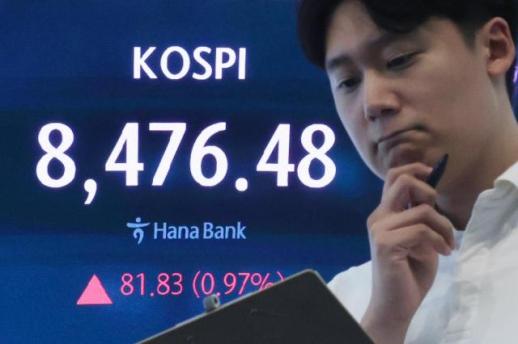 AI investment push, chip rally lift KOSPI; KOSDAQ slips SEOUL, June 30 (AJP) - South Korean stocks ended mixed on Tuesday as semiconductor heavyweights led a sharp recovery in the benchmark KOSPI after morning losses, helped by stronger U.S. chip stocks overnight and the South Korean government's fresh support for artificial intelligence semiconductors, while the junior KOSDAQ slipped as investors took profits in battery and biotechnology shares. The benchmark KOSPI closed up 0.97 percent at 8,476.48. The index had fallen as low as the 8,220 level in morning trading before staging a powerful rebound in the afternoon, briefly climbing above 8,660 as buying in large-cap chipmakers gathered pace. Institutional investors led the recovery, purchasing a net 2.89 trillion won ($1.86 billion) worth of KOSPI shares. Foreign investors sold a net 2.59 trillion won, while retail investors also remained net sellers. Both Samsung Electronics and SK hynix staged sharp intraday reversals. Samsung Electronics opened slightly higher before slipping 0.62 percent in early trading, then rebounded to an intraday high of 343,000 won, up as much as 6.19 percent, before closing 3.41 percent higher at 334,000 won. SK hynix also erased early losses, rebounding from a 3.31 percent decline to an intraday high of 2,742,000 won before finishing 0.84 percent higher at 2,650,000 won. The rebound in semiconductor heavyweights spilled over to related stocks. SK Square, a major shareholder of SK hynix, climbed 3.48 percent to 1,697,000 won, while Samsung Electro-Mechanics jumped 7.16 percent to 2,184,000 won after announcing a 450 billion won multilayer ceramic capacitor supply agreement with an undisclosed global technology company. Power and industrial names also advanced. LS Electric gained 6.25 percent to 238,000 won, Hyosung Heavy Industries rose 5.01 percent to 3,438,000 won, HD Hyundai Electric added 3.74 percent to 972,000 won, KB Financial climbed 3.45 percent to 159,000 won and LG Electronics advanced 3.20 percent to 203,000 won. Not all sectors participated in the recovery. Battery and biotechnology shares gave back part of the previous session's sharp gains as investors locked in profits LG Energy Solution tumbled 9.61 percent to 362,000 won after soaring more than 20 percent a day earlier, while Samsung SDI lost 4.88 percent to 487,000 won. Samsung Biologics fell 3.94 percent to 1,391,000 won, Celltrion dropped 3.29 percent to 173,300 won, Hanwha Aerospace declined 2.45 percent to 995,000 won, Kia slipped 1.85 percent to 138,000 won, while Samsung Life Insurance and Samsung C&T edged down 1.84 percent and 0.53 percent to 401,000 won and 468,500 won, respectively. The domestic rebound was also helped by stronger overseas cues. The Dow Jones Industrial Average rose 0.59 percent, while the S&P 500 and Nasdaq Composite gained 1.18 percent and 2.07 percent, respectively. Nvidia climbed 1.27 percent, Micron Technology rose 1.14 percent and Broadcom advanced 2.04 percent, pushing the Philadelphia Semiconductor Index up 3.83 percent. Investor sentiment was also lifted by the government's "three mega projects" initiative, which includes major investment in AI semiconductors. According to Daishin Securities, bargain hunting fueled the rebound, while Micron's strong earnings reaffirmed expectations for solid medium- to long-term demand despite recent concerns over higher memory chip prices. The junior KOSDAQ slipped 0.48 percent to 916.18 after giving up modest early gains. Individuals bought a net 307 billion won worth of shares, while institutions and foreign investors were net sellers. Despite the broader decline, semiconductor equipment makers outperformed on expectations of increased investment in the domestic chip industry. Semiconductor equipment maker Jusung Engineering jumped 13.82 percent to 201,000 won, while fellow chip equipment suppliers Wonik IPS and EO Technics rose 5.72 percent to 168,100 won and 4.27 percent to 476,000 won, respectively. Biopharmaceutical company HLB gained 1.96 percent to 52,000 won, while robotics maker Rainbow Robotics edged up 0.58 percent to 519,000 won. Battery and biotechnology stocks remained under pressure. EcoPro tumbled 9.66 percent to 106,600 won, EcoPro BM fell 7.77 percent to 142,500 won, Kolon TissueGene lost 3.90 percent to 93,600 won, Alteogen declined 3.22 percent to 361,000 won and Reno Industrial slipped 1.52 percent to 84,000 won. The Korean won weakened slightly against the U.S. dollar, trading at 1,548.6 won per dollar, compared with 1,545.2 won in the previous session. Regional markets were mixed. Japan's Nikkei 225 gained 0.86 percent to 70,062.32, supported by gains in technology shares. China's Shanghai Composite rose 0.50 percent to 4,094.40 after official manufacturing data returned to expansion in June. Hong Kong's Hang Seng Index fell 0.80 percent to 22,843.21 as investors took profits at the end of the quarter. 2026-06-30 16:38:21
-
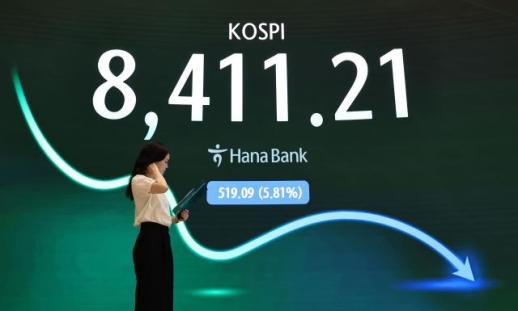 Margin-driven stock selloffs quadruple amid volatile KOSPI swings SEOUL, June 30 (AJP) - Involuntary stock selloffs more than quadrupled last week after a sharp market decline left many retail investors unable to pay for shares they had purchased. According to the Korea Financial Investment Association (KOFIA) on Tuesday, stocks forced to be sold due to margin calls totaled 271.7 billion won (US$200 million) last week, more than four times the 64.8 billion won recorded a week earlier. Stocks worth 50.9 billion won were sold off last Friday alone, up from 47.6 billion won the previous day, remaining above 40 billion won for the fourth consecutive trading session. The sharp selloffs followed a volatile week for South Korean stocks. The benchmark KOSPI briefly topped 9,100 for the first time last Monday, then plunged nearly 10 percent before rebounding and falling again over the week, triggering a wave of forced selling among investors who had borrowed money to buy stocks. That apparently led borrowing to slow, as unpaid trading balances fell to 1.56 trillion won last Friday from 2.07 trillion won the previous day, while outstanding loans also declined for a second consecutive session to 37.76 trillion won. But market jitters remain, as the KOSPI 200 Volatility Index (VKOSPI), South Korea's equivalent of Wall Street's VIX fear gauge stayed elevated at 94.30 as of early Tuesday afternoon, after surging to a record intraday high of 97.99 a day earlier, its highest intraday reading since the global financial crisis in 2008. Several factors fueled the market's sharp swings including over-dominance in leveraged ETFs linked to heavyweights like Samsung Electronics and SK Hynix and lingering tensions in the Middle East. Several factors such as excessive reliance on leveraged ETFs linked to heavyweight stocks like Samsung Electronics and SK hynix, and lingering tensions in the Middle East, continue to fuel the market's sharp swings. Rising memory chip prices also raised fears that major technology companies such as Apple could curb spending, adding pressure on semiconductor stocks. The South Korean bourse wrapped up another volatile day, with the KOSPI closing at 8,476.48 points after sharp swings during the session, as strong institutional buying outweighed persistent foreign selling. 2026-06-30 16:13:59
-
 FSS holds brokerage financially liable for wrap account losses SEOUL, June 30 (AJP) -South Korea's financial regulator has for the first time ruled that a brokerage must compensate investors for losses caused by improper discretionary asset management, setting a precedent that securities firms can be held financially liable for mishandling client assets. The Financial Supervisory Service's Dispute Mediation Committee said Tuesday it ordered investors to be reimbursed for 60 percent to 70 percent of losses stemming from the management of bond wrap accounts. The committee concluded that the brokerage breached its fiduciary duty by purchasing commercial paper and corporate bonds above market prices and investing in securities with maturities that exceeded those of the wrap accounts it was managing, exposing clients to unnecessary risks. Under South Korea's Capital Markets Act, investment managers are required to act in their clients' best interests and manage their money responsibly. The committee said this was the first mediation decision to find that a brokerage had failed to meet those obligations. Bond wrap accounts are investment products in which a brokerage manages money for a client under a one-on-one contract. Unlike mutual funds, which combine money from many investors, wrap accounts are managed separately for each client based on their investment goals and cash needs, making them a popular short-term cash management tool for corporate investors. According to the committee, one investor lost 4.6 billion won after investing 80 billion won ($58.8 million) in a bond wrap account in 2023. The brokerage postponed redemption one day before maturity, citing an internal audit into losses caused by its portfolio manager. Another investor was notified of a paper loss of about 450 million won after investing 15 billion won in the product. The investor later discovered that the brokerage had bought commercial paper above market prices and adopted maturity-mismatched investment strategies, eventually recovering the principal only after holding the investment beyond its maturity date. The committee also noted that the brokerage continued investing in securities with maturities of up to 10 months even as the wrap accounts neared maturity, without properly managing market risks. It further found that many of the overpriced trades were carried out to benefit other clients rather than the affected investors, and that the brokerage had previously been penalized for similar misconduct but failed to prevent their recurrence. It therefore ordered the firm to compensate the first investor for 70 percent of the recognized damages, equivalent to 1.26 billion won, and the second investor for 60 percent, or 390 million won. The compensation ratios were determined with reference to a related lower court ruling, which also assigned 70 percent liability, as well as previous dispute resolution cases. Damages were based on the difference between the principal and expected returns the investors should have received at maturity and the amount ultimately recovered. The mediation will become legally binding if both parties accept it within 20 days. "This ruling makes clear that firms can face not only regulatory sanctions but also civil liability if they unlawfully manage client assets," the committee said. "We will continue to encourage responsible bond investment practices among brokerages." 2026-06-30 13:41:25
-
 Overdue loans hit record as small business owners struggle to repay debts SEOUL, June 30 (AJP) - Small business owners are falling deeper into debt, with loans and overdue payments both hitting record highs in the first quarter amid a prolonged economic downturn. According to data submitted by the Bank of Korea to lawmaker Park Sung-hoon of the main opposition People Power Party (PPP) on Tuesday, outstanding loans of the self-employed reached 1,095.5 trillion won (US$803 billion) as of the end of March, the highest level since relevant records began in 2012. Their loans increased by 2.6 trillion won from the end of last year, with some 745.5 trillion won used for establishing or running their mom-and-pop businesses and the rest for household expenses and living costs. To make matters worse, loans overdue by more than a month hit a record 22.3 trillion won in the first quarter, up from 20.3 trillion won from the previous quarter, while the overall delinquency rate climbed to 2.04 percent, the highest since the second quarter of 2015. That suggests that more business owners are struggling to repay their loans after years of weak domestic demand and high interest rates, with expected rate hikes likely to add further pressure on them. Borrowers with multiple loans faced an even heavier burden. Self-employed business owners with loans from three or more lenders owed a combined 645 trillion won in the first quarter, while their average debt remained unchanged at 390 million won. Low-income business owners were hit hardest. Their outstanding loans reached a record 153.2 trillion won, while their delinquency rate climbed to 2.13 percent, the highest in more than a decade. But rising loan balances and delinquency rates among higher-income borrowers suggest the financial strain is no longer limited to the most vulnerable. The sharpest deterioration was seen at savings banks, which typically lend to riskier borrowers. Their delinquency rate on loans to self-employed business owners rose to 12.79 percent in the first quarter, up from 11.95 percent three months earlier. That was the highest level since 2015 and more than seven times the post-pandemic low of 1.78 percent recorded in 2022. The central bank said those with lower credit often turn to savings banks and other nonbank lenders, making them more vulnerable to rising interest rates. The outlook could worsen if interest rates rise further. The BOK estimates that a 0.25 percentage-point increase in lending rates would raise annual interest payments by 1.8 trillion won for the self-employed. For borrowers with multiple loans, the additional burden would reach 1.1 trillion won, or about 650,000 won per person annually. Many market analysts expect the BOK to raise interest rates at least twice before the end of this year to weather growing inflationary pressure. In a report released last week, it warned that faster increases in lending rates or a slowdown in the services sector could leave more self-employed borrowers unable to repay their loans on time. 2026-06-30 11:04:50