

Journalist

Ryu Yuna
Julia37@ajunews.com
-
 Generative AI's Impact on Media Discussed at Global News Conference in Marseille Leaders from newsrooms and tech companies around the world are gathering in Marseille, France, to discuss the use of generative artificial intelligence (AI) in the media industry. The 77th World News Media Conference (WNMC) kicked off on June 1 in the southern French port city of Marseille. Organized by the World Association of News Publishers (WAN-IFRA), the conference has attracted over 1,000 media professionals from more than 80 countries. This year's main topic is undoubtedly 'Generative AI.' On the first day, discussions focused on the changes generative AI could bring to news production, editing, search, content distribution, and revenue models, as well as survival strategies for media organizations in the AI era. The session titled 'AI: What the Latest Developments Mean for Publishers and Newsrooms' featured presentations on the direction of generative AI and its applications in newsrooms. Speakers included Florent Daudens, co-founder and CEO of the Canadian AI startup Mizal AI, and Christophe Israël, an AI and digital strategy consultant from Switzerland. Daudens has led AI innovations at the open-source AI platform Hugging Face and previously served as the editor-in-chief of the prominent Canadian daily Le Devoir and as the head of international, political, and reporting departments at CBC/Radio-Canada. He is currently researching the impact of AI on the media industry and continues to lecture and consult with global media organizations and universities. Israël has been involved in designing and mentoring programs such as the 'Newsroom AI Catalyst' and 'AI Frontier,' co-operated by WAN-IFRA and OpenAI. He has held positions as the digital director at France Inter and deputy editor at the daily Libération, as well as the head of digital and development at Swiss media group Tamedia. Currently, he runs OK Lab, a consulting firm focused on digital transformation and growth strategies for various companies, including media organizations. The conference will continue until June 3. On the second day, sessions will examine key technological changes surrounding generative AI and their implications for media companies' strategies and business models. Media executives are expected to discuss strategies for adapting to the AI era. 2026-06-01 16:33:00
 -
![[WNMC 2026] Media Leaders Discuss AI Strategies at World News Media Congress](https://image.ajunews.com//content/image/2026/06/01/20260601162718581718_518_323.jpg) [[WNMC 2026]] Media Leaders Discuss AI Strategies at World News Media Congress The 77th World News Media Congress, organized by the World Association of Newspapers (WAN-IFRA), is currently underway in Marseille, France, where global media leaders are focusing on new survival strategies and revenue generation methods in the age of artificial intelligence (AI). This year’s congress has highlighted the explosive growth of generative AI technology and its impact on the news ecosystem, as well as the strategic choices media organizations must make in response. A session titled "Deep Dive: What Media Companies Need to Do to Leverage the AI Content Market" drew significant attention from attendees on the morning of the event. WAN-IFRA views the emerging AI content licensing market as a new opportunity for media companies and outlined the key steps news publishers must take to successfully enter this ecosystem. The urgency for media companies to establish a market environment where they can take the lead and demand fair compensation arises from the indiscriminate use of news content in AI model training by major tech firms. Industry experts who are building the technical foundation for a new licensing market through AI models participated as speakers in the session. They shared practical approaches to protect original works produced by media companies from unauthorized scraping by external AI and to maximize revenue by establishing new licensing business models based on this protection. The session was moderated by Kevin Anderson, Director of the Digital Revenue Network at WAN-IFRA. Speakers included Birger Søiland, Head of Publisher Partnerships at TollBit, Frederick Jahn, Co-founder of Centinel Analytica, and Primavera de Filippi, Co-founder of Alien Intelligence. They led in-depth discussions on how to create a fair value exchange system between news media and AI companies, drawing on their expertise in data tracking technology and AI governance. WAN-IFRA emphasized that media companies must evolve from a passive role of merely providing content to becoming active players who establish the rules of the AI content market and share in its benefits. As more detailed remarks from the speakers and specific business cases are added, a clear blueprint for building sustainable business models for media companies in the AI era is expected to emerge. 2026-06-01 16:27:00
[[WNMC 2026]] Media Leaders Discuss AI Strategies at World News Media Congress The 77th World News Media Congress, organized by the World Association of Newspapers (WAN-IFRA), is currently underway in Marseille, France, where global media leaders are focusing on new survival strategies and revenue generation methods in the age of artificial intelligence (AI). This year’s congress has highlighted the explosive growth of generative AI technology and its impact on the news ecosystem, as well as the strategic choices media organizations must make in response. A session titled "Deep Dive: What Media Companies Need to Do to Leverage the AI Content Market" drew significant attention from attendees on the morning of the event. WAN-IFRA views the emerging AI content licensing market as a new opportunity for media companies and outlined the key steps news publishers must take to successfully enter this ecosystem. The urgency for media companies to establish a market environment where they can take the lead and demand fair compensation arises from the indiscriminate use of news content in AI model training by major tech firms. Industry experts who are building the technical foundation for a new licensing market through AI models participated as speakers in the session. They shared practical approaches to protect original works produced by media companies from unauthorized scraping by external AI and to maximize revenue by establishing new licensing business models based on this protection. The session was moderated by Kevin Anderson, Director of the Digital Revenue Network at WAN-IFRA. Speakers included Birger Søiland, Head of Publisher Partnerships at TollBit, Frederick Jahn, Co-founder of Centinel Analytica, and Primavera de Filippi, Co-founder of Alien Intelligence. They led in-depth discussions on how to create a fair value exchange system between news media and AI companies, drawing on their expertise in data tracking technology and AI governance. WAN-IFRA emphasized that media companies must evolve from a passive role of merely providing content to becoming active players who establish the rules of the AI content market and share in its benefits. As more detailed remarks from the speakers and specific business cases are added, a clear blueprint for building sustainable business models for media companies in the AI era is expected to emerge. 2026-06-01 16:27:00 -
 Record visitor arrivals drive biggest-ever April spending in Seoul SEOUL, June 01 (AJP) - Foreign visitors flocked to Seoul in record numbers in April and spent more than ever before, signaling that the city's tourism recovery is evolving into a broader consumer spending boom. The number of overseas visitors to the capital reached 1.56 million in April, up 18.8 percent from a year earlier and the highest figure ever recorded for the month, according to data released by the Seoul Metropolitan Government on Sunday. Foreign visitors spent a combined 1.1532 trillion won ($830 million) in Seoul in the same period, up 50.5 percent from a year earlier and the highest monthly total on record. It also marked the first time monthly foreign visitor spending in Seoul exceeded 1 trillion won. The growth was driven partly by strong demand for shopping and medical tourism, two sectors in which South Korea has emerged as a leading destination in Asia. Purchases at large retail complexes climbed 62.5 percent from a year earlier to 245.2 billion won, while medical tourism revenue rose 59.2 percent to 192.1 billion won. Gangnam accounted for the largest share of foreign spending at 29.1 percent, followed by Jung-gu, which includes the Myeongdong shopping district in central Seoul at 27.5 percent, and Mapo District, known for the Hongdae area, Seoul's heart of fashion and trends, at 7.4 percent. According to city officials, Myeongdong and Jamsil, a southern Seoul district where major shopping complexes are located, were the most popular shopping destinations, while the areas around Gangnam Station and Sinnonhyeon Station, famous for beauty and fashion stores, attracted large numbers of visitors seeking medical and cosmetic treatments. Chinese visitors accounted for the largest share of arrivals, with 440,000 tourists visiting, followed by 230,000 Japanese, 150,000 Taiwanese and 130,000 Americans. The cumulative number of foreign visitors to Seoul reached 5.2 million during the first four months of the year. Arrivals from China and Japan continued to strengthen in early May during Japan's Golden Week and China's Labor Day holidays. Between April 29 and May 6, 108,000 Chinese and 112,000 Japanese travelers visited South Korea, up 40.7 percent from a year earlier. Foreign visitor spending in Seoul reached 437.6 billion won during the period. The trend also highlights a shift toward higher-value tourism, with visitors increasingly combining shopping, entertainment and healthcare services in a single trip. To capitalize on the trend, Seoul plans to continue upgrading tourism content and visitor services. Kim Myung-joo, head of Seoul's Tourism and Sports Bureau, said the city aims to attract 30 million international visitors annually. 2026-06-01 10:22:22
 -
 AI becomes defining battleground at World News Media Congress MARSEILLE, France, June 1 (AJP) — Artificial intelligence has emerged as the defining battleground for the global news industry as publishers, editors and policymakers gather in southern France this week to debate the future of journalism amid one of the most disruptive technological shifts in decades. The 77th World News Media Congress, organized by the World Association of News Publishers (WAN-IFRA), will bring together more than 1,000 media executives, editors and innovators from over 60 countries in Marseille, including leaders from The New York Times, The Guardian, POLITICO and the European Commission. While the annual gathering traditionally focuses on the future of journalism and media business strategies, this year's agenda is overwhelmingly shaped by artificial intelligence, reflecting the technology's growing influence on newsroom operations, audience engagement, content distribution and revenue models. Generative AI has rapidly moved from a newsroom experiment to a strategic priority for publishers worldwide. At the same time, it has raised pressing questions about copyright, misinformation, editorial integrity and the long-term sustainability of professional journalism. Among the invited speakers is AJP, the English-language news platform of Aju Media Group, which has emerged as one of South Korea's early adopters of AI-driven newsroom innovation in one of the world's fastest-moving digital media markets. AJP Managing Editor Seo Hye-seung will participate in a session titled "How AI Is Transforming the News Experience," sharing how the organization has leveraged AI technologies to broaden its international reach, enhance content distribution and develop new audience experiences as a relatively young player in the global news industry. A.G. Sulzberger, chairman and publisher of The New York Times, will open the congress with a keynote address titled "AI, Journalism and the Uncertain Future of the Public Square." The speech is expected to explore how artificial intelligence is reshaping press freedom, public discourse and journalism's role in democratic societies at a time when AI-powered platforms are increasingly influencing how information is created, distributed and consumed. Sulzberger, a fifth-generation leader of the Ochs-Sulzberger family that has controlled the newspaper since 1896, has overseen one of the industry's most closely watched digital transformations. Since becoming publisher in 2018, he has led the Times to more than 12.8 million subscribers by the end of 2025 through a subscription bundle that spans news, games, cooking and audio products. He has also become a leading advocate for stronger copyright protections for publishers amid escalating disputes between news organizations and AI companies over the use of journalistic content to train large language models. The congress will also bring together policymakers shaping the future of artificial intelligence regulation and digital governance. Henna Virkkunen, Executive Vice-President of the European Commission for Tech Sovereignty, Security and Democracy, oversees the European Union's policies on artificial intelligence, digital regulation and cybersecurity. A former Finnish education minister and member of the European Parliament, she will deliver the closing keynote outlining Europe's vision for technological sovereignty, democratic resilience and the role of journalism in the digital age. Another prominent participant is Katharine Viner, editor-in-chief of The Guardian, who has spearheaded the publication's reader-revenue strategy while overseeing its expansion across Australia, the United States and Europe. At the plenary session "In Conversation," she will join AFP Global News Director Phil Chetwynd to discuss digital transformation, reader-supported journalism and the future of news organizations in the AI era. Goli Sheikholeslami, chief executive of POLITICO Media Group, will also address how publishers are adapting their business strategies to the AI age. Since taking the helm in 2022, Sheikholeslami has overseen POLITICO's expansion across North America and Europe. She previously held senior leadership positions at New York Public Radio, Chicago Public Media and The Washington Post. At the plenary session "Redefining Media Strategies in an AI-Transformed World," she will discuss how publishers are rethinking newsroom operations, business models and long-term growth strategies as generative AI reshapes the media landscape. As news organizations confront declining traditional revenues, changing audience habits and growing competition from AI-powered information platforms, the debates in Marseille are expected to provide an early glimpse into how journalism intends to defend its value while harnessing the opportunities of the technology transforming it. For many publishers, the question is no longer whether AI will change journalism, but whether journalism can adapt quickly enough to shape how AI changes the public's relationship with news. 2026-06-01 10:16:19
 -
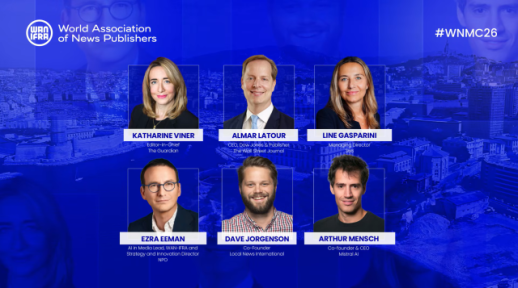 World News Media Congress 2026 Kicks Off in Marseille, Focuses on AI and Journalism The 77th World News Media Congress, organized by the World Association of Newspapers and News Publishers (WAN-IFRA), opened on June 1 in Marseille, France. The event brings together over 1,000 executives and editors from media organizations across more than 60 countries to discuss the future of journalism in the wake of the rise of generative artificial intelligence (AI). Key topics at the congress include "AI in Media," "Future of Journalism," and "Revenue & Growth." Discussions will focus on how generative AI is transforming news production and distribution, protecting media copyrights, and exploring new revenue models and innovations in newsrooms for the AI era. The event features executives from major global media outlets such as The New York Times, The Guardian, and POLITICO, along with digital policy leaders from the European Union, who will share insights on the future of journalism and the media industry in the age of AI. Notably, Seo Hye-seung, editor of AJP, the English-language news agency of the Ajou Media Group, is the only invited speaker from Korea. She will present on how AI is transforming news experiences, showcasing AJP's model of producing content in five languages and expanding its audience beyond Korea. A.G. Sulzberger, Chairman and Publisher of The New York Times, will deliver the keynote address on "AI, Journalism, and the Uncertain Future of the Public Sphere." The three-day congress will also feature prominent media leaders such as Goli Sheikholeslami, CEO of POLITICO, Katharine Viner, editor-in-chief of The Guardian, and Phil Chetwynd, Global News Director of AFP, who will discuss the role of journalism in a rapidly changing media landscape driven by AI innovation. 2026-05-31 17:51:00
 -
 AI wealth gap reaches city halls as Korea's chip hubs reap tax windfall SEOUL, May 29 (AJP) - South Korea's artificial intelligence boom is creating winners far beyond the stock market, with cities hosting semiconductor plants emerging as some of the biggest beneficiaries of a tax windfall fueled by record earnings at Samsung Electronics and SK hynix. The central government is expected to collect tens of trillions of won in additional tax revenue this year as the AI-driven semiconductor boom boosts corporate profits and equity valuations. At the local level, the gains are increasingly concentrated in a handful of cities in Gyeonggi Province that host facilities of the world's two largest memory-chip makers. For local governments that only a few years ago struggled with shrinking tax bases and relied heavily on central government transfers, the turnaround has been striking. Since the semiconductor industry's recovery began in the second half of 2025, five semiconductor cities in Gyeonggi Province have collected between 60 billion won and 200 billion won ($44 million-$147 million) more in tax revenue than initially budgeted as of April, according to local government data. The rebound marks a dramatic reversal from 2023, when corporate local income tax payments from major chipmakers nearly disappeared during one of the industry's deepest downturns. The surge reflects record profits at Samsung Electronics and SK hynix, whose earnings have been turbocharged by global demand for AI servers and high-bandwidth memory chips. As tax revenue floods into South Korea's semiconductor belt, local governments are increasingly divided over whether to spend the windfall on infrastructure and public services or save part of it for the next downturn in the notoriously cyclical chip industry. The debate is most intense in Hwaseong, one of South Korea's most important semiconductor hubs and home to major Samsung Electronics production facilities. City officials have declined to disclose detailed figures, but industry estimates suggest tax revenue linked to Samsung Electronics could exceed 1 trillion won. Under South Korea's tax-sharing system, part of corporate local income taxes is distributed to municipalities where production facilities are located. "Windfall tax revenue should be invested in infrastructure for the city's long-term growth potential rather than short-term spending," said Rep. Kwon Chil-seung of the ruling Democratic Party, who represents part of Hwaseong. Other semiconductor cities are taking different approaches. Icheon, home to SK hynix's flagship memory-chip complex and one of the largest beneficiaries of the company's earnings surge, is expected to receive nearly 200 billion won in corporate local income tax revenue. Rather than spending the proceeds immediately, city officials plan to place a substantial portion into fiscal reserve funds to cushion future economic downturns. Pyeongtaek, home to Samsung Electronics' largest semiconductor manufacturing complex, expects corporate local income tax revenue linked to Samsung to nearly triple to 155.6 billion won ($115 million) in 2026 from 51.6 billion won a year earlier. City officials plan to direct much of the increase toward construction of a new municipal government complex, one of the city's largest ongoing projects, while allocating additional funds to transportation and public services. Suwon, where Samsung Electronics maintains its headquarters, expects roughly 80 billion won in additional tax revenue. Officials say the funds will support transportation projects, electric-vehicle initiatives and other public investments. Yongin, which hosts facilities operated by both Samsung Electronics and SK hynix and is positioning itself as South Korea's next-generation semiconductor cluster, projects collecting about 64.9 billion won in corporate local income taxes from the two companies this year. Officials there remain cautious about treating the increase as a permanent revenue source. "It should ultimately be used to improve residents' quality of life," said Rep. Lee Sang-sik, who represents part of Yongin. "I hope some of the funds will be invested in cultural and sports facilities in Cheoin-gu, where related infrastructure remains underdeveloped." The discussion illustrates how the AI boom is widening economic disparities not only between companies and industries but also between local governments. While semiconductor hubs enjoy overflowing coffers, many municipalities elsewhere continue to struggle with stagnant tax revenue, aging populations and rising welfare costs. Some politicians and education officials have proposed directing a portion of the windfall toward social programs and public education, while others argue the money should be used to strengthen transportation networks and industrial infrastructure that can attract future investment. The debate has taken on added political significance ahead of local elections on June 3, with competing visions emerging over how to spend what many view as the first major local-government dividend from the global AI boom. For now, one thing is clear: the benefits of South Korea's semiconductor renaissance are no longer confined to chipmakers and investors. They are increasingly reshaping the finances—and political priorities—of the cities that host the factories powering the world's AI revolution. 2026-05-29 16:59:27
 -
 South Korean households spend more as income gap widens in Q1 SEOUL, May 29 (AJP) - South Korean households spent more in the first quarter, but their savings declined as spending grew faster than earnings for the first time in nearly two years, the Ministry of Data and Statistics said on Friday. According to the ministry, average monthly household income rose 2.4 percent from a year earlier to 5.48 million won (US$4,000) in the first quarter of 2026. Among them, average income for salaried workers stood at 3.42 million won. Average monthly household spending rose 5.3 percent from a year earlier to 3.11 million won, marking the fastest increase since the first quarter of 2023, and spending exceeded income for the first time since the second quarter of 2024. The average propensity to consume also increased 1.7 percentage points to 71.5 percent. The income gap widened as lower-income households faced growing financial pressure, while large performance bonuses at major companies such as Samsung Electronics and SK hynix boosted earnings among higher-income households. The average propensity to consume among the bottom 20 percent reached 155.3 percent, with households earning an average of 1.17 million won per month but spending 1.46 million won. By contrast, households in the top 20 percent saw the strongest income growth, with average monthly income rising 4.2 percent to 12.38 million won. They were also the only group to see their income grow, up 2.6 percent to 4.08 million won. As a result, the income gap between the two groups widened to 6.59 times from 6.32 times a year earlier. The ministry attributed the widening gap partly to wage growth at large corporations and performance bonuses from major chipmakers such as Samsung Electronics and SK hynix, which were partly reflected in February's income data. Households in the top 20 percent of the income bracket tend to include a higher proportion of employees at large companies, where wage gains were stronger in the first quarter. 2026-05-29 16:19:02
 -
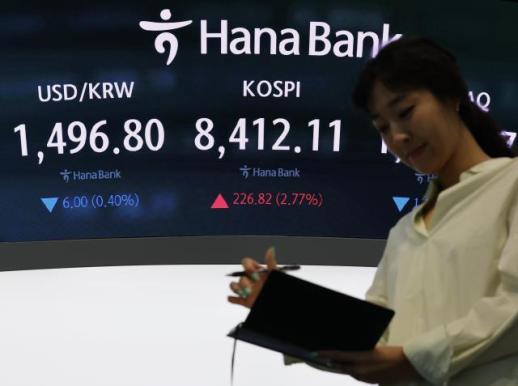 KOSPI rebounds as Middle East tensions show signs of easing SEOUL, May 29 (AJP) - South Korean stocks opened higher on Friday, recovering from a brief decline the previous day, as the benchmark KOSPI climbed back above 8,400 on hopes that the prolonged conflict in the Middle East could soon come to an end. The KOSPI rose 2.31 percent to 8,374.58 shortly after trading began, nearing its recent intraday high of 8,457.09. The junior KOSDAQ, however, fell 2.31 percent to 1,078.89 as investors shifted toward large-cap stocks. The rebound followed a volatile session the previous day, when the KOSPI closed 0.53 percent lower after briefly plunging more than 4 percent intraday, as the Bank of Korea kept its benchmark rate unchanged while hinting at future hikes. The rally was largely driven by improved investor sentiment amid signs of easing tensions in the Middle East, with reports suggesting Washington and Tehran were nearing a deal. Chipmakers led the gains, with Samsung Electronics up 4.34 percent to 312,500 won and SK Hynix up 3.23 percent to 2,363,000 won, boosting the broader market. Automakers and auto-parts makers also rallied, with Hyundai Motor climbing 6.35 percent to 720,000 won, Hyundai Mobis advancing 6.12 percent to 728,000 won and Kia adding 3.47 percent to 170,000 won. Technology and industrial shares traded higher, as Samsung Electro-Mechanics jumped 6.49 percent to 1,969,000 won, SK Square rose 1.13 percent to 1,251,000 won and HD Hyundai Heavy Industries gained 1.70 percent to 716,000 won. Financial and holding-company stocks also advanced, with Samsung Life Insurance rising 1.12 percent to 361,500 won, Samsung C&T gaining 3.38 percent to 413,000 won and Samsung Electronics preferred shares climbing 6.08 percent to 202,500 won. Defense-related shares remained firm, with Hanwha Aerospace adding 1.25 percent to 1,215,000 won. But battery, biotech and energy shares underperformed, as LG Energy Solution slipped 0.11 percent to 441,500 won, Samsung Biologics fell 0.58 percent to 1,365,000 won and Doosan Enerbility declined 2.46 percent to 103,300 won. Asian markets also opened broadly higher, with Japan's Nikkei 225 up 1.83 percent at 65,876.04, Hong Kong's Hang Seng Index rising 0.37 percent to 25,097.78 and China's Shanghai Composite adding 0.29 percent to 4,110.52. Overnight, U.S. stocks climbed to fresh record highs. The Nasdaq Composite rose 0.91 percent and the S&P 500 gained 0.58 percent, while the Philadelphia Semiconductor Index advanced about 1 percent. Investor sentiment was further boosted after Dell Technologies posted stronger-than-expected earnings and surged roughly 38 percent in after-hours trading, reinforcing optimism over AI-related spending. Lower oil prices and easing bond yields also supported risk assets. U.S. benchmark WTI crude fell to around $88 a barrel, while the yield on the 10-year U.S. Treasury note retreated to 4.44 percent. Meanwhile, the Korean won strengthened slightly against the greenback in early trading, with the dollar trading at 1,498 won, compared with the previous session's close of 1,502.80 won. 2026-05-29 10:23:59
 -
 Samsung's Bonus Disparities Spark Debate Among South Korean Firms "I should have raised ducks instead of getting a PhD," said HB Lee, a 33-year-old employee in the LSI division of a major South Korean conglomerate. Such self-deprecating remarks have recently circulated in employee communities. While some support staff in the memory division, benefiting from the AI semiconductor boom, receive bonuses in the tens of millions of won, PhD-level researchers in the loss-making system LSI and foundry divisions receive significantly lower compensation. Lee noted, "These days, there’s talk that even someone raising ducks in the semiconductor division is getting bonuses of 400 to 500 million won. It’s laughable that compensation depends more on which division you belong to than on actual performance." South Korea's export-driven economy has traditionally operated on a trickle-down economics model, where profits from large corporations flow down to subcontractors and small manufacturers. However, there are growing concerns that the current performance bonus conflicts in the AI era are creating a new form of trickle-down effect, exacerbating wage disparities, relative deprivation, and labor disputes across the industrial ecosystem. The competition for performance bonuses, which began in the memory semiconductor sector, is now shaking the distribution standards across South Korean corporate society. The compensation debate sparked by Samsung Electronics and SK Hynix is spreading to the platform, ICT, manufacturing, and bio industries, leading to polarization in the labor market, internal divisions within organizations, and conflicts throughout the supply chain. Professor Park Byeong-jin of Hanyang University’s Business School stated, "The precedent set by Samsung Electronics regarding performance bonuses is likely to have a domino effect on the entire South Korean labor market and the compensation systems of major corporations. The unlimited bonus structure of the country’s top company is becoming a benchmark that raises the compensation expectations of other corporate unions." He added, "If this trend continues, it could lead to performance bonus inflation across the industry, increasing the cost burden on companies." The demand for performance bonuses is intensifying across the industrial sector. The Hyundai Motor and Kia unions are demanding bonuses equivalent to 30% of their net profits this year, while the HD Hyundai Heavy Industries union has included a proposal for sharing 30% of operating profits in this year's negotiations. The Kakao union has raised the possibility of a strike for the first time since its founding, demanding bonuses of 13-14% of operating profits, and LG Uplus is also continuing to demand bonuses at the 30% level. The Doosan Enerbility union, benefiting from a boom in power equipment, has reportedly included a request for a revision of the bonus calculation method in this year's negotiations. SM, a 33-year-old manager at a domestic automotive company, remarked, "Ultimately, it’s a matter of how to distribute limited resources. There can’t be a win-win structure. If one person takes more, someone else has to take less. In the end, one side has to concede, but realistically, who is going to give up money?" Within Samsung Electronics, there is growing backlash over the extreme disparities in performance bonuses between divisions. The joint negotiation team of the Samsung Electronics union announced that a tentative agreement was approved with 73.7% support (46,142 votes) in a vote that closed at 10 a.m. on May 27. The turnout was 95.5%. As a result, Samsung Electronics has temporarily avoided the previously anticipated strike. The agreement includes an average wage increase of 6.2% and the establishment of a "special management performance bonus" for the DS division. This special bonus will be funded by 10.5% of business performance and will be paid in the form of restricted stock units (RSUs). The distribution ratio for the bonus fund is set at 40% for common divisions and 60% for business units. This structure is similar to the bonus system already implemented by SK Hynix, which provides bonuses equivalent to 10% of operating profits. Under the tentative agreement, employees in the memory division are expected to receive a total bonus of up to 600 million won based on an annual salary of 100 million won, combining the special management performance bonus and the existing excess profit incentive (OPI). In contrast, employees in the loss-making system LSI and foundry divisions are expected to receive around 210 million won. Some employees in the DX division, responsible for smartphones and home appliances, are reported to receive about 6 million won. The nearly 100-fold disparity has led to unprecedented "intra-company conflict" within Samsung Electronics. Internal dissent among employees in the non-memory and DX divisions continues even after the approval of the tentative agreement. The number of members in the Donghaeng union, primarily composed of DX division employees, surged from about 2,200 to around 12,800 following the announcement of the tentative agreement. This internal backlash highlights the structural dilemma faced by South Korean companies in the AI boom. They must reward successful divisions while also managing relative deprivation, distrust, and divisions within the organization. SM stated, "In the past, the company would explain that it was difficult due to public sentiment, but employees no longer accept such explanations. The disparities between divisions have become so pronounced that they begin to question the fairness of the structure itself." He added, "One side claims, 'We made money through good sales,' while the other side argues, 'If we hadn’t supported them, that business wouldn’t have operated at all.' When we start to scrutinize contributions, it ultimately leads to everyone feeling wronged." The conflict over performance bonuses has evolved beyond simple labor disputes to encompass competition between divisions, conflicts between job categories, tensions between regular employees and subcontractors, and clashes between primary and secondary contractors, as well as conflicts of interest between shareholders and employees. Particularly within platform and ICT companies, the difficulty of quantifying contributions to revenue generation among developers, marketing, sales, support teams, and management is complicating the conflict. The atmosphere is similar in booming industrial sectors. Samsung Biologics faced its first strike after negotiations broke down earlier this month, and the Doosan Enerbility union is also demanding changes to the bonus calculation method. The repercussions have already extended beyond large corporations. According to a survey on labor costs released by the Ministry of Employment and Labor in September 2025, performance bonuses have emerged as a key variable exacerbating labor market polarization in South Korea. In 2024, bonuses and performance incentives accounted for approximately 24.7% of total wages in large corporations with over 1,000 employees, while small businesses accounted for only about 8%. The widening gap is attributed to performance bonuses. While the gap in fixed salaries, such as base pay, was 4.71 million won for large corporations and 3.99 million won for small businesses, the average monthly performance bonus and incentive was 1.33 million won for large corporations, nearly four times that of small businesses (340,000 won). David Song, a 35-year-old employee at a small IT company in Gangnam, expressed, "For some, it’s tough to make ends meet for a month, while conflicts over bonuses in the tens of millions of won feel like a story from another world. Employees in small businesses can’t raise their voices like those in large corporations." The conflict is also spilling over to subcontractors. The domestic manufacturing sector relies heavily on numerous subcontractors and outsourced labor. As the scale of performance bonuses grows due to the AI boom, debates are intensifying over whether to extend bonuses to employees of subcontractors in areas such as cafeteria services, cleaning, and security. JW Kim, a 28-year-old employee in manufacturing, questioned, "Is it reasonable to pay subcontractor employees 80% of the performance bonus just because they work in the same facility?" He added, "Ultimately, this only breeds resentment toward subcontractors." Concerns are growing that the amendments to the Labor Union Act, which expanded the scope of primary contractors' responsibilities, could lead to demands for negotiations, strikes, and lawsuits from subcontractor unions throughout the supply chain. In fact, the logistics subcontractor union of SK Hynix has demanded collective bargaining to address performance bonus disparities, and the cafeteria union at Hanwha Ocean has also raised the issue of expanding bonuses. The debate over performance bonuses has also led to clashes between shareholders and employees. Some investors worry that when corporate performance declines, shareholders bear the losses, while employees may excessively allocate profits during boom periods to bonuses. In response, Professor Park suggested a realistic alternative: "Instead of simply distributing a percentage of operating profits, it would be better to first reflect the minimum capital costs and dividend resources that should go to shareholders, and then calculate the performance bonus fund based on the remaining economic value added (EVA)." He also proposed increasing the proportion of long-term stock compensation, such as RSUs, instead of excessive cash bonuses. Bonuses above a certain level should be paid in stock that can be disposed of after 3-5 years, encouraging employees to have a greater stake in the company’s value and stock price appreciation rather than focusing on short-term rewards. The conflict over compensation is beginning to change the internal atmosphere of companies. Employees are now constantly comparing compensation not only between companies but also within the same company across divisions, job categories, and organizational affiliations. Engineers in loss-making semiconductor divisions are publicly expressing dissatisfaction online, stating that support staff are receiving higher bonuses simply because they belong to the same organization. Analysts suggest that the community identity that once supported South Korean conglomerates is now being shaken. Hyun Mo, a 32-year-old employee who struggled to secure a position at a refinery, lamented, "In the past, it was considered an 'elite course' to go to a refinery or automotive company based on an electrical engineering degree, but these days, seeing the semiconductor bonus news makes many employees feel like they’re going crazy." Ultimately, South Korean companies find themselves at a crossroads between 'organizational stability' and 'performance differentiation' in the AI era. Professor Park analyzed that Samsung's current performance bonus (OPI) structure has a strong collective reward nature, where if a specific division is profitable, all members within that division receive high compensation together. He stated, "This structure imposes a tremendous burden on companies, as they have to reward 10,000 people equally to retain one key talent." He continued, "In the future, companies should reduce the proportion of collective performance bonuses and convert some of the saved resources into targeted bonuses (Retention Bonuses) directly awarded to irreplaceable key engineers and high performers to alleviate the overall cost burden and prevent the loss of key talent." This trend is partially reflected in Samsung Electronics' tentative agreement, which includes provisions for some of the special bonuses to be paid in restricted stock units (RSUs), indicating a shift from a short-term cash compensation structure to a long-term stock-linked compensation system.* This article has been translated by AI. 2026-05-29 08:02:00
 -
 Samsung's largest union adopts two-track DS-DX bargaining as membership slides SEOUL, May 28 (AJP) - Samsung Electronics’ largest labor union is rapidly losing members in the aftermath of a contentious wage agreement that exposed deepening rifts between the company’s semiconductor and device businesses, prompting the union to adopt a separate “two-track” bargaining structure for its divisions. Samsung Group Labor Union’s Samsung Electronics branch, the company’s largest and majority union, said Thursday its membership fell to 69,575 as of 10 a.m. from more than 76,000 during wage negotiations. The decline came after Samsung Electronics concluded this year’s wage negotiations with a compensation framework heavily favoring semiconductor employees in the Device Solutions (DS) division, fueling backlash among workers in the Device eXperience (DX) division, which oversees smartphones, TVs and home appliances. The outflow has raised concerns that the union could eventually lose its status as the majority union, weakening its legal bargaining authority and leverage in negotiations with management. The union initially secured majority status and legal employee representative rights from the Ministry of Employment and Labor in April. However, maintaining that status requires around 64,500 members, or roughly half of Samsung Electronics’ current workforce. If the union loses that status, its legal legitimacy and bargaining power in future negotiations could weaken sharply. The organization also risks becoming a DS-centered union as compensation tensions widen between Samsung’s semiconductor and non-semiconductor businesses. Meanwhile, rival unions have continued to gain members as the largest union’s membership declined. Membership in the National Samsung Electronics Union rose to around 20,000, while Samsung Electronics Labor Union Donghaeng grew to roughly 16,000. The voting results underscored the widening divide between Samsung’s DS and DX divisions over the wage deal. Within the majority union, 80.6 percent of members, or 44,606 workers, voted in favor of the agreement. But approval in the National Samsung Electronics Union stood at 21.1 percent, with only 1,536 members backing the deal. In response to the backlash, union chief Choi Seung-ho said “To better reflect each division’s specific conditions and pending issues, our future negotiations will operate under a ‘two-track’ system separating the DS and DX divisions within the union,” adding that the union leadership would also be split between the two divisions, with five executives assigned to DS and three to DX. For the DS division, the union said it plans to closely review the financial conditions of loss-making non-memory businesses such as System LSI and foundry operations while pressing management to present a credible turnaround vision. The union also capped executive position allowances at a maximum total of 5 million won following criticism that some executives were effectively receiving overlapping compensation alongside regular salaries. Meanwhile, the union will hold a confidence vote on Choi’s leadership on June 17 after he faced criticism over remarks seen as fueling tensions between DS and DX workers during the negotiations. Choi said he would accept responsibility for mistakes made during the negotiations. “I will humbly accept the members’ judgment,” he said. He added that the union would reorganize around preparations for the 2027 wage agreement and the new DS-DX operating structure, saying, “We will do our best to deliver a more favorable outcome in the next round of negotiations.” 2026-05-28 17:17:30