
Journalist

Kim Dong-young
davekim0807@ajupress.com
-
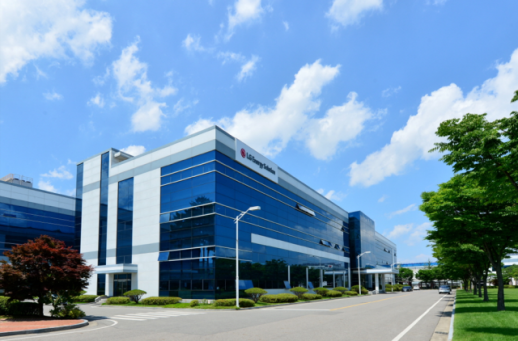 LG Energy Solution pivots to energy storage as EV battery demand slows SEOUL, March 20 (AJP) - LG Energy Solution announced it is accelerating a strategic shift toward energy storage systems as slowing electric vehicle demand reshapes the global battery industry, with the South Korean company moving to rebalance a business long anchored to the automotive sector. Chief Executive Kim Dong-myung told shareholders Friday at the company's annual general meeting in Seoul that the industry has entered a period of "value shift," in which growth is migrating away from electric vehicles and toward energy infrastructure. "We will seize new growth opportunities amid structural changes in power demand," Kim said. The remarks amounted to a formal acknowledgment that the battery sector's center of gravity is tilting from EVs to grid-scale storage, driven by rising electricity consumption from artificial intelligence data centers and the expansion of renewable energy generation worldwide. LG Energy Solution, one of Korea's largest battery maker, plans to raise ESS cell production capacity to more than 60 gigawatt-hours by the end of 2026. The company's ESS order backlog stood at 140 GWh at the end of 2025, and it is targeting an additional 90 GWh in new orders this year. North America is the centerpiece of the push. The company now operates five ESS production sites in the region, including standalone plants in Michigan and a facility run by its Canadian subsidiary NextStar Energy, as well as joint ventures with Honda in Ohio and partnerships with Ultium Cells in Tennessee. It is also converting existing EV battery lines to ESS use to minimize fresh capital spending. The North American focus carries a distinct policy advantage. Washington's Inflation Reduction Act restricts tax incentives for batteries and critical minerals sourced from Chinese supply chains, and LG Energy Solution's domestic manufacturing footprint positions it as one of the few non-Chinese suppliers of lithium iron phosphate cells in the United States. In Europe, the company is repurposing idle EV production capacity for ESS manufacturing, a strategy designed to contain investment costs while responding to regional demand. LG Energy Solution said it aims to raise the share of ESS and new businesses in its portfolio from about 20 percent at present to the mid-40 percent range, reducing its dependence on the volatile EV market. Industry analysts say companies that secure ESS production capacity and non-Chinese supply chains early are likely to gain a durable competitive edge as the battery market transitions from a single reliance on electric vehicles to a broader energy infrastructure model. 2026-03-20 13:48:40
 -
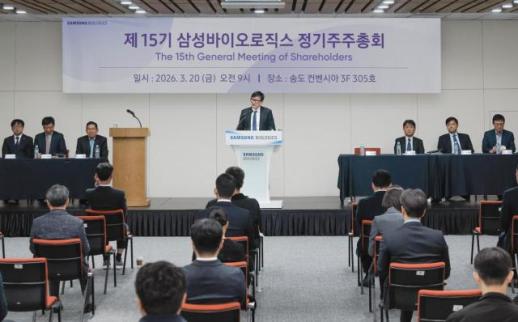 Samsung Biologics reappoints CEO John Rim as inside director SEOUL, March 20 (AJP) - Samsung Biologics said Friday that shareholders reappointed Chief Executive John Rim as an inside director at the company's 15th annual general meeting. About 1,400 shareholders participated in the meeting, which was conducted both on-site and via online livestream. All five agenda items put to a vote were approved as proposed. In addition to Rim, Executive Vice President Lo Kun, who heads the EPCV Center, was also reappointed as an inside director. Kim Jung-yeon, a professor at Ewha Womans University Law School, was newly appointed as an outside director and audit committee member. Other approved items included the adoption of financial statements, amendments to the company's articles of incorporation and a cap on executive compensation. "This year marks our meaningful 15th anniversary," Rim said. "We will continue our efforts to enhance corporate and shareholder value while contributing to the growth of South Korea's bio industry and economy." 2026-03-20 12:12:30
 -
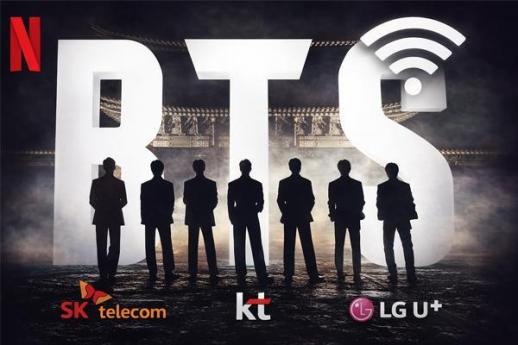 BTS Live D-2: K-tech takes center stage for a show of the century SEOUL, March 19 (AJP) - South Korea is home not only to BTS but also to some of the world's most advanced technology — and it does not need the Olympics to prove it. Saturday's comeback spectacle is set to showcase both K-pop and K-tech prowess on a truly global stage. The K-pop supergroup will return after nearly four years in groundbreaking fashion — an open-air concert at Gwanghwamun, Seoul's historic government and palace district — staged free of charge for nearly 300,000 spectators and streamed live to audiences in 190 countries via Netflix. Netflix, which secured exclusive global broadcasting rights, is deploying its full content delivery arsenal for its first-ever live event from Korea. The streamer will use Emmy Award-winning video encoding that automatically adjusts quality to each viewer's network and device, along with a load-balancing system featuring triple-redundancy encoder failover. A dedicated live-operation mode will reprioritize infrastructure resources to keep the stream uninterrupted — all powered by Open Connect, Netflix's proprietary CDN built with more than 1,000 ISP partners worldwide since 2012. In plain terms, the live feed will run on a highly resilient, high-capacity system designed to deliver seamless streaming regardless of demand. "BTS live broadcasts have always functioned as global gatherings, with fans setting alarms, taking long lunch breaks or staying up late so they can experience the moment together," Netflix said on its Tudum platform. AI-powered network defense In wireless technology, South Korea is second to none. All three telecom carriers have mounted a full-scale network defense. SK Telecom will deploy its proprietary AI-driven system "A.One" for the first time at a live event, dividing the venue into three zones based on crowd density. The carrier has also installed temporary base stations and dedicated roaming infrastructure for foreign visitors. "This large-scale K-pop concert is a global event drawing worldwide attention, and we expect an ultra-high-density traffic environment. We will demonstrate Korea's world-class AI-powered network capabilities and deliver stable telecommunications services," an SK Telecom spokesperson said. KT is applying its AI-based traffic management solution "W-SDN" to automatically control base station overloads, while deploying six mobile base stations, 79 wireless units and 14 Wi-Fi access points across the venue. "KT has the country's largest international network and internet backbone, and has significantly expanded capacity for the BTS concert. Drawing on experience from major events such as the Olympics and the WBC, we will ensure stable and seamless connectivity," a KT spokesperson said. LG Uplus is leveraging autonomous network technology to predict traffic surges and has installed temporary relay equipment at more than 10 locations near the square. Smart security and crowd control An extraordinary crowd also requires highly digitized security and crowd management. Organizers have introduced a mobile ticketing system that links each ticket to a device's unique identifier, preventing unauthorized transfers and scalping. At entry points, 31 metal-detection gates will screen attendees, while a real-time crowd management system will monitor density levels and relay data instantly to safety personnel. Police have deployed counter-drone vehicles and explosive-detection dog units around the venue. Mapping the mega crowd Internet and messaging platforms are also stepping in to guide the unprecedented influx of visitors into Gwanghwamun — an area roughly the size of three soccer fields. Naver Map has reconfigured the concert zone into an indoor-style navigation system, highlighting restrooms, entry gates, screens and information centers. Kakao Map has launched a pilot service through March 22, providing ultra-precise bus location data across about 420 Seoul routes to help commuters navigate detours caused by the event. "We are working closely with the Seoul Metropolitan Government to provide accurate traffic information so citizens can travel safely and conveniently," said Lee Chang-min, head of Kakao's map business development team. A city turned into a stage Technology will extend beyond the venue into the city itself. The Seoul Metropolitan Government and BigHit Music are transforming the capital into a citywide media canvas under the "BTS The City Arirang Seoul" project, running from Friday through April 19. Media facades will illuminate Sungnyemun Gate and Namsan Seoul Tower on the album's release day, followed by a drone light show over Ttukseom Hangang Park. Dongdaemun Design Plaza will host synchronized music-and-light shows every 30 minutes through April 12. Built on a legacy of tech-driven performance Saturday's showcase builds on BTS's long history of pushing technological boundaries — from volumetric hologram displays at the 2020 MAMA to multi-view XR livestreaming during "Map of the Soul ON:E," and a 108-camera volumetric capture system that rendered the group as AR holograms alongside Coldplay on The Voice in 2021. The upcoming 82-date Arirang World Tour, launching April 9 at Goyang Stadium, will feature a 360-degree "in-the-round" stage across 34 cities in 23 countries. As RM told GQ: "The most important thing is just that we are here back together again. We're going to see the fans all over the world." And this time, they are doing it at a truly global technological standard. 2026-03-19 14:54:49
 -
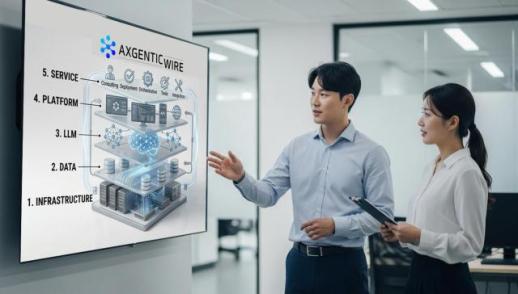 SK AX launches 'AXgenticWire' brand to drive agentic AI transformation in enterprise operations SEOUL, March 19 (AJP) - SK AX unveiled a new integrated brand called "AXgenticWire" on Thursday, signaling a push to accelerate agentic artificial intelligence adoption across corporate operations. The brand name combines "agentic AI" — systems capable of autonomous judgment and execution — with "Rewire," reflecting the company's ambition to fundamentally redesign how enterprises operate. SK AX said the platform is built to coordinate multiple AI agents across business functions, filling a gap left by piecemeal AI deployments that boost isolated task efficiency without lifting overall productivity. At its core, AXgenticWire runs on what SK AX calls "AI-readable data," a structured data format that AI models can process and learn from immediately. The platform layers in the company's accumulated AI Ops capabilities — which automate and intelligentize IT systems — to deliver a stable operating environment tailored to each enterprise's infrastructure. "The competitive edge in the agentic AI era lies not in model performance alone, but in the architecture that makes AI judgment actually function within real business operations," said Cha Ji-won, Chief AI Innovation Officer at SK AX. "We will expand our end-to-end enterprise AI full-stack execution framework — validated on the ground in real industries — to maximize corporate decision-making and operational efficiency." 2026-03-19 09:56:30
 -
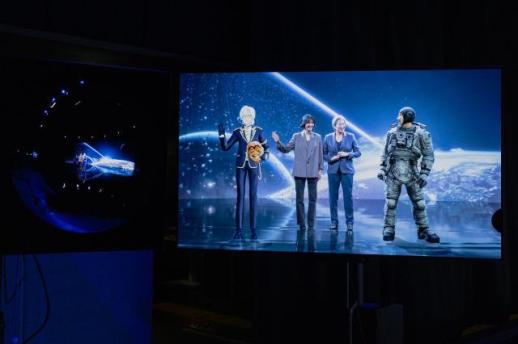 Naver, AMD sign MOU to strengthen AI GPU infrastructure cooperation SEOUL, March 18 (AJP) - South Korea's Naver and U.S. chipmaker Advanced Micro Devices (AMD) signed a memorandum of understanding to jointly develop next-generation GPU infrastructure aimed at expanding their artificial intelligence ecosystems. Under the agreement signed at Naver's 1784 headquarters Wednesday, the two companies will collaborate on building high-performance GPU computing environments optimized for Naver's proprietary large language model, HyperCLOVA X, and work to advance infrastructure technologies for stable AI model operations. The partnership also covers providing AI computing resources to academic researchers and launching joint research projects to broaden AI research outcomes across diverse infrastructure platforms. "The collaboration with AMD will serve as a meaningful opportunity to secure technological diversity and strengthen our AI infrastructure competitiveness," Naver CEO Choi Soo-yeon said. "We will continue to expand the potential of AMD platforms across Naver Cloud and our broader AI services, and pursue cooperation for next-generation technology stacks and service implementation." AMD CEO Lisa Su called Naver an optimal partner for implementing the chipmaker's next-generation AI GPU technologies, citing the Korean firm's AI capabilities and cloud platform. 2026-03-18 15:19:06
 -
 Korea's crackers edges toward shutdown as Hormuz blockade chokes naphtha supply SEOUL, March 13 (AJP) - South Korea's petrochemical plants are rapidly running out of naphtha as the closure of the Strait of Hormuz cuts off a major supply route, forcing producers to declare force majeure and slash operating rates to bare-minimum levels to avoid a full shutdown that could ripple through the country's manufacturing economy. Yeocheon NCC, LG Chem, Lotte Chemical and Hanwha Solutions have all warned customers of potential force majeure on product deliveries. GS Caltex, which shares the Yeosu industrial complex with several affected petrochemical producers, has postponed a scheduled maintenance turnaround at its Yeosu refinery from March to May in order to keep supplying naphtha to neighboring plants, industry officials said. The move underscores the urgency gripping the sector: halting refining operations now would almost certainly trigger a cascade of shutdowns downstream. About 54 percent of South Korea's naphtha imports and roughly 70 percent of its crude oil normally transit the Strait of Hormuz. Since Iran closed the waterway on Feb. 28 following joint U.S.–Israeli strikes, tanker traffic through the chokepoint has largely halted. "NCC operating rates across the region continue to decline as the Strait of Hormuz remains impassable, while prices of basic feedstocks such as butadiene and styrene monomer are surging on tighter supply and rising naphtha costs," said Kang Dong-jin, an analyst at Hyundai Motor Securities. "A recovery in NCC utilization hinges on the reopening of the strait." Naphtha prices have surged since the conflict escalated, hitting $883.40 per metric ton on Monday, up from $568.55 on Feb. 23, before easing slightly to $812.29 on Thursday, according to the S&P Global Platts Fujairah cargo assessment. Asia's steam cracker industry is overwhelmingly naphtha-based and structurally dependent on imports. Major petrochemical producers across the region — including India, Thailand, Indonesia, Malaysia, China, Japan, Singapore and South Korea — collectively imported 86.6 million tons of naphtha in 2025, according to Independent Commodity Intelligence Services (ICIS). As the supply shock spreads, petrochemical plants across Asia have begun cutting operating rates. Singapore's Petrochemical Corporation of Singapore has declared force majeure, citing disrupted naphtha deliveries, while Indonesia's PT Chandra Asri Pacific has followed with its own declaration. Korea's Yeocheon NCC has taken the same step. In China, the CNOOC and Shell Petrochemicals Company Limited has halted operations after crude supply to its integrated refinery was disrupted. Nearly 9 million tons per year of South Korean ethylene capacity is non-integrated and heavily reliant on imported naphtha, according to ICIS data. The price spike compounds an already dire situation for Korean producers, who are struggling to pass higher feedstock costs on to customers. Persistent oversupply from China has depressed ethylene and downstream product prices, compressing the ethylene spread — the margin between naphtha costs and ethylene selling prices — to about $100 per ton, far below the roughly $300 needed to break even. Korean petrochemical firms typically source about half of their naphtha from domestic refiners and import the rest. With the strait sealed off, those seaborne cargoes have stopped arriving and inventories are rapidly dwindling, leaving producers little choice but to conserve feedstock. Operating rates have been cut to what the industry calls "zombie mode." Yeocheon NCC, a 50-50 venture between Hanwha Solutions and DL Chemical, has reduced utilization to 60 percent and is reportedly considering a further cut to 50 percent, its turndown limit. Lotte Chemical has lowered utilization to 70 percent, while LG Chem has trimmed operations at its Daesan complex to about 54 percent. Once a plant falls below its turndown ratio — the minimum operating rate at which equipment can safely function — it must shut down entirely. Restarting a steam cracker typically takes up to two weeks. Domestic producers currently hold only about two weeks of naphtha inventories, according to the Ministry of Trade, Industry and Energy. A full shutdown would send shockwaves far beyond the chemical sector. Ethylene and propylene are core feedstocks for a wide range of industries, from automotive plastics and consumer electronics components to construction materials such as PVC piping and insulation, as well as synthetic fibers used in textiles. Logistics networks are already beginning to buckle. HMM, South Korea's largest shipping line, suspended new bookings on Middle East routes on Wednesday, while Korean Air has extended the suspension of its Incheon–Dubai flights through March 28. Rising freight and fuel costs are adding pressure to industries already weakened by a prolonged downturn, including steel, batteries and cement. The crisis has also complicated a government-led restructuring effort aimed at addressing structural overcapacity in the petrochemical sector. The Ministry of Trade, Industry and Energy and creditor institutions led by the Korea Development Bank had set an end-of-March deadline for companies in the Yeosu complex to submit voluntary ethylene capacity reduction plans. The war, however, has injected deep uncertainty into those negotiations. Analysts say the situation echoes the early stages of the 2022 Russia-Ukraine conflict, though the impact on Asia could prove more severe given the region's far heavier reliance on Middle Eastern feedstock. If the Hormuz blockade drags on, utilization rates at South Korea's three major petrochemical hubs — Yeosu, Daesan and Ulsan — could fall below 60 percent across the board, with ripple effects spreading through electronics, automotive, construction and consumer goods industries nationwide. 2026-03-13 14:30:45
 -
 Krafton, Hanwha Aerospace forge physical AI alliance with joint venture plans SEOUL, March 13 (AJP) - South Korean gaming giant Krafton and defense heavyweight Hanwha Aerospace signed a memorandum of understanding to jointly develop physical AI technologies and pursue the establishment of a joint venture spanning defense and other industrial applications. The partnership announced Friday marries Krafton's AI research capabilities and simulation expertise — honed through operating large-scale virtual worlds such as PUBG: Battlegrounds — with Hanwha Group's sprawling defense and manufacturing infrastructure. The two companies said they would collaborate on core physical AI research and development, field testing and application scenarios, and the buildout of shared technical and operational frameworks. The companies said they plan to set up a joint venture to fast-track the commercialization of co-developed technologies and deepen their long-term cooperation. Krafton will also invest in a fund managed by Hanwha Asset Management that targets AI, robotics and defense sectors, with a fundraising goal of about $1 billion. The fund aims to identify high-potential partners across the physical AI value chain and funnel investments toward joint development and commercialization. "We will establish a joint venture with Hanwha and grow it into a global defense technology firm on par with Anduril," said Kim Chang-han, CEO of Krafton. Hanwha Aerospace CEO Son Jae-il said AI technology is rapidly evolving beyond conventional industry applications into physical AI for the defense domain. He added that the partnership with Krafton would set a new technological benchmark in the field. 2026-03-13 10:28:38
 -
 Hanmi Pharmaceutical taps first outside CEO in 53-year history SEOUL, March 13 (AJP) - Hanmi Pharmaceutical announced it has nominated Hwang Sang-yeon, head of private equity at HB Investment, as its new chief executive, marking the first time in the South Korean drugmaker's 53-year history that an outsider has been tapped to lead the company. The board of Hanmi Science, the group's holding company, and Hanmi Pharmaceutical approved the nomination at separate meetings on Thursday. The appointment is subject to approval at the annual general meeting of shareholders scheduled for March 31. Hwang, 55, is a veteran of South Korea's capital markets and bio-pharmaceutical sector. A graduate of Seoul National University with bachelor's and master's degrees in chemistry, he previously served as head of research at Mirae Asset Securities, chief investment officer at Allianz Global Investors and CEO of Chong Kun Dang Holdings before joining HB Investment's newly established private equity division in 2025. His appointment comes amid a bitter feud between outgoing CEO Park Jae-hyun and Shin Dong-kuk, chairman of Hanyang Precision and Hanmi Science's largest shareholder, over allegations of improper management interference. Park, a 33-year company veteran, was not renominated for a new term after clashing with Shin over issues including the handling of a sexual misconduct case and attempts to substitute lower-cost pharmaceutical ingredients. Park released a statement after the board meeting, saying he did not believe he was the only person qualified to serve as a professional manager. He expressed hope that his resistance would serve as a reminder of the importance of preserving the legacy of the late founder Lim Sung-ki. The leadership change is widely seen as bringing an end to the standoff between Park and Shin at a company that posted record revenue of about 1.55 trillion won ($1.04 billion) and operating profit of 257.8 billion won in 2025. The board also nominated Kim Na-young, head of Hanmi Pharmaceutical's new product development division, as an inside director, along with former lawmaker Chae Yi-bae and Han Tae-jun, president of Ghent University Global Campus, as outside directors. Audit committee member Kim Tae-yoon was the only incumbent reappointed among five directors whose terms expire this month. All previous Hanmi Pharmaceutical CEOs — Lee Gwan-sun, Woo Jong-soo, Kwon Se-chang and Park — rose through the company's own ranks over decades, making Hwang's outside appointment a sharp departure from tradition. Shares of Hanmi Pharmaceutical closed Thursday same as the previous session at 488,000 won. 2026-03-13 08:54:37
 -
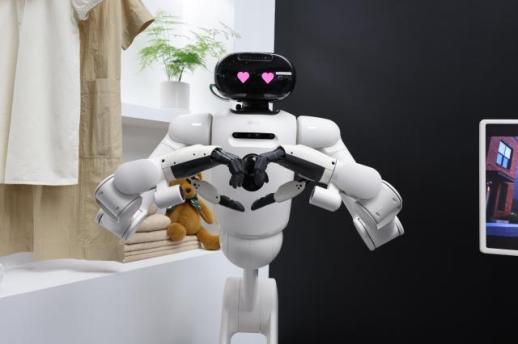 K-battery makers bet on premium to fight EV slump and China dominance SEOUL, March 12 (AJP) - South Korea's battery industry is doubling down on premium technologies — from high-nickel chemistries to all-solid-state prototypes and advanced cell engineering — as it seeks to outpace Chinese rivals and move beyond the slowing electric-vehicle market. The strategic pivot was on full display at the InterBattery 2026, the three-day exhibition that opened Wednesday at COEX in southern Seoul. The 14th edition of the show drew 667 companies from 14 countries across 2,382 booths, marking the largest turnout in the exhibition's history and underscoring how battery technology is rapidly expanding beyond automobiles into robotics, artificial intelligence and energy storage. National pavilions from Sweden, the United Kingdom, the United States, Australia, Canada and the Netherlands highlighted growing international demand for partnerships with Korean battery firms. China fielded 79 exhibitors, the largest single-country contingent. "Batteries are the heart of advanced industries," said Moon Shin-hak, vice minister of trade, industry and energy, at the opening ceremony, pledging continued government backing to help domestic manufacturers maintain their technological edge amid a slowdown in EV demand and an increasingly volatile global trade environment. On the exhibition floor, one theme was unmistakable: premium technology over low-cost chemistry. Discussion of lithium iron phosphate (LFP) — the inexpensive battery chemistry that has underpinned China's dominance in entry-level EVs and energy storage — was relatively muted. Instead, booth after booth highlighted high-nickel cathodes, all-solid-state batteries and sophisticated packaging technologies, signaling that Korean manufacturers are staking their future on the high-performance end of the market. SK On made perhaps the most vivid statement of that strategy by placing a Genesis GV60 Magma electric SUV at the center of its booth. The performance-focused vehicle carries an 84-kilowatt-hour battery pack built with SK On's high-nickel NCM pouch cells and offers a driving range of about 346 kilometers on a single charge. The company also unveiled a "Hyper Fast" battery capable of charging from 10 percent to 80 percent in just seven minutes, alongside its cell-to-pack architecture and immersion-cooling battery system. SK On further showcased its first sulfide-based all-solid-state battery, targeting mass production by 2029. Across the hall, LG Energy Solution occupied the largest exhibition space at 540 square meters. Its centerpiece was the JF2 DC LINK 5.0, a grid-scale energy storage system that won the InterBattery Awards 2026 and represents the company's first use of LFP chemistry in an ESS product. A Renault Scenic fitted with LG's mid-nickel battery — containing about 70 percent nickel — illustrated a different strategic approach. The configuration aims to balance the performance of high-nickel batteries with a cost profile that sits between premium cells and low-cost LFP alternatives. Robotics also made an appearance on the show floor, though demonstrations were limited. LG Electronics displayed its home robot CLOiD, first introduced at CES 2026, which greeted visitors with a heart-hand gesture while remaining largely static. Meanwhile, Samsung SDI drew heavy crowds with the first public unveiling of a pouch-type all-solid-state battery sample designed for robotics and other "physical AI" applications. The company aims to begin mass production in the second half of 2027. Samsung selected the pouch format for its lighter weight — a crucial advantage for robots that require high energy density and burst power in compact spaces. While the company declined to identify potential humanoid-robot clients, its booth slogan — "AI thinks, Battery enables" — left little doubt about its intended market. Samsung SDI also displayed a high-energy prismatic cell with a volumetric energy density of 700 watt-hours per liter, capable of powering an EV for roughly 800 kilometers on a single charge. Among cathode material suppliers, the emphasis on performance over cost was equally clear. POSCO Future M presented ultra-high-nickel cathodes with nickel content above 95 percent, along with newly developed steel battery cans. Rival suppliers L&F and EcoPro also attracted steady traffic. The premium-focused posture reflects a broader strategic calculation. With Chinese competitors dominating much of the mid-tier battery market, Korean manufacturers are betting that advanced chemistries, all-solid-state technology and sophisticated cell engineering will secure territory where margins remain higher and technological barriers harder to replicate. "The robot battery market is expanding very rapidly, with different technical requirements depending on the type of robot," said Jung Ji-sub, team leader at LG Energy Solution's small-size battery division on the sidelines of the exhibition. "While many robots rely on GPUs or CPUs for intelligence, their actuators and operating time create very different battery demands." Safety, however, remains the overriding concern. "One client at the vice-president level told us directly that they lose sleep over the prospect of a robot catching fire near people," Jung said. "Energy density and battery life are important, but for robots to coexist safely with humans, safety is the most critical requirement." 2026-03-12 17:02:36
 -
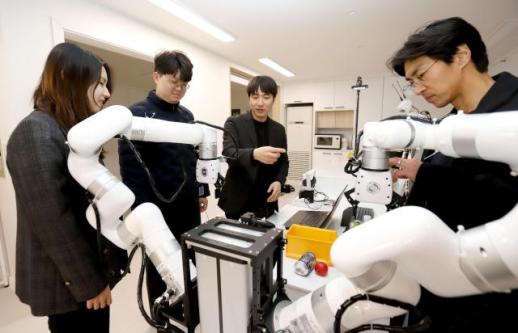 South Korean researchers develop task AI enabling robots to learn, execute everyday chores SEOUL, March 12 (AJP) - South Korean researchers have developed a robotic task artificial intelligence system capable of learning and carrying out routine household and workplace chores by observing human demonstrations, the state-run Korea Institute of Machinery & Materials (KIMM) said Thursday. The AI system, built by a team led by Kim Jeong-jung at KIMM's Department of AI Machinery, allows robots to acquire task skills from human demonstrations, replicate them in a virtual environment for training and verification, and then execute them in real-world settings through a hierarchical task-execution framework. Unlike conventional robotic task technologies that have largely been confined to single-task datasets and simulation-only validation, the new system integrates the entire pipeline — from multi-task dataset construction and real-space virtualization to hierarchical task AI and physical robot deployment, according to KIMM. The research team said it achieved a success rate exceeding 90 percent across a range of tasks by employing a layered execution structure that breaks down complex operations into sequential steps. The system was validated on an actual robotic platform operating in real-world conditions, confirming its viability for field deployment. Potential applications span household and office service tasks, retail shelf arrangement and logistics operations such as picking and sorting — areas where labor-intensive, repetitive work has long been a bottleneck for automation. "This robotic task AI learns from demonstrations and reasons hierarchically, much like a human worker," Kim said. "We have secured generalized task capabilities applicable across a wide spectrum of everyday operations." Kim added that the team verified the system's reliability by building a diverse task dataset, securing a real-world testing environment and running validation on an actual robot, confirming that robots can reliably assist with repetitive daily tasks. The team plans to broaden the range of tasks robots can perform and strengthen their adaptability to shifting environments and unfamiliar objects, with the aim of accelerating deployment in commercial service settings. 2026-03-12 09:58:12