
Journalist

AJP
-
 Park Ji-woo, Lim Ri-won Finish 21st and 28th in Women’s 1,500 at Milan-Cortina Olympics South Korea’s Park Ji-woo (Gangwon Provincial Government) and Lim Ri-won (set to enroll at Korea National Sport University) finished in the lower half of the field in the women’s 1,500 meters. They skated in the final on Feb. 21 at the Milan speedskating stadium at the 2026 Milan-Cortina Winter Olympics. Park placed 21st in 1:58.26, and Lim was 28th in 1:59.73. Lim, skating in the third pair, went through the first 300 meters in 26.49 seconds, starting faster than Erura Groenewoud, but was passed after the midway point. It was Lim’s first Olympic race. She had originally qualified only for the mass start, but was added to the 1,500 after an opening in the field and was notified three days earlier that she could compete. Park raced Austria’s Shanin Rosner in the fifth pair and opened in 26.26 seconds for the first 300 meters. She held a slight edge early, but the gap grew in the closing laps as she finished 21st. Both skaters were preparing for the mass start later Feb. 21. The gold medal went to the Netherlands’ Antoinette Rijpma-de Jong in 1:54.09. Rijpma-de Jong, who won silver in the women’s team pursuit, earned her first gold of the Games to become a multiple medalist. Norway’s Ragne Wiklund took silver in 1:54.15, and Canada’s Valerie Maltais won bronze in 1:54.40. Japan’s Miho Takagi, the women’s 1,500 world record holder, finished sixth in 1:54.86. 2026-02-21 02:33:00
 -
 Korea’s Won Yoon-jong Elected IOC Athletes’ Commission Member, Vows to Speak Up for Athletes Won Yoon-jong, the first Korean winter-sport athlete elected to the International Olympic Committee (IOC) Athletes’ Commission, pledged to “speak up when needed to protect the rights and interests of all athletes.” Speaking at a news conference Feb. 20 (local time) at Korea House for the 2026 Milan-Cortina d’Ampezzo Winter Olympics, held at Villa Necchi Campiglio in Milan, Won said, “As an Athletes’ Commission member representing winter sports, I think I can do a good job speaking for them.” On Feb. 19, Won won the IOC Athletes’ Commission election held during the 2026 Milan-Cortina d’Ampezzo Winter Olympics, finishing first with 1,176 votes. The vote selected the top two finishers out of 11 candidates. He will serve an eight-year term with the same authority as regular IOC members. Won became South Korea’s third IOC Athletes’ Commission member, following Moon Dae-sung, a taekwondo gold medalist at the 2004 Athens Olympics, and Yoo Seung-min, president of the Korean Sport & Olympic Committee and a men’s singles table tennis gold medalist. Won is the first from a Korean winter sport. Won described the tension as he awaited the result. “Every minute and second felt incredibly long,” he said. “Because the announcement came in a quiet setting, the tension peaked and I was anxious.” He credited his win to sincerity. “The one thing I kept in mind while preparing was sincerity,” he said. “I thought the first step was meeting athletes in person, communicating and listening to their voices. I started campaigning with that mindset and kept it to the end, and I think athletes responded positively and voted for me.” The election is decided by votes from athletes competing at the Olympics. With events spread across northern Italy, Won said the campaign became a physical grind. He recalled saying when he entered the race that he would “run until three pairs of sneakers wear out.” “With six clusters separated, getting around was especially difficult,” he said. “In places like Livigno, where it snowed or it was cold, it could be dangerous. After standing 14 to 15 hours, it felt like my knees and back wore out more than my shoes.” Won said he drew on Yoo’s campaign during the Rio de Janeiro Olympics in 2016. “I heard President Yoo walked more than 30,000 steps a day, and I did it with a similar feeling,” Won said. “From morning to night, I communicated with everyone — athletes, volunteers and staff. It’s meaningful that I approached it with sincerity.” Looking ahead, Won said he wants to broaden support for athletes in countries with limited winter-sports infrastructure. “I’m interested in helping athletes from many countries, including those without snow, understand the value of sport and ultimately support them so they can take part in the Olympics,” he said. “I’ve helped Jamaican sled athletes and supported athletes from Thailand and others who competed at the Youth Olympics as they transition into senior competition, and I want to expand that work.” Asked about changes to Olympic events, Won said he has heard concerns from athletes about potential cuts. “In the case of Nordic combined or snowboard alpine (parallel giant slalom), I heard athletes say on site, ‘There are lots of spectators and it’s fun — why should it be removed?’” he said. “I think my role is to listen carefully to athletes’ messages and deliver them to the IOC.” Won said he hopes that after his eight-year term, athletes will say they chose well. “I’d like to hear athletes say, ‘We picked a good representative,’” he said. “I want to do work that repays the trust they placed in me.” 2026-02-21 00:51:00
 -
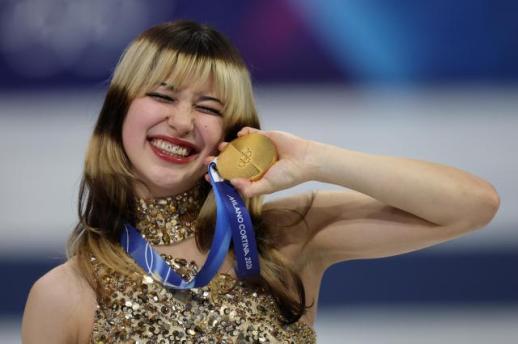 Alysa Liu Wins Olympic Women’s Figure Skating Gold, First for U.S. Since 2002 Alysa Liu of the United States, who stepped away from skating because of burnout, climbed to the top of the Olympic podium with a comeback gold in women’s figure skating singles at the 2026 Milan-Cortina Winter Olympics. Liu won the free skate on Feb. 20 (Korean time) at the Milan Ice Skating Arena in Italy, scoring 150.20 points for a total of 226.79. After placing third in the short program, she delivered a clean free skate to move into first. It was the first Olympic gold for an American in women’s singles since Sarah Hughes at the 2002 Salt Lake City Games, ending a 24-year drought. Liu emerged early as a U.S. figure skating standout. In 2019, at age 13 years, 5 months, she won the U.S. championships to become the youngest champion in event history. In 2018, she drew attention by landing a triple axel in international competition. She placed sixth at the 2022 Beijing Olympics and third at the world championships later that year, but announced a sudden retirement at age 16, citing burnout. She then focused on school and took time away before announcing her return in 2024. After coming back, Liu skated with a looser style, winning the 2025 world championships and the 2025-2026 International Skating Union Grand Prix Final in succession. In Milan, she again looked unburdened as she won over the crowd. After clinching gold, Liu said, “I did the things people told me not to do,” adding, “I hope my story can inspire many people.”* This article has been translated by AI. 2026-02-20 23:30:00
 -
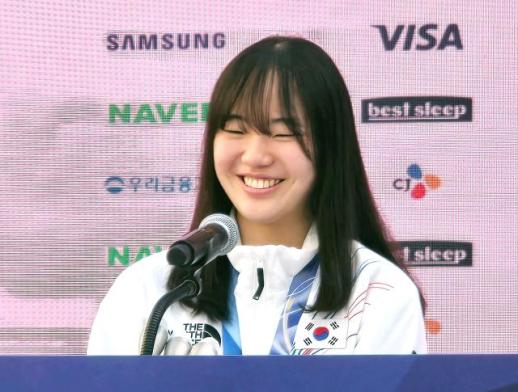 Olympic Big Air Bronze Medalist Yoo Seung-eun Vows to Improve Slopestyle After Missed Runs Yoo Seung-eun, the first South Korean female skier or snowboarder to reach an Olympic podium, said she wants to strengthen her slopestyle performance after winning bronze in her main event, big air. Speaking at a news conference at Korea House in Milan on Feb. 20 (local time), Yoo said, “I feel relieved now that the competition is over,” but added, “I’m disappointed and regretful because I couldn’t land all my runs in slopestyle.” Yoo, a high school student born in 2008, won bronze in women’s snowboard big air on Feb. 10, delivering South Korea’s second medal of the Games. It was the country’s third Olympic medal in skiing and snowboarding and the first by a woman. In slopestyle, Yoo qualified for the final in third place, but made mistakes on all three runs and finished last among the 12 finalists. “The moment I remember most is my first run in the big air final,” she said. “In slopestyle, I realized I still have a lot to work on.” She added that she is weaker on rails and thought she “might have finished mid-pack” in slopestyle. Yoo said she reached the Olympics despite suffering ankle and wrist fractures since 2024. “A lot of people around me helped and supported me. I never could have made it here on my own,” she said. On her condition, she said her ankle has recovered, though it can hurt briefly when she takes a hard impact on the board. She said her wrist still makes it difficult to brace directly with her hand, but it does not affect daily life. South Korean snowboarding set a single-Games record for medals, with Kim Sang-gyeom’s silver in men’s parallel giant slalom, Yoo’s bronze in big air and Choi Ga-on’s gold in halfpipe. “I’m not a rider who’s naturally great — I’m someone who works hard,” Yoo said. “Including Ga-on, everyone rides so well and seems really talented.” She said she was impressed watching Choi fall hard on her first run but still execute her third run. “She’s my friend, but I respect her,” Yoo said. Yoo said her preparation focused on big air, with airbag training in Japan. She said she prepared for slopestyle mainly by riding rails for about a month in Italy. “I’ll work to become a rider who can do both well,” she said. Yoo said she had been focused only on this Olympics and had not thought much about what comes next, but added, “At the next Olympics, I’ll practice more so I can show an even better performance.”* This article has been translated by AI. 2026-02-20 22:00:00
 -
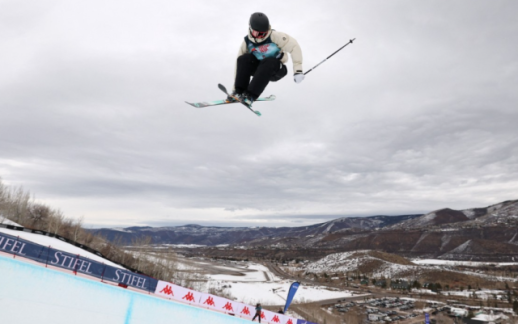 South Korea’s Lee Seung-hoon reaches Olympic men’s halfpipe final, a first for the country South Korea set a new Olympic milestone in freestyle skiing as Lee Seung-hoon (Korea National Sport University) advanced to the men’s halfpipe final, the first Korean to do so. Lee qualified on Feb. 20 (Korean time) at Livigno Snow Park in Italy at the 2026 Milan-Cortina d’Ampezzo Winter Olympics. He scored 76.00 points and finished 10th, earning one of 12 final berths. Halfpipe is judged on aerial tricks performed while riding up and down a semicylindrical course. In qualifying, athletes take two runs, with the higher score counting. Lee posted his 76.00 on his first run, linking five tricks smoothly as the 13th skier to start. On his second run, he increased the difficulty but lost balance on the landing of his third jump, leaving his score unchanged. Lee has shown promise internationally. He was runner-up at the 2021 junior world championships and won bronze at a World Cup event in Calgary, Canada, in February 2024 — South Korea’s first freestyle skiing World Cup medal. He also won halfpipe gold at last year’s Harbin Asian Winter Games. The Olympic final is scheduled for 3:30 a.m. Feb. 21 at the same venue.* This article has been translated by AI. 2026-02-20 21:06:00
 -
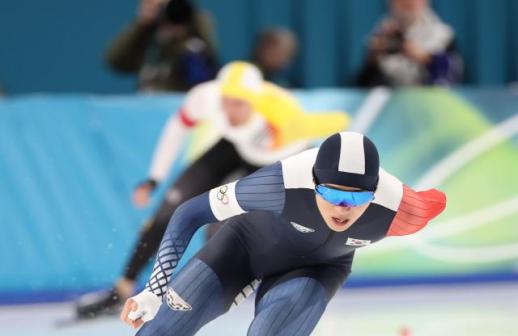 South Korea Speedskating Faces Medal Drought at Milan-Cortina Olympics South Korean speedskating is facing a crisis on the Olympic stage. Long one of the country’s most successful Winter Olympic sports after short track, speedskating has yet to win a medal at the 2026 Milan-Cortina d’Ampezzo Games, raising the possibility of finishing empty-handed. South Korea’s Olympic speedskating medal history began at the 1992 Albertville Games, when Kim Yoon-man won silver in the men’s 500 meters. Over the next six Olympics, the team added five gold, 10 silver and five bronze medals. As of the 20th, short track remains South Korea’s top Winter Olympic medal sport (27 gold, 17 silver, 13 bronze), with speedskating traditionally next. At the 2010 Vancouver Games, speedskating won three gold and two silver medals, earning more gold than short track at the same Olympics. But with three days left before the closing ceremony, South Korea still has no speedskating medals in Milan. In the women’s 500 meters, Lee Na-hyeon of Korea National Sport University placed 10th and Kim Min-sun of Uijeongbu City Hall finished 14th. In the men’s 500, prospect Kim Jun-ho of Gangwon Provincial Office placed 12th. Among the remaining events, the most realistic medal hope is Jeong Jae-won of Gangwon Provincial Office in the men’s mass start. He is scheduled to race at 11 p.m. on the 21st at the Milan speedskating stadium. Jeong is a leading national team skater who won silver in team pursuit at the 2018 Pyeongchang Games and silver in the mass start at the 2022 Beijing Games. In his third Olympics, he is trying to win a medal for a third straight Games. Jeong has shown steady form this season, winning two silver medals in mass start across ISU World Cup stops 1 through 4 in 2025-2026. Cho Seung-min, who is set to enter Korea National Sport University, will also compete in the men’s mass start, along with Park Ji-woo of Gangwon Provincial Office and Lim Ri-won, also set to enter Korea National Sport University, in the women’s mass start. Their medal chances are viewed as relatively lower. If South Korea fails to add a medal, it would mark the team’s first Olympic speedskating medal drought since the 2002 Salt Lake City Games — a span of 24 years. South Korean speedskating won medals at five straight Olympics from the 2006 Turin Games through the 2022 Beijing Games. This year’s results are expected to determine whether that run continues.* This article has been translated by AI. 2026-02-20 20:06:00
 -
 Entertainer Park Na-rae Questioned by Police as Suspect in Special Injury Case Entertainer Park Na-rae, who has faced allegations of mistreating her managers, appeared at a police station as a suspect. Police said Feb. 20 that Seoul’s Gangnam Police Station began questioning Park at 3 p.m. on allegations including special injury and violations of the Medical Service Act. Park had been scheduled to appear for questioning on Feb. 12 on the same allegations but postponed the date. It was reported to be her first time being questioned by police as a suspect. Earlier, Park’s former managers filed a complaint with Gangnam Police Station accusing her of special injury, defamation by alleging false facts, and violations of the Information and Communications Network Act. Park has temporarily halted her activities after the manager-abuse allegations and controversy over claims she received illegal medical procedures from a so-called “injection aunt.”* This article has been translated by AI. 2026-02-20 19:42:16
 -
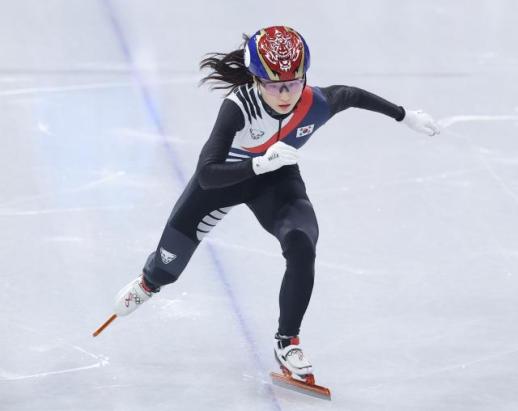 Choi Min-jeong Eyes Historic Third Straight Olympic 1,500m Title in Milan South Korean short track star Choi Min-jeong (Seongnam City Hall) will chase another milestone at the 2026 Milan-Cortina d’Ampezzo Winter Olympics. Choi is scheduled to race in the women’s 1,500 meters at 4:15 a.m. Friday (Korea time) at the Milan Ice Skating Arena in Italy. The event will run from the quarterfinals through the semifinals and final on the same day. The medal-deciding final is set for 6:07 a.m. After helping South Korea win gold in the women’s 3,000-meter relay, Choi has yet to take gold in an individual event at these Games. The 1,500 meters offers her a chance to finish short track’s final day with a title. The 1,500 is Choi’s signature event. She won it at the 2018 PyeongChang and 2022 Beijing Olympics and enters as the defending champion. No short track skater, male or female, has won the same Olympic individual event three straight times. If Choi wins again, she would be the first. Even including relays, the only three-peat in a single short track event remains South Korea’s women’s 3,000-meter relay, which won four straight from Lillehammer 1994 through Turin 2006. Choi has won four Olympic gold medals and two silvers. She is already tied for South Korea’s most Winter Olympic golds and tied for the most Olympic medals by a South Korean athlete across both the Summer and Winter Games. If she wins the 1,500 again, she would move into sole possession of the South Korean record with seven career Olympic medals. She would also set a new national mark with five Winter Olympic golds, while completing the first three-peat in an Olympic short track individual event. South Korea will also have Kim Gil-li (Seongnam City Hall) and Noh Do-hee (Hwaseong City Hall), both members of the relay gold team, in the women’s 1,500. The men’s team will go for gold in the 5,000-meter relay final at 5:30 a.m. Friday, led by Lim Jong-eon (Goyang City Hall) and Hwang Dae-heon (Gangwon Provincial Government), aiming to reclaim the title for the first time in 20 years.* This article has been translated by AI. 2026-02-20 18:45:00
 -
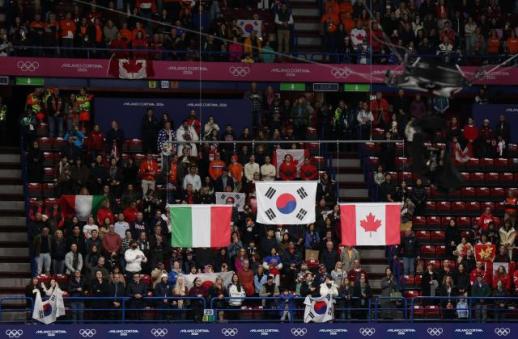 Upside-Down South Korean Flag Used Repeatedly at Milan 2026 Short Track Medal Ceremonies It was disclosed after the fact that an incorrect South Korean flag was raised during short track speed skating medal ceremonies at the 2026 Milan-Cortina d’Ampezzo Winter Olympics. The organizing committee used a flag with the taegeuk symbol tilted counterclockwise — a design that differs from the official standard — during the women’s 3,000-meter relay medal ceremony held at the Milan Ice Skating Arena in Milan, it said on Feb. 19 (Korea time). South Korea won gold in the event after finishing first in the final. Choi Min-jeong, Kim Gil-li (both Seongnam City Hall), Noh Do-hee (Hwaseong City Hall), Shim Suk-hee (Seoul City Hall) and Lee So-yeon (Sport Toto) stood on the podium. The same incorrect design was also used at three other medal ceremonies: the men’s 1,000 meters on Feb. 13 (Lim Jong-eon, bronze), the men’s 1,500 meters on Feb. 15 (Hwang Dae-heon, silver) and the women’s 1,000 meters on Feb. 16 (Kim Gil-li, bronze). A Korean Sport and Olympic Committee official said Feb. 20 that for each Olympics, the government provides the organizing committee with the official flag file and the national anthem audio, adding, “This was not our mistake.” The official said the committee will decide whether to respond after an internal review.* This article has been translated by AI. 2026-02-20 18:21:00
 -
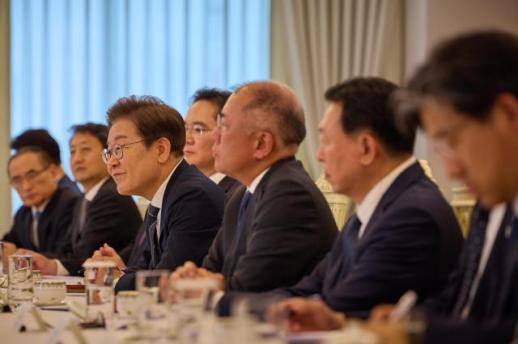 Korea’s Top Business Groups Head Into Annual Meetings With Focus on Stability Major South Korean business groups will hold annual general meetings late this month to set business plans and discuss key issues. Attention is on whether Sohn Kyung-shik, chairman of the Korea Employers Federation (KEF), will win a fifth term, and whether the heads of the country’s four largest conglomerates will return to the leadership council of the Federation of Korean Industries (FKI). Also in focus is whether the Korea Chamber of Commerce and Industry (KCCI) will reshuffle executives after a controversy over what it called false information about inheritance tax. According to the business community on Thursday, FKI, KEF, KCCI and the Korea International Trade Association (KITA) will hold annual meetings from Feb. 24 to 27 to approve business plans and budgets and review last year’s results. KEF will meet Feb. 24 to decide whether Sohn will serve a fifth term. Sohn, who took office in 2018, has led the group for eight years through four renewals. If approved again, he would lead KEF for 10 years and become its longest-serving chairman. KEF has no separate rule limiting renewals, meaning another term is possible if Sohn agrees. Sohn, born in 1939, is said to have decided after lengthy deliberation given his age. With major business issues pending — including a revised labor union law set to take effect in March and proposed revisions to the Commercial Act — business leaders have argued he is best positioned to convey management’s views to the government. He has been credited with actively delivering the business community’s positions and concerns about what the article describes as anti-business legislation since the Lee Jae-myung government took office. A business community official said Sohn has built extensive networks over about 65 years of work and is widely seen as having elevated KEF from a labor-management specialist group to a broader economic organization. The official said Sohn is among the few who can communicate candidly with the government on difficult issues such as labor regulation and Commercial Act revisions, adding that many inside and outside the business community view his working relationship with the Lee government, launched last year, as solid. FKI will hold a board meeting and annual general meeting Feb. 27. With Chairman Ryu Jin having won another term last year, the meeting is expected to focus on last year’s performance, this year’s plans, and budget and settlement items. Interest has centered on whether the owners of the four largest conglomerates — Samsung, SK, Hyundai Motor and LG — will return to FKI’s leadership council, though that is seen as unlikely. The four groups rejoined FKI as member companies in 2024, but their owners have not returned to the council. The leadership council is FKI’s top decision-making body, where major business leaders discuss economic issues and policy direction. Under FKI’s predecessor, the Federation of Korean Industries, about 20 conglomerate chiefs — including Samsung’s Lee Kun-hee, SK’s Chey Tae-won, Hyundai Motor’s Chung Mong-koo and LG’s Koo Bon-moo — met regularly, but the council was dismantled after the 2017 political scandal involving state affairs. A business community official said Ryu was reported to have tried to persuade the four group owners, but they declined. The official cited heavy corporate agendas and lingering public skepticism about such a top decision-making body as reasons for their reluctance. KITA will hold its annual meeting Feb. 25 at COEX in Seoul’s Samseong-dong to report 2025 results and approve its 2026 plan and budget, as well as vote on additional appointments of non-standing vice chairmen and directors. Chairman Yoon Jin-sik, who took the post in 2024 under the Yoon Suk Yeol administration, is serving a term through February next year, and there is little discussion of selecting a new chairman. KCCI will also hold its regular general meeting late this month to report major plans and strategy and last year’s results. After the meeting, discussions are expected to begin in earnest on an executive reshuffle that Chairman Chey Tae-won has signaled. Chey previously announced five reform steps tied to the inheritance-tax false-information controversy, including a review of whether to reappoint executives and a halt to events hosted by the chamber. A business community official said leaders of major business groups were often replaced when administrations changed, drawing criticism as “parachute appointments,” but this year there are few signs of leadership changes even as terms near expiration. The official said the government and business community appear aligned in wanting practical, working-level leaders amid high uncertainty at home and abroad. * This article has been translated by AI. 2026-02-20 18:04:15