

Journalist

KI SU JEONG
-
 KB Kookmin Bank Successfully Co-Leads $26.7 Billion U.S. Delfin LNG Infrastructure Project KB Kookmin Bank is expanding its presence in the global project finance market by participating in the funding of U.S. energy infrastructure projects. It is the only domestic financial institution to serve as a lead arranger, demonstrating its capabilities in overseas infrastructure investment. On June 4, KB Kookmin Bank announced the successful co-arrangement of financing for the Delfin floating LNG (FLNG) development project in the United States. Global banks such as MUFG and CITI also participated as co-arrangers. Among domestic financial institutions, KB Kookmin Bank was the sole lead arranger. The total syndication amounts to approximately 4 trillion won (about $26.76 billion), with KB Kookmin Bank contributing around 240 billion won (approximately $160 million). The Delfin FLNG project marks the first commercial floating liquefied natural gas facility being developed offshore in the United States. It is gaining attention as next-generation energy infrastructure due to its shorter construction period and lower investment risks compared to traditional land-based LNG terminals. The project involves key participation from the South Korean shipbuilding industry. Samsung Heavy Industries has secured a contract for the construction of the FLNG facility at Delfin Midstream in the U.S. This collaboration between South Korean shipbuilding and finance in the development of strategic energy infrastructure in the U.S. symbolizes the strengthening of South Korea-U.S. industrial cooperation and support for investment in the U.S. Lee Won-jong, Deputy Head of the CIB Sales Group at KB Kookmin Bank, stated, "The Delfin project is a symbolic transaction that elevates trade, energy, and shipbuilding cooperation between South Korea and the United States. We will continue to actively support the global expansion of Korean industries based on our expertise in local market assessments and collaboration with global financial institutions." 2026-06-04 09:09:00
 -
 Bespin Global to Showcase Manufacturing AX Strategy at Smart Tech Korea 2026 Bespin Global, an AI services and solutions company, announced on June 4 that it will participate in the Smart Tech Korea 2026 (STK 2026) exhibition, which will be held at COEX in Seoul starting June 10. Smart Tech Korea (STK) is a domestic tech exhibition showcasing innovative technologies across various industries, including artificial intelligence (AI), robotics, AI factories, security, and digital distribution and logistics. This year, approximately 500 companies are expected to participate with around 2,000 booths. Bespin Global will share its enterprise AI implementation and operational experiences through its comprehensive consulting service, HelpNow Journey to AI, and its AI orchestration and operations solution, HelpNow AI Foundry. The company will also introduce customized AX strategies for businesses. Additionally, Bespin Global will present success stories from various sectors, including manufacturing, distribution, public services, and finance. The company aims to address challenges faced by businesses during the AI transition process and propose solutions for stable AI operations in real work environments. Focusing on the manufacturing industry, Bespin Global will showcase the entire AX process, from data management to AI agent operations. The company will reveal AI implementation cases based on operational and production site data. It will discuss key challenges in the pre-AI adoption phase, such as data collection system issues, time and unit discrepancies, and data standardization, from the perspective of 'Ready Data' (data refined for immediate AI use). Strategies for data management and operations will also be covered. Bespin Global's HelpNow AI Foundry is an orchestration platform that integrates support for the entire process of enterprise AI implementation, from data integration to security governance. It offers features such as an AI agent workflow builder, enterprise RAG management (RAGOps), GraphRAG and ontology studio, enterprise LLMOps, and AI governance and security monitoring. The platform is designed to standardize and manage data generated across various industrial sites and support AI agent operations. It combines RAGOps with knowledge graph technology to enhance search quality. Additionally, it provides a flexible LLMOps environment tailored to corporate needs and establishes security frameworks, such as role-based access control (RBAC), to ensure safe AI service operations. At STK 2026, Bespin Global plans to emphasize the importance of creating environments where AI can be applied and continuously operated in real work settings, moving beyond simple proof of concepts (PoC). The company aims to help businesses connect AX to tangible business outcomes. Bespin Global is focused on communicating specific execution strategies to resolve the AI transition challenges faced by companies and to ensure these strategies lead to business success. Last month, the company participated in the AWS Summit Seoul 2026, hosted by Amazon Web Services, where it showcased its HelpNow AI Foundry and presented effective AI transition (AX) strategies that yield real results. Han Sun-ho, Chief AI Officer of Bespin Global, stated, "Many companies considering the adoption of generative AI face various challenges in data, security, and governance during the operational phase. At STK 2026, Bespin Global will demonstrate enterprise AX strategies and operational experiences to help businesses apply and operate AI reliably in real work environments."* This article has been translated by AI. 2026-06-04 09:06:00
 -
 Labor Ministry Strengthens Monitoring to Prevent Human Rights Violations of Migrant Workers The Ministry of Employment and Labor is enhancing its preventive measures to stop human rights violations against migrant workers. The key focus is on strengthening preemptive monitoring based on anonymous surveys and initiating proactive oversight. Immediate supervision will be implemented if incidents of violence or harassment are confirmed. On June 4, the Ministry announced the launch of its "Measures to Prevent Human Rights Violations of Migrant Workers." With the expansion of the employment permit system and chronic labor shortages in various industries, the number of migrant workers in South Korea has surpassed 1.1 million. Although the COVID-19 pandemic posed challenges to the recruitment of foreign workers, the numbers have steadily increased since the transition to an endemic phase. However, reports of human rights violations, including violence, harassment, and unfair treatment, continue to emerge in the workplace. Recently, incidents involving migrant workers in the manufacturing, agriculture, and construction sectors have sparked social controversy. Language barriers, unfamiliar systems, and job and residency insecurities often hinder workers from reporting or seeking advice. In response, the Ministry is establishing a comprehensive response system to detect human rights violations early and connect confirmed cases to prompt oversight and rights protection. A preemptive monitoring system will be set up to identify previously hidden cases of human rights violations against migrant workers. An online anonymous survey will be continuously available for workers to participate in their native language, and the results will be linked to inspections and oversight. The Ministry will also create a new category for "human rights violations of migrant workers" in its anonymous reporting center on the labor portal, allowing victims to report incidents confidentially. To ensure ongoing monitoring in the field, a new system of foreign human rights leaders will be implemented. Starting in June, the Ministry will conduct specialized inspections focused on violence and harassment at over 100 locations, particularly in areas with high concentrations of migrant workers and regions identified as having a high risk of human rights violations. Cases detected through preemptive monitoring will be immediately linked to inspections and oversight. In 14 regional labor offices with high concentrations of migrant workers, dedicated teams will be established to oversee and respond to human rights violation cases. Support for rapid separation of victims and perpetrators will be enhanced through connections to nearby shelters. To fundamentally prevent human rights violations, the Ministry will also work on improving the awareness of employers and managers. Vulnerable workplaces employing foreign workers will be included in the "Voluntary Improvement of Working Conditions" program, allowing employers to self-assess their employment practices for migrant workers and receive labor management consulting. Collaborating with local governments, the Ministry will provide training on essential labor laws and human rights protection for these vulnerable workplaces. Additionally, legal and institutional improvements will be pursued to prevent human rights violations at a structural level. The Ministry aims to enhance the workplace transfer system to allow migrant workers facing unfair treatment or hazardous working conditions to change jobs more easily. Recognizing the existing gaps due to different overseeing departments for various work visas, the Ministry plans to establish an integrated support system that connects information across departments, independent of residency status. "Migrant workers are colleagues who work alongside us, and their rights must be respected and protected equally, regardless of nationality," said Vice Minister Kwon Chang-jun. He emphasized the need to lower the barriers for migrant workers to report violations and seek redress, enabling quicker detection and response to human rights violations occurring in the workplace.* This article has been translated by AI. 2026-06-04 09:03:00
 -
 NVIDIA CEO Jensen Huang to Throw First Pitch for Doosan Bears Jensen Huang, CEO of NVIDIA, will throw the first pitch at a Doosan Bears home game at Jamsil Baseball Stadium in Seoul. In response, Park Jung-won, chairman of Doosan Group, will take the plate for the ceremonial first hit. According to Doosan, on June 7, during the regular season home game between the Doosan Bears and the Kiwoom Heroes, Huang will throw the first pitch while Park will bat. Huang is known for his keen interest in baseball. He will wear a Doosan Bears jersey featuring the number 93, representing the year NVIDIA was founded (1993), as he steps onto the mound to delight Korean baseball fans. Park, who is also the owner of the Doosan Bears, will wear a jersey with the number 96, symbolizing the founding year of Doosan (1896), as he joins Huang in this ceremonial event. Additionally, Huang has garnered attention for his collaborations with companies like Samsung Electronics and SK Hynix on HBM technology, as well as his recent meeting with Samsung Chairman Lee Jae-yong and Hyundai Motor Group Chairman Chung Eui-sun, which has been dubbed the 'Gangbu Meeting.' This gathering is seen as a significant symbol of cooperation in the semiconductor, automotive, robotics, and AI sectors, making Huang's activities a focal point for assessing the potential benefits of AI for Korean companies.* This article has been translated by AI. 2026-06-04 09:03:00
 -
 Daehan Cable Wins $65 Million Contract for High-Voltage Power Network in Scotland Daehan Cable has secured an additional contract for a high-voltage power network project in the United Kingdom. The company is capitalizing on the growing demand for renewable energy and the need to replace aging power infrastructure in the European market. According to industry sources, Daehan Cable will supply a 132kV high-voltage cable system for a power network construction project in Scotland. The contract is valued at approximately 65 billion won (about $65 million). This project is being led by the global infrastructure firm Valour BT, aiming to enhance the stability of power supply in the northern region of Scotland through the establishment of new transmission lines. Including this latest contract, Daehan Cable has secured four projects in the UK in the first half of this year, with a total value of around 100 billion won (about $100 million). The UK is recognized as a rapidly growing market for high-voltage underground and submarine cables, driven by simultaneous expansions in offshore wind energy and the replacement of outdated transmission networks. A representative from Daehan Cable stated, "Europe is a strategic market where the demand for underground and submarine cables is increasing rapidly due to the expansion of power networks and renewable energy. We will leverage our accumulated project experience and technological competitiveness to expand our presence in the global market." 2026-06-04 09:03:00
 -
 South Korea's FX reserves decline in May after brief rebound SEOUL, June 4 (AJP) - South Korea's foreign exchange reserves declined in May, reversing a brief one-month rebound. According to the Bank of Korea on Thursday, South Korea's foreign exchange reserves stood at $426.99 billion at the end of May, down $880 million from the previous month. The drop came after authorities implemented market stabilization measures including a foreign exchange swap with the National Pension Service (NPS), which reduced the country's dollar holdings amid a weaker won and rising long-term interest rates. In April, foreign exchange reserves rebounded by $4.22 billion as gains in the dollar value of non-dollar assets and stronger investment returns more than offset the impact of market stabilization measures. But in May, those measures became the main factor behind the decline, reversing the previous month's recovery. The latest decline came after reserves increased by $1.72 billion in February, dropped by $3.97 billion in March and then rebounded in April. Market volatility intensified in May. After briefly stabilizing in the 1,400 won range against the dollar in early May, the won weakened beyond 1,500 per dollar later in the month, prompting continued policy intervention. The average won-dollar exchange rate rose to 1,491.39 won in May from 1,486.72 won in April, while the average yield on South Korea's benchmark 10-year government bond climbed 34.7 basis points to 4.080 percent from 3.733 percent over the same period. While the stock market extended its gains, foreign capital outflows persisted. Foreign investors net sold 44.71 trillion won worth of KOSPI-listed shares between May 1 and 29, weighing on the won even as the broader equity market rallied. Despite the stock market rally, foreign equity outflows, a weaker won and rising long-term bond yields added to pressure in the foreign exchange market. Foreign securities fell by $3.39 billion to $380.68 billion, accounting for 89.2 percent of total reserves, while deposits rose by $2.59 billion to $21.35 billion or 5 percent of the total. Special Drawing Rights (SDRs) allocated by the International Monetary Fund (IMF) edged down by $30 million to $15.78 billion, while South Korea's reserve holdings at the IMF fell by $60 million to $4.4 billion. Gold holdings remained unchanged at $4.79 billion, accounting for 1.1 percent of total reserves. Monthly fluctuations in FX reserves are typically driven by changes in the dollar value of non-dollar assets, investment returns and market stabilization measures. The swings seen in recent months reflect a combination of exchange rate movements and policy intervention. Meanwhile, South Korea maintained its position as the world's 12th-largest holder of foreign exchange reserves as of the end of April with 427.9 billion. China topped the list with $3.41 trillion, followed by Japan with $1.38 trillion. 2026-06-04 09:02:22
 -
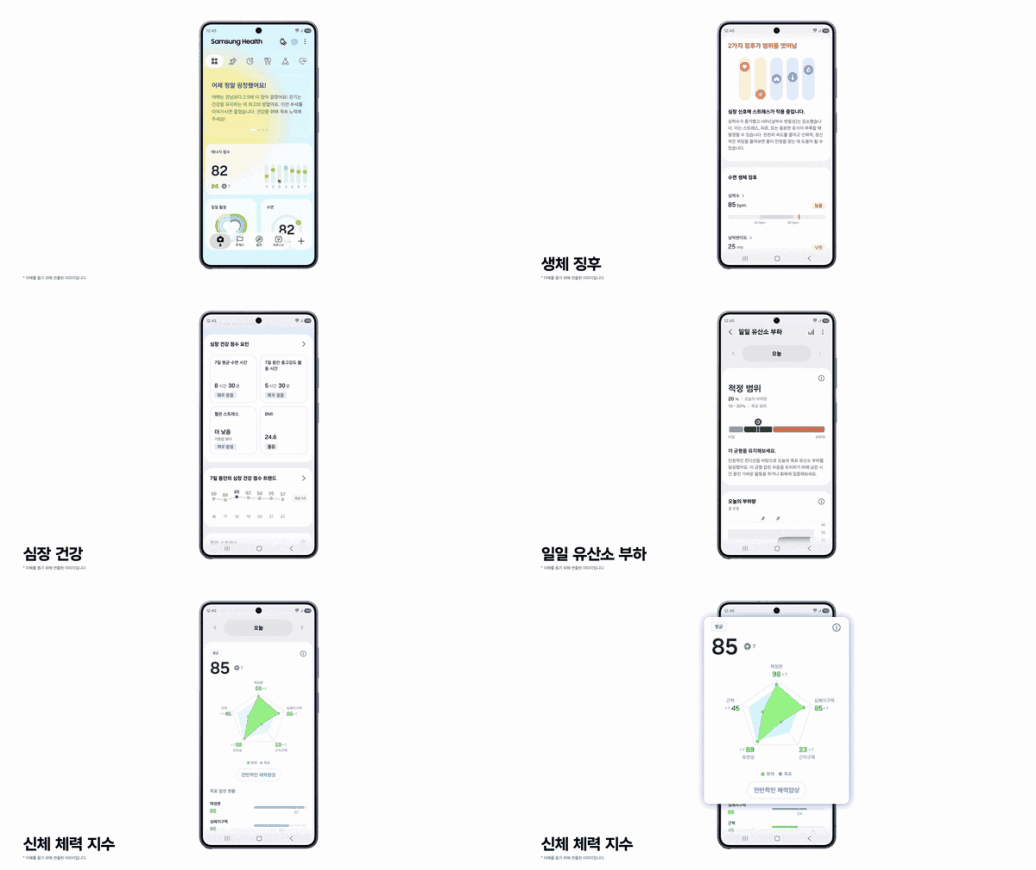 Samsung Unveils Next-Generation Health Features for Galaxy Watch Samsung Electronics is strengthening its push into the digital health market by unveiling next-generation health features for the Galaxy Watch. On June 8, Samsung announced that it will reorganize the Samsung Health app around five key health areas: sleep, activity, nutrition, mental health, and vital signs. The new features will be included in the upcoming Galaxy Watch products set to launch in the second half of the year. A standout feature is the 'Vital Signs' function. When users wear the Galaxy Watch while sleeping for over a week, it tracks metrics such as heart rate, heart rate variability, respiratory rate, skin temperature, and blood oxygen saturation. Users can then set personal baseline values, and the watch will notify them of any significant changes. The new 'Heart Health Score' will provide an intuitive overview of cardiovascular health. Samsung Health will score users based on sleep, activity levels, body composition, and changes in vascular stress, offering personalized guidance. For those lacking sleep, the app will suggest tips for improving sleep quality. Exercise management features will also be enhanced. The 'Daily Aerobic Load' function calculates the strain on the heart from daily activities and workouts, helping users balance exercise and recovery. The 'Physical Fitness Index' will compare key metrics, such as heart rate and maximum oxygen uptake, with other Samsung Health users of the same age to indicate individual fitness levels. A new hearing management feature will measure ambient noise levels and analyze the listening volume of Galaxy Buds, informing users whether their noise exposure is within safe limits. This feature aims to help users recognize situations where they are exposed to loud sounds for extended periods. Existing health indicators will also be visualized. Samsung has added trend charts for antioxidant levels and advanced glycation end products, making it easier for users to track dietary habits and metabolic health changes. Related content, such as blood sugar levels and cooking methods, will also be provided to assist with daily dietary management. These new features are intended for general health monitoring and fitness purposes, not for disease diagnosis or treatment. The availability of specific functions may vary by device, country, and data accumulation. Park Heon-soo, head of Samsung Electronics' MX Business Division Digital Health Team, stated, "Samsung Health is evolving to analyze health data measured by the Galaxy Watch using AI-based insights, allowing users to easily and intuitively understand their health status. We aim to expand personalized health management experiences based on the connectivity of the Galaxy ecosystem and digital health technology."* This article has been translated by AI. 2026-06-04 09:00:00
 -
 Opta Predicts South Korea's Chances of Advancing in World Cup at 70.35% Soccer statistics provider Opta has predicted that South Korea's national team has a 70.35% chance of advancing to the knockout stage of the 2026 FIFA World Cup in North America. On June 2, Opta released simulation results on its official website, forecasting the performance of the 48 participating countries ahead of the tournament. Using a supercomputer, the simulations were run 10,000 times to derive the results. This World Cup marks the first time the number of participating teams has expanded from 32 to 48. The group stage has been restructured into 12 groups, with the knockout stage beginning at the round of 32. A total of 32 teams will qualify for the tournament, including the top two teams from each group and the eight best third-placed teams. In this context, Opta estimates that under head coach Hong Myung-bo, South Korea has a 70.35% chance of reaching the round of 32. The probability of advancing to the round of 16 is 33.52%, while the chances of making it to the quarterfinals, semifinals, and finals are projected at 12.74%, 4.02%, and 1.30%, respectively. The likelihood of winning the tournament is estimated at 0.36%. Compared to its group rivals in Group A, South Korea's chances of advancing to the knockout stage appear favorable. Mexico, considered the strongest team in the group, has an 87.1% chance of reaching the round of 32. The Czech Republic, expected to compete closely with South Korea for second place, has a 63.38% chance, while South Africa, viewed as the weakest team in the group, stands at 49.29%. Spain is identified as a leading contender for the championship, with a 16.1% chance of winning. Opta explained its selection of Spain as the top favorite, stating, "The presence of Lamine Yamal, known as 'the talent of the century' from FC Barcelona, is significant. He was a key player in Spain's triumph at UEFA Euro 2024, showcasing overwhelming performance. Yamal's momentum leading up to the tournament is also fierce, having recorded 41 attacking points (24 goals and 17 assists) in official matches this season. He is second among La Liga players in goal involvement, following Kylian Mbappe (48 points, Real Madrid)." Following Spain, other top contenders include France (12.98%), England (11.18%), defending champions Argentina (10.36%), Portugal (7.00%), Brazil (6.61%), Germany (5.12%), the Netherlands (3.62%), Norway (3.51%), and Belgium (2.37%).* This article has been translated by AI. 2026-06-04 09:00:00
 -
 Traditional Korean Music Week Begins with Performances Across the Country From June 5 to 14, various traditional Korean music performances, exhibitions, academic events, and hands-on activities will take place nationwide. The Ministry of Culture, Sports and Tourism announced on June 4 that it will hold the second National Traditional Music Day ceremony on June 5 at the National Gugak Center, themed "Resonating Traditional Music in Daily Life." National Traditional Music Day is observed on June 5, designated as a legal commemorative day under the Traditional Music Promotion Act. Additionally, a variety of programs will be held across the country during Traditional Music Week from June 5 to 14. The ceremony will be attended by over 400 guests from the traditional music and cultural arts sectors, as well as pre-registered audience members, and will be broadcast live on traditional music channels. During the event, the "Korea Yeominrak Award" will be presented to individuals who have contributed to the promotion of traditional music. This year, the awards will recognize the city of Yeongdong in North Chungcheong Province and Kim Chang-hwan, the artistic director of the Gangwon Special Self-Governing Province Traditional Music Orchestra, for their efforts in promoting traditional music despite challenging circumstances. The ceremony will also feature celebratory performances. The National Dance Company will present "Gomuhak," a performance wishing for the prosperity of traditional music, while the traditional music group "4-in Nori" will showcase a modern reinterpretation of folk music in their performance "Nori." The Gyeonggi Sinawi Orchestra, along with vocalist Park Ae-ri and the Incheon City Education Office Traditional Music Choir, will perform "Our Desired Country." In the outdoor lawn area of the Gugak Center, performances will include the "Daechwita" by the Wanju Children's Traditional Music Band, a 65-member spinning top dance, the "Jindo Drum Dance" by the National Youth Dance Company, and the "Pangut" by the National Youth Performance Group. Additionally, a large-scale traditional performance parade will take place on June 5 around lunchtime, starting from the Daehanmun Gate of Deoksugung Palace and continuing to Gwanghwamun Square. Before the parade, performances by the National Gugak Center's folk music troupe and tightrope walkers from Namchang-dong will begin at 10 a.m. The parade will feature traditional performers from across the country, including the military band of the Ministry of National Defense, agricultural music and mask dance preservation groups from regions such as Gangneung, Jinju, and Pyeongtaek, as well as over 20 university and middle and high school traditional music groups. Following the parade, the Gwanghwamun Square performance area will host the Gwangju Chilseok Gosaum Nori Preservation Society, which will present the traditional wrestling game, a national intangible cultural heritage that prayed for agricultural prosperity. To celebrate Traditional Music Week, a variety of traditional music performances and hands-on activities are also planned. At the Seoul Donghwamun Gugak Hall, the "Donghwamun Gugak Week" will explore the origins and aesthetics of sound. At Namsan Palgakjeong, traditional performances and dances will be available for foreign tourists to participate in. The outdoor stage at Seoul Forest will host the "Korea Traditional Performance Festival," showcasing top talents from young performers and masters, while the National Gugak Center will present a new work titled "The King's Altar, The People's Stage," allowing audiences to experience both "Jongmyo Jeryeak" and "Sajik Jeryeak" simultaneously. Moreover, over 50 performances, educational events, and commemorative activities will be held in cities across the country, including Incheon, Sejong, Gwangju, and Busan. Detailed information about the National Traditional Music Day and Traditional Music Week events can be found on the website of the Traditional Performing Arts Promotion Foundation. However, schedules and order may change depending on on-site conditions. Minister Choi Hwi-young stated, "Through this National Traditional Music Day, we will reaffirm the value of 'Yeominrak,' which means 'the whole nation enjoys our music together,' and we will spare no policy support to ensure that traditional music becomes more integrated into the daily lives of our citizens." 2026-06-04 08:54:00
 -
 Hyundai Glovis Strengthens European Market Presence with Logistics Hub in Amsterdam Hyundai Glovis is establishing a large-scale supply chain hub at the Port of Amsterdam to target the European finished vehicle logistics market. The company aims to enhance its competitiveness in Europe by creating an integrated logistics system that encompasses vehicle storage, quality inspection, and inland transportation. According to industry sources on June 4, Hyundai Glovis recently signed an agreement with the Port of Amsterdam Authority to build a European finished vehicle supply chain hub. The signing ceremony was attended by Lee Kyu-bok, CEO of Hyundai Glovis, and Koen Overtoom, CEO of the Port of Amsterdam Authority. Under the agreement, Hyundai Glovis will develop a dedicated logistics base on a 480,000-square-meter site at the Port of Amsterdam. The facility will include berths capable of accommodating up to three car carriers simultaneously, a yard that can store over 20,000 vehicles, and quality inspection facilities before delivery. Plans also include utilizing rail connections for transportation. The terminal is set to begin operations in January 2027, managed by Hyundai Glovis Europe (GEU). This marks the first time Hyundai Glovis has secured a dedicated port facility for finished vehicle logistics in Europe. Hyundai Glovis plans to offer a one-stop logistics service connecting the port and inland areas. Vehicles imported into Europe will undergo unloading, storage, and quality checks before being delivered to dealers across the continent. Similarly, vehicles produced locally in Europe will be transported inland to the Port of Amsterdam for storage and shipping. The logistics hub at the Port of Amsterdam is expected to become a global export gateway for finished vehicles. According to the European Automobile Manufacturers Association (ACEA) and Eurostat, the volume of vehicle exports and imports in Europe is projected to rise from 10 million units in 2025 to 11.4 million in 2028 and 12.4 million by 2030. Notably, Germany and the Benelux countries account for approximately 28% of total demand in Europe. Hyundai Glovis is expanding its global automotive logistics network by establishing dedicated terminals at Pyeongtaek Port and a finished vehicle yard at the Port of Philadelphia in the United States. Lee Sang-jin, head of Hyundai Glovis Europe, stated, "We plan to develop Amsterdam into a European finished vehicle supply chain hub encompassing vehicle storage, quality inspection, delivery, and inland transportation. We will provide our clients with more stable and efficient integrated logistics services." Meanwhile, Hyundai Glovis reported that its distribution segment revenue for the first quarter of this year reached 3.87 trillion won, a 10.3% increase compared to the same period last year. Industry analysts attribute this improvement to increased demand for parts transportation due to the expansion of semi-knocked down (CKD) production by domestic automakers.* This article has been translated by AI. 2026-06-04 08:51:00