
Journalist

Kang Min seon
-
 Toss Bank Receives Full License for Fund Sales, Plans to Launch Investment Services This Year Toss Bank is set to introduce fund investment services within this year. On May 14, Toss Bank announced that it has obtained a full license for financial investment business from regulatory authorities, making it the second internet-only bank, following Kakao Bank, to sell funds directly. Previously, Toss Bank received preliminary approval for financial investment business in July of last year. After expanding its workforce and establishing IT systems, it applied for the full license in January. The bank plans to develop a fund lineup centered on products that are easy and intuitive for investors to understand. It aims to offer a variety of products based on country and asset type to reflect customers' investment preferences and needs. Toss Bank has been enhancing customers' financial product selection experience through its 'Money Management' service. Currently, it has partnerships with 11 companies, including Korea Investment & Securities, KB Securities, Samsung Securities, Mirae Asset Securities, Shinhan Investment Corp., Hana Securities, Kiwoom Securities, Meritz Securities, NH Investment & Securities, Hanwha Investment & Securities, and LS Securities. As of the end of last year, the cumulative amount linked to these financial products reached 23.7 trillion won. A Toss Bank representative stated, "With this full license acquisition, we can now offer customers a broader range of financial choices. We will strive to connect our unique financial innovation experience to fund services, providing a customer-centric user experience and contributing to the formation of a healthy investment culture."* This article has been translated by AI. 2026-05-14 10:48:00
 -
 CJ CheilJedang Shares Rise Over 5% on Recovery Hopes in Food and Bio Sectors CJ CheilJedang is experiencing a strong early trading session, with shares rising over 5% amid expectations of a rebound in its overseas food and bio business. As of 9:41 a.m. on May 14, the company’s stock was trading at 220,000 won, up 11,500 won (5.52%) from the previous trading day, according to the Korea Exchange. On May 12, CJ CheilJedang reported consolidated sales of 7.111 trillion won and an operating profit of 238.1 billion won for the first quarter of this year. These figures represent declines of 1.4% and 28.5%, respectively, compared to the same period last year. Excluding the logistics sector, consolidated sales and operating profit were recorded at 4.271 trillion won and 148.5 billion won, respectively. However, market sentiment is optimistic about the potential recovery in the overseas food and bio sectors. Domestic processed food sales increased by 9% year-on-year, driven by the popularity of gift sets and new product sales. Similarly, overseas processed food sales rose by 4.5%, supported by growth in the Americas, Europe, and the Asia-Pacific region. Notably, revenue from the bio sector increased by 10.4% year-on-year, attributed to rising prices of key amino acids such as lysine. Despite expectations of a loss, the sector reported an operating profit of 5.5 billion won, exceeding forecasts. Shim Eun-joo, a researcher at Hana Financial Investment, stated, "Due to the rapid changes in market conditions caused by the war, CJ CheilJedang's bio sector is expected to recover more quickly than anticipated. The current stock price reflects a price-to-earnings ratio of only 7.5 times, suggesting it may be a good time to buy considering the upward trend in earnings." Shim identified several factors contributing to the recovery of the bio business, including rising amino acid prices due to increased grain costs, potential benefits from competitors' supply chain issues, and the possibility of anti-dumping duties on Chinese lysine in North America. She projected that operating profit in the bio sector could expand to around 50 billion won in the second quarter. Kwon Woo-jung, a researcher at Kyobo Securities, also noted, "The decline in the bio and food sectors appears to be stabilizing, indicating that we have passed the bottom. Improvements in lysine and methionine prices, along with a recovery in overseas food business profitability, will drive earnings growth."* This article has been translated by AI. 2026-05-14 10:36:00
 -
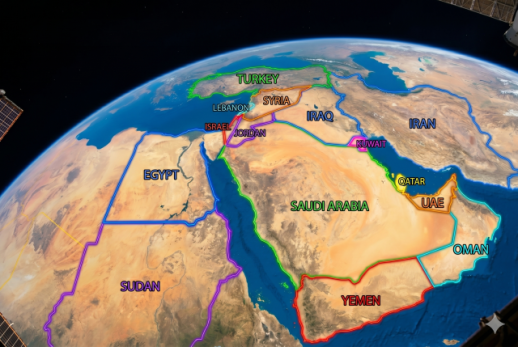 ASIA INSIGHT: Trump's Middle East peace formula may lie in Noah Covenant and new Arabian union The Middle East is moving again — not slowly, but with the dangerous speed that often precedes a historic geopolitical realignment. What began as another confrontation between Iran and Israel is no longer confined to missile strikes, proxy warfare, or retaliatory operations. It is becoming a wider struggle over the future architecture of the Middle East itself: who will control the sea lanes, who will shape the post-oil order, and which civilization will define the political grammar of the region in the age of artificial intelligence, energy transition, and strategic fragmentation. Against that backdrop, the revelation that Benjamin Netanyahu secretly visited the United Arab Emirates during the war may prove to be one of the most consequential diplomatic developments of the year. According to reports emerging from the region, Netanyahu met privately with UAE President Mohamed bin Zayed Al Nahyan in the oasis city of Al Ain near the Omani border. Intelligence and military coordination reportedly accompanied the visit, including multiple trips by senior Israeli intelligence officials. In ordinary times, such revelations would already be significant. In wartime, they become historic. The visit signals something far deeper than tactical cooperation. It suggests that the quiet strategic alignment between Israel and key Sunni Arab states is evolving into a structured security framework — one built not merely on diplomacy, but on shared survival. For years, the Abraham Accords were viewed primarily as a normalization project: trade, tourism, technology, investment, and symbolic reconciliation between Israel and several Arab states. Yet wars have a way of stripping diplomacy down to its essential core. Under pressure, nations reveal whom they truly trust. The current regional crisis is accelerating precisely that process. The emerging alignment now extends beyond Israel and the Gulf monarchies. Saudi Arabia and Pakistan have already deepened military cooperation through their Strategic Mutual Defense Agreement. Discussions regarding potential participation by Türkiye and Qatar suggest that a broader Islamic security architecture may be quietly taking shape. Some Indian analysts have begun referring to the possibility as an “Arab NATO.” The phrase may sound exaggerated today, yet history often begins as exaggeration before becoming reality. What makes the moment extraordinary is not merely the military dimension. Historically rival powers — Saudi Arabia and Türkiye among them — are now discovering common strategic interests under the shadow of expanding regional instability. The shared concerns are unmistakable: Iranian influence, maritime insecurity, economic vulnerability, militant spillovers, and the fear that prolonged war could permanently destabilize the energy arteries of the world economy. The recent tensions between Iran and Kuwait underscore how rapidly the conflict risks spreading across the Gulf. Kuwaiti authorities announced the detention of Iranian Revolutionary Guard personnel allegedly attempting infiltration operations near strategically sensitive islands. Tehran denied the accusations while simultaneously warning that it reserved the right to retaliate. Such episodes matter because geography matters. The Persian Gulf is not simply a regional waterway. It is one of the central nervous systems of global civilization. The Strait of Hormuz remains indispensable to energy flows, maritime insurance markets, shipping logistics, inflation trajectories, and ultimately the stability of financial systems from New York to Singapore. That is why the present conflict cannot be understood solely through the narrow lens of religion or ideology. It is fundamentally about the future balance of power across Eurasia. Yet amid this dangerous escalation, another possibility is quietly emerging — one that may ultimately offer a more durable foundation for peace than military victory alone. That possibility may be called the Noah Covenant. The Abraham Accords opened the door to political normalization between Israel and parts of the Arab world. But the deeper civilizational challenge of the Middle East cannot be solved merely through transactional diplomacy. The region requires a broader philosophical framework capable of transcending sectarian divisions without erasing historical identities. In Jewish tradition, the Noahide Covenant represents one of humanity’s oldest universal moral agreements. Unlike covenants tied to a single tribe or nation, it is understood as a covenant made with all humankind after the Flood. It establishes the minimum principles necessary for civilization itself: justice, restraint, human dignity, lawful order, and the rejection of chaos. Its symbolic power is profound because the three great monotheistic traditions — Judaism, Christianity, and Islam — all recognize Noah as a foundational patriarch of humanity. That matters enormously in today’s Middle East. Modern geopolitics often forgets that beneath contemporary rivalries lies a deeper civilizational memory. Arabs and Jews trace spiritual ancestry to Abraham. Persians, despite their distinct imperial and cultural identity, remain deeply woven into the historical fabric of the broader Middle Eastern civilization. Even Iran, frequently portrayed only as a revolutionary state, still carries the consciousness of an ancient imperial civilization shaped by thousands of years of history along the Silk Road. This is one reason outside powers have repeatedly misunderstood Iran. The United States, powerful though it is, remains historically young compared with Persia’s civilizational depth. Strategic cultures shaped over millennia do not behave according to short-term military logic alone. Iran understands endurance. Israel understands existential survival. The Gulf monarchies understand vulnerability. Türkiye understands imperial memory. And Pakistan understands the strategic realities of balancing multiple civilizational worlds simultaneously. The future stability of the Middle East may therefore depend less on decisive military triumph and more on whether these powers can gradually construct a new regional compact based on coexistence, deterrence, and mutual survival. This is where the concept of an Arab NATO becomes strategically important. If such a framework emerges — whether formally or informally — it would likely evolve beyond military cooperation. It could become a broader platform integrating energy security, artificial intelligence infrastructure, maritime defense, logistics corridors, cyber defense, and strategic investment. Saudi Arabia and the UAE are already investing aggressively in AI, smart cities, semiconductor ecosystems, and post-oil economic transformation. Türkiye possesses significant military-industrial capacity and geopolitical reach. Pakistan is both a nuclear power and a bridge between South Asia, China, and the Islamic world. Egypt controls the Suez Canal, one of the most vital arteries of global commerce. Combined, these states could form a stabilizing strategic axis capable of reshaping the wider Middle East. And this is precisely where President Donald Trump may still envision an opportunity. Trump has long approached Middle Eastern diplomacy through unconventional transactional frameworks rather than ideological grand strategy. The Abraham Accords themselves reflected that instinct. Yet the next stage may require something larger: not merely normalization between governments, but a broader architecture of regional coexistence anchored in shared security and economic interdependence. In that sense, the real successor to the Abraham Accords may ultimately become a Noah Covenant — a civilizational understanding that recognizes that endless sectarian war cannot produce a sustainable future for any side. For South Korea, these developments carry enormous implications. Korea should not view the Middle East merely as a source of oil or construction contracts. The region is rapidly becoming one of the principal theaters where energy, technology, logistics, AI infrastructure, and geopolitical competition intersect. Korea possesses world-class strengths in semiconductors, shipbuilding, nuclear energy, defense technology, and digital infrastructure. It also maintains unusually balanced relationships across the region, including with Israel, Saudi Arabia, the UAE, and Türkiye. That diplomatic balance gives Seoul a potentially important role. In the coming decade, Korea could emerge not only as an economic partner but also as a strategic bridge connecting East Asian technological capacity with Middle Eastern transformation. The Middle East today stands at a crossroads between escalation and reinvention. Wars destroy cities. But they also expose strategic realities that peacetime diplomacy often conceals. The deeper question is no longer who can win the next battle. It is who can build the next order. And increasingly, the outlines of that future may lie not only in weapons or alliances, but in a broader search for a civilizational covenant capable of allowing ancient rivals to survive together in a rapidly changing world. 2026-05-14 10:34:58
 -
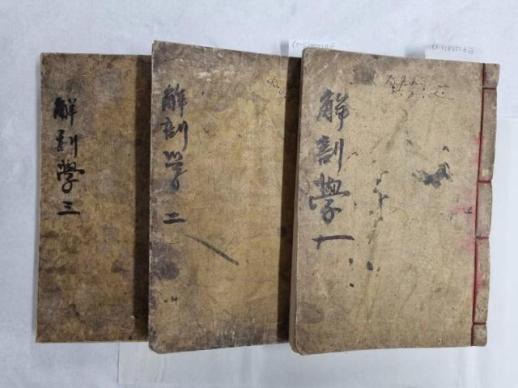 First Korean Anatomy Textbook to be Registered as National Cultural Heritage The first Korean medical textbook, "Anatomy" (Jejungwon Korean Medical Textbook), will be registered as a national cultural heritage. The Cultural Heritage Administration announced on May 14 that it plans to register "Anatomy" as a national cultural heritage. "Anatomy" is the first Korean anatomy textbook published by Jejungwon, the first modern Western-style medical institution in Korea. Established in April 1885 under King Gojong, Jejungwon served as Korea's first Western hospital, and this textbook was used as a teaching material at Severance Hospital's medical school and various missionary medical institutions. The textbook was translated into Korean by Kim Pil-soon (1880–1922), a medical student at Jejungwon, from the first three volumes of "Practical Anatomy" by Japanese anatomist Imada Tsukanu (1850–1889). It was published in 1906 with editing by Professor Oliver R. Avison (1860–1956) of Jejungwon. This textbook serves as a representative document showcasing the early educational practices during the introduction of Western medicine in Korea, confirming that modern medical education was based on a scientific understanding of human anatomy and function. It holds significant academic and historical value as a symbol of the beginning of modern medical education in Korea. Notably, the textbook explains medical terms in pure Korean, avoiding reliance on Chinese characters or foreign words, using terms like 'yeomtong' (heart) and 'baptong' (stomach). This illustrates the process of translating and popularizing modern medical knowledge into Korean, and it also provides valuable insights into early 20th-century Korean orthography and phonetic changes, making it an important resource for the history of the Korean language. * This article has been translated by AI. 2026-05-14 10:21:24
 -
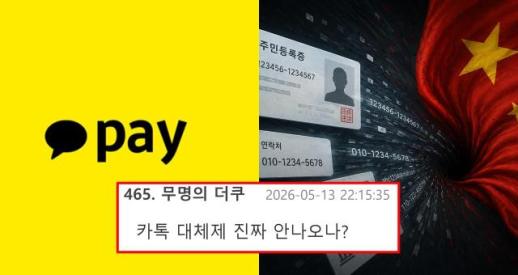 KakaoPay Under Investigation for Allegedly Sharing 404.5 Million User Data with China Authorities have launched a formal investigation into KakaoPay, which is accused of providing hundreds of millions of customer data records to China's Alipay. On May 13, the Chosun Ilbo reported that the Southern Gyeonggi Police Agency has begun its investigation after receiving a referral from the Financial Supervisory Service (FSS) last month. The police are currently investigating KakaoPay for potential violations of the Credit Information Act. According to the FSS's findings, KakaoPay transmitted a total of 54.2 billion customer data records to Alipay from 2018 to May 2024, affecting approximately 40.45 million users. This data transfer reportedly occurred when iPhone users registered KakaoPay as a payment method. At that time, KakaoPay shared user information with Apple, which then routed the data through Alipay. Sensitive information, including encrypted phone numbers, email addresses, and account balances, was allegedly included in this transfer. The controversy first came to light following an FSS announcement in August of last year. Subsequently, the civic group Freedom Korea Defense Corps filed a complaint against senior KakaoPay officials for alleged data breaches and violations of the Credit Information Act with the Seoul Central District Prosecutors' Office. The case was initially handed over to the Seongdong Police Station in Seoul, but the police considered closing the investigation early, citing that pursuing a separate investigation on a matter already under FSS review would be an unnecessary use of resources. Difficulties in obtaining FSS investigation materials at the time also contributed to this consideration. After concluding its investigation, the FSS imposed a significant penalty on KakaoPay in February, issuing a 'severe warning' along with a fine of 12.976 billion won and an additional penalty of 4.8 million won. Following the news, domestic internet users expressed their outrage, commenting, "No wonder I've been getting spam calls all day," "Korean companies have gone crazy," "Kakao is more urgent than Coupang," "Is personal information a public good in Korea?" and "It's time to reform resident registration numbers."* This article has been translated by AI. 2026-05-14 10:18:36
 -
 Singer Seo In-young Reveals She's in a Relationship 가수 서인영이 열애 중이라는 사실을 고백했다. On May 13, Seo In-young disclosed her relationship status on her YouTube channel, "Gaegwacheonseon Seo In-young," in a video titled "Seo In-young, a Dating Expert Who Has Never Been Single, Shares Her Dating Secrets (+ Charles Enter)." During the video, when Charles Enter mentioned being a lifelong single, Seo responded, "Why is that? I have never taken a break from dating since elementary school." When asked if she is currently in a relationship, Seo replied, "Of course. I am always in the present tense," eliciting laughter. Seo shared details about her boyfriend, stating, "The first time I met him, he wasn't my type. I had four or five friends with me, and it was a tough spot. I asked him, 'Can you come here?' and when he walked in, he smiled and didn't look away. That was so attractive that I started dating him. That's my current boyfriend." Seo In-young married a non-celebrity businessman in 2023 but divorced in 2024. Debuting in 2002 as a member of the girl group Jewelry, Seo In-young has left a mark with hits like "One More Time" and "Cinderella." She gained popularity for her candid charm on the 2008 MBC variety show "We Got Married."* This article has been translated by AI. 2026-05-14 10:16:45
 -
 LS Eco Energy Shares Surge 16% on AI Data Center Power Supply Deal in Vietnam Shares of LS Eco Energy soared by 16.7% in early trading after the company announced its participation in a power supply project for a large artificial intelligence (AI) data center in Vietnam. As of 9:27 a.m. on May 14, LS Eco Energy's stock was trading at 109,000 won, up 15,600 won from the previous trading day. The stock reached an intraday high of 109,800 won, setting a new record. The company revealed that its subsidiary, LS-VINA, based in Haiphong, will supply power cables for the construction of the AI data center, which is being developed by Viettel Group, Vietnam's largest telecommunications company. This project is one of the largest AI infrastructure initiatives in northern Vietnam, involving the establishment of a 60-megawatt (MW) data center in a new city near Hanoi. This capacity is sufficient to power approximately 40,000 to 50,000 households simultaneously. It is seen as a significant infrastructure project to meet the growing demand for generative AI and cloud services. The products supplied by LS Eco Energy will be used in the power network connecting the data center and substations. As the competition for generative AI expands beyond servers and semiconductors to include power and communication networks, expectations are rising for companies involved in electrical infrastructure. Recently, LS Eco Energy also supplied bus ducts and transmission cables for hyper-scale AI data centers being built by major global tech firms in Indonesia and Malaysia. Market analysts suggest that the ongoing trend of increased investment in Southeast Asian data centers is reflected in the company's growing order expectations. Lee Sang-ho, CEO of LS Eco Energy, stated, "The AI data center market is evolving from a server competition to a competition for power and communication infrastructure. We will strengthen our efforts to penetrate the global AI infrastructure market, focusing on high-voltage cables and power and optical communication solutions for data centers."* This article has been translated by AI. 2026-05-14 10:15:00
 -
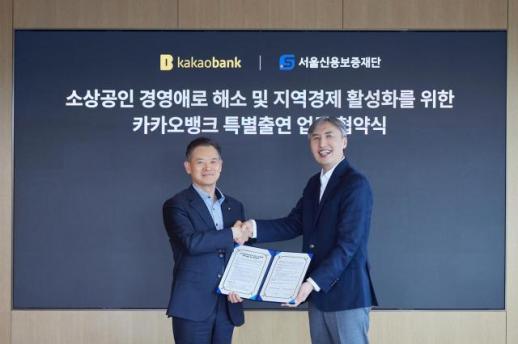 KakaoBank Provides 125 Billion Won in Guaranteed Loans to Support Small Businesses in Seoul KakaoBank is taking steps to alleviate the financial burden on small businesses in Seoul.On May 14, KakaoBank announced a special contribution of 10 billion won to the Seoul Credit Guarantee Foundation, which will facilitate a total of 125 billion won in guaranteed loans.Under this agreement, KakaoBank plans to allocate 62.5 billion won each to two initiatives: the 'Rapid Financial Support' program in collaboration with the Seoul city government and the 'District Economic Support' program working with all 25 districts in Seoul.The Rapid Financial Support program includes a 'Special Contribution Guarantee' product with a maximum limit of 100 million won and the 'Quick Dream' product, which offers up to 30 million won to small business owners with personal credit scores below 839 (according to NICE standards).The District Economic Support program aims to provide loans of up to 100 million won to small businesses located in the 25 districts of Seoul. This marks the first instance of an internet-only bank collaborating with all districts in the city.Based on KakaoBank's special contribution, the Seoul Credit Guarantee Foundation will issue the guarantees, while each district will work to expand support and promote assistance for small businesses in their areas.A KakaoBank representative stated, "We initiated this agreement to ease the financial burden and enhance convenience for small business owners in Seoul. We will continue to expand financial support for individual entrepreneurs based on innovative financial technology and practice inclusive finance."* This article has been translated by AI. 2026-05-14 10:10:04
 -
 PSG Secures Fifth Consecutive Ligue 1 Title; Lee Kang-in Misses Match Due to Injury Paris Saint-Germain (PSG), featuring national team midfielder Lee Kang-in, has secured its fifth consecutive Ligue 1 title. On May 14, PSG defeated second-place RC Lens 2-0 in an away match at the Bollaert-Delelis Stadium in Lens, thanks to goals from Khvicha Kvaratskhelia and Ibrahim Mbaye. With one league match remaining, PSG (24 wins, 4 draws, 5 losses; 76 points) has established a 9-point lead over Lens (21 wins, 4 draws, 8 losses; 67 points), ensuring their 14th overall title and fifth straight championship. Lee Kang-in, who joined PSG in July 2023, has now lifted his third Ligue 1 trophy. He has previously celebrated victories in the UEFA Champions League, UEFA Super Cup, and French Super Cup. However, Lee was unable to enjoy the victory on the field, as he missed the match due to an ankle injury sustained during a game against Brest on May 12. He is currently focusing on recovery through indoor training. PSG is now set to target a consecutive UEFA Champions League title, facing Arsenal from England on May 31 at the Puskás Aréna in Budapest.* This article has been translated by AI. 2026-05-14 10:05:12
 -
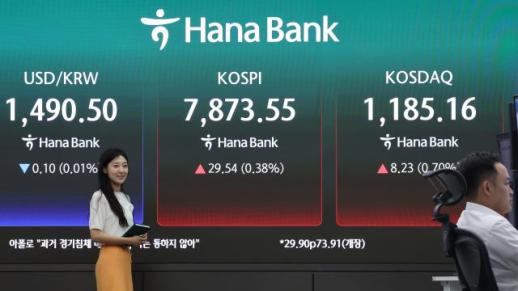 Oil Prices Hit $100 as U.S. Inflation Concerns Rise, Threatening 1490 Won Exchange Rate The exchange rate of the won against the dollar has shown volatility, surpassing the 1490 won mark during trading, influenced by rising international oil prices and inflation concerns in the United States. As of 9:20 a.m. on May 14, the exchange rate was trading at 1489.2 won per dollar. The rate opened at 1489.8 won, down 0.8 won, and briefly crossed the 1490 won threshold shortly after the market opened before retracting some gains. With ongoing geopolitical tensions in the Middle East, forecasts suggest that the blockade of the Strait of Hormuz will continue until the end of May, keeping international oil prices, particularly West Texas Intermediate (WTI), around the $100 per barrel mark. On May 13, WTI for June delivery closed at $101.02, down $1.16 (1.14%) from the previous session on the New York Mercantile Exchange. The U.S. Producer Price Index (PPI) for April surged by 1.4% month-over-month and 6.0% year-over-year, exceeding market expectations. Following the consumer price index (CPI), the PPI also surpassed forecasts, raising inflation concerns and leading to an increase in U.S. Treasury yields, particularly for long-term bonds. The dollar strengthened in tandem with rising Treasury yields. Minkyu Won, an economist at Woori Bank, noted, "The rise in bond yields is clearly contributing to a stronger dollar. Given this trend, there is a significant likelihood that the won will face downward pressure today." He added, "In addition to active buying by importers, the re-entry of demand for dollar conversions related to overseas stock investments due to a strong U.S. stock market supports the actual demand for dollars. However, the volume of export-related deferred negotiations and the authorities' caution regarding speed control may limit the upper range of the exchange rate."* This article has been translated by AI. 2026-05-14 10:03:19