

Journalist

Sohn Jie-ae
-
 Korean Pharmaceutical Companies Shift Focus to Direct Sales and Distribution Networks Korean pharmaceutical companies are moving beyond simply expanding overseas sales to securing control over sales in foreign markets. They are not only exporting products but also establishing local distribution networks and sales organizations. This shift is seen as an attempt to change their revenue structure, as growth potential is limited in the domestic market, which is characterized by price reductions and intense generic competition. According to a report from the Korea Institute for International Economic Policy, the global pharmaceutical market is expected to grow from $1.67 trillion in 2024 to over $3 trillion by 2034. In contrast, South Korea accounts for only 1.7% of the global pharmaceutical market revenue. The United States holds 47.8%, the five major European countries account for 14.4%, and China and Japan represent 6.8% and 3.7%, respectively, highlighting a significant disparity. Expanding into international markets has become a common goal for domestic pharmaceutical companies. However, recent trends indicate that the ability to secure sales leadership in foreign markets is becoming a key competitive factor, rather than just the volume of exports. As distribution layers increase, companies face constraints on pricing strategies and market responsiveness. More companies are entering markets directly to secure leadership. GC Green Cross invested 138 billion won in 2024 to acquire full ownership of ABO Holdings, a local blood bank operator in the United States, to expand its local business from raw plasma procurement to finished product sales. The blood product 'Aliglo,' which entered the U.S. market, recorded sales of 34.9 billion won in the first quarter of this year, marking a nearly fourfold increase compared to the same period last year. Annual sales are projected to rise from 48.6 billion won in 2024 to 151.1 billion won last year. The company aims to achieve $1 billion in sales in the U.S. market by 2035, with Aliglo being a core growth driver. Celltrion established direct sales systems in Europe in 2020 and in the United States in 2023, expanding its sales network centered on local subsidiaries. In the U.S., the company has integrated production, supply, and direct sales distribution networks, enhancing its pricing competitiveness and negotiation power with pharmacy benefit managers (PBMs). With the direct sales system firmly in place, key products like Uplizna, Vegzelma, and Truxima have achieved the top prescription status in both European and U.S. markets. SK Biopharm successfully established direct sales in the U.S. with its self-developed epilepsy treatment 'Xcopri.' This marks the first instance of a Korean pharmaceutical company building a direct sales system in the U.S. based on its own new drug. The company believes that efficient market penetration is possible even with a limited workforce, prompting its decision to pursue direct sales. An SK Biopharm official stated, "The starting point for our direct sales success was the selection of the disease. We determined that central nervous system (CNS) disorders could be efficiently commercialized with a specialized sales team of about 80 to 120 people, compared to chronic diseases." The strategy for securing sales leadership is not limited to direct sales. Vietnam is noted for its strong pharmacy-centered distribution structure. Dongwha Pharmaceutical acquired a 51% stake in the Vietnamese pharmacy chain Trung Son Pharma for approximately 39.1 billion won in 2023, aiming to secure local sales channels. This approach focuses on establishing distribution networks rather than merely exporting products. The pharmaceutical market in emerging countries places significant importance on brand recognition, making it difficult for latecomers to disrupt market share once an initial foothold is established. The company plans to use its position in the Vietnamese pharmaceutical market as a springboard to expand into the Southeast Asian pharmaceutical and beauty markets. A Dongwha Pharmaceutical official remarked, "Many companies start their overseas expansion with quick and low-cost product exports. We decided to acquire the Vietnamese pharmacy chain to build direct relationships and trust with local consumers." An industry insider noted, "Pharmaceuticals face varying insurance systems and regulations in each country, making it challenging to establish local sales networks. While the initial investment burden is significant, it is meaningful as it allows for securing market leadership after establishing a presence."* This article has been translated by AI. 2026-06-03 19:03:00
 -
 Korean Pharmaceutical Industry Shifts to Export-Driven Growth Amid Domestic Challenges The Korean pharmaceutical industry is facing limits to its domestic growth and is rapidly transitioning to an export-driven model. With ongoing price reductions and market stagnation making it difficult to expand domestic sales, the performance of companies is increasingly reliant on global drug sales and royalties.According to industry reports, the first quarter of this year saw mixed results for pharmaceutical companies, with those heavily reliant on exports showing significant improvements, while companies focused on domestic markets struggled to grow. However, the domestic market has structurally limited growth potential. The government's ongoing price reduction policies and intensified competition in generics are making it increasingly difficult to secure profitability. There is a growing recognition in the industry that the existing domestic and wholesale-centered structure cannot sustain long-term growth.In this context, success in the global market and royalty income have become the core pillars of performance. Yuhan Corporation has seen significant profitability improvements from overseas sales and royalties of its non-small cell lung cancer treatment, Lurbinectedin. GC Pharma is accelerating its expansion in North America with its immunoglobulin product, Aliglo. SK Biopharm is transforming its performance structure with the U.S. sales growth of its epilepsy drug, Cenobamate, while HK inno.N continues its stable growth thanks to the overseas expansion of its gastroesophageal reflux disease treatment, K-Cab.Yuhan Corporation expects to surpass 100 billion won in annual operating profit as milestone payments and royalties from Lurbinectedin's technology transfer begin to materialize. GC Pharma anticipates approximately $300 million in sales by 2028 based on the growth of Aliglo in the U.S. SK Biopharm's Cenobamate generates annual sales of $400 million to $600 million in the U.S., with first-quarter sales this year reaching 197.7 billion won, a 48.4% increase from the same period last year. HK inno.N recorded 58.5 billion won in prescriptions for K-Cab in the first quarter, raising expectations for overseas expansion.The high exchange rate environment is particularly favorable for export-oriented companies. While the cost burden increases due to the import structure of raw pharmaceuticals, dollar-based sales offset this, leading to overall profitability improvements. Consequently, companies with a higher proportion of sales in advanced markets like the U.S. and Europe are benefiting relatively more.Ultimately, the competitive landscape of the domestic pharmaceutical industry is rapidly shifting from a domestic focus to an export-driven model. The business focus is moving beyond simple finished drug sales to include global drug commercialization, technology transfers, contract development and manufacturing (CDMO), and biosimilars.An industry insider stated, "The domestic prescription market is primarily serving as a basic revenue base, while actual growth and profitability are now determined overseas. The restructuring will accelerate around companies that secure new drugs and business models that can succeed in the global market."However, there are also concerns about the limitations of the current export-focused growth strategy. According to a report by the Korea Health Industry Development Institute, there have been over ten instances of technology transfers exceeding 1 trillion won from 2012 to 2024. While achievements are increasing, the industry is still criticized for not breaking free from a revenue structure dependent on global pharmaceutical companies.As a result, there is a growing call for stronger collaboration models between large domestic pharmaceutical companies and bio ventures. Bio ventures possess innovative technologies and early research capabilities, while large pharmaceutical companies have strengths in clinical development, approval, production, and distribution, allowing for mutually beneficial synergies.An industry representative remarked, "The industry will accelerate its restructuring around companies that not only transfer technology but also possess their own commercialization capabilities and global pipelines. A well-defined strategy is also required to build a collaborative ecosystem between large pharmaceutical companies and bio ventures."* This article has been translated by AI. 2026-06-03 19:03:00
 -
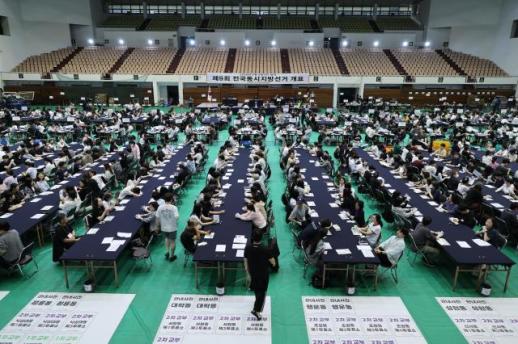 Ruling party leads in South Korean local election exit polls SEOUL, June 03 (AJP) -South Korea's ruling Democratic Party of Korea holds a strong lead in 11 out of 16 metropolitan mayoral and gubernatorial races, according to joint election-day exit polls released Wednesday. The projected outcomes position the party to expand its local administrative power as President Lee Jae-myung enters the second year of his term. The nationwide vote serves as the first major electoral test for the Lee Jae Myung administration, a critical midterm referendum on his first year in office. A decisive victory would grant the ruling party a unified mandate across administrative, legislative, and local levels, while a defeat for the opposition People Power Party could trigger immediate leadership restructuring. In the high-profile race for mayor of Seoul, the country's capital and primary political barometer, ruling party candidate Jung Won-oh leads opposition incumbent Oh Se-hoon by 51.4 percent to 46.0 percent. Control of the capital is historically viewed as a critical prize in South Korean elections due to the city's massive population and economic influence. Broadcasters classified several major regions as tight contests, including the southern port city of Busan and the metropolitan city of Daegu, which is traditionally regarded as the heart of South Korean conservatism. In the Daegu mayoral race, opposition candidate Choo Kyung-ho holds a razor-thin lead over ruling party candidate Kim Boo-kyum by 49.9 percent to 49.1 percent. In Busan, the ruling party's Jeon Jae-su maintains a narrow edge with 50.2 percent over the opposition's Park Hyung-jun at 48.3 percent. Meanwhile, the North Jeolla gubernatorial race shows the ruling party's Lee Won-taek leading independent candidate Kim Kwan-young by 48.5 percent to 46.3 percent. A separate prediction survey released by cable network JTBC projected the ruling Democratic Party of Korea to win 10 seats and the conservative opposition to win one seat. The network classified five regions as battlegrounds, listing Daegu, Chungnam, Chungbuk, Jeonbuk, and Gyeongnam as too close to call. The joint exit polls, conducted by major terrestrial broadcasters KBS, MBC, and SBS, were released simultaneously at 6 p.m. as polling stations closed across South Korea. 2026-06-03 19:00:17
 -
 Democratic Party Claims Exit Polls Reflect Support for Lee Jae-myung's Government The Democratic Party of Korea on June 3 praised the exit poll results released at 6 p.m. as a reflection of public support for the stability of Lee Jae-myung's government. Lee Yeon-hee, head of the party's Central Election Countermeasures Committee, told reporters, "I won't make any definitive statements, but I believe this predictive survey confirms public sentiment supporting President Lee Jae-myung's effective governance." Lee expressed optimism about the situation in the Yeongnam region, noting, "There are tight races, especially in Daegu, and I hope candidate Kim Boo-kyum emerges victorious in the final count." Regarding the by-election for the Pyeongtaek constituency, he adopted a cautious stance, stating, "The exit poll results indicate a close race within the margin of error, so we will only know the final outcome once all ballots are counted. I still hope candidate Kim Yong-nam wins." On the gubernatorial election in Jeonbuk, he took a humble approach, acknowledging the competitive nature of the race between Democratic candidate Lee Won-taek and independent candidate Kim Kwan-young. He said, "I accept the sentiment of the Jeonbuk electorate with humility and will strive to understand their views better." He also addressed the issue of ballot shortages in some areas, urging the Election Commission to resolve the problems quickly, particularly in Seoul's Songpa District. Lee interpreted the projected voter turnout exceeding 60% as a sign of mobilization among Democratic supporters and moderates. He explained, "I analyze that both our supporters and those seeking stable governance came out to support the Lee Jae-myung administration and its policy momentum." According to exit polls released by three major broadcasters, the Democratic Party is expected to win in Seoul and 10 other locations, while four areas, including Busan, Daegu, Jeonbuk, and Gangwon, are predicted to be competitive. JTBC's predictive survey forecasts the Democratic Party winning in Seoul and 10 other areas, with Daegu, Chungnam, Chungbuk, Jeonbuk, and Gyeongnam classified as competitive regions.* This article has been translated by AI. 2026-06-03 19:00:00
 -
 Democratic Party Expected to Dominate Local Elections, Retake Seoul and Busan Exit polls conducted by three major broadcasters—KBS, MBC, and SBS—indicate that the Democratic Party is poised for a significant victory in the local elections, leading in most regions across the country. The People Power Party is struggling even in its stronghold of Yeongnam, signaling a potential shift in the electoral landscape. The exit polls show the Democratic Party leading in Seoul, Gyeonggi, Incheon, as well as Busan, Ulsan, and South Gyeongsang, with the party ahead in 14 out of 17 metropolitan areas. The only region where the People Power Party is leading is North Gyeongsang, while Daegu is showing a very close contest. In the crucial Seoul mayoral race, Democratic candidate Jeong Won-o recorded 51.4%, leading People Power Party candidate Oh Se-hoon, who garnered 46.0%. This puts Oh's bid for a third term in jeopardy. In the Gyeonggi gubernatorial race, Democratic candidate Choo Mi-ae achieved 60.4%, significantly ahead of Yang Hyang-ja, who received 34.1%. In Incheon, Park Chan-dae also led with 53.7%, defeating Yoo Jeong-bok, who secured 45.5%, confirming the Democratic Party's strength across the metropolitan area. One of the biggest surprises in this election is in Busan, where Democratic candidate Jeon Jae-soo is projected to win with 50.2%, surpassing Park Hyung-jun, who received 48.3%. In Ulsan, Kim Sang-wook is leading with 52.8% against Kim Du-gyeom, who has 43.2%. In South Gyeongsang, Kim Kyung-soo is ahead with 54.3%, while Park Wan-soo trails with 45.7%. In Daegu, considered the last bastion of conservative support in Yeongnam, the race is extremely tight. People Power Party candidate Choo Kyung-ho is at 49.9%, while Democratic candidate Kim Boo-kyum is close behind at 49.1%. In contrast, in North Gyeongsang, Lee Cheol-woo is leading with 69.7% over Oh Jung-ki, who has 30.3%. The Democratic Party's dominance is also evident in the Chungcheong region. In Daejeon, Huh Tae-jung is leading with 55.9%, while in Sejong, Jo Sang-ho is at 64.3%. In South Chungcheong, Park Soo-hyun is slightly ahead with 52.1% against Kim Tae-heum's 47.9%, and in North Chungcheong, Shin Yong-han has 56.2%, leading Kim Young-hwan, who has 43.8%. In the Honam region, the Democratic Party's advantage is overwhelming. In Gwangju, Min Hyung-bae has 78.6%, and in North Jeolla, Lee Won-taek is narrowly ahead with 48.5% over Kim Kwan-young, who has 46.3%. While the results for the South Jeolla gubernatorial race have not been announced, a strong Democratic trend is expected to continue. In Gangwon, Woo Sang-ho is leading with 51.3% against Kim Jin-tae's 48.7%, and in Jeju, Wi Seong-gon has 62.2%, significantly ahead of Moon Seong-yu, who has 34.9%. The by-elections for the National Assembly are also highly competitive. In Pyeongtaek, Gyeonggi, Cho Kuk is at 31.1%, followed closely by Yoo Yi-dong at 30.6% and Kim Yong-nam at 30.3%, all within the margin of error. In Busan's Buk-gu Gap, Ha Jung-woo is leading with 42.6%, while Han Dong-hoon is at 41.6%, indicating a tight race. If the exit poll results reflect the actual vote counts, the Democratic Party will secure a decisive victory in its first nationwide election since the inauguration of the Lee Jae-myung administration, gaining momentum for governance. Conversely, the People Power Party may face demands for leadership restructuring and party reform as its traditional support base in Yeongnam shows signs of instability. However, in some areas like the Daegu mayoral race and the Pyeongtaek and Busan by-elections, the margins are very narrow, leaving the final outcomes uncertain. 2026-06-03 18:42:00
 -
 Voting continues despite fire in polling station building SEOUL, June 03 (AJP) - A fire broke out in the underground parking garage of the Sangdo 4-dong Community Complex in southwestern Seoul, at around 3:30 p.m. (0630 GMT) on Wednesday, election day. The blaze was extinguished in approximately five minutes and no injuries were reported. According to police, a citizen attempted to fight the fire using an extinguisher kept in his vehicle. Despite the noisy fire alarm, voting at the polling station on the third floor continued without interruption. Fire authorities said that they believe the fire originated in a pile of rubbish in the underground garage collection area. The cause of fire will be investigated, the rescuers said. 2026-06-03 18:36:48
 -
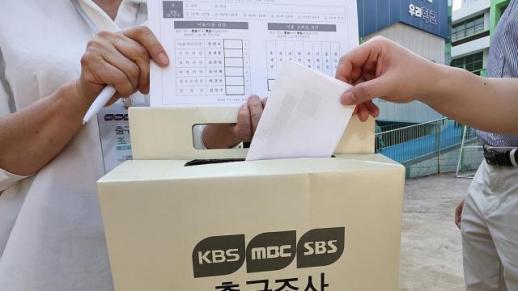 JTBC Exit Polls Predict Democratic Party Leads in 10 Regions, One for People Power Party JTBC's exit poll results for the June 3 local elections indicate that the Democratic Party is expected to win in 10 regions, including Seoul, while the People Power Party is projected to secure victory in one area, North Gyeongsang Province. Five regions—Daegu, Chungnam, Chungbuk, Jeonbuk, and Gyeongnam—are showing competitive races. JTBC reported these exit poll results shortly after voting concluded at 6 p.m. on June 3. In the highly contested Seoul mayoral election, Democratic Party candidate Jeong Won-o is projected to receive 53.5% of the vote, while People Power Party candidate Oh Se-hoon is expected to garner 42.9%, resulting in a 10.6 percentage point lead for Jeong. In the Busan mayoral race, Democratic Party candidate Jeon Jae-soo is anticipated to lead with 53.9%, ahead of People Power Party candidate Park Hyung-jun, who is expected to receive 44.4%, a margin of 9.5 percentage points. The exit polls also revealed predictions for key by-elections. In Busan's Buk-gap, independent candidate Han Dong-hoon is expected to receive 48.1%, while Democratic Party candidate Ha Jeong-woo is projected to get 37.6%. In Pyeongtaek, Democratic Party candidate Kim Yong-nam is forecasted to achieve 34.2%, while Cho Guk of the Justice Party is expected to receive 31.6%.* This article has been translated by AI. 2026-06-03 18:36:00
 -
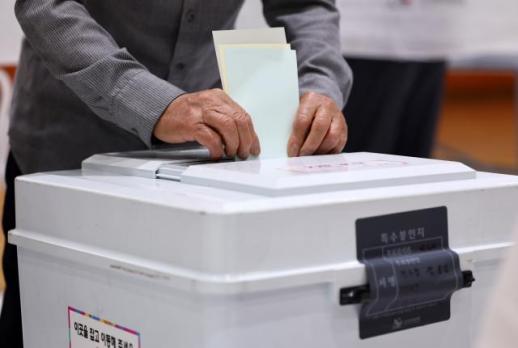 Democratic Party Leads in Local Elections, Exit Polls Show In the local elections held on June 3, the Democratic Party is projected to lead in 11 out of 16 metropolitan mayoral races, while the People's Power Party is expected to win in just one, according to exit polls from three major broadcasters: KBS, MBC, and SBS. The regions of Busan, Daegu, Jeonbuk, and Gangwon are anticipated to be closely contested. The exit poll results released at 6 p.m. show the Democratic Party leading in Seoul, Gyeonggi, Incheon, Ulsan, Gyeongnam, Daejeon, Sejong, Chungnam, Chungbuk, Jeonnam-Gwangju, and Jeju. Conversely, the People's Power Party is ahead in Gyeongbuk. The races in Busan, Daegu, Jeonbuk, and Gangwon are expected to be within the margin of error. In the highly contested Seoul mayoral race, Democratic candidate Jung Won-oh is leading with 51.4%, significantly ahead of People's Power candidate Oh Se-hoon, who has 46%. For the Busan mayoral race, Democratic candidate Jeon Jae-soo is at 50.2%, while People's Power candidate Park Hyung-jun trails closely at 48.3%. The Daegu mayoral contest is also tight, with People's Power candidate Choo Kyung-ho at 49.9% and Democratic candidate Kim Boo-kyum at 49.1%. In the National Assembly by-elections, the race in Pyeongtaek is competitive, with Cho Guk of the Justice Party at 31.1%, People's Power candidate Yoo Yi-dong at 30.6%, and Democratic candidate Kim Yong-nam at 30.3%. In Busan North Gap, Democratic candidate Ha Jung-woo leads with 42.6%, followed closely by independent candidate Han Dong-hoon at 41.6%, while People's Power candidate Park Min-sik stands at 15.78%. JTBC's exit polls predict the Democratic Party will win in 10 areas and the People's Power Party in one, identifying five regions, including Daegu, Gyeongnam, Jeonbuk, Chungnam, and Chungbuk, as competitive. In the Seoul mayoral race, JTBC shows Jung Won-oh leading with 53.5% compared to Oh Se-hoon at 42.9%. Similarly, in Busan, Jeon Jae-soo is ahead with 53.9%, while Park Hyung-jun has 44.4%. In Daegu, the mayoral race is extremely close, with Democratic candidate Kim Boo-kyum at 49.7% and People's Power candidate Choo Kyung-ho at 49.2%. 2026-06-03 18:33:00
 -
 Voter Turnout of 44,649,908: Revitalizing Local Areas is Key to South Korea's Future The local elections held on June 3 concluded with a voter turnout of 44,649,908. While this figure may seem like just a statistic, it encapsulates the current and future challenges facing South Korea, including urban concentration, regional extinction, aging populations, low birth rates, industrial transitions, and the AI revolution. During the election period, political parties competed fiercely over victory and defeat, and the media focused on who won and who lost. However, the essence of local elections is not merely an extension of central politics; they are elections that determine the future of local communities. This process allows South Koreans to choose whether to reinforce the dominance of the metropolitan area or to foster a nation where regions grow together. The election is over, and now the focus must shift from results to implementation. The issue of regional extinction is not just a local problem; it is a national concern. The voter registration reflects the reality of South Korea: Gyeonggi Province has 11,878,997 voters, while Seoul has 8,319,134. Voters from the metropolitan area account for over 45% of the total. In contrast, many regions face existential threats due to youth outmigration and declining birth rates. Regional extinction is no longer a distant concern. Some areas have seen elementary schools close, while others lack maternity wards, and some universities struggle to fill their enrollment quotas. Young people born in these regions leave for the metropolitan area to pursue higher education and employment, and those who leave often do not return. This vicious cycle means that regional crises soon become national crises. The diminishing growth potential of South Korea can be traced to this issue. While people, businesses, and capital flock to the metropolitan area, regions are losing vitality. Viewed from a national perspective, it is akin to a plane flying with only one engine running. The true significance of this local election lies here. Residents did not merely elect mayors and governors; they chose a survival strategy for their regions. However, we must face the harsh reality. Even though local elections are crucial, local governments alone cannot prevent regional extinction. Currently, South Korea's financial and industrial policy powers remain concentrated in the central government. The designation of large national industrial complexes is heavily influenced by the central government. The national AI strategy is also determined by the central government. Establishing semiconductor special zones, power grids for data centers, and regional transportation networks is challenging without central government support. A change in local leadership through elections does not automatically revitalize the local economy. Thus, balanced development is a challenge that both local and central governments must address together. The real test for the Lee Jae-myung administration lies here. Every past government has promised balanced development, yet the concentration in the metropolitan area has only intensified. Now, action is needed, not just declarations. The AI revolution could present new opportunities. The Chungcheong region could develop into a hub for semiconductors and AI data centers, Jeollabuk-do could focus on physical AI and agricultural biotechnology, Gwangju and Jeollanam-do could become centers for AI semiconductors and future mobility, while Busan, Ulsan, and Gyeongsangnam-do could foster manufacturing AI and innovations in shipbuilding and defense. However, achieving this requires a genuine decentralization of significant portions of industrial policy, budget, and regulatory authority to local governments. Maintaining a structure where the central government holds all the power while claiming to support local revitalization is clearly limited. Local leaders must evolve from mere administrators to strategists. The responsibilities of local governments do not diminish. Even under the same systems and authorities, there are local leaders who achieve results and those who do not. In the past, the role of local government leaders was primarily administrative, focusing on budget execution and handling complaints. However, leaders in the AI era must change. They need to attract businesses, engage with investors, and connect universities and research institutions. Analyzing regional strengths and linking them to future industries is essential. Today, competition is not only between nations but also between cities. Successful cities around the world did not grow by chance; they had long-term strategies and bold implementations. Of course, cities like Singapore and Dubai cannot be directly compared to South Korean local governments, as they possess much stronger financial and autonomous powers. However, even under similar conditions, there are leaders who achieve better results. Ultimately, the success of regional development depends on the combination of central government support and the execution capabilities of local governments. There is a recurring debate during local elections: the claim that "infrastructure projects are outdated." In the past, regions competed to build airports, stadiums, and exhibition centers, but many of these projects have become burdensome liabilities. However, we should not dismiss infrastructure itself. AI data centers require power grids, semiconductor factories need water and roads, and the robotics industry needs test beds and research complexes. Ultimately, future industries will also grow on new forms of infrastructure. The key is not the scale of infrastructure but its purpose. Does it create productivity? Does it build a regional industrial ecosystem? Does it attract youth and businesses? These criteria are crucial. While we should avoid showy construction projects, we must invest boldly in infrastructure for future industries. The election is over, but the competition for the future has just begun. The choice of 44,649,908 voters goes beyond merely changing local power; it poses a question about what kind of nation South Korea will become. For the nation to thrive, regions must also prosper. A country that only sees growth in the metropolitan area is not sustainable. Even in the AI era, regions should not merely be recipients of support but should become new growth hubs. Achieving this requires both the transfer of authority from the central government and innovation from local governments. Revitalizing regions cannot be accomplished by merely changing local leaders. Authority must also be decentralized. True local autonomy will only be realized when changes in personnel through elections coincide with systemic changes through decentralization. The winners of this local election are not just specific political parties but all 44,649,908 voters who headed to the polls, concerned about the future of South Korea. The ball is now in the court of the political arena and local governments. The public has made its choice. What remains is to prove the results.* This article has been translated by AI. 2026-06-03 18:15:00
 -
 WNMC 26: AI reshapes how news is experienced, not just made, media leaders say in Marseille MARSEILLE, June 03 (AJP) - Artificial intelligence is no longer merely changing how journalism is produced but is rewiring how audiences encounter the news itself, a panel of global media leaders said at the World News Media Congress. South Korea's AJP, an AI-native news agency built for that shift, took its place alongside publishers from India and Germany to argue that the technology is dissolving the old path of search, click and read, replacing it with content that anticipates what readers want before they ask. The session, titled "How AI Is Transforming the News Experience," was moderated by Dmitry Shishkin, a former BBC World Service digital editor and now an independent media adviser, whose long-championed "user needs" model framed much of the discussion. The 77th congress, organized by the World Association of News Publishers and held at the Palais du Pharo from June 1 to 3, drew about 1,000 participants from more than 60 countries, representing over 450 news publishers. Seo Hye-seung, managing editor of AJP and part of the Aju Media Group, opened with a personal story about her 83-year-old mother, who now relies on her smartphone to take her medication and book restaurants. "This is the most ordinary thing that's happening in Korea," Seo said, noting that the country had absorbed broadband, smartphones and now AI faster than almost anywhere. She cited a study finding that more than half of office work in Korea passes through an AI tool at some point each day. Because AJP entered the crowded English-language agency market late, Seo said, it was built to its advantage. "We were built AI-native from the first line of code," she said, adding that reporters with less than two years of experience now produce 5,000-word features and analyses. The group publishes in five languages, she said, filtering selected stories from its Korean flagship through a system called AI Pick that translates them automatically. The automation lifted output in four additional languages tenfold and raised English traffic by about 30%, according to the company. Seo said the shift had freed journalists to seek out audiences rather than wait for them, pointing to the group's saturation coverage of a BTS concert in central Seoul earlier this year. "The new question is who offers the best experience," she said, "because users know best." Sannuta Raghu, executive producer and head of the AI lab at India's Scroll.in, said AI was becoming core infrastructure for what she called "personal, machine-mediated sense-making." Her newsroom, she said, employs about 20 people in a country of 1.4 billion. Five years ago it abandoned the chase for breaking news to focus on context and depth, finding its paying readers among academics and researchers studying South Asia. Rather than compete with chatbots that aggregate answers from many sources, Raghu said, Scroll.in was turning its platform into a "trusted workspace" offering what she termed auditable comprehensiveness. "We are very open about the comprehensiveness gap," she said, describing a system that maps what the newsroom can cover and transparently fills the rest from verified sources such as datasets and government bodies. Markus Knall, chief editor and director of content at Germany's Ippen Digital, struck an optimistic note for community journalism. "This may be the best time for local publishers in the last few years, and AI is the reason," Knall said. He argued that small audiences and high costs, once crippling constraints, had become the sector's biggest opportunity. Ippen runs about 170 local news websites in Germany, he said. On a recent election night, the group published more than 4,000 articles covering some 20,000 communities, output he said no human staff could ever match. But Knall warned against treating AI purely as an efficiency tool, urging newsrooms to chase genuine new scale while reserving human reporters for the trust that underpins democratic life. Astrid Maier, chief deputy editor and head of strategy at German news agency dpa, said the industry was facing not an efficiency story but a wholesale platform shift. "If there weren't any independent news agencies right now in the age of AI, they should be invented right now," Maier said, arguing that verified, fact-committed information was more vital than ever as machines learn to read the structured data inside each news article. She presented DPA-IQ, a trusted information layer launched as a minimum viable product two weeks ago, which lets clients' AI agents pull verified text, images and soon video on demand rather than receiving a constant push down the wire. Maier cautioned that if publishers did not set shared standards for how facts are attributed within such systems, the large technology platforms would set them instead. "Otherwise facts won't matter anymore," she said. The discussion echoed a session a day earlier on the evolution from search optimization toward answer- and generative-engine optimization, where panelists stressed that audiences increasingly meet the news through AI rather than the open web. Across both sessions the underlying message was consistent: while algorithms and platforms keep shifting, the direct relationship between a publisher and its readers remains the enduring source of value. 2026-06-03 18:09:06