

Journalist

&
""
Latest by
Kakao Launches Membership and AI Services Amidst Innovation Challenges

Kakao is enhancing its platform competitiveness by introducing a paid membership and artificial intelligence (AI) services centered around KakaoTalk. However, the current focus on integrating its own services raises questions about whether it can effectively translate its user base into actual revenue and expanded service usage.With a planned corporate split in December, CEO Jeong Shin-a faces increasing pressure to demonstrate the results of the 'KakaoTalk innovation' initiative.On October 6, Kakao announced that it continues to accept users for its Kakao Membership, which was launched on October 1. The membership, priced at 4,900 won per month, is being rolled out through a soft launch aimed at a limited number of users. While the exact recruitment target has not been disclosed, the program will close once the internal goal is met, with plans to gradually expand the number of subscribers.The Kakao Membership integrates several key services, including gifting, Talk Deals, KakaoPay, Melon, KakaoPage, emoticons, Talk Cloud, KakaoPay Insurance, and KakaoPay Securities. Members can earn shopping points through gifting and Talk Deals, accumulate KakaoPay points, and choose between Emoticon Plus or Talk Cloud. Additional benefits include KakaoPage cash, securities commission cashback, and mobile screen damage compensation.Given that the monthly subscription fee matches that of Naver Plus Membership, the differentiation of initial benefits is seen as a challenge. Naver Plus has expanded its offerings beyond shopping to include reservations and content, as well as partnerships with external services like Netflix. In contrast, Kakao has primarily focused on bundling its services around KakaoTalk.A Kakao representative stated, “As this is a soft launch, we plan to gradually expand the membership scope with various partners in mind.” Initially, the strategy is to combine frequently used services within the Kakao ecosystem, with plans to enhance benefits through external partnerships in the future.In the AI sector, Kakao is solidifying its strategy by taking on government projects centered around KakaoTalk, but it has yet to achieve notable results. Since Jeong Shin-a's appointment, Kakao has integrated 'Kanana in KakaoTalk' and introduced 'ChatGPT for Kakao' in collaboration with OpenAI, positioning KakaoTalk as a key interface for AI services.However, the decision to terminate the 'Kanana' service on October 15 and concentrate AI functionalities within KakaoTalk has drawn criticism for potentially missing opportunities. The monthly active users (MAU) of the Kanana app remained limited, dropping from about 13,000 in January to around 10,000 in September, compared to KakaoTalk's user base.On a positive note, Kakao has been selected as the lead agency for the 'Everyone's AI' project. The company plans to unveil a beta version of a nationwide AI service based on KakaoTalk by the end of this month, with a full launch expected later this year. The goal is to integrate AI capabilities into the main interface of KakaoTalk, connecting a large user base to AI services.Hanwha Investment & Securities noted in a report that “the company’s stock has continued to underperform relative to market returns, and it appears to be increasingly linked to expectations for the success of its AI new business.”As the company approaches its planned corporate split, shareholders are keenly focused on whether the new business initiatives based on KakaoTalk will translate into actual growth. A Kakao representative stated, “Following the soft launch, we plan to expand benefits and outreach through various service integrations.”
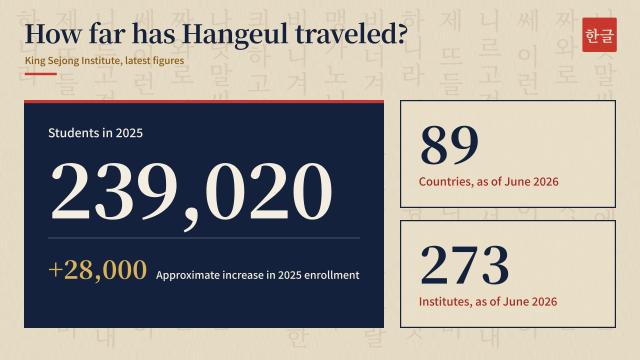
AJP FAQ : How far has Hangeul traveled ?

One measure of the international spread of Korean-language learning is the King Sejong Institute network, a government-backed system that provides Korean language and culture classes overseas. The network had expanded to 273 institutes in 89 countries as of June 2026. Enrollment reached a record 239,020 students in 2025, roughly 28,000 more than a year earlier. The growth has accompanied broader international interest in Korean culture, including music, television, film and food. But the figures should not be read as the total number of Korean learners worldwide: they cover only students enrolled through King Sejong Institutes and exclude universities, schools, private academies and independent learners. This also measures the spread of Korean-language education, rather than Hangeul alone. Hangeul is the writing system; Korean is the language being taught.

KOSDAQ cybersecurity stocks surge as bank hacks raise AI attack concerns

SEOUL, October 6 (AJP)— South Korean cybersecurity stocks surged Tuesday as a series of attacks on financial institutions and concerns over the possible use of artificial intelligence (AI) in hacking fueled expectations for stronger security spending. AhnLab, one of the country’s largest cybersecurity companies, which provides software and services to protect computers, networks and cloud systems, jumped 15.58 percent to close at 89,000 won ($65.50) on the junior KOSDAQ. Genians, another cybersecurity company that helps businesses control network access and detect cyber threats, climbed 20.83 percent to 24,650 won. Both stocks hit their highest levels of 2026. Some names posted even sharper gains. SANDS Lab, which develops AI-based cyber threat intelligence and security technologies, surged 29.99 percent to 8,970 won, while RaonSecure, an IT security and digital authentication provider, jumped 29.98 percent to 14,870 won. Both stocks hit the daily upper limit. The broader cybersecurity sector also advanced. Fasoo AI, a data security company, rose 15.60 percent. SGA Solutions, which provides system and cloud security services, gained 15.61 percent. Monitorapp, a web and network security company, advanced 11.23 percent, while X-Gate, which specializes in VPNs and firewalls, climbed 9.10 percent. The rally followed a series of cyberattacks on major banks in the country, including Shinhan Bank, KB Kookmin Bank and Hana Bank. The breaches exposed personal information of at least 25,935 customers and employees through support systems, while the banks' main internet and mobile banking transaction systems were not compromised. Concerns intensified after President Lee Jae Myung said Tuesday that AI appeared to have been used in the attacks. Financial authorities were examining whether AI tools helped automate parts of the hacking, although they had not identified a specific tool or specified exactly how it may have been used. Investors are looking at whether the attacks could prompt broader cybersecurity spending beyond the financial sector, including at public institutions and private companies. Demand for security solutions could grow further if AI-assisted cyberattacks become more widespread and companies seek to strengthen existing defenses.

AJP FAQ : How was Hangeul created ?

Before Hangeul, Koreans primarily relied on Chinese characters for written communication. Because the system did not match the structure of spoken Korean and was difficult for ordinary people to master, King Sejong sought a writing system that could be learned more easily. He completed the new script in 1443. Some Confucian officials, including Choe Manri, opposed it, arguing that Korea should continue using the Chinese literary tradition. Despite the resistance, Hunminjeongeum was promulgated in 1446 together with explanatory material describing how the letters worked. The original system contained 28 letters, 17 consonants and 11 vowels. Modern Hangeul uses 24 basic letters. Several basic consonant forms were designed with reference to the speech organs used to produce their sounds, while the original vowel system drew on symbols representing heaven, earth and humans.

AJP FAQ : What is Hangeul Day ?

Hangeul Day, observed every Oct. 9 in South Korea, commemorates the creation and promulgation of Hangeul, the writing system used for the Korean language. King Sejong completed the new script in 1443, and Hunminjeongeum, the document introducing and explaining it, was promulgated in 1446. The modern observance began in 1926 as Gagyanal, or “Gagya Day,” and was renamed Hangeul Day two years later. Oct. 9 became the commemorative date after Korea’s liberation in 1945. Hangeul Day was designated one of Korea’s national celebration days in 2005, and its status as a public holiday was restored in 2013. The date marks the promulgation of Hunminjeongeum, rather than a precisely documented day on which Hangeul itself was invented.

Korean won holds firm — for now — as US investment pledge turns into payments

SEOUL, October 6 (AJP) — South Korea has begun wiring funds to the United States under its $200 billion investment commitment in exchange for tariff relief, testing its ability to finance the pledge without unsettling the won. The currency held firm Tuesday, closing 0.4 won stronger at 1,343.6 per dollar despite signs that preparations for the investment program were beginning to affect foreign-exchange reserves. Deputy Prime Minister and Finance Minister Lee Hyoung Il told a parliamentary audit hearing that the government transferred $2.4 billion on Oct. 1 for a gas-fired power project in Texas. A further advance payment of up to $10 billion for U.S. nuclear projects by year-end would require commercial-viability checks and completion of domestic legal procedures, he said. The bilateral framework caps strategic investment at $20 billion annually and allows Seoul to seek adjustments to payment timing and amounts depending on foreign-exchange conditions. The first transfer comes as the Bank of Korea reported a $1.72 billion decline in September reserves to $440.56 billion. The central bank cited lower foreign-currency deposits, valuation effects and asset entrustment to the Korea-U.S. Strategic Investment Corporation. It was the first time the corporation’s asset entrustment had appeared among the factors affecting monthly reserves. Investment income partly offset the decline, the BOK said, without disclosing the amount. No specific size or timetable has been set for further entrustments. The September figures exclude the Oct. 1 payment. They nevertheless show that preparations for U.S.-bound investment were already affecting Korea’s official foreign assets before the first transfer. For the won, the immediate question is how much of that investment requires fresh dollar buying. Exporter dollar sales, particularly by chipmakers, helped the currency withstand a firmer global dollar, foreign equity outflows and concerns over the investment pledge. Funding the initial transfer with existing foreign assets also limited the need for immediate dollar purchases in Seoul’s spot market. Kim Jung-sik, an economics professor at Yonsei University, told AJP that future currency pressure would depend heavily on how the government raises the money. Issuing won-denominated bonds and converting the proceeds into dollars would put more immediate depreciation pressure on the won, he said. Borrowing dollars overseas could ease that pressure by avoiding equivalent purchases in the domestic market. “The immediate impact would be limited, and the risk would be lower than if won-denominated bonds were used, but it could still be viewed as a potential risk later,” Kim said. Overseas borrowing would shift part of the burden into foreign-currency liabilities that must eventually be serviced in dollars. Expectations could also move the market before any transaction takes place. “Even expectations that the government will buy dollars in the future can put upward pressure on the exchange rate,” he said. Citi has similarly assessed the near-term currency impact as limited, citing plans to use foreign-reserve investment income and government-guaranteed foreign-currency bonds. Kim Jin-wook, Citi’s chief economist, said Korea’s large structural current-account surplus should provide longer-term support for the won even as the U.S. investment program generates capital outflows. That surplus does not automatically become dollar supply in Seoul’s currency market, however. Exporters may retain their earnings abroad or reinvest them overseas. The longer-term test is therefore how repeated funding requests will be met. Reserve income and existing foreign assets can reduce immediate dollar demand, while offshore borrowing creates future repayment obligations. Further payments are also conditional. Beyond the commercial and legal requirements for the proposed nuclear investment, participation in an Alaska liquefied natural gas project remains under review. The won has absorbed the first transfer. Its resilience as payments accumulate will depend on whether dollar inflows and funding arrangements can keep pace without placing sustained pressure on reserves or adding substantially to Korea’s foreign-currency debt. AJP Takeaways - South Korea transferred its first $2.4 billion under the U.S. investment program on Oct. 1, while September reserve data separately showed U.S.-investment-related asset entrustment for the first time. - The won closed 0.4 won stronger at 1,343.6 per dollar as exporter dollar sales and the use of existing foreign assets limited immediate demand for dollars in Seoul’s spot market. - Future FX pressure will depend on how subsequent investments are funded, with offshore borrowing reducing near-term spot-market demand but creating foreign-currency liabilities and future repayment needs.

AJP FAQ: Who is King Sejong ?

King Sejong, who ruled Joseon from 1418 to 1450, is best known for overseeing the creation of Hangeul, but his reign was also marked by efforts to expand scientific knowledge and make practical information more accessible. His government supported work on astronomical instruments, clocks and rainfall measurement, while scholars compiled Nongsa jikseol, an agricultural manual based on farming conditions in Korea. Sejong also strengthened the Hall of Worthies, a royal research institution whose scholars worked on language, history, science and state affairs. Hangeul remains his most enduring legacy. The script was intended to give people who could not master classical Chinese a more accessible way to read and write their own language.

South Korean Minister Denies Allegations of Forcibly Sending North Korean Defectors Back

South Korean Minister of Foreign Affairs Jo Hyun stated on October 6 that allegations suggesting the Lee Jae-myung administration intends to forcibly send North Korean soldiers, recently returned from Ukraine, back to North Korea are "unimaginable."During a National Assembly audit session, Jo expressed, "Hearing such statements in the National Assembly makes me acutely aware of how free our Republic of Korea is." He added, "The claim that we would send back defectors, whom we have brought home after over a year of effort, seems far-fetched."Lawmaker Park Chung-kwon of the People Power Party questioned Jo, stating, "Kim Jong-un is aware that North Korean soldiers are coming to South Korea," and suggested that the Lee administration's acknowledgment of the defectors' return to Ukraine might be an attempt to conceal the situation. He raised concerns that this could lead to anger directed at Ukraine on behalf of Kim Jong-un.Park further argued, "If the fact that North Korean soldiers have come to South Korea is made known, it could encourage additional defections from the North." He also expressed suspicions that the government might be considering using the defectors as bargaining chips in negotiations with Kim Jong-un, referencing a precedent where two North Korean fishermen were forcibly repatriated in 2019, with an appeals process currently underway.* This article has been translated by AI.

Financial Supervisory Service Accelerates Investigation into Shinhan Bank Data Breach

The Financial Supervisory Service (FSS) has expedited its investigation into a data breach at Shinhan Bank, transitioning from an initial on-site inspection scheduled to conclude by the 20th to a full-scale examination. This shift aims to assess potential regulatory violations and internal control responsibilities following the incident.As of today, the FSS has commenced its on-site inspection related to the Shinhan Bank data breach. Following the incident, the FSS deployed inspection personnel to determine the extent of the data leak, the method of external intrusion, and the circumstances surrounding the breach.Originally, the on-site inspection was set to continue until the 20th, but the FSS has moved up the timeline to facilitate a quicker resolution regarding the causes of the incident and the responsibilities of the financial institution, especially in light of recent similar breaches in the financial sector and ongoing police investigations.The on-site inspection focuses on understanding the facts surrounding the incident and system vulnerabilities, while the full-scale examination will officially investigate any regulatory violations and the adequacy of internal controls. If any illegal or improper actions are identified during the inspection, it could lead to subsequent sanctions.The FSS is expected to scrutinize whether the access processes and authentication procedures for external unauthorized users were properly managed, as well as whether access controls for personal and credit information functioned effectively. The adequacy of the reporting and response processes following the incident may also be included in the inspection scope.It has been confirmed that unauthorized external individuals accessed customer information by bypassing authentication procedures for certain services at Shinhan Bank. To date, approximately 25,000 individuals' names, phone numbers, CI, annual income, and calculated limits have been identified as compromised.Based on the results of the on-site inspection, the FSS plans to determine any violations of relevant regulations and the extent of Shinhan Bank's responsibility.* This article has been translated by AI.

Ueda: Core Inflation Approaches 2% as Further Rate Hikes Continue

Bank of Japan (BOJ) Governor Kazuo Ueda reaffirmed that while core inflation is nearing the target of 2%, the financial environment remains accommodative, indicating that further interest rate hikes will continue. However, he did not specify the exact timing or pace of these hikes, stating that decisions will be made based on the likelihood of achieving the BOJ's economic and inflation forecasts and assessing risk factors.In remarks at the National Securities Conference on October 6, Ueda said, "We will continue to raise policy interest rates and adjust the degree of monetary easing based on economic, price, and financial conditions." He emphasized that stabilizing core inflation around 2% has become more important than before, explaining that the risk of core inflation exceeding 2% could negatively impact the economy.Regarding the Japanese economy, Ueda noted some sluggish trends due to the situation in the Middle East but assessed that a gradual recovery is underway. He explained that exports have begun to rise again, driven by increased global demand for artificial intelligence (AI), and corporate profits remain at a high level. The business sentiment index from the September Tankan survey, released on October 1, was also rated as "good." While equipment investment is affected by rising construction costs, it continues to grow. Personal consumption, although still somewhat weak, shows a solid trend due to improvements in employment and income conditions.Ueda also identified ongoing inflationary pressures, citing rising oil prices, a weaker yen, and expanding AI-related demand, which have led to sustained increases in corporate prices. He noted that these pressures are beginning to translate into consumer prices, with movements to reflect wage increases in selling prices continuing. He assessed that medium- to long-term inflation expectations are rising and that the core inflation rate is approaching 2%. He stated that the trends in the Japanese economy and prices are generally in line with the forecasts presented in the BOJ's economic and price outlook report.Ueda pointed out risk factors surrounding economic and price forecasts, including the situation in the Middle East, the expansion of AI-related demand, and exchange rate fluctuations. He emphasized the need to closely monitor the impact of these factors on the Japanese economy and prices, warning that there is a risk of core inflation exceeding the 2% target.Following the interest rate hike to 1.25% in September, Ueda stated, "The accommodative financial environment will continue to firmly support economic activity." He added, "We will appropriately manage monetary policy from the perspective of achieving the 2% price stability target in a sustainable and stable manner."The BOJ is set to hold a monetary policy meeting on October 29-30 to discuss the possibility of further interest rate hikes.* This article has been translated by AI.