


Latest by
-
 Elderly Woman Repays 48-Year-Old Debt with Cash Gift at Yeongdeungpo Station At Yeongdeungpo Station, staff members expressed their gratitude through letters posted on the bulletin board for an elderly woman who returned to repay a long-standing debt. Nearly 48 years ago, she was unable to purchase a train ticket for her young son, and on August 26, she visited the station to deliver a cash envelope containing 5 million won.According to a representative from Korea Railroad Corporation's Western Metropolitan Headquarters, the woman, in her 80s, presented a handwritten letter along with the cash to a station employee around 11 a.m. on that day.The story dates back to October 1978, when the grandmother, facing financial difficulties, could not afford a ticket for her son to travel from Jeongeup, North Jeolla Province, to Yeongdeungpo, Seoul. The stationmaster allowed them to board the train without collecting the fare of 500 won.After nearly five decades, the grandmother returned to Yeongdeungpo Station with an envelope bearing her son's name and insisted on making the payment. Despite the staff's repeated refusals, they ultimately accepted her gesture.Following her departure, the station employees responded with a letter titled 'To the Grandmother from Nangok-dong.' The letter expressed their commitment to remember her kindness and to approach customers with the same warmth she demonstrated.A representative from the Korea Railroad Corporation's Western Metropolitan Headquarters noted, "The staff initially insisted they could not accept the money, but the grandmother was adamant about wanting to give it to Yeongdeungpo Station. In the end, we had no choice but to accept it, and it has been categorized as 'other income.'"He added, "Beyond the monetary value, it was a moment to reflect on the warmth of the human spirit. This incident has inspired all railway staff to strive for better service while maintaining that same spirit of kindness." 2026-09-14 14:32:00
 -
Concerns Grow as Launch of Public Prosecution Office Approaches The launch of the Public Prosecution Office is less than 20 days away, yet discussions surrounding its organization and personnel have returned to square one. President Lee Jae-myung directed revisions and enhancements to the proposed structure of the office shortly after returning from a state visit to France on September 10. He deemed the name 'Judicial Control Department' for the organization reviewing non-prosecution cases as inappropriate and suggested that the proposed quota of 2,292 prosecutors is excessive. Following this directive, the ruling party is considering renaming it to 'Non-Prosecution Case Review Department' and reducing the number of prosecutors.The Public Prosecution Office is set to open on October 2, marking a fundamental shift in the criminal justice system, including the complete separation of investigation and prosecution, the dismantling of the prosecution office, and the elimination of direct investigative powers. However, the current situation raises concerns. A committee to recommend candidates for the inaugural chief of the Public Prosecution Office has yet to be formed. Considering the National Assembly's confirmation hearing, it appears the office will launch without a leader. Additionally, the newly established Serious Crimes Investigation Agency lacks basic infrastructure, such as a building and investigative computer network.More serious issues are emerging, particularly the legal gaps evident throughout the criminal justice system.Prosecutor Ahn Mi-hyun, deputy chief prosecutor at the Daejeon District Prosecutors' Office, highlighted a significant concern. When a suspect is arrested by the police, they must be transferred to a prosecutor within a maximum of 10 days. The prosecutor then has a limited period (up to 20 days) to decide whether to file charges. Ahn shared past instances where the police's arrest led to wrongful detention, which was later rectified through supplementary investigations. However, the elimination of prosecutors' supplementary investigation authority has blocked their ability to directly investigate and correct police errors.The same issue applies to wanted cases. When a suspect, previously sought by the prosecution, is apprehended by the police, the prosecution must decide on their custody within 48 hours. During the time it takes to request supplementary investigations and exchange records with the police, the suspect could be released. There are also concerns regarding detention locations. Ahn pointed out that if a suspect is moved to a police station's detention center for continued custody, citing the prosecutor's inability to investigate, it could raise legal issues.The Criminal Procedure Act is not a political declaration. It is a procedural law that specifically regulates the rights of investigative bodies (police, Serious Crimes Investigation Agency), prosecutorial bodies (Public Prosecution Office), judicial bodies (courts), as well as the rights of suspects and victims. If this procedure is flawed, justice cannot be achieved. Delays in investigations could allow criminals to escape, while wrongfully detained individuals may remain imprisoned longer.Yet, the current focus of the political arena is on the four-character name 'Judicial Control Department.' The goal of prosecutorial reform should not merely be to reduce the number of prosecutors. The aim must be to appropriately distribute the state's coercive investigative powers and create checks and balances to protect the 'fundamental rights of the people.'What is needed now is a clear direction. With only a few weeks until the launch of the Public Prosecution Office, it is crucial not to give the impression that the organization and personnel are being hastily revised in response to the demands of a strong support base. The destination must be clearly defined: 'What kind of criminal justice system do the people need?' 2026-09-14 14:32:00
-
Shift in Banking Workforce: Fewer Full-Time Employees, More Temporary Workers The banking sector is witnessing a notable shift in its workforce structure, with a decrease in full-time employees and an increase in temporary workers. As online banking becomes more prevalent, banks are reducing their physical presence and hiring fewer new employees, while filling specific roles with temporary staff.According to the financial sector on September 14, the four major banks in South Korea—KB Kookmin, Shinhan, Hana, and Woori—reported that their full-time workforce stood at 46,599 in the first half of this year, down 3.3% (1,572 employees) from the same period last year (48,171). This marks a 12.5% (6,676 employees) decrease compared to the first half of 2021.The decline in full-time positions is attributed to natural attrition from voluntary retirements and a reduction in new hires. The banks are not replacing retirees with large-scale recruitment as they did in the past, leading to a continuous decrease in full-time staff.New hiring at the four major banks fell from 1,880 in 2023 to 1,280 last year, a 31.9% (600 employees) drop over two years. In the first half of this year, they hired only 485 employees, an 18.5% decrease from the same period last year (595 employees).This reduction in hiring is influenced by changing consumer behaviors in finance. With the rise of internet and mobile banking, the need for a large number of staff at physical branches has diminished. The number of domestic branches for the four major banks decreased from 3,303 at the end of 2020 to 2,688 at the end of last year, an 18.6% (615 branches) decline over five years. The number of offline financial touchpoints, such as ATMs, is also decreasing.In contrast to the decline in full-time positions, the number of temporary workers has surged. The four major banks employed 6,552 temporary workers in the first half of this year, up 53.3% (2,277 employees) from 4,275 in the first half of 2021. Notably, this represents a 16.5% increase (929 employees) compared to the same period last year, a significant rise from the 240-employee increase seen in the first half of last year.The proportion of temporary workers within the total workforce has also increased. The share of temporary employees among the combined total of full-time and temporary workers rose from 7.4% in the first half of 2021 to 12.3% in the first half of this year. During the same period, the overall workforce decreased from 57,550 to 53,151, a 7.6% decline, while the number of temporary workers increased.KB Kookmin Bank has the highest proportion of temporary workers at 17.3% among the four major banks. This trend reflects a shift towards greater flexibility in workforce management, as banks reduce regular staff while hiring temporary workers for specific tasks such as internal controls and specialized roles.However, the increase in temporary workers should not be viewed merely as a replacement for full-time positions. Banks are increasingly re-hiring retired employees with relevant experience as temporary workers or securing specialized personnel for specific projects. While the rise of online banking has led to a reduction in full-time and overall staff, the increase in temporary workers is a response to the demand for flexible utilization of necessary skills and expertise.A banking industry official stated, “As offline branches decrease and digital and artificial intelligence technologies supplement repetitive tasks that previously required more human labor, there is a reduction in workforce demand. However, the trend of hiring temporary workers for specific tasks, including re-hiring retired employees for internal controls, is on the rise.” 2026-09-14 14:28:10
-
Yeosu World Island Expo: Beyond Attendance, Can Yeosu Shape the Future of Islands? The success of the 2026 Yeosu World Island Expo should not be judged solely by attendance numbers.The theme of the expo is 'Islands, Connecting the Sea and the Future.'Yeosu is home to 365 islands. This expo should serve as a starting point to transform the islands, previously overshadowed by land tourism, into a new pillar of Yeosu tourism, rather than just a one-time event that attracts visitors to exhibition halls in the Jindo area.The direct budget for the expo is reported to be 71.3 billion won, comprising 6.4 billion won from the national government, 15.3 billion won from the provincial government, 37.6 billion won from the city, and 12 billion won from business revenues. Including related projects such as road maintenance and tourism and cultural programs, the total budget is expected to be even larger.Given the significant public funds involved, critical scrutiny is warranted.□ Aiming for 3 million visitors: A realistic perspective is neededThe organizing committee has set a target of 3 million visitors. However, only 41,446 people attended in the first three days, raising concerns about the initial turnout. The average daily attendance of about 13,800 falls significantly short of the numbers needed to reach the 3 million goal.Thus, using the term 'successful event' at this stage may be premature.Conversely, declaring the expo a 'failure' just a week after its opening would also be excessive.In response to early criticisms, the organizing committee has enhanced performances and experiential programs, with reports indicating a shift in the atmosphere by the second weekend. Following a weekly concert on the 12th, cooking shows, traditional performances, dance, and creative dance dramas on the 13th have been implemented to increase visitor engagement.It is essential to recognize both the initial missteps and the ongoing adjustments being made on-site.□ The expo is more than just the main venueA more pressing issue lies outside the main venue.Promotional materials for the expo describe Geodo and Geomundo as 'Slow Healing Islands' and 'Emotional Trekking Islands,' respectively.On Geodo, activities such as camping, art exhibitions, wellness programs, and island spot tours are being offered, while Geomundo connects trekking with island tourism. The organizing committee is also running programs to move visitors from the main venue to the actual islands.During the expo, shuttle buses will operate 30 on weekdays and 45 on weekends, with plans to increase to 60 on busy weekends and up to 100 reserve vehicles if necessary. A total of 11 routes connecting the mainland and islands have been established.Ultimately, the key to success lies in how effectively the expo can move visitors from the venue to the islands. If attendees leave Yeosu after just a few hours at the exhibition hall, the term 'Island Expo' may fall short of its promise.Conversely, if the expo encourages visitors to spend a night on Geodo, hike the trails of Geomundo, enjoy meals prepared by local residents, and return to Yeosu, the 61-day event could have lasting benefits.□ Criticism should be turned into an asset for the expoThe organizing committee's response strategy is also noteworthy.In response to early media reports regarding content issues related to the theme islands, the future island content, and operational problems on Geodo, the committee released official explanations.Regarding the vessels at Gukdong Port, the committee clarified that they are not simply abandoned waste but are subject to preservation and seizure measures, making their removal difficult. They also stated that the Geodo camping site operates with 68 sites and that the grassy area is an open relaxation space, not a permanent program area.However, not all controversies have been resolved.From the visitor's perspective, aesthetics and convenience take precedence over legal explanations. Even if the administrative agency's explanations are accurate, if tourists at an international event feel inconvenienced or find the attractions lacking, that remains a problem the expo must address.Instead of merely countering criticisms, the focus should be on making tangible changes on-site.In this regard, the immediate expansion of performances and experiential programs to increase visitor engagement is commendable.□ The real test begins after November 4The expo concludes on November 4.However, Yeosu's islands will not disappear that day.In fact, the true evaluation of the expo will begin after that date.While the number of attendees during the event is important, it is equally crucial to assess how many tourists return to Yeosu's islands, including Geodo and Geomundo, after the expo, the changes in residents' income and employment, and the improvements in transportation and tourism infrastructure.On the weekend of the 13th, the Yeosu World Island Expo presented a scene that was difficult to describe solely based on the online impressions from its opening.Visitors were engaged, performances were lively, and staff and volunteers filled the venue.However, the focus now is on what comes next.Rather than relying on free and group visitors to meet the 3 million target, the expo should leave tourists asking, 'Did Yeosu really have such islands?'Among the 365 islands, those highlighted in brochures—Geodo, Nango, Sado, Geomundo, Geomundo, Yeondo, Hahwado, Sonjukdo, Ando, Daeyeojado, Jobaldo, and Chodo—each with unique landscapes and stories, must continue to attract visitors even after the expo.That is more important than the title of being the world's first.Will the 71 billion won expo conclude as a 61-day festival, or will it serve as a starting point to connect Yeosu's 365 islands as new tourism assets?The answer remains to be seen.The true evaluation of the Yeosu World Island Expo will not begin with the closing ceremony on November 4, but rather from that point onward.* This article has been translated by AI. 2026-09-14 14:28:00
-
Arco Highlights Franco Mancuso Oral History as a Case of Korean-Italian Cultural Exchange The connection between Korea and Italy, established over 30 years ago during the construction of the Korean Pavilion at the Venice Biennale, was revisited through records.The Korea Arts and Culture Education Service (Arco) presented the 'Franco Mancuso Oral History' during a book talk titled 'Italy? Books! - Italians Encountering Korea' at the Italian Embassy in Korea on September 11.The event featured a book talk program where Korean authors introduced Italian culture, aimed at expanding cultural exchanges and understanding between the two countries.Professor Jeon Jin-young, an honorary professor at Myongji University and a key researcher for the Mancuso oral history, shared insights on the academic and cultural significance of the records. Holding qualifications in both Korean and Italian architectural history, Professor Jeon is a leading scholar in promoting Italy's urban and architectural culture in Korea. He detailed the architectural considerations and the meaning of cooperation between the two countries as expressed in Mancuso's oral history.The Korean Pavilion, completed in 1995, is a remarkable achievement that overcame numerous challenges, including local cultural administration in Venice and strict building regulations. Mancuso (1937-) is the only surviving architect who co-designed the pavilion with Kim Seok-cheol (1943-2016) and can testify to the circumstances of that time.In this context, the Arco Art Archive recorded Mancuso's experiences from the 1990s during the construction of the Korean Pavilion and published the oral history book titled 'Research on the Opening and Operation of the Korean Pavilion at the Venice Biennale II: Construction and Remodeling Plans' in 2025.The Italian Embassy in Korea provided diplomatic support from the early 1990s, advocating for the necessity of the Korean Pavilion's construction to its home country. Due to this connection, Emilia Gatto, the Italian Ambassador to Korea, personally wrote the preface for Mancuso's oral history.During the event, Ambassador Gatto remarked, "The work highlighting the history of the construction and operation of the Korean Pavilion by Arco holds special value. It serves as a meaningful example of how memories of Korean-Italian cultural cooperation can be passed on to future generations, creating a new bridge between the two cultures."Additionally, the exhibition 'One Table: 7. PAPER TO SPACE, Korean Pavilion' will be held at the Arco Art Archive's headquarters in Seocho-dong until November 30. This exhibition is based on the collection of the Korean Pavilion and materials donated by Mancuso. Visitors will be able to see the negotiation processes between the two countries surrounding the pavilion's construction, as well as the architectural considerations involved in completing the space.Commissioner Lee Beom-hun stated, "It is very meaningful that the oral history book of Mancuso, which captures the history of the Korean Pavilion's construction at the Venice Biennale, shines as a representative case of cultural exchange between the two countries. I hope many people will encounter the value of Korean-Italian cultural cooperation that transcends time and space through the One Table exhibition, which is based on the collection and materials established by the Arco Art Archive."Arco plans to continue strengthening the recording and preservation of cultural and artistic assets and to pursue various domestic and international cooperation projects utilizing these resources.Mancuso is an architect and urban design researcher who taught at IUAV in Venice and co-designed the Korean Pavilion, which opened in 1995, with the late Kim Seok-cheol. The two developed their design through sketches and plans exchanged via fax between Seoul and Venice from 1993 to 1995, making several revisions during discussions with local permitting authorities in Venice.* This article has been translated by AI. 2026-09-14 14:28:00
-
South Korea Men's Volleyball Team Secures Third Place at Asian Championship, Qualifies for World Cup The South Korea men's volleyball team finished third at the 2026 Asian Championship, securing a spot in the 2027 FIVB World Cup.Under the guidance of Brazilian coach Isanaye Ramirez, South Korea (ranked 24th in the world) triumphed over Australia (ranked 38th) in the third-place match held on September 13 at the Kitakyushu City Gymnasium in Japan, winning 3-2 (16-25, 25-18, 22-25, 25-18, 15-9).After losing to Japan in the semifinals the previous day, this victory marked South Korea's return to the top three in the Asian Championship for the first time since 2017. Additionally, the top three teams in the tournament earned direct tickets to the 2027 FIVB Men's Volleyball World Cup.Star player Heo Soo-bong (Hyundai Capital) led the team with 28 points, the highest of any player in the match. Lim Sung-jin (Army Sports Corps) contributed 15 points, while Lim Dong-hyuk (Korean Air) scored 10 points before leaving the court due to back pain in the middle of the fourth set. Park Chang-seong (OK Savings Bank) and Lee Sang-hyun (Army Sports Corps) added 9 and 8 points, respectively.The tournament also highlighted individual achievements for South Korean players. Heo Soo-bong finished as the top scorer with a total of 113 points. He also ranked second in service points (10) and second in receptions (34), showcasing his all-around performance. Libero Park Kyung-min (Hyundai Capital) recorded the most digs (49) and was awarded the Best Libero of the tournament.With the World Cup qualification secured, South Korea continues to aim for a spot in the 2028 Los Angeles Olympics. The men's volleyball team has not participated in the Olympics since the 2000 Sydney Games and will seek to qualify through their performance in next year's World Cup and future ranking points.The Olympic tournament will feature 12 teams, including five continental championship winners, the top three teams from the 2027 World Cup, the host nation, the United States, and the top three teams based on world rankings.Following a successful tournament, the team will return home for a brief regrouping before heading to Nagoya, Japan, for the 2026 Asian Games, which begin on September 24, where they will continue their quest for medals.* This article has been translated by AI. 2026-09-14 14:24:00
-
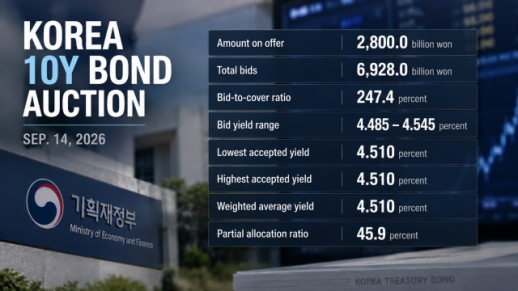 Korea's bond offering draws 2.5 times bigger bids despite rising yields SEOUL, Sept. 14 (AJP) — South Korea's 10-year government bond offering drew bids worth nearly 2.5 times the amount on offer despite yields hovering near multi-year highs. Bids totaled 6.928 trillion won for 2.8 trillion won ($2.1 billion) of 10-year government bonds offered, equivalent to 247.4 percent of the planned sale, according to the Ministry of Economy and Finance. The offering was sold at a weighted average yield of 4.510 percent, slightly below the benchmark 10-year government bond yield of 4.540 percent at the close on Friday and above the 4.415 percent recorded at the previous 10-year auction in August, reflecting the sharp rise in domestic bond yields over the past month. Bid coverage, however, improved from the previous sale. The August auction received 7.156 trillion won of bids for 3 trillion won offered, equivalent to 238.5 percent of the planned issuance. The coverage ratio was 8.9 percentage points higher than in August, although the absolute amount of bids declined as the offering size was reduced. Bids ranged from 4.485 percent to 4.545 percent, while both the lowest and highest accepted yields were set at 4.510 percent. The partial allocation ratio at the cutoff yield was 45.9 percent. The auction followed a sharp selloff in the domestic bond market last week, with the benchmark 10-year government bond yield ending Friday at 4.540 percent after rising 8.7 basis points in a single session. The rise in yields has come amid higher global bond rates and renewed inflation concerns driven by elevated crude oil prices. The latest sale nevertheless showed resilient demand for Korean government bonds, with the government placing the full amount offered despite sharply higher borrowing costs than at the previous auction. The 10-year bonds carry a 4.25 percent coupon and mature in June 2036. AJP Takeaways - South Korea's 10-year government bond auction received 6.928 trillion won of bids for 2.8 trillion won offered, producing bid coverage of 247.4 percent. - Bid coverage improved from 238.5 percent in August even as the weighted average auction yield rose 9.5 basis points to 4.510 percent. - The government awarded the full 2.8 trillion won despite elevated bond yields, although absolute bids declined from August as the offering size was reduced. 2026-09-14 14:21:02
 -
KB Financial Group to Conduct Regular Inspection of KB Kookmin Card 금융당국이 KB금융그룹과 KB국민은행에 이어 KB국민카드 정기검사에 나선다. 롯데카드 해킹 사고 이후 보안 체계를 제대로 갖췄는지 점검하고 소비자 보호 관련 규정이나 법 등을 준수했는지 중점적으로 살펴볼 예정이다. 14일 금융권에 따르면 금감원은 내달 KB국민카드 정기검사를 위해 국민카드에 사전자료 제출을 요구했다. 국민카드에 대한 정기검사는 2020년 이후 처음이다. 금감원은 소비자보호와 내부통제, 건전성 등 경영 전반을 폭넓게 들여다볼 것으로 예상된다. 이사회의 독립성과 최고경영자(CEO) 선임 절차의 공정성·투명성 등 지배구조 모범관행 이행 여부도 주요 검사 대상에 포함될 것으로 보인다. 특히 금감원은 이번 정기검사에서 금융소비자보호 관련 검사반을 별도로 편성하는 방안을 검토하고 있다. 통상 금감원은 정기검사를 실시할 때 경영 실태 전반을 살피는 총괄 조직 등 3~5개 검사반을 편성한다. 올해는 소비자보호 검사반을 별도로 투입해 금융소비자보호법 등 관련 법규 준수 여부를 집중적으로 살피는 방안을 염두에 두고 있다. 카드론과 현금서비스를 취급하는 과정에서 금리·한도와 주요 계약조건을 고객에게 제대로 설명했는지, 광고와 민원 처리 및 취약차주 보호 등에 문제가 없었는지 등을 들여다볼 가능성이 있다. KB국민카드의 정보보호 체계도 주요 점검 대상이 될 전망이다. 앞서 금감원은 지난해 롯데카드 해킹 사고와 관련해 수시검사와 정기검사를 진행했다. 같은 해 말에는 가맹점 대표의 휴대전화번호와 생년월일, 성명 등 개인정보 약 19만건이 유출된 신한카드에 대해서도 현장검사에 착수했다. 이후 금감원은 유사한 보안 취약점이 존재하는지 확인하기 위해 국민카드를 포함한 8개 전업카드사(삼성·신한·KB국민·현대·롯데·하나·우리·비씨카드)를 대상으로 보안 실태를 점검했다. 금융당국은 당시 금융회사가 새로운 전산 프로그램을 적용하면서 충분한 테스트를 거치지 않아 사고가 발생히먄 전자금융거래법과 신용정보법 등에 따라 과태료나 과징금을 부과할 수 있다고 경고했다. 이번 정기검사에서도 전산 프로그램의 개발·변경 절차와 개인정보 접근 권한 관리, 정보유출 방지 체계 등을 살펴볼 것으로 예상된다. 국민카드의 건전성 지표는 개선세를 나타내고 있다. 회사의 올해 상반기 연체율은 1.07%로 전년 동기보다 0.33%포인트 하락했다. 같은 기간 고정이하여신(NPL) 비율도 1.08%에서 0.94%로 0.14%포인트 낮아졌다. 반면 소비자보호 부문에서는 일부 지표가 악화했다. 국민카드의 올해 상반기 민원은 265건으로 전년 동기보다 40% 증가했다. 단순 건수 기준으로 4대 카드사(삼성·신한·현대·KB국민카드) 가운데 신한카드(321건)에 이어 두 번째로 많았다. 금융소비자보호 실태평가에서도 일부 항목의 등급이 낮아졌다. 국민카드는 금융사고 및 휴면금융자산 찾기, 금융상품 개발 단계에서 준수해야 할 기준과 절차, 임직원 금융소비자보호 교육 및 보상체계 운영 등 평가등급이 2022년 ‘양호’에서 2025년 ‘보통’으로 하락했다. 금융권 관계자는 “소비자보호를 최우선 과제로 두고 이와 연계된 건전성과 정보보호 체계 등을 유심히 들여다볼 것으로 보인다”고 말했다. 2026-09-14 14:20:11
-
LG Chem Expands Semiconductor Cleaning Material Production in China LG Chem is enhancing its collaboration to target the global semiconductor market by establishing a local supply chain for ultra-pure isopropyl alcohol (IPA), a key cleaning material for semiconductors.On September 14, LG Chem signed a memorandum of understanding (MOU) with Jianghuawei, a leading precision chemical materials company in China, to collaborate on the ultra-pure IPA business for semiconductors. Jianghuawei produces and refines high-purity chemical materials for semiconductor and display processes, supplying them to major local semiconductor companies.Ultra-pure IPA is an essential cleaning material used repeatedly throughout the semiconductor manufacturing process. Even minute impurities can affect semiconductor performance and yield, necessitating strict quality control.HP-IPA, the product in focus, is based on C3-IPA, which LG Chem produces under a rigorous production management system to ensure stable quality competitiveness. LG Chem is a major supplier, producing 165,000 tons of high-purity, high-quality C3-IPA annually at its facility in Yeosu, South Korea, and is expanding its supply to global markets, including North America and Asia, in addition to domestic semiconductor customers.The MOU aims to combine LG Chem's C3-IPA production capabilities with Jianghuawei's refining technology to establish a local supply system for HP-IPA for semiconductor cleaning. LG Chem will supply high-purity, high-quality C3-IPA, which Jianghuawei will refine into HP-IPA for semiconductor cleaning.Both companies plan to enhance the quality competitiveness and commercialization of HP-IPA, targeting leading semiconductor customers in AI semiconductors and high-bandwidth memory (HBM). They will engage in various collaborative activities, including technology exchange, information sharing, and joint marketing.Kim Sang-min, Executive Vice President of LG Chem's Petrochemical Division, stated, "We will strengthen our supply base for ultra-pure raw materials for semiconductors based on differentiated quality competitiveness and stable supply capabilities, while also seeking new growth opportunities in the global semiconductor materials market."The MOU signing ceremony took place at Jianghuawei's facility in Zhangjiagang, Jiangsu Province, China, attended by key executives from both companies, including Xu Liheng, Vice President of Shanghai Huayi Group, and Kim Sang-min.Additionally, LG Chem has been actively pursuing the semiconductor market, recently announcing in July that it would supply semiconductor strippers to Amkor, a global semiconductor back-end company in the United States.* This article has been translated by AI. 2026-09-14 14:20:00
-
KIC China Partners with Seoul National University to Explore Opportunities in China One of China's largest international forums in the field of science and technology, the '2025 Pujiang Innovation Forum – International Technology Transfer Expo,' hosted the 'China-Korea Science and Technology Innovation Entrepreneurs Forum' on September 14 in Shanghai.The Global Innovation Center (KIC China) co-hosted the '6th China-Korea Science and Technology Innovation Entrepreneurs Forum' with the Eastern Center for National Technology Transfer and the Shanghai International Technology Exchange Market. The event aimed to showcase the technologies of Korean innovative companies and explore collaboration opportunities between the two countries.First held in 2008, the Shanghai Pujiang Innovation Forum is a national-level forum co-hosted by the Chinese Ministry of Science and Technology and the Shanghai Municipal Government. Since 2021, a separate session for Korea has been included.This year, 11 innovative Korean companies participated, including Eigen Drug, Biotic, Novomedicine, Respect, Simply Bio, Jubik, Medicare Tech, JH Global, Tiroh, Abionogen, and Phispear. Approximately 200 attendees from the governments, industries, and research institutions of both Korea and China were present.Notably, KIC China and the Seoul National University Industry-Academic Cooperation Foundation announced plans to discover outstanding technologies and research outcomes based on their agreement, aiming to promote technology transfer and commercialization. They also agreed to expand cooperation among universities, research institutions, and companies in both countries.KIC China Director Kim Jong-moon stated, 'The Pujiang Innovation Forum is an important international platform for expanding science and technology innovation and technology transfer cooperation between Korea and China. We hope this forum effectively connects the excellent technologies of Korean innovative companies with the industrial and market demands of China, further enhancing technology exchange and collaboration opportunities between companies and research institutions in both countries.'* This article has been translated by AI. 2026-09-14 14:20:00