


Latest by
-
 Song Mi-ryung: Agriculture and Rural Areas at a Crossroads, Strategy for Future in 20 Years The Ministry of Agriculture, Food and Rural Affairs is developing a long-term strategy aimed at envisioning the future of agriculture and rural areas by 2045. The plan involves gathering input from various stakeholders, including young farmers, producer and consumer groups, and private experts, to enhance agricultural competitiveness, rural development, and generational transition.On September 7, the ministry held a town hall meeting in Myeongdong, Seoul, attended by over 50 participants, including young farmers, rural entrepreneurs, students from the Korea National College of Agriculture and Fisheries, producer and consumer groups, private experts, and new public officials from the ministry.This event was organized to explore the long-term direction of agriculture and rural areas in connection with the national development strategy for 2045, which marks the 100th anniversary of Korea's liberation. The government has established a long-term national development strategy, launching the 'Korea 2045 Strategy Establishment Committee' in May.The first session of the town hall reviewed the achievements of agricultural policy over the past 80 years since liberation and the key issues currently facing agriculture and rural areas. The Korea Rural Economic Institute presented on the impact of sector-specific megatrends on the future of agriculture and rural areas, prompting open discussions among attendees.The second session focused on discussing the future of agriculture and rural areas as envisioned by the public in 2045. The ministry first outlined its future outlook and review directions. Given the deepening structural limitations of agriculture and rural areas due to changing socio-economic conditions, the strategy emphasizes enhancing agricultural competitiveness, rural development, and generational transition.Participants proposed directions for the future of agriculture and rural areas, as well as challenges that the government and the field need to address. An interactive program titled 'What is Your Choice?' allowed attendees to intuitively express and share their visions for agriculture and rural areas in 20 years.Minister Song Mi-ryung stated, "Our agriculture and rural areas face crises such as climate change and regional extinction, but they are at a significant crossroads where opportunities coexist with challenges, including advanced technologies like AI and robotics, as well as growing public interest in rural areas."She added, "It was very meaningful to hear diverse and vivid voices from the field about the future during the town hall meeting. Based on the opinions presented today, we will do our best to establish a long-term strategy for agriculture and rural areas to pass on a competitive agriculture and vibrant rural communities to future generations in 20 years."The ministry has been operating a dedicated task force for the establishment of a long-term strategy for agriculture and rural areas since June. In August and September, it is conducting a 'Public Proposal Contest' and holding idea meetings with the '2030 Youth Advisory Group' to engage with experts, the general public, and young people. The ministry plans to continue gathering input from various sectors to inform its policies.* This article has been translated by AI. 2026-09-07 17:20:00
 -
Kim Byeong-eun Promoted to Vice President at DB Insurance DB Group's Kim Byeong-eun has been promoted to vice president of DB Insurance. According to the financial sector on the 7th, Kim, who is the nephew of DB Group founder Kim Jun-ki and a cousin of Kim Nam-ho, honorary chairman of DB Group, has been appointed as the head of the management planning office at DB Insurance this month. Born in 1976, Kim joined Dongbu Fire & Marine Insurance in 2011, gaining diverse experience in corporate operations and overseas support. He became an executive in 2021 as the head of corporate marketing, was promoted to managing director in 2022, and has now ascended to vice president. Kim graduated from Seoul National University with a degree in law. He plans to utilize his background to work on board governance, internal regulations, environmental, social, and governance (ESG) issues, and organizational management. This appointment appears to be a follow-up to the recent announcement that Park Je-gwang, the former head of DB Insurance's management planning office, has been designated as the new CEO of DB Life. Park is expected to be officially appointed as CEO following the shareholders' meeting and board of directors meeting on the 16th.* This article has been translated by AI. 2026-09-07 17:20:00
-
Hanmi Global Selected as Construction Management Partner for Eunma Apartment Redevelopment Hanmi Global announced on September 7 that it has been selected as the construction management (CM/PM) partner for the redevelopment project of Eunma Apartment in Daechi-dong, Gangnam-gu, in collaboration with Heerim Architects. Eunma Apartment, completed in 1979, is one of the prominent residential complexes in the Gangnam area. The redevelopment process has attracted significant attention from the construction industry and market, having passed the integrated review for the redevelopment project in February and received project implementation approval in July. Following the approval of the management and disposal plan, as well as the relocation and demolition procedures, the goal is to commence construction in 2028. The redevelopment plans to transform the current 14-story, 4,424-unit structure into a large complex of 29 buildings, ranging from 6 underground floors to 49 above ground, totaling 5,850 units. The redevelopment association issued a bid announcement in August for the selection of a construction management partner. After a comprehensive evaluation of the three participating firms, including the Hanmi Global and Heerim consortium, based on their status and performance in redevelopment projects, the consortium was chosen as the construction management partner. Hanmi Global and Heerim will handle all aspects of pre-construction (Pre-con) construction management before the start of construction. Pre-con refers to the preliminary management tasks that assess and simulate the entire process, including cost, schedule, and quality, before the actual construction phase begins. The core of this work is to review construction costs and contract terms before the association finalizes the contract with the construction company, as well as to develop cost-saving measures. The association plans to evaluate the appropriateness of the construction costs through a specialized construction management firm and establish cost-saving strategies through value engineering (VE) and economic reviews during the design phase. Subsequently, negotiations for the final contract with the construction company will be pursued. Lee Jeong-bok, Executive Director of Hanmi Global's domestic sales, stated, “Hanmi Global aims to focus on projects that create top-tier complexes in the redevelopment sector. We will concentrate all our efforts on the successful advancement of the Eunma Apartment project, which has historically served as a barometer for redevelopment trends.”* This article has been translated by AI. 2026-09-07 17:16:10
-
South Korea and France Establish Strategic Industry Dialogue to Enhance EV and Supply Chain Cooperation South Korea and France are establishing a ministerial-level consultative body to discuss industrial, trade, supply chain, and economic security issues on a regular basis. The government aims to address trade challenges faced by South Korean companies operating in France, including issues related to electric vehicle subsidies.The Ministry of Trade, Industry and Energy announced that Minister Kim Jung-kwan met with Roland Lescure, France's Minister of Economy, Finance, Industry, Energy, and Digital Sovereignty, in Paris on September 7 (local time) during President Lee Jae-myung's visit to France. They discussed ways to enhance industrial and trade cooperation between the two countries.As a result of the meeting, the two nations agreed to establish a ministerial-level consultative channel called the 'Korea-France Strategic Industry Dialogue.' This dialogue will broadly cover industrial policies and technologies, trade and investment, supply chains, economic security, and critical minerals.Working groups for key sectors will also be set up. Through the ministerial dialogue and working groups, both countries plan to continuously identify specific industrial cooperation projects as well as address individual trade issues.Minister Kim requested improvements to the French electric vehicle subsidy system to ensure that South Korean electric vehicles are not disadvantaged. Both sides agreed to continue discussions on related issues through the working groups.Discussions were also held regarding the European Union's Industrial Acceleration Act (IAA). Minister Kim requested the French government’s attention and support to ensure that South Korea, as a key industrial partner of the EU, receives equal treatment with regional countries.Trade and investment cooperation between companies from both nations will also be expanded. On the same day, a memorandum of understanding (MOU) was signed between the Korea Trade-Investment Promotion Agency (KOTRA) and Business France, with both ministers in attendance. The two agencies will collaborate on trade and investment seminars and support startups entering each other's markets.Minister Kim also met with François Jacko, CEO of the French industrial gas company Air Liquide, to discuss plans for expanding investments in South Korea. Air Liquide is pursuing domestic business expansion after completing the acquisition of DIG Air Gas in January. CEO Jacko stated that he plans to finalize new investment plans soon.Minister Kim stated, "With the establishment of the ministerial-level Strategic Industry Dialogue, our two countries have developed a cooperative framework that allows for ongoing discussions on industrial policies, trade and investment, supply chains, and economic security, beyond just addressing individual issues. We will work to resolve trade challenges faced by our companies while continuously identifying new cooperation projects in advanced industries and supply chains."* This article has been translated by AI. 2026-09-07 17:16:00
-
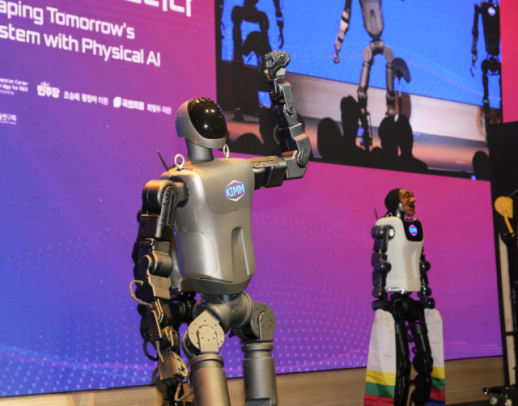 One year in, Korea's humanoid still toddles SEOUL, September 07 (AJP) - KAIROS showed off its dancing skills to a national calisthenics tune on a Seoul stage Monday, but to an audience accustomed to somersaulting and kung fu-performing Chinese humanoids, its wobbly movements and seemingly glued feet hardly drew genuine applause. The performance offered a candid look at how far South Korea has come — and how far it still has to go — little more than a year into a state-backed effort to close the humanoid gap with China and the United States. Four of the six KAIROS units on display performed. Each had to be lowered from hangers holding it upright and worked into a starting posture before it could move. "We started humanoid research a little over a year ago," said Park Dong-il, director of the Advanced Robotics Research Center at the Korea Institute of Machinery & Materials (KIMM), with a rueful smile. "We got here from nothing, on the software, hardware and AI the institute has built up over a long time." The arms came up to shoulder height and no higher. Each command took a beat to register before the machine began to move, and the joints turned as if they were dry. One unit stood in a white body with hansam on its wrists, the long white sleeves used in talchum, Korea's traditional masked dance, and slowly traced the steps on the beat. Its feet stayed almost firmly on the floor. The audience clapped through every crank and sway, almost as if coaxing the machines along. However feeble the movements looked, nobody in the hall laughed. Humanoid industry leaders are well past that stage. China's Unitree Robotics has demonstrated G1 humanoids performing coordinated kung fu routines and other highly dynamic movements, while Boston Dynamics' Atlas has performed a "Ghost Rabona" — a feint followed by a cross-legged football kick requiring the robot to leave the ground and regain its balance. KAIROS is not there yet, and Park said so plainly. The robot, whose name comes from the Greek word for a decisive or opportune moment, is KIMM's attempt to create a homegrown humanoid platform at a time when physical AI is emerging as the next global technology race. Korea's broader K-Moonshot initiative uses AI to accelerate science and technology development and includes humanoid robots among 12 national missions. The government formally launched the program this year with the goal of doubling research productivity by 2030 and achieving its key missions by 2035. KAIROS itself grew out of work launched in May 2025 by KIMM's Global TOP strategic research group for self-growing AI humanoids. The rationale is straightforward: a country confronting a shrinking workforce does not want to depend entirely on foreign humanoid platforms once robots begin moving from laboratories into factories, logistics centers and eventually homes. KAIROS stands about 170 centimeters tall, weighs roughly 80 kilograms and has 29 degrees of freedom, according to the institute. The version shown Monday is V0.7. V1 is scheduled for April 2027 and V2 for 2030. The six machines are not identical. Each carries a different combination of components, including different reducers and motors, and is designed to test a different role and set of trade-offs, Park said. "We prepared a scenario with unit zero handing me a glass of water as for my dry throat. Technical difficulties barred us from the skit toady," Park said. "Units one, two, three, four — every one of them does something different." The aborted glass-of-water demonstration underscored the size of the challenge. Walking, balancing and moving an arm are only the beginning for humanoids expected eventually to perceive their surroundings, make decisions, manipulate objects and work safely around people. Zhang Byoung-tak, a professor of computer science and engineering at Seoul National University who heads its Humanoid AI Robot Center, opened the forum by arguing that humanoid AI represents the next major wave of artificial intelligence after generative and agentic AI. Generative AI gave machines the ability to understand and produce language and images. Agentic AI moved toward systems capable of setting goals and using tools within digital environments, Zhang said. Humanoid AI takes that evolution into the physical world. It gives intelligence a body capable of perceiving, judging and acting in real environments rather than remaining behind a screen. The global race is accelerating quickly. China has built a broad humanoid hardware ecosystem backed by its enormous manufacturing supply chain, while U.S. companies are pushing advances in AI models and sophisticated robot control. Korea's researchers acknowledge they are trying to catch up rather than defending a lead. Park Chan-hoon, director of KIMM's AI Robotics Institute, has described the effort as a "humanoid one-team" bringing together roughly 20 teams including Seoul National University and LG Electronics to develop an indigenous platform. He has argued that Korea needs to master the technology from "head to toe" rather than rely on foreign systems. KAIROS is intended to become the common platform on which those technologies can be integrated and tested. Ryu Seok-hyun, president of KIMM, and Doosan Robotics Chief Executive Kim Min-pyo also spoke at Monday's event. But the clearest message came at the end of the robots' performances. The researchers who built KAIROS joined the machines on stage, bowed and asked lawmakers and government agencies in the audience for sustained support. "Humanoid development is a race against speed, and we have pulled our schedule forward as far as we can," Park Chan-hoon said. "We need at least 3 billion won ($2.2 million) budgeted, and we will answer it with results." The engineers behind him were dressed head to toe in black T-shirts and jeans. Their robots may still toddle, but their eyes were steady. AJP Takeaways - KAIROS managed a slow dance on a Seoul stage Monday, a modest display beside the acrobatics already demonstrated by Chinese and U.S. humanoids. - Korea began developing the homegrown humanoid little more than a year ago in a bid to build its own hardware, software and physical AI platform. - Researchers say speed is now critical as KAIROS moves toward V1 in 2027 and V2 in 2030. 2026-09-07 17:13:09
 -
KLPGA-Samchunri Together Dream Tournament Kicks Off in Gunsan The 'KLPGA-Samchunri Together Dream Tournament 2026,' a key event for discovering promising young talent in Korean women's golf, officially began on September 7 at the Gunsan Country Club in Jeollabuk-do.Co-hosted by Samchunri and the Korea Ladies Professional Golf Association (KLPGA), the tournament runs from September 7 to 11. This year marks the 10th edition of the event, featuring a total of 256 young golfers from across the country, including 80 middle school students and 176 high school students. The top 128 players will advance to the finals after the qualifying rounds on September 7 and 8, competing for the championship from September 9 to 11.Promising players who perform well will have opportunities to advance to the professional stage. The top three finishers in the high school division will receive exemptions from the KLPGA's junior member practical test, while the top three overall in both middle and high school divisions will be recommended for participation in the KLPGA regular tour and Dream Tour.Additionally, the organizers are covering all green fees, caddy fees, and cart fees for all players during the tournament, providing quality meals to create an environment where athletes and their guardians can focus solely on the competition.This year, in celebration of the tournament's 10th anniversary, various events have been organized for participating players. After the first round of the finals, a 'Distance Approach Challenge' event will take place. On the second day of the finals, a food truck will offer 300 servings of drinks and snacks to help players relax and recharge.Since its inception in 2015, this tournament has produced numerous star players, establishing itself as a gateway to success. Notable past winners include Kim Jae-hee (2016 middle school champion), Kim Min-joo (2017 middle school champion), Jo Ah-yeon (2017 high school champion), Kim Min-byul (2018 and 2019 middle school champion), Hong Jung-min (2019 high school champion), Lee Hyo-song (2022 middle school champion), and Seo Kyo-rim (2022 high school champion), all of whom are currently active on domestic and international stages.Samchunri is also committed to systematic player development, operating the 'Samchunri Sports Team,' which includes players like Ko Ji-woo and Ma Da-som, and the 'Samchunri Academy,' which selects and nurtures high-potential amateurs, continuously supporting their growth and contributing to the advancement of Korean women's golf.A representative from Samchunri stated, "In the future, the Samchunri Group plans to continue supporting junior players through the 'KLPGA-Samchunri Together Dream Tournament' so they can discover their potential and leap to greater stages. We will also expand differentiated benefits and programs to contribute to the cultivation of golf talent in the country."* This article has been translated by AI. 2026-09-07 17:12:00
-
Yoon Ho-jung Nominates Kim Ji-yong as First Head of Major Crimes Investigation Agency Yoon Ho-jung, the Minister of the Interior and Safety, has nominated Kim Ji-yong, former chief prosecutor of the Chuncheon District Prosecutors' Office, as the first head of the Major Crimes Investigation Agency. In response to concerns about Kim's background as a prosecutor, Yoon emphasized the need to eradicate improper special investigation practices while transferring investigative expertise to the new agency.During a briefing at the Government Seoul Building on September 7, Yoon stated, "I have decided to respect the recommendations of the Major Crimes Investigation Agency's Candidate Recommendation Committee and nominate Kim Ji-yong among the candidates."The recommendation committee reviewed candidates submitted by the public on September 4 and recommended four individuals, including Kim, to Yoon. The minister selected Kim based on his expertise in major crime investigations, as well as his fairness, neutrality, and organizational management experience.Yoon remarked, "The so-called practices of special investigations that the prosecution has maintained must be eradicated, but the investigative expertise of the prosecution should be properly transferred to the Major Crimes Investigation Agency."He further explained, "Rather than excluding candidates based on their background as prosecutors, I used the criteria of whether they possess the qualities to effectively lead the newly established agency while correctly implementing the intent of prosecutorial reform."Yoon also addressed questions regarding Kim's previous public statements advocating for direct supplementary investigations by the prosecution during the 'prosecutorial reform' phase, which some argued contradicts the intent of separating investigation and prosecution. Yoon stated, "I do not see this as denying the intent of prosecutorial reform," adding that Kim would have the opportunity to clarify these details during the confirmation hearing.In response to concerns that the recommendation process was conducted too quickly, Yoon defended the committee's thorough discussion based on the candidate's materials, stating, "The decision was made after considering public recommendations, the committee's review results, and opinions from various sectors."Kim Ji-yong was born in May 1968 in Buyeo, Chungnam, and graduated from Gongju National University of Education and the law department at Sungkyunkwan University. He passed the 38th National Judicial Examination and completed the 28th Judicial Research and Training Institute.He has held various key positions, including prosecutor at the Daejeon District Prosecutors' Office, head of the special investigation unit at the Daegu District Prosecutors' Office, head of the second trial division at the Seoul Central District Prosecutors' Office, head of the inspection division at the Supreme Prosecutors' Office, chief prosecutor of the Chuncheon District Prosecutors' Office, head of the criminal division at the Supreme Prosecutors' Office, and deputy chief prosecutor at the Gwangju High Prosecutors' Office. He is currently practicing as a lawyer at Apex Law Firm.The Ministry of the Interior and Safety has evaluated Kim as an expert in criminal justice with experience in investigation, inspection, and trial. His background in managing organizations within major investigative agencies was also cited as a reason for his selection.The Major Crimes Investigation Agency is set to launch on October 2. A key task for the new head will be to ensure the successful implementation of the reformed criminal justice system that separates investigation and prosecution, while preventing any investigative gaps that may arise in the early stages of operation.Yoon emphasized, "The Major Crimes Investigation Agency must contribute to the protection of citizens' fundamental rights based solely on law and principles, free from specific interests," and assured that the Ministry of the Interior and Safety would fulfill its responsibility to ensure the agency's successful establishment and trustworthiness as an investigative body.* This article has been translated by AI. 2026-09-07 17:08:00
-
New Book Explores a Future Without the Dollar A Future Without the Dollar=Lee Ha-gyeong, RH Korea.The author, a financial expert, diagnoses that the global economy is at a turning point from an 'era of credit' to an 'era of real assets.' As indicated by the subtitle 'The Currency Order Reshaped by Real Assets and Technology,' he argues that the question of 'What does money now serve as collateral for?' reflects a shift where real assets and technology are replacing the credit that has underpinned the global economy for decades. He asserts that the power of money in the future will depend on access to energy, minerals, semiconductors, electricity, and key technologies.The global economy has operated on the belief that nations repay debts, central banks maintain currency value, and that money printed based on these principles can purchase necessary goods. The author sees cracks forming in this long-standing engine. During the COVID-19 pandemic, even with money, people could not obtain masks and vaccines. The ongoing Russia-Ukraine conflict has shown that natural gas and grain can be more powerful weapons than the dollar through financial sanctions against Russia. To advance AI, physical foundations such as GPUs, HBM, data centers, power grids, and key minerals are essential.The author predicts that gold, energy, key minerals, power grids, and manufacturing capabilities, along with the technologies that control them, will become the new collateral of this era. He claims, 'The extent to which a nation holds essential materials and technologies for survival will have a greater impact on the value of currency.'Capital is already on the move. Major asset management firms and sovereign wealth funds are securing stakes in key infrastructure such as ports, railroads, and gas pipelines. Instead of burying money in financial assets like dollars or government bonds, they are acquiring ownership of the pathways through which energy and goods flow. The case of NVIDIA paying large upfront fees to SK Hynix to secure HBM production capacity during the semiconductor shortage illustrates this trend.The book uses various examples to explain these concepts clearly. For instance, it highlights that those who sold picks and shovels, made work clothes (Levi's), and provided services to transport gold and cash (American Express) during the American Gold Rush ultimately emerged as the winners, emphasizing the importance of controlling the pathways of gold. This perspective can also be applied to the current competition over AI among big tech companies and major powers.The book also discusses how countries like the U.S., China, and those in the Middle East are responding to this new order. It illustrates the problems that arise when nations like Japan and Germany lack the physical foundations necessary for new competition. In Japan, despite a sharp rise in government bond yields, the yen has depreciated. The government's efforts to redirect domestic savings into investments through various policies, such as tax-exempt investment systems, have seen significant funds flow into U.S. stocks, indicating a loss of confidence in the yen.'Sovereign AI must possess the power to determine its own operational costs and GPU time—interest rates and money supply—at least within the scope of essential national industries and public services. With monetary sovereignty, a nation can adjust interest rates and money supply to independently steer its economic direction and pace. Losing monetary sovereignty means losing a crucial shield that protects citizens' lives from external shocks. Sovereign AI should be viewed in the same context.'The Temperature of Exchange Rates=Kim Myung-sil, Hans Media.The macroeconomic expert states, 'Exchange rates are the most honest map showing where money flees and where it accumulates.' Recently, the value of the Korean won against the dollar has plummeted to around 1,500 won. The author diagnoses that the current weakness of the won differs from the situation during the 1997 financial crisis. While that crisis was an acute condition caused by a lack of dollars, the current situation is a chronic issue stemming from a strong dollar, increased overseas investment, interest rate differentials between South Korea and the U.S., geopolitical instability, and changes in industrial structure. 'In the past, the question was, 'Can we trust Korea?' Now, the question is, 'Why should we hold onto won?''The forces driving exchange rates have also changed. Previously, it was believed that an increase in exports and a favorable current account would strengthen the won. However, now, the dollars earned from semiconductor sales may be outpaced by the dollars that domestic investors, pension funds, and companies send abroad to invest in foreign assets. This trend is exacerbated by U.S. protectionism. As the U.S. demands local production through semiconductor legislation, investments from Korean companies are increasingly directed to the U.S. Dollars earned locally are also being reinvested there. The author notes, 'Capital has no patriotism.'The new growth drivers for the Korean economy are also in question. Key industries such as automobiles, smartphones, and steel, aside from semiconductors, are not demonstrating explosive growth. The weakness of the won reflects doubts about the growth potential of the Korean economy. The author discusses investment strategies for the high exchange rate era, methods for investing in dollars, the potential of a post-dollar era, and the implications of a 1,500 won exchange rate.'The problem is that there is no visible sub-engine to replace or supplement this engine. As key items that once supported our economy, such as automobiles, smartphones, and steel, fail to show the same explosive power, market skepticism is turning into certainty. Global investors are now coldly asking, 'What remains of the Korean economy if the semiconductor engine stops?' If a clear answer cannot be provided, trust in the won will inevitably crumble like a sandcastle.' 2026-09-07 17:08:00
-
Kang Hoon-sik Calls for Comprehensive Measures to Address Rising Vacancy Rates in Knowledge Industry Centers Kang Hoon-sik, head of the Presidential Office, highlighted the alarming increase in vacancy rates at knowledge industry centers and called for fundamental institutional reforms on September 7.During the 49th senior secretary and advisor meeting held at the Blue House, Kang stated that the surge in supply of knowledge industry centers was driven by excessive profit-seeking by construction companies and indiscriminate approvals by some local governments amid low interest rates and a real estate boom around 2020. He noted, "The average unsold rate of knowledge industry centers completed in the last three years is 27%, with vacancy rates reaching 44%. In some areas with poor location conditions, vacancy rates exceed 70%, leaving them effectively abandoned as 'ghost buildings.'"Kang also pointed out that citizens have fallen victim to fraud, including false advertising and illegal resale practices. To address the vacancy issue, he directed relevant ministries, including the Ministry of Trade, Industry and Energy and the Ministry of Small and Medium Enterprises, to swiftly develop a comprehensive plan for alleviating vacancies and improving regulations. This includes proactive repurposing of facilities, adjustments to tenant qualifications and industries in line with current trends, and reforming management and oversight systems to break the cycle of 'pre-sale and neglect.'Additionally, Kang noted that from 2023 to last year, there were an average of 836 workplace accidents involving environmental workers, stating, "The workplace, where they go to earn a living, should not become a site of death."He emphasized that despite the government's mandate since December 2019 for 'three-person teams' and 'daytime work' for environmental workers, exceptions are being excessively granted. He instructed the relevant ministries, including the Ministry of Climate and Environment, the Ministry of Labor, and the Ministry of the Interior and Safety, to investigate why these principles are not being implemented on-site and to promptly establish effective measures to address the issue.* This article has been translated by AI. 2026-09-07 17:04:00
-
AI-Produced Film 'Steelay' Aims to Prove 90-Minute Runtime Viability 10 million won in production costs and a six-month production period. A 90-minute commercial film created entirely by artificial intelligence (AI) is set to hit theater screens. This full-time AI production film is expected to present a new production paradigm in the South Korean film industry. On September 7, a press screening and media conference for the film 'Steelay' took place at CGV Yongsan I-Park Mall in Yongsan, Seoul. Attendees included director Seol Woo-in, Ham Seul-ki, CEO of Aino Studio, Jo Heung-kyu, CEO of Raon Company Plus, and Ha Jung-woo, Vice Chairman of the National AI Strategy Committee, along with team leaders Kang Tae-kyung and Oh Se-eun, and assistant director Won Kyung-hye. 'Very Steelay' is a sci-fi action film that tells the story of an autonomous robot, AIRA, which perceives humans as a threat. The protagonist, Yoon Kang, searches for his missing father with the help of his AI, Ara, while donning a combat suit called Steelay left behind by his father to combat the worst virus known to humanity, Code Zero. This project is a full-time AI production film, created entirely by AI from planning to completion. The production cost was under 10 million won, with approximately 5 to 6 million won spent on AI generation tools. The production period was just six months, resulting in 13,000 pieces of content created to maintain the narrative, which underwent a rigorous editing process involving thousands of video cuts. The most significant difference between 'Steelay' and previous AI films like 'Middle Earth' and 'I Am 404' is its longer runtime and 100% AI implementation. Ham Seul-ki stated, "While previous works had shorter runtimes or incorporated some CGI, we opted to rely entirely on AI, even if the quality was somewhat lower. Since there has been no precedent for a tech hero genre film made entirely in Korea, we wanted to prove that a 90-minute feature could be created solely with AI and provide opportunities for creators." In response to concerns about the film's quality on large screens, Ham acknowledged, "We began production earlier this year, and at that time, we did not anticipate the AI quality would improve as it has. After completing about 90%, better quality tools became available, leading to inconsistencies in some sections. However, we believed that if we didn't release it, there would be no examples left in the world, and the industry wouldn't progress. While it may not be perfect, our primary goal was to meet the audience and leave a mark in the market." Director Seol Woo-in discussed the challenges of maintaining dialogue synchronization and character consistency, stating, "We created a prompter using words that closely match Korean lip movements. The protagonist's voice was recorded with both an actor and a voice actor to match the lip movements, and some parts utilized AI voices for naturalness." Regarding character design, he explained, "We analyzed current trends and constructed characters based on the physical traits of popular idols using specific prompts." However, he emphasized the need for caution regarding portrait rights, noting, "As there are currently no regulations or systems in place, creators must make conservative judgments. They should clearly explain what materials were used in the final product, and we hope a system is established soon." Kang Tae-kyung, a team leader who participated in the project as an actor, shared, "I even tried to incorporate my face into some scenes. As an actor, I feel confident that while AI cannot replace actors, it can certainly be a valuable creative tool." During the conference, Ha Jung-woo, Vice Chairman of the National AI Strategy Committee, addressed government strategies and tasks for the development of the AI film industry. He explained his attendance, saying, "I received a call from the director during my break. Since K-content is our strength, I wanted to see firsthand how advancements in generative AI video technology would change creators and hear voices from the field." Ha pointed out that investment in domestic core technology is focused on innovative AI models that excel in programming, while the content AI sector, which requires large amounts of video data and GPUs, has not been prioritized and is lagging behind. He emphasized future government support directions, stating, "First, we need to find ways to provide creators with stable access to their own AI tools. Second, we must support many creators in entering the AI creative space without financial burdens." Ha also raised concerns about copyright and attribution issues facing the industry. He noted, "As the AI creation ecosystem grows, copyright issues will be the first to arise. We need to quickly establish a structure where existing copyright holders and AI creators can share added value, whether through funds or data purchasing methods." He added that there should be clear guidelines and standardization from the Ministry of Culture regarding the mandatory labeling of AI-generated content, as quality issues may arise. Addressing fears that AI could threaten the existing creative ecosystem, Ha remarked, "Just as the advent of television did not eliminate radio, I don't believe AI will completely replace content. It will simply change the types of content we enjoy. AI has a clear role in reducing time by 10-20% or making dangerous shoots less risky. If we can help creators utilize this effectively, we can grow alongside the existing ecosystem." Meanwhile, 'Steelay' is set to be released in theaters in October.* This article has been translated by AI. 2026-09-07 17:00:20