


Latest by
-
 LG Electronics Shares Surge Over 10% on Robot Actuator Contract Hopes LG Electronics' stock price has surged over 10% in early trading amid expectations of securing contracts for robot actuators from major global tech companies.As of 9:56 a.m. on September 7, LG Electronics shares were trading at 222,000 won, up 10.17% (25,000 won) from the previous trading day. At one point, the stock rose as much as 10.42% to 222,500 won.The increase in stock price is attributed to reports that LG Electronics is in discussions with multiple global tech giants regarding orders for robot actuators. Actuators are key components that combine motors and gear reducers to precisely control the movements of robots, functioning similarly to human joints.Baek Seung-tae, head of LG Electronics' HS Business Division, stated during a media briefing for 'IFA 2026' in Berlin on September 5 that the company is actively pursuing orders for actuators with several big tech firms. He mentioned that meetings are scheduled for October to discuss production preparations and technical aspects with a specific company.He expressed a desire to announce contract wins as soon as possible next month. While specific clients and contract sizes were not disclosed, the discussions with major tech companies have sparked optimism among investors that these talks could lead to actual contracts.Leveraging its motor technology accumulated in the home appliance sector, LG Electronics is developing actuators as a new growth driver in the business-to-business (B2B) market. Earlier this year, at the 'CES 2026', the company unveiled its robot actuator brand 'LG AXIUM', marking a significant step in targeting this market.Given LG Electronics' long history of developing and manufacturing motors for appliances such as washing machines, air conditioners, and refrigerators, the company is positioning its existing technology and production capabilities as a competitive advantage in the robot parts business. Currently, the company is producing initial quantities of actuators at its Changwon plant and preparing to meet future customer demand.The market is closely watching the upcoming meetings with big tech companies next month to see if they will result in actual contract wins. If successful, this could mark a significant expansion of LG Electronics' robot business and increase the proportion of its B2B operations within its appliance-focused business structure.* This article has been translated by AI. 2026-09-07 10:04:00
 -
Online Reviews Must Be Clearly Disclosed, South Korea's Fair Trade Commission Says From now on, businesses posting consumer reviews on online shopping malls must clearly disclose information regarding the authority to write reviews, posting duration, evaluation criteria, and deletion standards. The Fair Trade Commission announced on September 7 that it has distributed a 'Q&A on User Review Collection and Processing Information Disclosure' to assist businesses in understanding and implementing these requirements. The user review disclosure system was introduced under the revised 'Consumer Protection in Electronic Commerce Act,' which took effect on July 21. According to the revised e-commerce law, businesses engaged in electronic commerce or telemarketing must disclose key information related to the collection and processing of consumer reviews when posting reviews about products and services sold through cyber malls. Specific disclosure requirements include: the scope of individuals eligible to write reviews, the duration for which reviews will be posted, criteria for rating evaluations and their effects, standards for deleting reviews, and procedures for contesting deletions. This Q&A document aims to reduce confusion businesses may encounter while applying the system to their online shopping platforms. It includes definitions of 'user reviews' subject to the system, methods and locations for disclosing review-related information, and specific content that must be included in each disclosure item. Notably, the document provides examples of how businesses can implement their legal disclosure obligations on cyber malls, along with various phrasing examples to facilitate understanding. The Fair Trade Commission believes this will enable businesses to provide clearer information to consumers based on their review management practices. For consumers, this means they will be able to more easily verify who wrote the reviews they rely on for purchasing decisions, the criteria and procedures for posting and evaluating those reviews, and the circumstances under which reviews may be deleted. However, businesses will need time to adjust their online interfaces to comply with the new disclosure obligations. Therefore, the Fair Trade Commission is operating a three-month grace period starting from the law's effective date of July 21. This grace period will end on October 21, with the related law set to be fully implemented on October 22. A Fair Trade Commission official stated, "We expect this Q&A document will enhance businesses' understanding of the new system and facilitate the smooth implementation of related obligations. Given that user reviews significantly influence consumers' purchasing decisions, this system aims to increase transparency in review management and support consumers in making informed purchasing choices."* This article has been translated by AI. 2026-09-07 10:00:20
-
Woojung Foods Launches 'Solve & Go Seed' Protein Products Made from Seed Protein Woojung Foods has introduced a new line of pouch protein products utilizing plant-based protein derived from seeds.On September 7, Woojung Foods announced the launch of two varieties of its plant-based protein product, 'Solve & Go Seed.'Solve & Go Seed replaces traditional protein sources like milk and soy with seed protein and adds dietary fiber for convenient nutrition. The product features a high protein and fiber content, complemented by crunchy grain toppings for enhanced texture and flavor. Packaged in pouches, it is designed for easy consumption.The company focused on minimizing the characteristic fishy taste and artificial sweetness often found in protein products. It adheres to a 'Clean Label' standard, avoiding the use of flavoring agents, colorants, and sweeteners. Each serving is designed to contain about a quarter of the recommended daily caloric intake.The product comes in two varieties: 'Plain,' which combines seed protein with grain toppings, and 'Sugar Care,' a functional food containing banaba leaf extract, aimed at helping to suppress post-meal blood sugar spikes.To celebrate the launch, an online promotion will be held. From September 7 to 21, a limited quantity of three-pack sample sets will be available for purchase on the Naver Brand Store. Additionally, a launch special will offer an 18% discount on the new products until September 30.SSG.com will recruit a product testing group from September 14 to 21, providing selected consumers with a three-pack sample of Solve & Go Seed.A Woojung Foods representative stated, 'We have launched a pouch protein product using seed protein to help people easily incorporate protein and dietary fiber into their busy lives. We plan to expand the Solve & Go product line to promote convenient health options in the future.'According to the Korea Agro-Fisheries & Food Trade Corporation (aT), the domestic protein market has grown from 120.6 billion won in 2019 to an estimated 450 billion won by 2024, marking a fourfold increase. This year, the market is projected to reach 800 billion won.* This article has been translated by AI. 2026-09-07 10:00:00
-
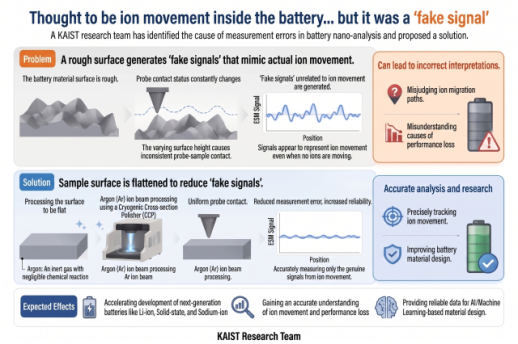 Battery scans read bumps as ion movement: KAIST SEOUL, September 07 (AJP) - Some of the signals that battery researchers read as ions moving inside a material are produced by nothing more than an uneven surface, a team at the Korea Advanced Institute of Science and Technology found, and the correction is as simple as polishing the sample flat. The team tested the effect on single-crystal silicon, a material in which no ions travel, after machining fine trenches into its surface, and a signal resembling ion movement appeared anyway. The same behavior showed up in a graphite anode of the kind used in lithium-ion batteries and in a sodium solid electrolyte. The Korea Advanced Institute of Science and Technology (KAIST) announced the findings Monday. Batteries work by shuttling lithium or sodium ions back and forth inside the cell as they charge and discharge. How fast and how freely those ions travel determines how quickly a battery can be refilled and how long it survives, so laboratories building the next generation of cells spend much of their effort mapping where inside a material ions flow easily and where they stall. One of the main tools for that mapping is electrochemical strain microscopy. The instrument drags an extremely fine probe across the surface of a battery material and applies a small alternating voltage through the tip. The voltage nudges the ions nearby, the material swells or contracts by an amount far too small to see as they crowd or thin out, and the probe registers the flexing. Ion traffic is never observed directly, only inferred from it. That is what leaves the measurement exposed. A change in the height of the surface alters how firmly the tip presses against the sample, and that shift alone moves the reading. The instrument's control system, which adjusts continuously to keep the probe tracking the surface, lags a fraction behind a sudden step or dip, and during the lag the contact stiffens or softens. The result looks much like ions on the move. To separate the two, the researchers needed a sample incapable of producing a real signal. Silicon in single-crystal form conducts no ions, so anything the instrument picked up had to come from the shape of the surface. Cutting trenches into it reproduced the grooves and steps found on a sliced battery electrode, and the height changes on their own generated a response. The mechanism resembles what happens to a car on a rutted road. The body rises and falls with the surface and the load on the tires changes with it. A probe crossing a ridge on an electrode behaves the same way, and the varying pressure feeds straight into the measurement. Real materials behaved no differently. In a graphite anode and in a sodium solid electrolyte known as Na2Zn2TeO6, the reading tracked the shape of the surface, which pointed to a problem that follows the instrument rather than any one class of material. The sharpest case appeared at grain boundaries, the seams where the small crystals making up a battery material meet, similar to the lines between laid tiles. Ions are widely thought to move quickly along those seams, and before the samples were smoothed the signal there was strong. After smoothing, the extra signal was gone. Smoothing was done with a cooling cross-section polisher, a machine that trims the cut face of a sample with a beam of argon ions. Argon reacts with almost nothing, which lets the beam shape a surface without changing the chemistry underneath. Roughness fell sharply, and the false readings fell with it. The work stops short of showing that published measurements of fast ion movement along grain boundaries were wrong. It establishes that surface shape by itself can generate a comparable signal, and that in these samples the extra signal at the seams vanished once the face was flattened. How much earlier work carries the same error has not been tested, and the polishing method was demonstrated on a small set of materials. Accurate readings at this scale also feed a second line of research, in which artificial intelligence and machine learning systems are trained on nanoscale data to predict how a new battery material will perform before anyone builds it. Those predictions are only as reliable as the measurements behind them. Three groups at KAIST ran the study together. Hong Seung-bum and Yuk Jong-min, both in the Department of Materials Science and Engineering, worked with Choi Nam-soon in the Department of Chemical and Biomolecular Engineering. Hong said he expects the result to help researchers "understand and design the operating principles of next-generation battery materials," including solid-state cells that replace liquid electrolyte with a solid and sodium-ion cells that swap lithium for a cheaper and far more plentiful metal. The paper appeared online June 11 in the journal Small Methods. Dongyan Chen, a doctoral researcher in the Department of Materials Science and Engineering, is its first author. Journal/Source: Small Methods Title: Quantitative Analysis of Topographic Crosstalk in DART-ESM Arising from Feedback-Loop-Delay-Induced Contact Stiffness Variations in Battery Materials Link/DOI: 10.1002/smtd.70763 AJP Takeaways - KAIST said a widely used nanoscale imaging technique can produce signals resembling ion movement when the only thing changing is the height of the sample surface. - KAIST researchers reproduced the effect on single-crystal silicon, which conducts no ions, and again in a graphite anode and the sodium solid electrolyte Na2Zn2TeO6. - KAIST reported that the strong signal seen at grain boundaries disappeared once the sample face was flattened with an argon ion beam, and the team did not test how much earlier work carries the same error. - Small Methods published the paper online June 11, three months before the announcement, tracing the false readings to a lag in the instrument's tracking system that changes how firmly the probe presses on the surface. 2026-09-07 09:53:35
 -
Everland to Launch Immersive Horror Theme Zone 'Blood City Zero' on September 12 This fall, Everland will offer an immersive horror experience where visitors can become survivors in a zombie city and complete escape missions.Samsung C&T's Resort Division announced on September 7 that its signature fall festival horror theme zone, 'Blood City Zero: The Gates of Hell,' will operate from September 12 to November 22 for 72 days.Now in its 10th year, Blood City has attracted over 10 million visitors and is a hallmark of Everland's horror experiences. In 2022 and 2023, it collaborated with 'Squid Game' art director Chae Kyung-sun to create a dystopian train station and a cyberpunk future city. In 2024, it will unveil a large-scale outdoor experience zone featuring popular intellectual properties in collaboration with Netflix. Last year, it reinterpreted 'The Wizard of Oz' into a chilling and bizarre horror universe, garnering significant attention.This season, the theme zone will feature a cinematic horror world created in collaboration with director Lee Seok-hoon, known for films like 'Pirates' and 'Confidential Assignment 2.' It transforms from a simple viewing experience into an audience-driven immersive horror content.One of the most notable features is the country's first outdoor large-scale immersive live horror performance. Breaking down the boundaries between stage and audience, the entire Blood City space will serve as a massive stage. Visitors will become members of White Z, fighting against a zombie army led by Dark X, as they navigate five themed zones: the Gates of Hell, an uncontrollable laboratory, a mad circus, a blood-soaked correctional facility, and the Platform of Destruction.Actors, including towering zombies over 2 meters tall, will engage with the audience, drawing them into the narrative. By watching performances and completing missions in each themed zone, participants can earn stamps on their member cards. Completing all missions grants priority access to the 'Monimorush' zone, themed around the Platform of Destruction.In Monimorush Square, a 5-meter tall inflatable zombie sculpture will be installed, and the Blood City Square and Monimorush will feature vivid atmospheres created by Panasonic's 4K ultra-high-definition projectors. The performances will take place daily from 4 PM to 9 PM, and Everland visitors can participate for free.Various experiential elements, including horror-themed merchandise and unique food options, will also be available. A total of 38 new products, including skull hooded capes, will be launched, and the Alpskuch restaurant will offer horror-themed dishes like Dark Energy Black Chicken Curry Rice. Additionally, a zombie costume shop and makeup salon will allow visitors to transform into zombies themselves.As the outing season approaches, Everland will also present family-friendly fall festival content. The 'Wild Savannah Expedition,' opening on September 12, will allow visitors to walk through Lost Valley and observe 15 species of animals, including giraffes and rhinos. Furthermore, the 'Smiley Pumpkin Parade' will take place daily during the festival, and the Four Seasons Garden, Everland's signature garden, will transform into a themed garden featuring autumn flowers and plants. A new band performance utilizing animal IP will debut at the end of September.* This article has been translated by AI. 2026-09-07 09:52:00
-
Gunpo Mayor Han Dae-hee Aims to Establish South Korea's First 'Youth Sovereignty City' Gunpo Mayor Han Dae-hee expressed his commitment on September 7 to establish South Korea's first 'Youth Sovereignty City,' where young people will be co-decision-makers in urban transformation.During his remarks, Mayor Han noted that Gunpo was selected as one of the top five municipalities in Gyeonggi Province in the youth-friendly city evaluation conducted by the provincial government.This marks the second consecutive year that Gunpo has been recognized, following its ranking among the top three municipalities last year.Mayor Han highlighted that the city's youth policies have yielded positive results, contributing to its high ranking in the evaluation for two years in a row.The evaluation assessed local governments' policies and frameworks aimed at enhancing youth participation in regional policy-making, strengthening their capabilities, and improving their quality of life.He explained that the city received high marks for its plan to establish a 'youth-friendly city governance' model, where young people actively participate in the proposal, decision-making, and feedback processes of policies.This initiative aligns with Mayor Han's vision of a 'Youth Sovereignty City,' which he has emphasized since taking office.Citizens have positively evaluated Gunpo's recognition as a top youth-friendly city for two consecutive years, appreciating the ongoing commitment to youth policies.One resident remarked, "It is encouraging to see consistent recognition for youth policies over the past two years. I hope that job and housing opportunities for young people in Gunpo will continue to be strengthened."Another resident added, "While increasing the youth budget and launching various initiatives are important, it is crucial that citizens can feel the impact. I hope to see tangible changes in areas that young people truly need, such as employment, housing, and cultural activities."Since taking office, Mayor Han has prioritized youth policies, initiating the establishment of a 'Youth Sovereignty Office' as his first official act.In the past three years, the youth budget has increased by 15.2%, and the city has been selected for various youth policy projects by central government ministries, including the Office for Government Policy Coordination, the Ministry of Employment and Labor, the Ministry of Education, and the Ministry of Culture, Sports and Tourism, thereby expanding its policy foundation.Currently, Mayor Han is implementing 47 initiatives across five areas—participation and rights, jobs, housing, education and culture, and welfare—under the 'Second Basic Plan for Youth Policy in Gunpo (2025-2029).'The youth-friendly city initiative is a program operated by the Office for Government Policy Coordination to enhance youth participation in regional policies and support improvements in their quality of life.After a recommendation from the metropolitan government and a series of evaluations, designated municipalities receive a total of 500 million won in national funding and government-linked consulting support over two years.With Gunpo's recent recognition among the top five municipalities in Gyeonggi Province, Mayor Han plans to challenge for designation as a youth-friendly city following the final evaluation by the Office for Government Policy Coordination.Mayor Han emphasized, "Gunpo is undergoing a major transformation that reconfigures industry, housing, and living spaces simultaneously. This will become a city of opportunities designed in collaboration with young people."* This article has been translated by AI. 2026-09-07 09:52:00
-
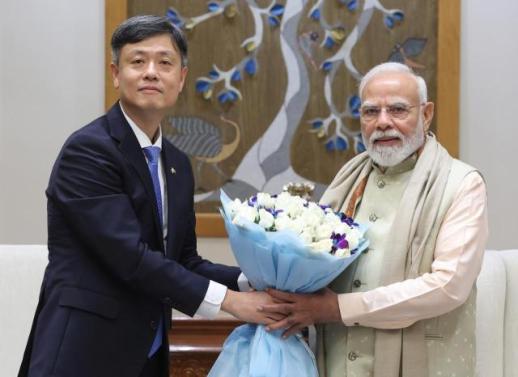 Krafton steers India bet toward AI, robotics SEOUL, September 07 (AJP) - Krafton will invest an additional $250 million in India over the next three to four years, pushing beyond mobile gaming into artificial intelligence, the company said after its founder met Prime Minister Narendra Modi. The move deepens a push that already runs through a South Korean consortium as Krafton earlier this year joined internet giant Naver and asset manager Mirae Asset to launch the $670 million Unicorn Growth Fund, an India-focused vehicle backing growth stage startups in AI, software and deep tech. The fresh pledge, separate from that fund, lifts Krafton's total planned direct investment in India to $500 million. Krafton has quietly built a substantial Indian startup portfolio, backing around 18 companies, of which only a handful are gaming studios, with bets spanning audio platform Kuku FM, streaming platform Loco and storytelling service Pratilipi. Krafton Chairman Chang Byung-gyu, who met Modi on Sept. 4, cast the outlay as a durable wager on Indian talent. "India is a major market with outstanding talent across gaming, technology and innovation," Chang said, adding that the investment reflected long-term confidence in the country's digital economy. The bet dovetails with warming ties between Seoul and New Delhi, which in April unveiled an "Korea-India Digital Bridge" to anchor cooperation in AI and semiconductors and pledged to nearly double bilateral trade to $50 billion by 2030. Korean heavyweights from Samsung Electronics to HD Hyundai have been widening their footprint in the fast-digitizing economy. Alongside the capital, Krafton is building local capacity, having acquired Pune-based Nautilus Mobile, maker of the Real Cricket franchise, and launched the KIGI Academy training program with the Indian Institute of Technology Madras. AJP Takeaways - Krafton will invest an additional $250 million in India over the next three to four years, expanding beyond mobile gaming into artificial intelligence, robotics and deep tech, and lifting its total planned direct investment in the country to about $500 million. - The commitment builds on the $670 million Unicorn Growth Fund that Krafton launched with Naver and Mirae Asset to back growth-stage Indian startups, and follows the "Korea-India Digital Bridge" that South Korea and India unveiled in April 2026 to deepen cooperation in AI and semiconductors. - Krafton has backed around 18 Indian companies, most of them outside gaming, including audio platform Kuku FM, streaming platform Loco and storytelling service Pratilipi, and has acquired Pune-based Nautilus Mobile while launching the KIGI Academy training program with the Indian Institute of Technology Madras. 2026-09-07 09:50:50
 -
Goldman Sachs Maintains KOSPI Target of 12,000 Amid AI Investment Boom Goldman Sachs has projected that the boom in memory semiconductors driven by increased investment in artificial intelligence (AI) may last longer than expected, maintaining its KOSPI target of 12,000.On September 6, Timothy Moe, Goldman Sachs' Chief Asia-Pacific Equity Strategist, stated in an interview with Bloomberg, "We are still maintaining this target, and the performance improvements we expect will support it." He emphasized that the market is underestimating how long this performance cycle will last.Goldman Sachs initially set the KOSPI target at 12,000 in June, which was considered one of the most optimistic forecasts at the time.Recently, the KOSPI has fallen about 27% from its all-time high recorded in June, influenced by concerns over the sustainability of AI investments from big tech companies and increased volatility in the Korean stock market. Although Samsung Electronics and SK Hynix reported strong earnings, this did not lead to a rebound in their stock prices.However, Moe noted that the competition in global data center construction is leading to a continued shortage of memory and storage semiconductors, which he predicts will worsen by 2027.He estimated that investment spending by major U.S. tech companies will exceed $1.2 trillion next year, significantly up from the previous forecast of $800 billion.Moe remarked, "Hyperscalers must continue to invest even if they are not making profits, which is very positive for the memory industry. This will drive demand for processing power, which requires a lot of memory."Goldman Sachs expects that the profits of KOSPI-listed companies will increase by about 360% this year, but the growth rate is projected to slow to about 35% by 2027. Moe added that the market is already well aware of the expected slowdown in profit growth.He identified the competition from Chinese rivals like CXMT and potential political backlash against the expansion of data centers in the U.S. as risk factors. Nevertheless, he anticipates favorable conditions for advanced memory semiconductor companies over the next two years.The KOSPI target of 12,000 is based on an expected forward price-to-earnings ratio (PER) of 7.5. Currently, the KOSPI's forward PER stands at 5.3, which is about half of the recent seven-year average.Moe stated that if Korean companies achieve Goldman Sachs' profit forecasts, the KOSPI target of 12,000 is "not as outrageous as it may seem."* This article has been translated by AI. 2026-09-07 09:48:00
-
Amazon Cargo Plane Crashes at Miami Airport, Killing 5 An Amazon cargo plane crashed at Miami International Airport, veering off the runway and colliding with several vehicles, resulting in at least five fatalities and five injuries.According to the Associated Press, the incident occurred around 2 p.m. local time on September 6. The cargo plane, which had departed from San Juan, Puerto Rico, landed at Miami International Airport but overshot the runway, crossing a road used by warehouse and business personnel. The plane then struck multiple vehicles, igniting a fire.Miami-Dade County officials reported that five people died, three sustained serious injuries, and two were transported to the hospital with minor injuries. It remains unclear whether the deceased were on the aircraft or in the vehicles involved in the collision.The AP reported that thick black smoke billowed from the crash site, with the pilot and co-pilot trapped in the cockpit, and some vehicle occupants also trapped inside their cars. Approximately 200 emergency responders were deployed to the scene, and rescuers managed to extricate individuals trapped beneath vehicles.The aircraft involved was a Boeing 767 operated by 21 Air, a cargo airline based in North Carolina. According to flight tracking site FlightRadar24, the plane was 32 years old, originally built for passenger service, and had been converted to cargo in 2015 after over 20 years of operation with various airlines.The cause of the accident has not yet been determined. At the time, thunderstorms were reported in the area, with gusts reaching up to 30 mph, leading investigators to consider whether weather conditions contributed to the incident. The National Transportation Safety Board (NTSB) plans to send a team led by Chair Jennifer Homendy to Miami to investigate.The crash disrupted airport operations, with over 160 flights canceled and approximately 325 delayed by late that day, according to the AP. Some flights were rerouted to Orlando International Airport, more than 200 miles north of Miami.Amazon issued a statement expressing its commitment to cooperate with the investigation and extended condolences to the families of the victims and all those affected by the incident. 2026-09-07 09:48:00
-
Video Sparks Controversy Over Fireworks Falling Near Crowds at Yeouido Festival The 2026 Seoul World Fireworks Festival, hosted by Hanwha, concluded safely, but a video showing fireworks seemingly falling near the crowd has sparked controversy over its authenticity.On September 7, a video titled "A Close Call at the Yeouido Fireworks Festival" was posted on an online community.The footage appears to show fireworks falling in an area where general spectators are restricted. Notably, the video captures people quickly moving away as the fireworks hit the ground.Viewers have expressed mixed opinions on whether the video is real or generated by artificial intelligence (AI). Comments included, "It can't be AI, right? It looks like AI these days," and "If something like this happened, it would have caused a huge uproar, so it can't be real, right?" Some users speculated whether the footage was taken from a restricted area.Concerns were also raised about crowd control at the event. One user noted, "I saw people setting up blankets in areas that were clearly marked as off-limits."It remains unclear whether the widely circulated video is authentic or AI-generated, but many viewers lean towards the latter.Meanwhile, the Seoul World Fireworks Festival took place on September 5 at Yeouido Hangang Park, attracting approximately 1 million spectators. Hanwha Group covered the festival's operating costs, totaling about 13 billion won, with around 4.5 billion won allocated for safety management.Kim Seung-yeon, chairman of Hanwha Group, emphasized the company's commitment to expanding the festival so that more citizens can enjoy it. He stated, "The reason Hanwha launches fireworks into the sky is to share happiness with everyone looking up at the sky."The spread of this video has heightened awareness of the importance of crowd control, safety management, and adherence to restricted areas during large-scale events like the fireworks festival.* This article has been translated by AI. 2026-09-07 09:44:20