


Latest by
-
 HUG, HF, and SGI to Share Information on Landlords Who Fail to Return Deposits Guarantee institutions for jeonse deposits will share information on landlords who fail to return deposits, which will be used to restrict the issuance of jeonse guarantees. Properties owned by landlords with a history of having deposits paid on their behalf by any guarantee institution will be restricted from obtaining jeonse and rental guarantees across all institutions.The Housing and Urban Guarantee Corporation (HUG), the Korea Housing Finance Corporation (HF), and SGI Seoul Guarantee (SGI) announced on September 7 that they will jointly implement the 'Landlord Deposit Prohibition Information Sharing' initiative starting October 1.This measure involves sharing information about landlords who have failed to return deposits to tenants, leading to compensation payments made by guarantee institutions. Consequently, these landlords will face restrictions on guarantee subscriptions for properties they own.The guarantee institutions will send the landlord deposit prohibition information they hold to the Korea Credit Information Corporation, which will consolidate the data and provide it back to each guarantee institution.Information on landlords who have not returned deposits can be collected and shared without the landlord's consent under the amended Enforcement Decree of the Credit Information Act, which took effect on February 3. The information shared will pertain to landlords who have failed to return deposits after the enforcement date. However, the restrictions on guarantees for these landlords will take effect on October 1.HUG explained that this initiative aims to prevent recurring jeonse fraud and proactively block guarantee incidents. It is a follow-up measure under the Financial Services Commission's 'Household Debt Management Plan' and is part of efforts to establish an information-sharing infrastructure to prevent real estate financial fraud.Starting September 21, the status of landlords regarding deposit prohibitions can be checked through the landlord information inquiry menu on the HUG Safe Jeonse app.As information sharing among guarantee institutions becomes more established, tenants will be able to verify landlords' guarantee incident histories before signing contracts, enhancing risk assessment during the jeonse contract phase.* This article has been translated by AI. 2026-09-07 10:48:00
 -
North Korea Deploys New 5,000-Ton Destroyer 'Ganggeonho' to Eastern Fleet North Korea has deployed its new 5,000-ton destroyer, the 'Ganggeonho,' to its Eastern Fleet. Kim Jong Un stated that the Ganggeonho is part of the country's nuclear response system, signaling a commitment to enhance the navy's nuclear capabilities.The North Korean state media reported that the commissioning ceremony for the Ganggeonho, the second ship of the Choi Hyun class, took place on September 6 at Wonsan Port, attended by Kim. North Korea claims to have verified the ship's combat performance and reliability through a series of evaluation tests following its launch.In his speech at the commissioning ceremony, Kim emphasized that the navy's nuclear armament is being realized and is becoming more suitable, diversified, and practical for deterrence. He defined the Ganggeonho as a means and capability included in the national nuclear response system. Kim instructed the crew that if adversaries attempt to use force against them, he would command them to use the most devastating absolute power, calling for a 'decisive retaliatory strike' if such orders are given.The Ganggeonho and the Choi Hyun class destroyer, which was deployed to the Western Fleet in June, share the same class and weapon systems. However, Kim highlighted the significance of the Ganggeonho's deployment, noting that the East Sea is a key area where North Korea is exposed to direct military threats during joint exercises involving the U.S. and South Korea or trilateral drills with Japan.He stated, 'The formal commissioning of the Ganggeonho into the East Sea naval force and the construction of naval bases in the East Sea are clear signals to our enemies,' adding, 'It is now time for us to exercise our sovereignty at sea and underwater.'Kim also hinted at the possibility of revealing additional naval capabilities, stating, 'We are currently executing important plans to strengthen naval power, and I will prove it to the world in eight months.' While he did not specify the plans, there is speculation that they may relate to North Korea's ongoing construction of nuclear-powered submarines.North Korea has identified the possession of nuclear submarines and underwater-launched nuclear strategic weapons as key tasks for its defense development. In March of last year, it revealed the construction site of a 'nuclear-powered strategic cruise missile submarine,' and in December, it showcased the entire hull of a presumed 8,700-ton nuclear submarine.The Ganggeonho, which experienced a capsizing incident during its launch in May of last year, was raised 22 days after the accident, and the commissioning ceremony was held. Last month, Kim observed tests of the ship's weapon systems, indicating that its commissioning was imminent.After his speech, Kim boarded the Ganggeonho to inspect the combat command space and took commemorative photos with the crew. Photos released by North Korean media also captured his wife, Ri Sol-ju, and daughter, Ju-ae.Professor Lim Eul-chul of Kyungnam University’s Far East Institute commented, 'This formalizes the operational deployment of a sea-based nuclear response system and showcases the diversification and practical application of maritime nuclear deterrence through ship-launched nuclear weapons such as tactical nuclear cruise missiles.'* This article has been translated by AI. 2026-09-07 10:44:00
-
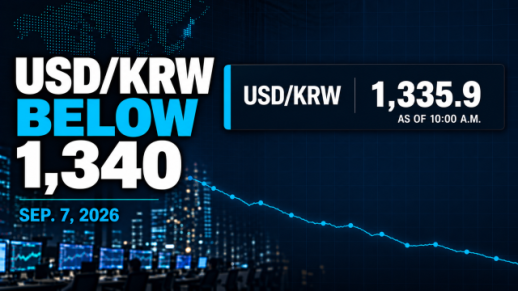 KRW/USD enters 1,330 range for first time in 23 months SEOUL, September 07 (AJP) - The South Korean won climbed to its strongest level against the greenback in nearly 23 months Monday as exporters rush to convert their dollar holdings for fiscal settlement. The USD/KRW exchange rate traded at around 1,335.9 won as of 10 a.m. The pair entered the 1,330 range for the first time since Oct. 4, 2024, when the exchange rate traded between 1,331 and 1,335 won before closing daytime trading at 1,333.7 won. The won's advance stood out against a firmer U.S. dollar after stronger-than-expected U.S. employment data revived expectations that the Federal Reserve could raise interest rates this month. U.S. nonfarm payrolls increased by 162,000 in August, nearly three times the 56,000 increase economists had expected, while the unemployment rate held at 4.1 percent. Financial markets raised the probability of a quarter-percentage-point Fed rate increase at its Sept. 15-16 meeting to about 62 percent after the report, while the dollar and U.S. Treasury yields rose. Korea-specific dollar supply continued to offset those external pressures, with semiconductor exporters bringing in large amounts of overseas earnings as the country's export boom accelerated. South Korea's cumulative exports reached $709.4 billion in early September, already surpassing the record for the whole of 2025. Semiconductor exports surged 169.6 percent from a year earlier to $281 billion in the first eight months of this year. Exporter dollar selling has remained a major source of supply in the local foreign exchange market, although companies have also accumulated record dollar deposits as the won strengthened and some exporters delayed converting proceeds. Foreign equity inflows added support Monday as Korean semiconductor shares rallied, with foreign investors turning net buyers of the benchmark KOSPI in early trading. The won's rally also persisted despite authorities having absorbed about $20 billion of dollar proceeds repatriated from SK Hynix's U.S. American depositary receipt issuance through off-market transactions. The transactions reduced the amount of dollar supply that could have reached the spot market directly. The exchange rate had only entered the 1,340 range on Friday for the first time in about 14 months, as the won's appreciation accelerated. AJP Takeaways: - South Korea's won strengthened into the 1,330-per-dollar range for the first time in nearly 23 months, trading at 1,335.9 won as of 10 a.m. - Korean exporters continued to supply dollars to the local foreign exchange market as strong semiconductor exports increased overseas earnings available for conversion into won. - Federal Reserve rate-hike expectations rose after stronger-than-expected U.S. employment data, but Korea-specific dollar supply outweighed broader support for the U.S. currency. 2026-09-07 10:41:46
 -
Doosan Fuel Cell Shares Surge 22% on Entry into U.S. AI Data Center Market Doosan Fuel Cell shares surged more than 20% in early trading following news of its entry into the U.S. artificial intelligence (AI) data center power market. The increase in demand for on-site power generation in the U.S. has sparked investor optimism about potential additional orders and improved performance next year.According to the Korea Exchange, as of 10:02 a.m. on September 7, Doosan Fuel Cell's stock was trading at 53,600 won, up 9,750 won (22.23%) from the previous trading day. The stock opened at 45,650 won and briefly soared to 55,000 won in early trading.The surge in stock price is attributed to the announcement that Doosan's U.S. subsidiary, HyAxiom, will supply fuel cells for AI data centers, marking its first foray into the U.S. power market.Earlier, Doosan Fuel Cell disclosed that it signed a contract with HyAxiom to supply phosphoric acid fuel cells (PAFC) worth 501.4 billion won on September 2. The products will be delivered to HyAxiom in phases from the second half of this year through the first half of 2028, and HyAxiom will supply them to AI data centers in the U.S.Analysts have also expressed positive evaluations. Jeong Yeon-seung, a researcher at NH Investment & Securities, noted in a report that "considering the absolute supply scale, it is highly likely that these will be used as primary power sources rather than auxiliary power for data centers," adding that there is a high possibility of additional PAFC orders due to the increasing demand for on-site power generation in the U.S.He also mentioned that while there have been financial burdens due to annual operating losses and increased working capital stemming from stack replacement costs and low operating rates for previously supplied fuel cells, production is expected to ramp up significantly next year, potentially easing fixed cost burdens and leading to a return to operating profit.* This article has been translated by AI. 2026-09-07 10:32:10
-
Kim Seung-won Acknowledges Relationship with Yang Amid Controversy Kim Seung-won, the nominee for Minister of Justice, acknowledged on September 7 that he has been close to Yang, who is embroiled in allegations of soliciting approval for a COVID-19 treatment clinical trial. This statement effectively revises his previous claim that he had only 'accidentally met' Yang. He did not provide specific explanations regarding the recorded conversation in which he referred to Judge Jeong Mo as 'my buddy' or the allegations that complaints were relayed to the Ministry of Food and Drug Safety.Speaking to reporters as he arrived at the confirmation hearing preparation office in Jongno, Seoul, Kim said he first met Yang at a restaurant and café frequented by legal professionals. He noted that they had little interaction until he took on a case involving a violation of labor standards.Kim described Yang as a successful businesswoman who produces and sells women's products and is pursuing a master's and doctoral degree at Kyung Hee University, stating, 'It is true that we have been close.' He explained that his previous statement was not communicated effectively due to family health issues.Earlier, lawmaker Han Dong-hoon released a recording of a phone call from October 14, 2021, in which Kim referred to Judge Jeong as 'my buddy.' Judge Jeong had previously dismissed an arrest warrant for a Genensel official. Kim stated, 'I do not know the internal circumstances well, but I believe it was handled appropriately according to the law and procedures,' adding that he would explain to the public after reviewing the matter. He did not clarify his relationship with Judge Jeong or the context of his recorded remarks.Kim categorically denied the allegations that he solicited clinical trial approval from the Ministry of Food and Drug Safety. He asserted, 'I have never made any improper requests to the Ministry, nor has the review been conducted unfairly,' while acknowledging that he should have been more cautious during the complaint process.He claimed that he only communicated concerns about delays in the development process of a domestic small pharmaceutical company's COVID-19 treatment, stating, 'I called the Minister to request fair and prompt handling,' and emphasized that his communication was limited to a single phone call and a text message on the same day. He added that he had no prior acquaintance with the Minister and maintained a neutral and formal tone in conveying the complaint.Han alleged that after Kim's contact, the then-secretary of the Minister mentioned Kim's text to the relevant department, suggesting that it was a successful lobbying effort. When asked if the complaint might have pressured the responsible staff, Kim did not respond.Kim also refuted Han's claim that he received a suspension of prosecution due to external pressure, questioning how, as a first-term member of the Democratic Party, he could exert influence over the prosecution during the Yoon Suk-yeol administration, which included Minister of Justice Park Sung-jae and Prosecutor General Shim Woo-jung.He demanded that Han appear at the confirmation hearing to take responsibility for his statements, insisting, 'He should come and prove the external pressure.' He also indicated he would request the testimony of prosecutors involved in the decision.Kim accused Han of conducting a political offensive by leaking investigation materials to the media, stating, 'The leak of investigation materials is indeed subject to criminal punishment,' and called for clarification on how the materials were obtained legally. However, he did not address the allegations regarding a recording in which someone allegedly offered him 20 million won the day after the clinical trial plan was approved, nor the suspicions of stock trading based on undisclosed information.Regarding allegations that his spouse and children received 330 million won in salaries from a government voucher program for a facility serving individuals with developmental disabilities, Kim countered that these were legitimate earnings for actual work. He remarked, 'They are trying to portray it as a family business,' and expressed a desire for the facility not to be distorted or disparaged. He did not provide a clear stance on the allegations that the facility operated without proper authorization.* This article has been translated by AI. 2026-09-07 10:32:10
-
Yuhan Corporation Partners with Novartis to Distribute 'Rapsido' in South Korea Yuhan Corporation has partnered with Novartis Korea to distribute, sell, and promote the chronic spontaneous urticaria treatment 'Rapsido' (active ingredient: remibrutinib) in South Korea. The two companies announced the strategic partnership agreement on September 7. Under the agreement, Yuhan Corporation will handle domestic distribution, while Novartis Korea will focus on promotional activities in general hospitals, and Yuhan will target clinics and private practices. Rapsido is the first oral Bruton’s tyrosine kinase (BTK) inhibitor approved for the treatment of chronic spontaneous urticaria. It received domestic approval in April for adult patients whose symptoms are inadequately controlled by H1 antihistamines. Chronic spontaneous urticaria is a condition characterized by the activation of mast cells, leading to the release of inflammatory mediators such as histamine, resulting in hives, angioedema, and itching. While existing antihistamines work by blocking the action of released histamine on receptors, Rapsido operates by inhibiting BTK, which is involved in the activation of mast cells and basophils, thereby reducing the release of inflammatory mediators. The domestic approval was based on the results of global Phase 3 clinical trials 'REMIX-1' and 'REMIX-2'. In these trials, Rapsido significantly improved the weekly urticaria activity score (UAS7) compared to placebo at 12 weeks, with effects maintained up to 24 weeks. The 52-week analysis showed improvements in itching and hives symptoms from the first week of treatment, with therapeutic effects lasting up to 52 weeks. The safety profile over 52 weeks was generally consistent with the 24-week analysis. The two companies plan to expand the distribution and sales of Rapsido through this partnership and enhance treatment accessibility for patients with chronic spontaneous urticaria. Yuhan Corporation CEO Cho Wook-je stated, "Leveraging our sales and marketing capabilities and nationwide distribution network, we aim to effectively communicate the value of Rapsido to healthcare professionals and patients, contributing to the improvement of treatment environments." Meanwhile, Yuhan Corporation's active pharmaceutical ingredient (API) business is progressing well. On September 1, the company announced a supply contract worth 130 billion won with a global pharmaceutical company, although the identity of the partner was not disclosed. The contract amount is 131,074,440,640 won. This year, Yuhan Corporation has confirmed a total of three API supply contracts through public announcements, with a total contract value of approximately 397 billion won.* This article has been translated by AI. 2026-09-07 10:32:00
-
Hyundai Pharmaceutical Shares Surge Amid U.S. Interest in Hair Loss Treatments A surge of investment interest in companies developing hair loss treatments in the U.S. market has led to a strong performance by Hyundai Pharmaceutical in early trading. As of 10:15 a.m. on September 7, Hyundai Pharmaceutical's shares rose by 680 won (8.5%) to 8,630 won, according to the Korea Exchange. The increase in Hyundai Pharmaceutical's stock price is attributed to the recent strong performance of hair loss treatment companies in the U.S. Bloomberg reported on August 29 that these companies have become a new focus for investors on Wall Street, following interest in obesity treatments. For instance, shares of U.S.-based Veradermix have skyrocketed nearly 500% since its listing in February, reflecting the rising stock prices of companies in the hair loss treatment sector. Hyundai Pharmaceutical is one of the leading developers of hair loss treatments, known for its minoxidil-based product line, including the brand 'Minoxidil.' The company offers various hair loss treatments, such as Minoxidil solution in 3% and 5% concentrations, a 5% gel, and a combination Minoxidil solution. Last year, it launched the 'Minoxidil Foam 5% Aerosol,' which contains 5% minoxidil. Other companies in the KOSDAQ market are also experiencing significant gains, including JW Pharmaceutical (up 12.1%) and Samik Pharmaceutical (up 29.7%). JW Pharmaceutical sells oral hair loss treatments 'Monad' containing finasteride and 'Dutamoa' containing dutasteride. Meanwhile, Samik Pharmaceutical has developed a technology to convert its existing daily oral treatment for alopecia areata into a once-a-month injectable treatment using baricitinib (a JAK inhibitor), which was introduced in January. 2026-09-07 10:28:10
-
CJ CheilJedang Opens Flavoring Technology Center in Singapore to Target Asia-Pacific Market CJ CheilJedang has established a technical support hub for flavoring materials in Singapore, enhancing its strategy to penetrate the Asia-Pacific market. The company aims to expand collaboration with local food companies by supporting technology development and commercialization of flavoring materials.On September 7, CJ CheilJedang announced the opening of its 'Global Technical Center' for flavoring materials at the Biopolis research complex in Singapore. This center is the fourth of its kind, following those in Korea, Chicago, and Wageningen, and will provide technical support to clients in the Asia-Pacific region.The Global Technical Center will develop technologies to apply CJ CheilJedang's flavoring materials to products produced by clients, ensuring the desired taste is achieved. The center will also assist in the commercialization process to apply the developed technologies to actual products. Key flavoring materials include 'TasteNrich,' 'CJ TIDE,' and 'Add-Mi' nucleic acid solutions.CJ CheilJedang plans to use the Singapore center as a base to expand technical exchanges and collaborations with major food companies in neighboring countries. The company aims to develop tailored solutions for clients' products, particularly focusing on the premium flavoring material 'TasteNrich' to boost sales in the Asia-Pacific region.TasteNrich is a natural flavoring material produced using CJ CheilJedang's microbial fermentation research and development technology. It is made from naturally derived ingredients, such as sugarcane, without artificial additives. By utilizing TasteNrich, food manufacturers can maintain flavor while reducing sodium and other additive content. CJ CheilJedang plans to diversify the TasteNrich product line to provide flavor solutions tailored to client needs.Previously, CJ CheilJedang held an opening ceremony for the Singapore Global Technical Center on September 1, attended by officials from the Singapore Economic Development Board (EDB) and the South Korean Embassy in Singapore. From September 2 to 4, the company invited key clients from the Asia-Pacific region to showcase its flavor and nutrient products and food application solutions.A representative from CJ CheilJedang stated, "The Singapore Global Technical Center will enable us to collaborate more closely with clients in the Asia-Pacific region. We will provide solutions that meet both health and taste requirements based on our differentiated technology and product capabilities."Earlier, in July, CJ CheilJedang restructured its business model from a focus on food and bio to three sectors: lifestyle food, technical materials, and core materials. The technical materials division includes global flavoring materials such as nucleic acids and the natural flavoring material TasteNrich, as well as eco-friendly plastic materials like PHA.* This article has been translated by AI. 2026-09-07 10:28:00
-
Kim Min-seok Calls for a Strong National Identity and a Dignified Society Kim Min-seok, the leader of the Democratic Party, emphasized on September 7 the need to establish a strong national identity outwardly while creating a dignified society internally. He highlighted that South Korea has reached a level of advanced nation in politics, economy, diplomacy, and science and technology, underscoring the importance of a 'strong national consciousness.'In his representative speech at the National Assembly, Kim stated, "National innovation starts with political innovation," pointing to the necessity for changes in the government, the National Assembly, and political parties. He pledged that the Democratic Party would lead the way in innovation, focusing on people's livelihoods and enhancing youth policies. He also announced plans to strengthen alliances with the ruling coalition and to initiate discussions on adjusting the number of negotiation groups.Among the urgent tasks he mentioned were police reform, the promotion of three major mega-projects, and the development of public-private partnerships. He specifically stated, "We will pursue a realistic constitutional amendment that reflects the changes of the times and the demands of the people," proposing to include the spirit of the May 18 Democratic Uprising and the Busan-Masan Democratic Uprising in the preamble of the constitution. Regarding the restructuring of power, he remarked, "We can go as far as the people desire."Kim also expressed his willingness to communicate not only with the ruling coalition but also with the opposition. He suggested, "Let’s create areas for participation by both parties one by one and expand them two at a time," proposing cooperation on youth and housing policies. He further suggested that lawmakers from both parties sit together in the National Assembly.* This article has been translated by AI. 2026-09-07 10:28:00
-
JB Financial Group Expands into Indonesia with Acquisition of Local Finance Company JB Financial Group has completed key regulatory procedures to enter the Indonesian financial market. The company plans to expand its operations centered on automotive financing through a local finance company and to launch specialized services such as financing for electric bicycles.On September 7, JB Financial Group announced that it received approval from the Indonesian Financial Services Authority (OJK) for the change of major shareholders in PT KB Bukopin Finance, a local finance company.Previously, JB Woori Capital signed a stock purchase agreement in July of last year to acquire an 85% stake in KB Bukopin Finance for approximately 29 billion won from KB Kookmin Bank's Indonesian subsidiary, PT Bank KB Indonesia Tbk (KBI).Established in 1983, KB Bukopin Finance specializes in corporate financing and working capital loans. As of the end of last year, it operated its headquarters in Jakarta and eight branches, with total assets amounting to 11.604 trillion rupiah (approximately 928 million won), a 78.7% increase from the previous year. The company reported a net profit of 19.131 billion rupiah (about 1.5 million won).JB Financial plans to leverage JB Woori Capital's automotive financing, corporate financing, credit evaluation, and risk management capabilities to expand its business in the region.In particular, the company aims to develop financing for electric bicycles as a new growth area. Once the acquisition process is finalized, JB Financial will also complete its investment in the Indonesian subsidiary of AI-based fintech company Aigen Global, with which it signed a new share subscription agreement last year, and will begin collaboration.Kim Ki-hong, Chairman of JB Financial Group, stated, "This acquisition marks a significant turning point for JB Financial Group in establishing a long-term growth foundation in Indonesia. We will combine JB Woori Capital's lending and risk management capabilities with Aigen Global's data-driven mobility expertise to create a differentiated local business model."* This article has been translated by AI. 2026-09-07 10:24:00