


Latest by
-
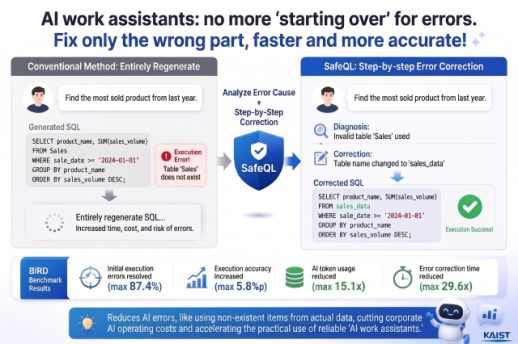 KAIST method cuts 87 % of AI query errors and token costs SEOUL, September 04 (AJP) - When an artificial intelligence system writes a database query that will not run, the database that rejected it already knows what is wrong with it. Most systems treat that rejection as a plain failure signal and hand the whole query back to the AI to be written again from scratch. A team at the Korea Advanced Institute of Science and Technology has built software that reads the rejection as a set of directions and repairs only the broken piece. Tested on BIRD, a benchmark researchers use to compare systems of this kind, the software cleared up to 87.4 percent of the execution errors in queries the AI produced on its first attempt, and raised execution accuracy, the share of questions that come back with the right answer, by up to 5.8 percentage points over the strongest previous method. Measured against systems that regenerate the query from scratch, it consumed up to 15.1 times fewer tokens, the units of text a language model is billed by, and finished its repairs up to 29.6 times faster. The software is called SafeQL. It was built at the Korea Advanced Institute of Science and Technology (KAIST), South Korea's state-funded science and technology university, by a School of Computing team led by Kim Min-soo. Doctoral student Lee Geon-ho was the first author on the paper, and Kim was the corresponding author. The work was published in the Proceedings of the VLDB Endowment and listed in the program of the International Conference on Very Large Data Bases, which ran from Aug. 31 to Sept. 4 in Boston. Databases answer only in SQL, short for Structured Query Language, a command language that requires every table and column to be named exactly as it exists in the system. Text-to-SQL tools remove that requirement. A manager can ask which product sold best last year, or which items are running low in stock, and the AI converts the question into SQL and returns the figures. The conversion goes wrong often enough to matter. A language model querying a company's sales records may invent a column that does not exist, call a function the database does not support, or link two tables in a way the underlying structure does not permit. The query fails to execute, and the AI comes back with nothing. Until now, the standard remedy has been to send the error message back to the model and ask for a replacement. Rewriting an entire document because one word in it is wrong carries an obvious cost, and query repair works the same way. Parts that were already correct can change, new errors can appear in place of the old one, and every round trip to the model spends more tokens and more time. SafeQL keeps the query the AI wrote and works from it. Reading the error the database reports alongside the schema it can inspect directly, the software locates the element that failed and replaces it, swapping a nonexistent column for a real one, adding a missing table link, or correcting a function or a search value. A single error usually has several plausible fixes, and testing all of them across a chain of repairs would multiply the candidates beyond any useful limit. KAIST defined the set of queries the database can actually execute as a safe query space, then searched toward it by trying first the candidates closest in structure and meaning to what the model originally wrote. Candidates whose data types do not match are discarded before they are tested. Kim and Lee proved mathematically that the search arrives at the safe query space within a finite number of steps. Rather than sit alongside the database, SafeQL runs inside PostgreSQL, the open source database system used across much of the software industry. Working from the parse tree PostgreSQL builds for every incoming command, it can pinpoint the failure even in long and heavily nested queries. Repeated similarity calculations are held in a cache and a vector index to keep the search cheap. When the first query is too badly broken to patch, the software calls the language model back for a fresh one and resumes the search from there. KAIST said the approach should reduce the cost and time of running AI on company data, and bring closer the point at which AI agents can handle sales, customer and inventory records reliably enough to be trusted with the work. Errors at the data access stage carry forward, since everything an agent does next rests on figures it was unable to retrieve in the first place. "For AI to take on real work at a company, accurately finding the data it needs is what matters," Kim said. On Spider, an older benchmark drawn from databases across many different fields, SafeQL reached 91.7 percent execution accuracy while using up to 96.5 times fewer tokens than regeneration methods and cutting repair time by up to 34.5 times. Title: SafeQL: Search-based Refinement for Safe and Efficient LLM-based Text-to-SQL Link/DOI: 10.14778/3819518.3819545 AJP Takeaways - KAIST's SafeQL repairs only the failed element of an AI-generated database query rather than regenerating the entire query, clearing up to 87.4 percent of execution errors on the BIRD benchmark. - Kim Min-soo's team reported token use down by up to 15.1 times and repair time down by up to 29.6 times against regeneration methods, with 91.7 percent execution accuracy on the Spider benchmark. - PostgreSQL hosts the software directly, giving it the database's own parse tree to locate failures inside long and heavily nested queries. - The VLDB Endowment published the paper in its Proceedings, and the International Conference on Very Large Data Bases listed it in a program that ran Aug. 31 to Sept. 4 in Boston. 2026-09-04 10:35:48
 -
 Support for Relocation and Housing Costs: Will Special Supply System for Sejong Relocation Agencies Be Revived? The Ministry of Justice and the Ministry of Gender Equality and Family are moving forward with plans for a local relocation to Sejong City in the first half of next year, raising questions about the potential revival of the special supply system for apartments that was offered to employees of relocating agencies during the city's early days. According to the Ministry of the Interior and Safety on September 4, the two ministries are set to begin the relocation process in earnest next year. The Supreme Prosecutors' Office and the National Police Agency plan to secure office space before proceeding with their moves. Data from Sejong City indicates that the Ministry of Justice and the Ministry of Gender Equality and Family have a combined workforce of 1,100, while the police and prosecutors' offices employ around 3,000 people. This suggests that, assuming an average of three family members per employee, the relocation could lead to an influx of over 10,000 residents. As various committees finalize their relocation plans, the announcement of public institution relocation plans scheduled for October is expected to increase the number of agencies moving to Sejong City. Considering the relocation of central government facilities and agencies, some forecasts suggest that the population influx could exceed 20,000. In light of this, there are growing calls for urgent housing measures for employees of the relocating agencies. When the Government Sejong Complex opened, around 5,500 public servants from six agencies, including the Prime Minister's Office, the Ministry of Strategy and Finance, the Ministry of Land, Infrastructure and Transport, the Ministry of Environment, the Ministry of Agriculture, Food and Rural Affairs, and the Fair Trade Commission, moved to Sejong. To support the settlement of relocating agency employees, the government temporarily operated a 'special supply system' that prioritized up to 70% of apartment sales for public servants. However, this system was abolished in July 2021 due to criticisms that relocating public servants were not actually residing in the city and were only seeking profit from real estate price increases. Now, five years later, as the government plans a second round of central administrative agency relocations, there are renewed calls to reinstate the special supply system for apartments. On September 3, Prime Minister Han Seung-soo stated at a public institution relocation plan announcement that the government would provide substantial support for relocation and housing costs to ensure that employees of relocating agencies do not face inconveniences. Sejong City is also considering allocating 10% of the private apartment sales planned for supply between October and December to special supply for employees of relocating agencies. According to housing supply regulations, without establishing a separate system, local government heads can allocate up to 20% of general sales as special supply at their discretion. A Sejong City official noted, “Even without establishing a separate system, we can secure special supply quantities at the discretion of the local government head. However, in cases like this where a large-scale relocation plan is announced, additional discussions with the Ministry of Land, Infrastructure and Transport regarding the special supply system may be necessary.”* This article has been translated by AI. 2026-09-04 10:32:20
 -
Vietnam's National Assembly Chair to Visit South Korea Amid 35th Anniversary of Diplomatic Ties Tran Thanh Man, the Chair of the National Assembly of Vietnam, will officially visit South Korea. As both countries expand cooperation in trade, investment, advanced technology, and human exchanges based on their comprehensive strategic partnership, parliamentary collaboration has come to the forefront.According to local media including VnExpress on September 4, Tran Thanh Man, along with his wife and a high-level Vietnamese delegation, will visit South Korea from September 6 to 9 at the invitation of Speaker Cho Jung-sik. This visit is seen as a significant step in solidifying parliamentary cooperation since the establishment of the comprehensive strategic partnership in 2022.The parliamentary relationship between South Korea and Vietnam has gained momentum through recent high-level exchanges. Former Speaker Woo Won-sik visited Vietnam last year, during which the two national assemblies signed a memorandum of understanding on cooperation. Both sides have continued exchanges among parliamentary leadership, standing committees, friendship groups, and women and youth lawmakers, discussing legislative experiences and policy implementation measures.In the economic sector, South Korea has established itself as a key partner for Vietnam. It ranks as Vietnam's second-largest investor, second-largest source of tourists, second-largest provider of official development assistance, and third-largest trading partner. According to Vietnamese government data, trade between the two countries is projected to reach $89.5 billion in 2025, a 9.6% increase from 2024, with trade from January to July of this year expected to hit $70 billion, marking a 41% increase compared to the same period last year.Investment cooperation is also expanding. As of the end of July this year, South Korea was the largest investor among 154 countries investing in Vietnam. The cumulative registered investment from South Korea in Vietnam stands at $102.6 billion, with 10,567 projects concentrated in manufacturing, advanced technology, electronics, automotive parts, construction, and real estate.Advanced technology has emerged as a new pillar of cooperation between the two countries. In April 2026, the Ministry of Science and Technology of Vietnam and the Ministry of Science and ICT of South Korea held the 10th Joint Committee on Science and Technology Cooperation, agreeing to promote collaboration in artificial intelligence, biotechnology, quantum technology, and semiconductors, as well as to foster high-level talent and connect innovation ecosystems. South Korea has provided $30 million in grant aid for the establishment of the Vietnam-Korea Institute of Science and Technology, and both sides are currently advancing to the second phase of the project.Human exchanges also serve as another foundation for the relationship. As of the end of last year, the number of Vietnamese nationals in South Korea was approximately 352,000, an increase of 30,000 compared to the same period in 2024. Among them, over 100,000 are students and workers, and there are about 100,000 multicultural families of Vietnamese and Korean descent. Approximately 200,000 South Koreans reside or conduct business in Vietnam, with around 10,000 South Korean companies operating there.Cooperation in labor and education continues as well. In June 2023, the two countries signed a memorandum of understanding on the cooperation for the dispatch and acceptance of Vietnamese workers under the employment permit system, which was extended last August. By the end of last year, it was estimated that about 45,000 Vietnamese workers had entered South Korea under the EPS program.In an interview with the Vietnam News Agency, Speaker Cho stated, "This visit will strengthen parliamentary cooperation and the comprehensive strategic partnership between our two countries." He noted that both nations aim to achieve a trade volume of $150 billion by 2030 and are exploring cooperation in infrastructure, new cities, high-speed rail, nuclear energy, and power grid sectors.Cho highlighted advanced technology and citizen protection as key areas of collaboration. He emphasized the need for cooperation in artificial intelligence, semiconductors, biotechnology, mineral resources, security, defense, and cybersecurity. He also mentioned that the 350,000 Vietnamese in South Korea and 190,000 South Koreans in Vietnam serve as bridges between the two nations, and the parliament will play a role in protecting the rights and supporting the settlement of multicultural families, workers, and students.This visit is expected to take place as South Korea and Vietnam approach the 35th anniversary of their diplomatic relations, aiming to institutionalize economic, technological, and human exchange cooperation through parliamentary diplomacy. The two countries are likely to continue discussions to expand the scale of existing cooperation while strengthening the legal and institutional framework.* This article has been translated by AI. 2026-09-04 10:32:00
-
Government and Industry Discuss Revisions to Emissions Trading and PPA for Green Transition The government and industry representatives convened to discuss improvements to the emissions trading system and power purchase agreements (PPA) aimed at facilitating corporate green transitions.On September 4, the Ministry of Climate Energy and Environment held a policy meeting with executives from member companies of the Korea Business Council for Sustainable Development (KBCSD) at the Westin Seoul Parnas in Gangnam.About 30 attendees, including Oil-Young, Director of the Climate Energy Policy Office at the ministry, and Hong Hyun-jong, Secretary General of KBCSD, participated in the meeting to address challenges faced by the industry in the climate, energy, and environmental sectors and to discuss potential regulatory improvements.Key topics included the rationalization of the emissions trading system, enhancements to the PPA framework, promotion of low-carbon steel product purchases, and strengthening government support measures.The ministry plans to review the suggestions made by industry representatives and communicate reasonable regulatory improvements and support measures.Since 2014, the Ministry of Climate Energy and Environment and KBCSD have held biannual policy consultations to discuss regulations and challenges in the climate, energy, and environmental sectors.Oil-Young stated, "The decarbonization and green transition of companies are becoming new benchmarks for competitiveness. We will enhance the system to allow companies to invest boldly in a predictable environment and will implement comprehensive support policies to help them become global leaders."* This article has been translated by AI. 2026-09-04 10:32:00
-
 Yasukuni visit casts shadow over Seoul Defense Dialogue SEOUL, September 04 (AJP) - Japanese Defense Minister Shinjiro Koizumi is expected to skip next week's Seoul Defense Dialogue amid controversy over his visit to the Yasukuni Shrine, cooling a recent run of high-level defense exchanges between the two neighbors. Japan will instead send a vice-minister-level official to the 15th Seoul Defense Dialogue, an annual multilateral security forum hosted by South Korea's Ministry of National Defense from Sept. 7 to 9, as the ministry itself undergoes a leadership transition following President Lee Jae Myung's nomination of retired four-star Gen. Kang Shin-chul to replace Defense Minister Ahn Gyu-back. Seoul's defense ministry said Ahn will represent Seoul regardless of the reshuffle and a change in his Japanese counterpart. The exact reason for Koizumi's absence has not been disclosed, but it comes less than three weeks after he visited the Yasukuni Shrine on Aug. 15, the anniversary of Japan's surrender in World War II and South Korea's Liberation Day. Koizumi later acknowledged the visit during an Aug. 25 press conference. South Korea's Foreign Ministry condemned visits and offerings by senior Japanese figures to the shrine, saying Japanese leaders should face the country's wartime past and demonstrate sincere reflection through their actions. The Yasukuni Shrine honors Japan's war dead, including 14 Class-A war criminals convicted after World War II, and visits by senior Japanese officials have repeatedly drawn protests from South Korea and China. Koizumi's absence stands out after a series of defense exchanges that had signaled improving security ties between Seoul and Tokyo. South Korean Defense Minister Ahn Gyu-back and Koizumi met in Yokosuka, Japan, in January and agreed to promote reciprocal visits and regular defense ministerial meetings. They met again on the sidelines of the Shangri-La Dialogue in Singapore on May 30. Koizumi then visited South Korea on June 27-28 for another round of talks with Ahn. Japan's Defense Ministry said at the time that the two sides reaffirmed bilateral defense cooperation as well as trilateral security cooperation with the United States. Last year, then-Japanese Defense Minister Gen Nakatani attended the Seoul Defense Dialogue in Seoul, making Koizumi's absence this year a step down in the level of Japanese representation. The Seoul Defense Dialogue, launched in 2012, brings together senior defense officials and security experts to discuss regional and global security issues. Japanese Defense Minister Shinjiro Koizumi is expected to skip next week's Seoul Defense Dialogue due to controversy surrounding his visit to the Yasukuni Shrine, sending his deputy on his behalf instead. The 15th Seoul Defense Dialogue, an annual multilateral security forum hosted by South Korea's Ministry of National Defense, is set to take place in Seoul from Sept. 7 to 9. Koizumi visited the Yasukuni Shrine on Aug. 15, the anniversary of Japan's surrender in World War II and South Korea's Liberation Day. He later acknowledged the visit during an Aug. 25 press conference. South Korea's Foreign Ministry condemned visits and offerings by senior Japanese figures to the shrine, saying they reflected a failure to face Japan's wartime past and calling on Japanese leaders to demonstrate sincere reflection through their actions. The Yasukuni Shrine honors Japan's war dead, including 14 Class-A war criminals convicted after World War II, and visits by senior Japanese officials have repeatedly drawn protests from South Korea and China. The dispute comes after a series of high-level defense exchanges between Seoul and Tokyo this year. South Korean Defense Minister Ahn Gyu-back and Koizumi met in Yokosuka, Japan, in January and agreed to promote reciprocal visits and regular defense ministerial meetings. They met again on the sidelines of the Shangri-La Dialogue in Singapore on May 30. Koizumi then visited South Korea on June 27-28 for another round of talks with Ahn. Japan's Defense Ministry said at the time that the two sides reaffirmed cooperation between South Korea and Japan as well as trilateral security cooperation with the United States. Last year, then-Japanese Defense Minister Gen Nakatani traveled to Seoul for the Seoul Defense Dialogue and held talks with Ahn during the visit. 2026-09-04 10:30:28
 -
Samsung Electronics Expands Resource Recycling System, Achieves 38 Recognitions 삼성전자가 반도체·가전 생산 과정에서 발생하는 폐기물을 제품 원료로 다시 활용하는 자원순환 체계를 확대하고 있다. 웨이퍼 운반 용기를 스마트폰 부품으로 재활용하는 등 사업부문 간 협업도 강화하면서 지난해 연간 6800톤 이상의 폐기물을 줄였다. 삼성전자는 올해 8월 기준 총 38건의 순환자원 인정을 취득했다고 4일 밝혔다. 이를 통해 2025년 기준 연간 6859톤의 폐기물을 감축했다. 순환자원 인정제도는 인체와 환경에 유해하지 않고 경제성을 갖추는 등 법적 기준을 충족한 폐기물을 자원으로 인정하는 제도다. 순환자원으로 인정받으면 폐기물 관련 규제를 적용받지 않고 원료로 다시 활용할 수 있다. 삼성전자 반도체 사업을 담당하는 디바이스솔루션(DS)부문은 2019년부터 폐기물 재활용과 자원화를 확대해왔다. 올해 8월 기준 전 사업장에서 누적 30건의 순환자원 인정을 취득했다. DS부문은 반도체 생산 과정에서 발생하는 폐기물을 분리·회수한 뒤 전문 소재업체 및 다른 사업부문과 협력해 새로운 원료로 전환하고 있다. 대표적인 사례가 반도체 웨이퍼 운반에 사용하는 '웨이퍼 트레이'다. 고품질 플라스틱으로 만들어진 웨이퍼 트레이를 회수한 뒤 삼성전자 디바이스경험(DX)부문 순환경제연구소와 협업해 재활용 플라스틱으로 가공한다. 해당 소재는 갤럭시 S25 시리즈의 사이드키와 볼륨키에 적용됐다. 반도체 생산 과정에서 발생하는 불량 웨이퍼도 재활용한다. 불량 웨이퍼를 잘게 부순 뒤 전문 소재업체에서 실리콘을 추출해 알루미늄 합금 원료로 활용한다. 재생 소재는 항공·건설 산업 등에 공급된다. 웨이퍼 연마 공정에 사용되는 '다이아몬드 디스크'에서도 팔라듐을 회수한다. 사용이 끝난 디스크를 전문업체가 처리해 팔라듐을 추출한 뒤 화합물 원료 등으로 가공해 인쇄회로기판(PCB) 제조에 다시 활용하는 방식이다. DX부문도 순환자원 인정 품목을 늘리고 있다. 삼성전자는 2024년 한국환경공단과의 컨설팅을 통해 수원·구미·광주 등 주요 사업장에서 발생하는 폐기물을 전수 검토하고 폐지와 철판, 세탁기 드럼, 트레이 등 20개 품목을 순환자원 인정 추진 대상으로 발굴했다. 현재까지 12개 품목에 대해 총 8건의 순환자원 인정을 취득했으며 나머지 8개 품목도 2027년 6월까지 인정을 받을 계획이다. 광주사업장은 냉장고 내부 공간을 만드는 플라스틱 성형 과정에서 발생하는 잔재물에 대해 지난해 순환자원 인정을 받았다. 기존에도 잔재물을 분쇄해 삼성전자 제품 원료로 재사용했지만 법적으로 폐기물로 분류돼 보관·운반 기준 준수와 인계서 제출 등의 절차가 필요했다. 순환자원 인정 이후 관련 관리 절차를 간소화하고 재활용 효율을 높였다. 사업장 밖에서 발생하는 폐기물을 제품 소재로 되돌리는 작업도 확대하고 있다. 삼성전자는 냉장고·세탁기 등 가전제품 설치 후 남은 포장용 스티로폼을 수거해 플라스틱 혼합 신소재로 재활용했다. 해당 소재는 국내에서 생산되는 '비스포크 AI 무풍콤보 갤러리' 에어컨과 '인피니트 AI 공기청정기' 내장재에 적용됐다. 제품 제조 과정에서 발생하는 폐유리는 복합섬유 소재로 재활용해 일체형 세탁건조기 '비스포크 AI 콤보'의 외부 세탁조에 적용했다. 폐식용유를 재활용한 소재도 냉장고 수납장에 활용하고 있다. 삼성전자는 향후 사업장에서 재활용 가능한 품목을 추가로 발굴하고 새로운 자원화 기술 도입을 확대할 방침이다. 폐기물에서 회수한 소재를 제품 원료와 제조 공정에 다시 투입하는 순환자원 공급망을 구축하고 순환자원 인정 취득 품목도 지속적으로 늘릴 계획이다.* This article has been translated by AI. 2026-09-04 10:28:00
-
China Urges South Korea to Uphold 'One China' Principle The Chinese Foreign Ministry has protested the Gwangju Biennale's decision to allow participation from the 'Taiwan Pavilion' and has demanded corrective action from the South Korean government.In a statement released on its website on the night of September 3, spokesperson Guo Jia-kun criticized the Biennale organizers for allowing Taiwan to participate under a name that does not align with its status, stating, "This is a blatant violation of the One China principle." He added, "China firmly opposes this and has lodged a serious diplomatic protest, demanding that the relevant parties immediately rectify this mistake."Guo emphasized that South Korea has repeatedly clarified its unchanged position on the One China principle this year, urging the South Korean government to honor its political commitments and fulfill its responsibilities by taking concrete actions to implement the One China principle.A spokesperson for the Chinese Embassy in South Korea also addressed the issue on the same day through the embassy's official WeChat account. They stated, "The embassy and the Consulate General in Gwangju have discussed this matter multiple times with the integrated government of Jeollanam-do and Gwangju Metropolitan City, as well as the Gwangju Biennale Foundation, but the organizers have insisted on their erroneous approach," claiming it seriously undermines the One China principle and directly damages the political foundation of China-South Korea relations. The embassy noted that a Chinese curatorial team has already announced its withdrawal in strong protest.Earlier, the Gwangju Biennale organizers changed the name of the 'Taiwan Pavilion' to 'National Taiwan Museum of Fine Arts' in early August. However, after Taiwan protested the change as "political censorship," the name was reverted back to 'Taiwan Pavilion.' In response to this situation, 19 artists and curators from mainland China were scheduled to exhibit their works at the Ha Jung-woong Art Museum from September 5 to November 5 but halted their installation work on August 28. 2026-09-04 10:28:00
-
People Power Party Calls for Withdrawal of Kim Seung-won and Yong Hye-in Nominations 국민의힘은 4일 이재명 대통령을 향해 김승원 법무부 장관 후보자와 용혜인 성평등가족부 장관 후보자에 대한 지명을 철회하라고 촉구했다. 정점식 원내대표는 이날 국회에서 열린 원내대책회의에서 "공소 취소 담당 장관 김 후보자는 청문회를 받을 자격이 없다"며 지명 철회를 요구했다. 정 원내대표는 김 후보에 대해 "본인은 공소 취소에 대해 직접적인 권한이 없고 검찰총장을 통해 지휘할 생각도 없다고 주장하는데 특검을 비롯한 우회로와 꼼수를 이용해서 빠져나갈 구멍을 만들어 두는 거짓말"이라며 "신약 뇌물 사건이 점입가경인데 기소유예자가 법무부 장관이 된다는 것 자체가 어불성설"이라고 비판했다. 이어 "뇌물 관련 사건의 기소유예자가 기소를 담당하는 공소청 소관 부처의 장관이 된다는 것 자체가 엄청난 이해 충돌"이라며 "5개의 재판이 진행 중인 피고인 대통령도 모자라 기소유예 법무부 장관까지 들어선다는 것은 국가적 비극"이라고 주장했다. 임이자 정책위의장은 "공소 취소, 청탁 비리 의혹의 김 의원과 특혜, 독점, 가족정당 용 의원에 대한 국민의 평가는 이미 끝났다"며 "후안무치의 끝판왕"이라고 질타했다. 그러면서 이 대통령을 향해 "이번 주말까지 국민의 명령대로 두 사람에 대한 지명을 단호히 철회하라"고 덧붙였다. 김 후보자는 코로나19 신약 개발 임상시험 승인 청탁 의혹을 받고 있고, 용 후보자는 배우자의 당직 근무 논란과 비례대표 의원직과 장관직을 겸직하겠다는 입장을 밝혀 비판을 받고 있다.* This article has been translated by AI. 2026-09-04 10:24:10
-
U.S. Treasury: EU Officially Joins Economic Outcast Operation Against Iran U.S. Treasury Secretary Scott Bensett announced that the European Union (EU) has officially joined the United States' "Economic Outcast Operation" against Iran.In a post on social media platform X on September 3, Bensett stated, "The EU has officially decided to participate in the 'Economic Outcast Operation.' We appreciate the EU's swift and decisive stance." He added, "The U.S. will work with our allies to ensure that Iran's murderous regime cannot exploit the global financial system to fund its nuclear ambitions, weapons programs, and terrorist proxies."Bensett emphasized, "The world is sending a clear message to the Iranian regime: we will not stop until we cut off every remaining source of funding."Previously, the EU issued a statement last month indicating its commitment to work closely with the U.S. and G7 member countries to maintain pressure on Iran and contribute to de-escalation and regional stability.The 'Economic Outcast Operation' is a set of sanctions aimed at isolating Iran economically, announced by Bensett on August 24. The core of the operation involves imposing secondary sanctions on third-country companies that engage in trade with Iran. Targeted sectors include digital assets and technology, gold, aviation, and shipping, with the goal of pressuring foreign companies and intermediaries that support trade with Iran to cut off its international trading network.The Treasury Department also designated approximately 60 Iranian-linked entities and individuals, as well as vessels related to nuclear, missile, cyber, and oil networks, as new targets for sanctions. The department explained that it is focusing on a network of intermediaries spanning the United Arab Emirates (UAE), Hong Kong, China, Singapore, Switzerland, and Europe, as well as vessels belonging to what is known as the 'shadow fleet.' This shadow fleet refers to a network of ships that transport oil and other goods while evading sanctions.* This article has been translated by AI. 2026-09-04 10:24:00
-
Young Generation's Silence: A Study on Reduced Communication A recent study has revealed that the phenomenon known as 'Gen Z stare'—where young people reportedly stare blankly without responding to questions—stems from a genuine decline in verbal communication among the younger generation, rather than a mere generational misunderstanding.According to a report by The Washington Post, the findings were published in the journal Perspectives on Psychological Science. The term 'Gen Z stare' combines 'Gen Z' (those born between 1997 and 2006) with the English word 'stare,' describing the behavior of young individuals who do not respond to greetings or inquiries but instead gaze silently at others.This behavior has gained traction on social media, resonating with older generations who have expressed frustration over the lack of verbal interaction from younger individuals. Posts lamenting the tendency of young people to simply look at others without exchanging pleasantries or small talk have proliferated online.The study found that from 2005 to 2019, the average number of words spoken daily by Americans decreased to 338, equating to about 120,000 words annually. Notably, the decline was more pronounced among those under 25, who averaged a drop of 415 words per day, compared to a reduction of 314 words for those over 25.The researchers identified increased social media usage as a contributing factor. They noted, “Younger individuals are more likely to communicate through text or social media, which may lead to a greater loss of spoken words compared to older adults.”This research involved a reanalysis of extensive data collected by Valerie Piper, a professor at the University of Missouri-Kansas City, from 2,197 participants aged 10 to 94 regarding their everyday conversations.Some experts argue that the reduction in spoken communication should not be viewed solely as a change in communication style. Face-to-face conversations require working memory and attention, as individuals must listen to others and prepare responses simultaneously. In contrast, text messages or emails allow for delayed responses and less immediate pressure, as well as a reduced need to remember details due to written records.Technological advancements have also played a role in this shift. Nowadays, ordering at restaurants or cafes can be done through kiosks, and generative AI tools like ChatGPT can handle everything from simple inquiries to complex information searches, further decreasing the need for direct human interaction.Cal Newport, a professor at Georgetown University, told The Washington Post, “Our social brains recognize that investing time and attention in someone is an important signal. Ironically, as socializing becomes easier, we may find ourselves less connected and lacking in social skills.” This suggests that the challenges of face-to-face interactions are contributing to the trend of reduced verbal communication among younger generations.* This article has been translated by AI. 2026-09-04 10:20:00