


Latest by
-
 Muan County Council Chair Im Yoon-taek Calls for New Era Centered on Airport Development The Muan County Council in Jeollanam-do held its first regular session of the 10th assembly on September 2, beginning a 20-day agenda that includes administrative audits and reviews of the 2026 second supplementary budget.In his opening remarks, Chair Im Yoon-taek highlighted key issues for Muan, such as the relocation of the Gwangju military airport and the establishment of a distributed energy specialized national industrial complex, emphasizing the need for a new development strategy centered around the airport.This regular session marks the first since the 10th Muan County Council was established. Chair Im expressed his commitment to responsible governance that prioritizes the lives of residents, based on their expectations and trust.He noted that Muan is currently at a critical juncture, needing to address multiple challenges simultaneously, including setting a future development direction centered on the airport, expanding industrial growth, responding to rural population decline and regional extinction, and improving living conditions.Chair Im pointed out that Muan has been designated as a candidate site for the distributed energy specialized national industrial complex, and that the area around Mangun-myeon has been selected as a candidate site for the relocation of the Gwangju military airport, calling this a significant turning point for the region's future.He also called for a development strategy that organically connects the airport, railways, and the distributed energy industrial complex."If we can establish a comprehensive development strategy, Muan can evolve from a mere transportation hub to a center for advanced industries, logistics, and energy industries in the southwestern region of the country," Chair Im stated.Regarding the issue of relocating the Gwangju military airport, he emphasized the importance of considering residents' opinions and ensuring procedural transparency.Given that this has been a major issue for the community for a long time, he stressed the need to carefully consider both the expectations and concerns of residents regarding the selection of the relocation site.Chair Im urged the administration to ensure that future procedures, including resident voting and the final selection of the relocation site, are conducted transparently with sufficient understanding and consensus from the community.He evaluated the past relocation of the Jeonnam Provincial Office and the development of the Namak New Town as key turning points for Muan's growth, reiterating the need to create new growth momentum centered around the airport.Chair Im emphasized, "We are at a decisive moment that can change the fate of the region. I will maintain a collaborative approach, closely communicating with the administration to develop necessary institutional support and policy alternatives together."This regular session will address administrative audits, the review of the 2026 second supplementary budget, as well as various ordinances and issues.The Muan County Council plans to assess the overall performance and results of major policy initiatives through the administrative audit, and will not only raise issues that require improvement but also propose realistic alternatives.Regarding the supplementary budget, the council will focus on whether limited resources are prioritized for stabilizing residents' lives and addressing local issues, and whether the necessity and urgency of each project are adequately reflected.Chair Im Yoon-taek stated, "Muan is at a turning point where possibilities must be turned into reality. If residents, the council, and the administration trust each other and pool their wisdom, we can create a broader and more secure future for Muan together."He added, "The 10th Muan County Council will always be by the side of the residents, listening and prioritizing their lives, and will move forward unwaveringly for the sustainable development of Muan."* This article has been translated by AI. 2026-09-02 14:24:00
 -
Gwangju City Council Recognizes Im Mi-ok as Employee of the Month for August The Gwangju City Council has named Im Mi-ok, head of the Tanbeol-dong Administrative Welfare Center's general affairs team, as the Employee of the Month for August. On this day, the council presented Im with a certificate of recognition in the council chair's office. Im was selected based on a recommendation from council member Joo Im-rok. Since July 2023, Im has been working as the general affairs team leader at the Tanbeol-dong Administrative Welfare Center, where she has been recognized for her efforts in monitoring local safety-related tasks and addressing residents' daily inconveniences. Notably, she has led initiatives such as the Mokhyeon 4-dong flood safety network project and the installation of drainage trenches in Mokhyeon 6-dong, as well as conducting preemptive inspections of flood-prone areas, drainage systems, and snow removal vulnerable zones to enhance disaster prevention. Im also took action to address issues directly affecting resident safety, such as damaged roads and poor drainage, by coordinating with relevant departments to ensure necessary repairs. Her collaboration with the city council to relay residents' concerns to the administration and facilitate smooth operations was another key reason for her selection. Residents have responded positively to the prompt identification and resolution of everyday issues like road damage and drainage problems, appreciating the focus on on-site administration. Among staff, there is a sense of significance in the recognition of work that often goes unnoticed but is crucial for resident safety and living conditions. A council official stated that this recognition aims to highlight the efforts of public officials who serve close to the community and to reflect on citizen-centered administration. Meanwhile, the city council selects an employee of the month each month through recommendations from council members, honoring those who diligently fulfill their duties as public servants for the citizens.* This article has been translated by AI. 2026-09-02 14:24:00
-
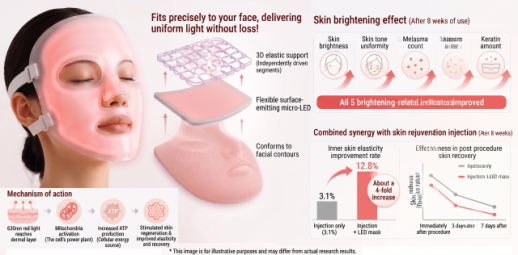 KAIST LED mask quadruples skin injection gains SEOUL, September 02 (AJP) - A wearable LED mask that conforms to the face's contours has made a common dermatology injection about four times more effective at restoring skin elasticity in a clinical trial. This result points to home beauty devices as a way to carry the benefit of a clinic visit into daily use, the Korea Advanced Institute of Science said Wednesday. According to the Korea Advanced Institute of Science and Technology (KAIST), the project was led by Lee Keon-jae, a professor in the Department of Materials Science and Engineering, and was carried out with researchers at the cosmetics group Amorepacific. The researchers found that deep skin elasticity improved by 12.8 percent on the side of the face that received both the injection and the mask, compared with 3.1 percent on the side treated with the injection alone. Thirty-three people took part, using the mask on one side of the face for eight weeks. Home skin care devices have sold well in South Korea and abroad, but the rigid LED masks on the market cannot press against the nose and the hollows under the eyes at the same time. Wherever a gap opens between the light and the skin, more of the light reflects away, and heat that pools in one spot raises the risk of a low-temperature burn. The mask tested here has two parts. Thousands of tiny LEDs sit under a diffusing layer so that light leaves the device as an even sheet rather than a scatter of bright points, and the whole panel rests on a three-dimensional elastic frame whose sections move independently to follow the nose, the cheeks and the jaw. That frame lifted the share of the mask in contact with skin to 78.1 percent from 46.9 percent and cut the distance between the light source and the skin to 1.8 millimeters. Across eight measurement points on the face, the red light arrived at 93.83 percent uniformity. In a 2024 study, a KAIST team reported that the same class of mask improved deep skin elasticity by as much as 340 percent compared with conventional LED masks. The new trial extends the work to skin brightening and to what happens after a needle procedure. The injection used in the trial delivers polynucleotide, a DNA-derived material, into the dermis, the layer beneath the skin's surface that holds the collagen and elastic fibers responsible for firmness. Dermatologists use it to prompt regeneration, and it has become one of the more popular treatments in South Korean clinics. On its own it has no established effect on skin tone. Every participant received the injection across the entire face. The mask went on one side only, a design known as a split-face trial, which lets researchers compare two treatments on the same person and remove differences in individual skin type from the result. No group used the mask without the injection, so the trial measures what the light adds rather than what it does alone. The mask side scored better on all five brightening measures the team tracked, covering skin brightness, evenness of tone, dead skin buildup, and the number and area of melasma patches, the brown discoloration that spreads across cheeks and foreheads with sun exposure and hormonal change. Skin tissue taken from human donors and treated in the laboratory showed the same pattern. Expression of MITF and TYR, two markers that govern how much melanin skin cells produce, fell in the tissue exposed to the LEDs, and new collagen formation ran about 15 percent higher than with the injection alone. The light itself was red, at a wavelength of 630 nanometers, or 630 billionths of a meter. The researchers attribute the effect to mitochondria, the structures inside cells that generate energy, which respond to red light by producing more ATP, the compound cells burn to repair and rebuild tissue. Recovery after the needle went faster as well. Three days on, water loss through the skin had dropped 20.8 percent on the mask side against 12.4 percent on the other, a sign that the skin barrier had rebuilt more quickly, and redness was lower. "This study confirms clinically that a home LED mask can go beyond regeneration to deliver a brightening effect, and it shows how much it matters to press the light against the skin," Lee said. He added that he expects the approach to grow into a platform linking clinic treatment to home care. Amorepacific, whose researcher is a co-corresponding author on the paper, plans to bring a product based on the technology to Japan in the fourth quarter of this year and the United States in the first quarter of 2027. Journal/Source: Nano Energy Title: Clinical validation of skin brightening and rejuvenation enabled by a skin-conformable surface-emitting micro-LED mask with injection Link/DOI: 10.1016/j.nanoen.2026.112288 2026-09-02 14:16:13
 -
Gwangju to Commission Basic Plan for Military Airport Relocation in November Gwangju is set to establish a basic plan for the relocation of the Gwangju Military Airport to Muan.To this end, the city plans to commission an external agency in November.On September 2, Gwangju officials held an executive meeting at the Gwangju City Hall to share the schedule for the military airport relocation project.Following the selection of the Muan area in Mangun-myeon as a candidate site for the relocation by the Ministry of National Defense's site selection committee on August 28, the city aims to expedite subsequent procedures by advancing three projects: the basic plan, strategic environmental impact assessment, and construction project management.The basic plan project will detail the layout and scale of military facilities at the new airport and prepare various documents necessary for future project approvals.Simultaneously, the strategic environmental impact assessment and construction project management will ensure the appropriateness of the basic plan and systematically manage the overall project timeline and budget.The total project cost for the three contracts is estimated at 26 billion won. The city has secured an initial 3 billion won through a supplementary budget, with plans to include the remaining funds in the 2027 main budget based on the progress of the projects.The city has completed contract reviews and plans to announce bids this month, with work on the three projects expected to begin in November.Additionally, the city will develop a support plan for surrounding areas and conduct public hearings and resident votes for Muan residents.Based on the results of the resident vote and Muan's application for hosting, the final site for the military airport relocation is expected to be selected by the end of this year.During the meeting, plans for a wastewater reuse project to supply water to the semiconductor cluster in the Honam region were also reported.The city is developing a water reuse management plan to supply 300,000 tons of reused wastewater daily to the semiconductor industrial complex, with a total project scale of 720 billion won.Funding for the buffer storage facilities and supply infrastructure for the reused wastewater has been included in the 2027 government budget proposal.The city has been in discussions with the Ministry of Climate, Energy and Environment, prospective companies, and the Korea Environment Corporation, and plans to sign a memorandum of understanding (MOU) for water supply this month, with related projects to be completed by November.Mayor Min Hyung-bae emphasized, "Even if each department pursues the infrastructure development for water and power for the semiconductor cluster individually, I ask that you collaborate closely with the semiconductor support organization to work as one team."* This article has been translated by AI. 2026-09-02 14:16:00
-
U.S. Congress Pushes Bill to Promote American AI Amid China Competition The U.S. Congress is advancing legislation aimed at securing America's global leadership in the open weight artificial intelligence (AI) sector. This move comes as Chinese companies rapidly expand their influence in the open weight AI market by publicly sharing model weights, prompting the U.S. to support the development and dissemination of American models.U.S. House Considers 'Open Source AI Leadership Act'According to the South China Morning Post, the U.S. House of Representatives reviewed the 'Open Source AI Leadership Act' on September 1. The bill proposes establishing a dedicated office within the U.S. Department of Commerce to promote the use of American open weight AI models and to identify barriers to their adoption. It also mandates the collection of data to compare the utilization of U.S. and Chinese AI models.Once enacted, the bill requires the Department of Commerce to disclose risks associated with the use of Chinese AI models, including censorship, supply chain vulnerabilities, and potential misuse, within 18 months.Representative Gabe Evans, a Republican who introduced the bill, stated, "Unfortunately, the leading companies in the open source and open weight model space are Alibaba, DeepSeek, and Moonshot," claiming these companies are "deeply intertwined with the Chinese Communist Party." He noted that American companies are increasingly falling behind their Chinese counterparts in the global open weight AI market.The bill passed to the full committee review stage through a verbal vote on the same day. If approved, it will proceed to a vote in the House.This legislative push comes as American companies like OpenAI and Anthropic have led the way in closed AI models, while Chinese firms have quickly gained traction in the open weight AI market.According to the AI-focused newsletter Interconnects, downloads of Chinese open weight AI models exceeded 328 million last month, more than double that of American models. This surge is attributed to the release of powerful new products like Moonshot AI's 'Kimi K3' and DeepSeek's updated 'V4 Pro' model.There has also been an increase in U.S. companies, including Purple City and Meta Platforms, testing Chinese open weight models directly.Focus on Promoting American AI Rather Than Blocking Chinese ModelsNotably, the bill includes provisions that prevent the Department of Commerce from banning or restricting the distribution of open AI models. Instead of directly blocking Chinese AI models, the focus is on supporting the adoption and proliferation of American models.Major U.S. tech companies, including NVIDIA, Microsoft, and Meta, have previously called for securing U.S. leadership in the open weight AI sector. However, they opposed the Trump administration's efforts to regulate Chinese open weight AI models, emphasizing the importance of fostering the development and spread of American models to enhance U.S. influence in the global AI ecosystem.Meanwhile, as the U.S.-China AI competition intensifies, there are calls for cooperation in AI safety. Concerns about the potential for AI to operate beyond human control have emerged as a key issue.Dean Ball, OpenAI's head of strategic futures and a former White House official, stated on September 31 that he believes U.S.-China AI safety cooperation is desirable and that a window of opportunity for collaboration is opening. He noted that the risks associated with AI and the upcoming Trump-Xi Jinping summit could lead to increased opportunities for cooperation in the coming months.There is a possibility that discussions on AI safety measures will take place during the anticipated U.S.-China summit next month. U.S. Treasury Secretary Scott Bessenet also indicated in a previous interview with Reuters that authorities from both countries would continue dialogues on various topics, including AI safety measures and regulations.However, while both the U.S. and China emphasize the importance of AI openness and safety, they differ in their perspectives. Recently, Chinese state media has voiced opposition to the U.S. regulating Chinese models under the pretext of AI safety or strengthening American technological hegemony.China's state-run CCTV affiliate Yuyuantan Tian stated on August 30, "AI safety standards should not be unilaterally set by the U.S. or specific companies," arguing that labeling Chinese AI models as a 'security threat' confuses safety issues with technological competition. 2026-09-02 14:12:00
-
Korea Promotes Investment Appeal of Free Economic Zones Linked to Mega Projects and AI Transition The Korea Trade-Investment Promotion Agency (KOTRA) held a domestic briefing on Free Economic Zones (FEZ) on September 2 at the Shilla Hotel in Seoul.The event aimed to showcase Korea's investment appeal as a hub for advanced industries in the Asia-Pacific region and to attract foreign investment to stimulate the local economy.KOTRA highlighted the differentiated investment conditions of the FEZ in line with the government's key national policy tasks, including regional growth initiatives, three major mega projects, and the Manufacturing AI Transition (M.AX) strategy.More than 300 attendees included diplomatic representatives, foreign chambers of commerce, and officials from major foreign-invested companies such as Amkor Technology Korea and Merck Korea.Since the launch of the first FEZ in Incheon in 2003, nine zones are currently operational, serving as key hubs for foreign investment through regulatory easing and improvements in the business and living environment.According to a survey released by the Ministry of Trade, Industry and Energy in January, the total investment by companies in the FEZ is projected to reach 59 trillion won, with exports amounting to 35.7 trillion won in 2024, marking increases of 14.4% and 10.1%, respectively, compared to the previous year.Notably, companies in key strategic industries reported a 27% increase in employment and a 17.2% rise in sales, contributing to the expansion of the local advanced ecosystem.A representative from a foreign-invested company cited the world-class infrastructure and the potential for partnerships with domestic advanced firms as major attractions of the FEZ. Kim Tae-hyung, CEO of Invest Korea, emphasized, "We will actively support the FEZ to become a global platform where local industries and global companies can grow together."Lee Min-woo, Director of the Industrial Growth Office at the Ministry of Trade, Industry and Energy, also stated, "The Free Economic Zones are key hubs connecting advanced industry investment and regional growth, and we will strive to ensure that global companies can invest with confidence." 2026-09-02 14:04:10
-
Samsung Electro-Mechanics President Emphasizes Future Competitiveness Through Components and Materials Samsung Electro-Mechanics held a forum on September 2 to discuss collaborative partnerships and strategies for securing future technological competitiveness. President Jang Deok-hyun and other key executives attended the '2026 Supplier Site Visit Communication Forum' at Fine Technology in Yangsan, South Gyeongsang Province, along with representatives from over 40 partner companies.In addition to members of the Supplier Council, Samsung Electro-Mechanics invited additional partners from the Gyeongsang region to gather insights from the field.During the communication session, Jang presented the company's current management status and key initiatives for each business division. He emphasized that "the realization of future industrial technologies must be supported by the competitiveness of components and materials," urging close collaboration to secure core technologies and create growth opportunities in the global market.He also highlighted the importance of differentiating component technologies aimed at high-growth markets such as artificial intelligence (AI), servers, and automotive electronics, while seeking solutions with partners regarding growth strategies, new product roadmaps, and global market outlooks.Kwon Hyuk-seok, chairman of the Supplier Council and CEO of MK Chem & Tech, responded, stating, "We will continue our partnership to lead high-value markets through technological innovation and quality management."Samsung Electro-Mechanics collaborates with over 900 suppliers domestically and internationally. Among them, 40 core component companies have been active members of the Supplier Council since its establishment in 1986. Under the agreement with the Shared Growth Committee, the company plans to invest 200 billion won over the next three years, starting last year, to support funding, improve manufacturing sites, and provide tailored training. 2026-09-02 14:04:00
-
 BOK sees September inflation easing, core pressures persist SEOUL, September 02 (AJP) - South Korea's consumer inflation is expected to ease in September as a telecom-related base effect fades, but underlying price pressures are likely to remain elevated, the Bank of Korea said Wednesday. The central bank made the assessment after an inflation review meeting chaired by Deputy Governor Lee Ji-ho earlier in the day. Consumer prices rose 3.1 percent in August from a year earlier, accelerating from 2.8 percent in July. "Consumer price inflation is expected to be lower in September than in August as the base effect disappears, but the underlying upward trend is expected to continue, particularly in core items," Lee said. The BOK said the acceleration in August was largely driven by a base effect stemming from large discounts on mobile service charges a year earlier. Core inflation, which excludes food and energy, climbed to 3.4 percent in August from 2.6 percent in July as the telecom effect pushed up public-service prices. Public-service prices rose 6.5 percent from a year earlier, sharply higher than the 1.4 percent increase recorded in July. Mobile-phone charges jumped 26.8 percent. Price pressures also remained firm in other core categories. Personal-service prices rose 3.5 percent, unchanged from July, while durable-goods inflation accelerated to 4.1 percent from 3.9 percent. The increase in headline inflation was partly offset by slower petroleum-price growth and falling agricultural, livestock and fisheries prices. Petroleum-product prices rose 14.2 percent from a year earlier in August, slowing from a 15.5 percent increase in July as the effect of lower government-imposed price ceilings continued. Agricultural, livestock and fisheries prices fell 2.6 percent after rising 0.9 percent in July, reflecting lower vegetable prices and slower increases in livestock prices. Agricultural prices dropped 6.7 percent, with vegetable prices falling 9.7 percent. Livestock prices rose 1.5 percent, slowing from a 4.4 percent increase in July. The BOK said government discount programs for agricultural and fisheries products also helped contain overall price pressures. The cost-of-living index, which tracks 144 frequently purchased items that account for a relatively large share of household spending, rose 3.2 percent in August. That compared with a 2.5 percent increase in July. Consumer inflation expectations for the next 12 months remained at 2.7 percent for a second consecutive month. The BOK said the temporary telecom effect should fade in September, pulling headline inflation lower from the August level. Still, the central bank warned that inflation could remain elevated, particularly in core categories, amid continued uncertainty surrounding the conflict in the Middle East. It also cited the pass-through of earlier cost shocks and the possibility of stronger demand-side pressure as factors that could sustain underlying inflation. The BOK said it would continue to closely monitor price developments with heightened vigilance. AJP Takeaways August consumer inflation accelerated to 3.1 percent, largely reflecting a base effect from mobile service discounts a year earlier. The BOK expects headline inflation to ease in September, while underlying price pressures remain firm, particularly in core categories. Lower agricultural prices and slower petroleum-price growth offset some of the increase, while services and durable-goods prices continued to rise. 2026-09-02 14:00:22
 -
South Korean Officials Confirm Release of Two Nationals Kidnapped in Haiti The Ministry of Foreign Affairs announced that two South Korean employees, who were kidnapped by a gang in Port-au-Prince, Haiti, in July, have been released.On September 2, the ministry stated, "One citizen was released on August 18, and the other was freed on the afternoon of September 1." It added, "Both individuals are in good health." The ministry emphasized that after receiving a report on July 31 from the South Korean embassy in the Dominican Republic, which oversees Haiti, it established a task force for the protection of overseas citizens and dispatched a rapid response team to collaborate closely with local authorities, including the Haitian police and diplomatic missions from allied countries, to ensure the safe release of the abducted individuals.It also explained that Haiti has been designated a travel ban country since May 2024, requiring exceptional passport usage permission for any stay. The two abducted citizens had obtained this permission for business activities.Furthermore, the ministry urged South Koreans currently in Haiti to move to safe areas and minimize unnecessary travel to prevent similar incidents from occurring. 2026-09-02 14:00:00
-
Government to Announce Plan for Relocation of Public Institutions The government will unveil its plan for the relocation of administrative and public institutions on September 3. A reform plan to adjust the functions of public institutions will also be announced. The Prime Minister's Office stated that a press conference on "Relocation of Administrative and Public Institutions and Reform of Public Institution Functions" will be held on the morning of September 2, chaired by Prime Minister Han Seung-soo at the Government Seoul Complex. The conference will include participation from Minister of the Interior and Safety Yoon Ho-joong, Minister of Land, Infrastructure and Transport Kim Yoon-deok, and Deputy Minister of Finance and Economy Heo Jang. As the Ministry of the Interior and Safety will oversee the relocation of administrative agencies, the Ministry of Land, Infrastructure and Transport will handle the relocation of public institutions, and the Ministry of Finance and Economy will manage the reform of public institution functions, the relevant ministries are expected to explain the policy direction and implementation plans together. Discussions are anticipated on how to adjust similar and overlapping functions of public institutions and how to link the relocation of these institutions to the development of local industries. The government aims to distribute public institutions and quality jobs, which are currently concentrated in the metropolitan area, to foster growth in regional areas. The promotion of the relocation of companies and public institutions, along with investment incentives, was also highlighted as a key agenda item at the National Land Transformation Interagency Council held the previous day. However, there has been significant pushback, particularly from financial public institutions, regarding the relocation. Unions from the Industrial Bank, Korea Development Bank, and Export-Import Bank held a joint rally on August 11 in Yeouido, Seoul, with an estimated 2,000 participants, arguing that relocating policy banks could undermine their competitive edge in policy finance and operational efficiency. On August 24, unions from the Financial Supervisory Service and the Korea Deposit Insurance Corporation also held a joint press conference opposing the relocation. The National Financial Industry Labor Union has announced a general strike on September 4, demanding a halt to the unilateral relocation of financial institutions. 2026-09-02 13:56:00