


Latest by
-
 France Tourism Office Appoints Jeong Hye-won as New Director in Korea On September 1, the France Tourism Office announced the official appointment of Jeong Hye-won as the new director of its Korea office.Jeong began her career in the French tourism sector in 1996 as an in-flight interpreter for Air France. She joined the France Tourism Office in Korea in 1998, marking the start of her 28-year journey in promoting and marketing French tourism in the Korean market.Throughout her extensive career, Jeong has closely observed the changes and trends in the Korean travel market, collaborating with various regional tourism offices in France and industry partners on numerous marketing and promotional projects. She has worked diligently to enhance tourism exchanges between Korea and France and to showcase the diverse attractions of traveling to France.“I feel a great sense of responsibility taking on the role of director of the Korea office, based on the field experience I have accumulated over the past 28 years at the France Tourism Office,” Jeong said. “Above all, I would like to express my heartfelt gratitude to the travel industry partners, media, and all collaborators who have been steadfast partners along the way.”She added, “The environment surrounding the travel market is challenging, with numerous obstacles ahead, but as always, I will turn crises into new opportunities. I will actively present high-quality travel experiences and sustainable travel options that allow visitors to vividly experience local culture and lifestyles, in line with the rapidly changing trends in the Korean travel market.”Korea is one of the long-haul markets that France is focusing on. Last year, approximately 830,000 Korean tourists visited France, marking a notable growth rate of 12.3% among long-haul markets.Jeong emphasized, “I will introduce the rich culture, gastronomy, and pristine nature of various regions in France, as well as the diverse attractions that are still not widely known to Korean travelers, in a broader and deeper manner. I will concentrate all efforts to elevate and activate tourism exchanges between our two countries based on close cooperation with industry partners.”* This article has been translated by AI. 2026-09-01 18:00:20
 -
Youth Advisory Groups Visit Anyang Prison to Address Correctional Officer Conditions The 2030 Youth Advisory Groups from the Ministry of Justice and the Ministry of Veterans Affairs visited Anyang Prison to hear firsthand about the working conditions of correctional officers.According to the Ministry of Justice, the joint visit took place on August 31, where members experienced the daily tasks of correctional officers and listened to their challenges. This visit marked the first collaborative field schedule between the two ministries aimed at diagnosing issues in correctional administration from a youth perspective and seeking effective policy alternatives.During the visit, the members toured key facilities within the prison, including housing units, the kitchen, and the rehabilitation program area known as 'House of Hope.' They also engaged in hands-on experiences with security procedures and inmate management, gaining deeper insights into the working conditions faced by correctional officers.Following the tour, a meeting was held where young correctional officers from various ranks shared their experiences. Participants expressed concerns about fatigue from continuous shifts and night work, as well as administrative difficulties stemming from overcrowded conditions, urging for practical measures to improve their treatment.The Ministry of Justice has been working on reforms to enhance the dignity of correctional officers, having discussed measures to expand their recognition with the Ministry of Veterans Affairs in March.Nam Chang-hyung, a youth advisor at the Ministry of Justice, stated, "Having witnessed the difficulties on-site, we will thoroughly examine the issues from a youth perspective to ensure that improvements in the treatment of correctional officers translate into actual policy changes." The youth advisory groups from both ministries plan to continue their collaboration to establish field-centered systems.* This article has been translated by AI. 2026-09-01 18:00:00
-
Global eSSD Market Surges to $37.59 Billion, Samsung Electronics Leads The global enterprise solid-state drive (eSSD) market has more than doubled in size in the second quarter of this year, driven by a surge in investments in artificial intelligence (AI) infrastructure. The competition among major tech companies to expand their data centers has significantly increased the demand for high-capacity and high-performance storage devices.According to market research firm TrendForce, the combined revenue of the top five eSSD manufacturers reached $37.59 billion (approximately 51.5 trillion won) in the second quarter, marking a 103.6% increase compared to the previous quarter. The ongoing supply shortage of eSSDs, essential for AI-enabled servers, has contributed to both rising sales prices and increased volumes.Samsung Electronics and SK Hynix have maintained their positions as global leaders with strong performances.Samsung Electronics reported eSSD sales of $14.35 billion (approximately 19.71 trillion won) in the second quarter, holding a market share of 35.1%, consistent with the previous quarter and solidifying its top position. The company expanded its shipment of next-generation high-density NAND flash-based high-performance products, resulting in a significant 103.6% increase in revenue compared to the prior quarter.SK Hynix also saw its revenue rise by 85.9% to $8.63 billion (approximately 11.85 trillion won) during the same period, maintaining its second-place position with a market share of 21.1%. However, due to intensified market competition, its share decreased slightly by 2 percentage points from the previous quarter.Micron, the third-largest player, is also making significant strides. The company reported a remarkable 126.3% increase in eSSD revenue to $6.98 billion (approximately 9.59 trillion won) in the second quarter, the highest growth rate among the top five manufacturers.Micron has leveraged proactive production line restructuring focused on high-bandwidth memory (HBM) and eSSDs, along with strengthening its high-capacity product lineup, to boost its market share to 17.1%. 2026-09-01 17:56:00
-
Controversy Over Birth Support Payments: Government to Consider Retroactive Application As the government prepares to reform its childbirth and childcare support system, a significant issue has arisen regarding a discrepancy of over 10 million won in support payments based on a one-day difference in birth dates. The government is now considering retroactively applying the new system to children born from January to June 2027.President Lee Jae-myung raised concerns about equity during a Cabinet meeting on September 1 regarding the implementation date for the child support payment and child basic allowance, which is set to begin in July 2027. He stated, "If the cutoff date is set for July 1 next year, what happens to those born the day before? Should they delay their births? Children born in the same year should receive the same treatment," he emphasized. He instructed relevant ministries to explore options for applying the new system to children born after January 1, 2027.According to the government's proposed childcare support payment reform, starting in July 2027, the existing first meeting voucher and parental benefits will be consolidated into the child support payment. The new payment will provide 10 million won for the first child, 12 million won for the second, and 15 million won for the third and subsequent children. In designated priority regions, these amounts will increase to 15 million, 17 million, and 20 million won, respectively.The existing child allowance will also be expanded into the child basic allowance, with a base payment of 200,000 won per month, increasing to 300,000 won in priority regions. The age for receiving payments will gradually expand, with support planned for children under 13 starting in 2030.The issue arose when the initial cutoff date for the new system was set for July 1, 2027. For example, a first child born on June 30, 2027, would receive a total of 35.6 million won under the current system, which includes the first meeting voucher of 2 million won, parental benefits of 18 million won, and child allowance of 15.6 million won until the age of 12.In contrast, a first child born the following day, July 1, 2027, would be eligible for the new child support payment of 10 million won, along with 31.2 million won in child basic allowance and 7.2 million won in home care bonuses, totaling 48.4 million won. This results in a staggering difference of 12.8 million won based solely on the birth date. The gap could be even larger for second or subsequent children or for families living in priority regions.This situation has led to concerns among expectant parents about a so-called "birth date cliff." There are fears that parents may feel pressured to time their births to align with the new system's implementation date.The government's current proposal is to begin the new system as scheduled on July 1, 2027, but to extend eligibility to children born from January to June 2027, allowing for retroactive payments. If the information system is established more quickly than anticipated, there may be a possibility of advancing the implementation date.Minister of Health and Welfare Jeong Eun-kyeong stated, "It seems feasible to apply the retroactive method based on birth years," adding that adjustments to the implementation date and budget could be made during discussions in the National Assembly.It is estimated that retroactive application would require an additional budget of approximately 250 billion won. However, this plan still needs to pass through legislative amendments and National Assembly budget reviews, meaning the retroactive application for children born from January to June 2027 has not yet been finalized.Even if the eligibility is expanded to include all children born in 2027, the disparity will not be completely eliminated. A gap would still exist between children born on December 31, 2026, and those born on January 1, 2027.President Lee also mentioned this issue, suggesting that rather than having significant differences in support amounts among children born in the same school year, it may be necessary to consider applying the system based on birth years. The final eligibility and implementation date are expected to be determined during future discussions in the National Assembly.* This article has been translated by AI. 2026-09-01 17:56:00
-
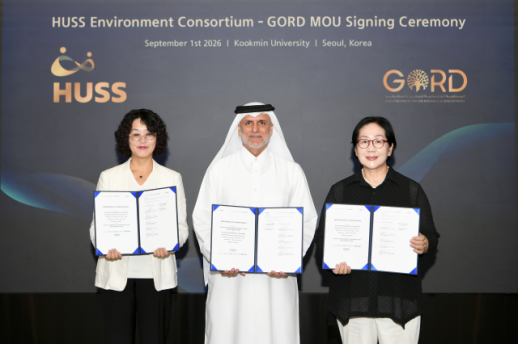 Kookmin signs Qatar deal on carbon market training for students SEOUL, September 01 (AJP) - Students from five South Korean universities will train inside the international carbon market under an agreement signed Tuesday in Seoul, opening a route into a Qatari crediting program whose credits airlines buy to meet United Nations emissions obligations. That program, the Global Carbon Council, won full approval from the International Civil Aviation Organization in October 2024 to supply credits under the Carbon Offsetting and Reduction Scheme for International Aviation, the U.N. body's global offsetting system for air travel. In May it added eligibility under the Core Carbon Principles set by the Integrity Council for the Voluntary Carbon Market. The council says it is the only carbon crediting program based in the Global South holding both accreditations. What makes the arrangement unusual is who is being sent. The consortium that signed the deal is funded under a Ministry of Education program for humanities and social sciences students, not for engineers or climate scientists. The agreement was signed at Kookmin University's main administration building by the environment consortium of the Humanities Utmost Sharing System, a program run by the ministry and the National Research Foundation of Korea that pays universities to build joint degree tracks across institutional and departmental lines. Kookmin leads the consortium, which was selected in the program's environment category. Officials from the four other member universities attended, those being Duksung Women's University, University of Ulsan, Inha University and Chosun University. Carbon markets reward a humanities background more than the label suggests. A carbon credit represents one ton of greenhouse gas emissions reduced or removed, and its price depends less on the technology behind the reduction than on whether the reduction can be verified, whether it would have happened anyway, and whether two countries have both claimed it. Those are questions of rule-writing, auditing, contract law and public policy. Article 6 of the Paris Agreement, named in the agreement as one of the training areas, governs how countries trade emissions reductions among themselves and count them toward national targets. Its operating rules were settled only at the 2024 U.N. climate conference in Baku, after years of deadlock over double counting, and the market built on them is still taking shape. The other party is the Gulf Organization for Research and Development, a Doha non-profit established in 2009 by Yousef Alhorr at Qatar Science and Technology Park and held under Qatari Diar Real Estate Investment Company. Its work runs from applied research in carbon, energy efficiency, renewable energy and water to professional training and carbon neutrality advisory services, framed around Qatar National Vision 2030, the development plan the government launched in 2008. The Gulf Organization for Research and Development (GORD) also operates the Global Sustainability Assessment System, a green building rating scheme adopted this year as the regional Gulf standard. Every stadium built for the 2022 World Cup was certified under it. The carbon council began in 2016 as the Global Carbon Trust and is one of two affiliates GORD operates alongside its accreditation bureau. Under the agreement the two sides will expand training and practical experience in the voluntary carbon market and Article 6, run teaching and research exchanges with GORD and Qatari universities, link student research and startup projects in climate technology, and build career networks in the Middle East. Internships and hands-on programs tied to the carbon council sit at the center of the plan. Kookmin said it expected students to see the international carbon market directly and build professional skills through them, and that cooperation would later widen to Qatari universities and related bodies through joint teaching programs, research and overseas links for student ventures in climate technology. Qatar has been building climate technology into a national strategic industry, and Kookmin cast the agreement as a way both to widen student access to the region and to push South Korean environmental teaching and research outward. The environment consortium works under the theme of coexistence and shared growth in an age of climate crisis, developing coursework that crosses departments and campuses so that students trained in the humanities and social sciences can read environmental problems through those disciplines and propose workable answers. Kookmin has designated water, energy and environment as one of eight fields marked for concentrated investment under its long-term development strategy, KMU VISION 2035: EDGE. 2026-09-01 17:53:44
 -
Ulsan City Bus System Faces Transition with 100% Financial Support Ulsan's city bus system is at a turning point.With a proposal to fully support the transportation losses of private bus companies starting next year, discussions are intensifying over whether to maintain the current financially supported private model or to expand public roles in routes, vehicles, and operations.Ulsan City is reviewing plans to restructure the operational system, including the establishment of a public bus system and a transportation corporation.As the burden on public finances increases, the key question is how far public authority and responsibility for bus operations will extend. Public finances, private operations... Will the management structure change?One of the reasons for discussing the establishment of a transportation corporation is the management structure of bus vehicles and routes.While national and city funds are invested in introducing eco-friendly buses, the current system has private transportation companies owning and operating the vehicles.Ulsan Mayor Kim Sang-wook raised concerns about the management structure of vehicles funded by public finances during a public transportation meeting in July, emphasizing the need for direct operation through a transportation corporation. Ulsan City is also considering establishing a transportation organization within the urban corporation and directly operating new routes.The operation of routes is also a major focus of the current private model review.New route establishment, vehicle increases, and scheduling adjustments require negotiations with transportation companies. This has led to concerns about delays in responding to new demand or adjusting routes in less profitable areas.In July, students from seven high schools in the Buk-gu area submitted a policy proposal to Ulsan City, signed by over 3,500 students, demanding improvements in commuting inconveniences, student-centered route adjustments, and the introduction of a semi-public system.Mayor Kim stated at the time, "If city buses are operated publicly, we can secure the flexibility to adjust routes according to citizen demands immediately."Ulsan City believes that if the public directly participates in the operation of new vehicles and routes, it can enhance responsiveness to changes in citizen demand. Preliminary steps for establishing a transportation corporation... Utilizing the urban corporationThe establishment of a separate transportation corporation is not the only option being considered.Ulsan City is first looking to create a transportation-related organization within the Ulsan Urban Corporation to discover and operate new routes, accumulating public operational experience before linking this to the future establishment of a transportation corporation.The advantage of this approach is that it allows for the verification of transportation costs, necessary personnel, and service levels during actual operations while directly operating new vehicles and routes.The transition committee for the ninth elected Ulsan mayor has also suggested that, in the short term, normalizing routes based on limited licenses should be prioritized, while in the long term, a phased transition to establish a transportation corporation should be encouraged.However, the establishment of a transportation organization within the urban corporation and the separate transportation corporation is still under review.Specific organizational forms, operational scopes, timelines, and how to divide responsibilities between existing private companies and public operations will need to be examined in the future design process. Public operation does not necessarily mean reduced financial burdenThe establishment of a transportation corporation or the introduction of a public system does not immediately lead to a reduction in financial burdens.The semi-public system allows private companies to handle actual operations while local governments expand their management roles over routes, revenues, and standard transportation costs.In contrast, a fully public system increases the public's responsibility across all operations, including vehicles, facilities, and personnel.Depending on the operational model, the required finances, organizational structure, and roles of private businesses will inevitably differ.The Korea Transport Institute has indicated that while a semi-public bus system can contribute to maintaining unprofitable routes, stabilizing management, and improving services, it also presents challenges such as increased financial support and potential declines in management efficiency.It emphasizes the need for careful examination of standard transportation costs and the establishment of a management and oversight system for local governments regarding company accounting and personnel.Ulsan is already providing financial support for most transportation losses.Therefore, during the restructuring process, the key considerations will not only be the choice between public or private systems but also how to establish management authority and operational responsibilities that correspond to the scale of financial support. To change the operational system... Addressing assets, employment, and debt is also a taskThe financial structure of existing bus companies is also a problem that needs to be addressed during the restructuring process.As of the end of last year, the unpaid retirement benefits of six city bus companies in Ulsan amounted to 81.3 billion won.Establishing a transportation corporation or transitioning to a public system does not automatically transfer these unpaid amounts or other debts of private companies to the public's burden.However, if the public expands its role to include acquiring vehicles or depots from existing companies or directly operating routes previously run by private companies, the situation will change.It will be necessary to determine the evaluation and acquisition scope of assets such as vehicles and depots, as well as how to succeed the employment of drivers and maintenance personnel.The approach to gradually transferring existing routes to the public sector or directly operating new routes will also significantly affect the required costs and procedures.Ultimately, establishing a public system or a transportation corporation is not just about changing the operating entity; it also involves examining the asset, employment, and debt relationships of existing private businesses. The ultimate evaluation of restructuring is citizen serviceThe restructuring of Ulsan's city bus operational system will be evaluated not only on financial and operational structures but also on improvements in citizen services.Currently, the bus ridership rate in Ulsan is around 10%. Even after a major route overhaul at the end of 2024, complaints regarding routes and schedules continue, prompting Ulsan City to pursue the restoration of discontinued routes, increases in service frequency, and adjustments to additional routes.A transportation expert in Ulsan stated, "For the establishment of a public system or transportation corporation to translate into actual policy effects, improvements in accessibility, service intervals, and transfer convenience that citizens can feel must be achieved."He added, "Along with the expanded public role, there should also be a concurrent strengthening of management and service evaluation systems for transportation costs, labor costs, and investments in vehicles and facilities."In the future, the restructuring of Ulsan's city bus operational system will need to continuously assess how to adjust financial burdens and operational responsibilities, as well as whether institutional changes lead to improvements in routes and services that citizens can experience.* This article has been translated by AI. 2026-09-01 17:52:20
-
Unification Church Leader Receives Two-Year Sentence, Remains Free Until End of Month The leader of the Unification Church, Han Hak-ja, who was sentenced to two years in prison for alleged collusion with the Yoon Suk-yeol administration, will remain free until the end of the month.On September 1, the Seoul Central District Court's Criminal Division 27, led by Judge Woo In-sung, accepted Han's request to extend the suspension of his sentence. The suspension period, originally set to expire at 6 p.m. on September 2, has now been extended to 6 p.m. on September 30.Han was sentenced the previous day to one year in prison for violating the Political Fund Act and another year for breaching the Anti-Graft Act and embezzlement. Although the court denied his bail request, he was not taken into custody due to the remaining suspension period.Han's legal team cited health issues, including a shoulder fracture and vision problems, as reasons for the extension of the suspension. The suspension of sentence allows for temporary release while maintaining the effectiveness of the sentence in cases of serious illness or urgent circumstances.Previously, Han was indicted for allegedly providing 100 million won to former People Power Party lawmaker Kwon Seong-dong and gifting expensive jewelry and bags to Kim Geon-hee in exchange for favors related to church matters.The court found him guilty of these charges and some allegations of embezzlement involving church funds.However, the court ruled him not guilty of the 14.4 million won related to 'split donations' to lawmakers, stating that there was no intent to illegally gain from the actions. Charges related to witness tampering and embezzlement concerning political donations to foreign politicians were dismissed as they did not fall under the jurisdiction of the special prosecutor's investigation team led by Kim Geon-hee.* This article has been translated by AI. 2026-09-01 17:52:00
-
Political Parties Clash Over Cabinet Appointments Amid National Concerns Following President Lee Jae-myung's announcement of his second cabinet appointments, political parties have been engaged in a heated exchange. The Democratic Party has reiterated its commitment to completing confirmation hearings before the Chuseok holiday, signaling a push for significant cooperation to minimize governance gaps. In contrast, the People Power Party has ramped up its attacks, alleging that the Lee administration is using Minister of Gender Equality and Family nominee Yong Hye-in as bait to support the nomination of Justice Minister candidate Kim Seung-won.On September 1, lawmakers from both parties continued their fierce prelude to the confirmation hearings. With the regular National Assembly session now underway, the Democratic Party expressed its determination to expedite the hearings to reduce any governance void under the Lee administration. Han Byeong-do, the party's floor leader, stated during a meeting that they aim to finalize the new cabinet before Chuseok, allowing President Lee to focus on governance.Jo Gye-won, a spokesperson for the Democratic Party, directly criticized the People Power Party, led by Representative Jang Dong-hyuk, for its aggressive stance. Jo accused Jang of framing Kim as a 'scapegoat' and condemned the party for spreading rumors and obstructing governance efforts. He urged the opposition to refrain from undermining the government's attempts to secure national unity and momentum.In a conversation with Aju Business Daily, Jeon Eun-soo, a spokesperson for the Democratic Party, noted that they have yet to receive the confirmation hearing request from the Blue House but plan to hold the hearings promptly once it arrives. She acknowledged that significant pressure from the People Power Party is anticipated during the hearings and emphasized their commitment to ensuring the process meets public expectations.The People Power Party, on the same day, focused its criticism on the qualifications of the nominees, particularly highlighting the controversies surrounding Kim and Yong. Park Chung-kwon, the party's chief spokesperson, stated in a commentary that the Justice Ministry, which should be the last bastion of the Constitution and rule of law, has been reduced to a 'shield' for the president's personal misconduct.Kang Seon-young, a lawmaker serving as the opposition's secretary on the National Assembly's Gender Equality and Family Committee, pointed out Yong's remarks about not resigning from her legislative position after being appointed as a minister. She criticized Yong, stating, 'It's not about the difficulties of an out-of-parliament party but rather an inability to forgo 1.1 billion won in party subsidies.'Notably, the People Power Party emphasized that President Lee is using Yong as a decoy to facilitate Kim's confirmation. Na Kyung-won, a lawmaker, stated on her Facebook page on August 31, 'Yong Hye-in is merely bait; the essence is Kim Seung-won,' arguing that the administration is attempting to create extreme conflict to distract from Kim's past involvement in efforts to dismiss charges against him.* This article has been translated by AI. 2026-09-01 17:48:00
-
Rotea Enters Amazon, Finds Path to Market with Government Support The Ministry of Small and Medium Enterprises and Startups and the Small Enterprise and Market Service have reported a remarkable success story stemming from their support for online expansion.According to the Small Enterprise and Market Service, Rotea launched its anti-aging cream, 'Resilience Cream,' on Amazon in November 2024, targeting consumers with sensitive skin and pregnant women. The product, developed in collaboration with researchers from Harvard Medical Center, combines a unique formula with K-beauty manufacturing techniques, earning it vegan certification and the iF Design Award 2025 in the Brand & Communication category.Despite its strong product quality, Rotea faced challenges due to a lack of marketing and promotion. To overcome this, the company participated in the 'Global Package Program,' part of the 'Online Sales Support for Small Businesses' initiative led by the Ministry of Small and Medium Enterprises and Startups and the Small Enterprise and Market Service.With the program's support, Rotea produced promotional content, including product photography, short-form videos, and detailed web pages. This content effectively communicated the product's unique features and brand message, enhancing trust among international consumers.As a result of the produced content, Rotea's Resilience Cream was selected as an 'Amazon's Choice' product in August 2025, based on high consumer ratings, and it continues to maintain stable sales.Song Han-eol, CEO of Rotea, stated, "Being able to create tailored content for the U.S. market was crucial for effectively conveying our brand message to consumers worldwide. The support from the Small Enterprise and Market Service has been a significant help for companies like ours that lack sufficient funding and personnel." He added, "I hope many small businesses can export their products globally through the online sales support program."The Ministry of Small and Medium Enterprises and Startups and the Small Enterprise and Market Service have revamped the program this year into the 'Overseas Online Platform Sales Support Program,' which now operates in three tracks: entry support, utilization support, and logistics support.Entry support includes assistance with entering overseas online platforms, consulting, content creation, and intellectual property rights. Utilization support focuses on marketing and advertising to help already established companies increase their sales. The newly established logistics support program expands the export opportunities for small businesses by handling domestic and international transportation and customs for orders from overseas online platforms.In Tae-yeon, Director of the Small Enterprise and Market Service, expressed, "This year, we have restructured our support methods to allow small businesses to choose the services and implementing organizations they want, hoping that more small businesses will gain confidence to challenge the overseas online market." 2026-09-01 17:48:00
-
 Samsung, SK buybacks keep KOSPI afloat despite broad selling SEOUL, September 01 (AJP) - South Korea's benchmark stock index eked out a gain Tuesday as massive share buybacks by Samsung Electronics and SK hynix absorbed heavy selling by foreign, institutional and retail investors, while record chip exports helped steady sentiment despite a sharp rise in bond yields. The benchmark KOSPI closed at 6,835.80, up 0.23 percent from the previous session. The index fell as low as 6,732.47 in early trading before recovering to an intraday high of 6,857.35. The rebound came even as all three major investor groups sold shares. Foreign investors sold a net 491.9 billion won ($359 million) of KOSPI shares, institutions unloaded 634.0 billion won and retail investors sold 539.8 billion won. Other corporations emerged as the major counterweight, buying about 1.69 trillion won as Samsung Electronics and SK hynix continued their large-scale share repurchases. The two chipmakers bought a combined 10.3 trillion won worth of shares from Aug. 20 through Aug. 28, according to Shinhan Securities. Their purchases totaled 8.05 trillion won from Aug. 24 through Aug. 28, nearly matching the 8.32 trillion won of KOSPI shares sold by foreign investors over the same period. The buying helped pull both chip heavyweights and the broader index back from their morning lows. Strong August export data provided another cushion. South Korea's exports surged 68.7 percent from a year earlier to $98.25 billion, the third-highest monthly total on record. Semiconductor exports soared 209 percent to a record $46.65 billion as AI-related demand continued to drive chip shipments. The government's record spending plan for next year presented a more mixed signal for markets. Seoul proposed an 820.9 trillion won ($597 billion) budget for 2027, up 12.8 percent from this year in the biggest annual increase on record, drawing heavily on a tax windfall generated by booming semiconductor profits. While the fiscal expansion raised expectations for stronger government-led investment, concerns over public finances and future debt issuance hit the bond market. The 30-year government bond yield jumped 10 basis points to 4.627 percent, while the 20-year yield climbed 6.9 basis points to 4.559 percent. The 10-year yield rose 5.8 basis points to 4.371 percent. Semiconductor heavyweights recovered alongside the broader market after falling early in the session. Samsung Electronics rose 0.38 percent to 261,000 won, while SK hynix gained 1.14 percent to 1,693,000 won. Gains extended to several other large-cap shares. Samsung C&T climbed 3.72 percent to 390,500 won, while SK Square rose 2.89 percent to 1,067,000 won. Samsung Life gained 1.14 percent to 309,500 won and Shinhan Financial advanced 2.02 percent to 111,100 won. Samsung Biologics edged up 0.13 percent to 1,520,000 won, while Kia added 0.15 percent to 131,200 won. On the downside, Hanwha Aerospace dropped 3.99 percent to 1,058,000 won, while LG Energy Solution fell 2.91 percent to 367,000 won. Samsung Electro-Mechanics lost 1.92 percent to 1,430,000 won and Doosan Enerbility declined 1.33 percent to 81,400 won. KB Financial fell 1.21 percent to 171,200 won, while Hyundai Motor slipped 0.74 percent to 400,500 won. The junior KOSDAQ moved in the opposite direction, closing 1.56 percent lower at 821.25 as foreign and institutional selling outweighed retail buying. The index fell as low as 815.52 after reaching an intraday high of 833.52. Retail investors bought a net 433.7 billion won, while foreign investors sold 151.4 billion won and institutions unloaded 275.1 billion won. Losses were widespread, with 950 stocks falling, 686 advancing and 98 finishing unchanged. Biotechnology, battery and semiconductor-related shares were among the main decliners. Alteogen, a biotechnology company developing drug-delivery and biologics platform technologies, fell 2.11 percent to 301,000 won. HLB dropped 4.35 percent to 34,050 won. Battery-material shares were also under pressure. EcoPro, the holding company at the center of the group's battery-material business, slid 4.49 percent to 87,200 won. EcoPro BM, which produces cathode materials for electric vehicles and energy storage systems, lost 3.81 percent to 116,200 won. Rainbow Robotics, which develops collaborative, mobile and humanoid robots, declined 2.39 percent to 449,500 won. Semiconductor equipment and component makers were broadly lower. Jusung Engineering, which makes semiconductor deposition equipment, fell 2.26 percent to 173,000 won, while Wonik IPS, a semiconductor and display equipment maker, slipped 1.35 percent to 110,000 won. LEENO Industrial, which makes semiconductor test pins and sockets, declined 1.65 percent to 65,500 won. EO Technics, a maker of laser-based semiconductor equipment, dropped 2.48 percent to 394,000 won, while Simmtech, which produces semiconductor package substrates, lost 2.86 percent to 125,600 won. In the currency market, the Korean won weakened 1.8 won to close at 1,370.4 per dollar. The broader market has become less volatile but also markedly less active after the sharp swings earlier in the summer. The VKOSPI, a gauge of expected volatility in KOSPI 200 shares, closed at 44.03 Tuesday, less than half its June 29 level of 96.94, according to the Korea Exchange. The calmer market has been accompanied by a sharp drop in turnover. Average daily KOSPI trading value fell to 25.77 trillion won in August, nearly half June's 50.35 trillion won and the lowest level this year. The share turnover ratio declined to 0.54 percent. Retail participation has also remained subdued. Investor deposits stood at 98.70 trillion won as of Aug. 28, down nearly 30 percent from a record 139.69 trillion won on June 4, as investors remained cautious following losses during July's selloff. Investors have also remained wary ahead of the September Federal Open Market Committee meeting as uncertainty over the direction of U.S. interest rates persists. Korean investors nevertheless continued buying U.S. equities, with net purchases reaching $1.96 billion in August for a third straight month. Foreign investors, meanwhile, remained net sellers of Korean shares, unloading 10.18 trillion won of KOSPI stocks in August. They nevertheless bought a net 14,246 KOSPI 200 futures contracts in the final week of the month, suggesting some easing in bearish positioning. Across the region, stocks were mostly lower. Japan's Nikkei 225 slipped 0.15 percent to 66,215.34 as rising Japanese and U.S. yields weighed on the market. China's Shanghai Composite edged down 0.16 percent to 3,979.89 as weakness in technology shares offset gains in defensive sectors. Hong Kong's Hang Seng Index fell 0.93 percent to 25,329.73. AJP Takeaways • South Korea's KOSPI closed 0.23 percent higher at 6,835.80 on Sept. 1, 2026, after falling more than 1 percent intraday, as corporate share purchases and strong August exports offset selling by foreign, institutional and retail investors. • Samsung Electronics and SK hynix helped support the market through recent share purchases, while South Korea's August exports rose 68.7 percent from a year earlier to $98.25 billion and semiconductor exports surged 209 percent to a record $46.65 billion. • The broader market remained calmer but less active, with the VKOSPI ending at 44.03 on Sept. 1 and August KOSPI trading value falling to about half its June level, while foreign investors stayed net sellers of Korean shares and domestic investors continued buying U.S. equities. 2026-09-01 17:47:22