루닛이 환경·사회·지배구조(ESG) 경영 성과를 인정받아 산업통상부장관 표창을 받았다. 루닛은 지난 29일 서울 여의도 KBS홀에서 열린 '2026 대한민국 생산성·지속가능경영 혁신대상'에서 지속가능경영(ESG) 부문 산업통상부장관 표창을 수상했다고 30일 밝혔다. 지속가능경영유공 포상은 ESG 경영을 통해 산업 경쟁력 강화와 지속가능한 발전에 기여한 기업과 단체에 수여하는 정부 포상이다. 루닛은 환경 정책 수립과 글로벌 이니셔티브 참여, 윤리경영 체계 구축, 의료 접근성 확대, 노동·인권 존중, 지속가능한 조달 체계 마련 등을 추진해왔다. 글로벌 ESG 평가에서도 성과를 냈다. 루닛은 지난 6월 글로벌 ESG 평가기관 에코바디스(EcoVadis)로부터 2년 연속 실버 메달을 받았다. 올해 평가에서는 전체 평가 기업 가운데 상위 9%에 포함됐다. 서범석 루닛 대표는 "앞으로도 의료AI 기술을 통한 사회적 가치 창출과 책임 있는 경영을 함께 실천하며, 글로벌 의료AI 기업으로서 지속가능한 성장 기반을 더욱 강화해 나가겠다"고 말했다. 한편, 루닛은 미국 나스닥 상장 바이오기업 '서밋 테라퓨틱스(Summit Therapeutics, 이하 서밋)'와 차세대 면역항암제 '이보네시맙(ivonescimab)' 개발을 위한 인공지능(AI) 바이오마커 연구 협력에 나서기로 했다. 이번 협력은 서밋이 진행 중인 이보네시맙의 연구개발 과정에서 종양미세환경(TME)을 AI로 분석, 신약 개발에 활용할 바이오마커를 발굴하기 위해 추진됐다.* This article has been translated by AI.
Hyundai Mobis continues to achieve strong performance in its electrification business as it embarks on a significant transition to a robotics components company.The company announced on October 30 that it recorded sales of 15.7233 trillion won and an operating profit of 914.1 billion won for the third quarter of this year. These figures represent increases of 4.6% and 17.2%, respectively, compared to the same period last year. However, net profit fell by 35.7% to 598.4 billion won.The growth in sales from the electrification business, driven by increased electric vehicle volumes in the European market and improvements in product mix, has led to two consecutive quarters of profitability for modules and core components. Additionally, the aftermarket parts segment performed well due to rising global sales, favorable exchange rates, and reduced tariff burdens in some countries.During a conference call to discuss the results, Hyundai Mobis unveiled its strategy to become a leading provider of robotics core components. Starting next month, the company will produce prototype actuators for Boston Dynamics' humanoid robot, Atlas, at its research facility in Uiwang, Gyeonggi Province. Actuators serve as the joints of the robot.In anticipation of the expected supply date in 2028, the company will collaborate with clients to validate performance and reliability. Hyundai Mobis is continuously improving performance through product standardization and modularization.In addition to the confirmed actuator orders, the company is also working to secure technology for other key components, including hand grippers, perception modules, and controllers. This expansion of the product portfolio aims to diversify its customer base among various humanoid robotics companies.A Hyundai Mobis representative stated, "We plan to establish an organization dedicated to diversifying our robotics core components portfolio and to double our related workforce. We will strengthen our collaborative system to connect all processes from customer response to product planning, research and development, and production technology swiftly and organically."* This article has been translated by AI.
Cristiano Ronaldo of Portugal has been honored as the 'Greatest Ballon d'Or' by a fan vote.According to France Football, the organization that awards the Ballon d'Or, Ronaldo's performance in 2008, when he won his first Ballon d'Or, was selected as the top choice by fans.Lionel Messi's performance in 2012, when he won the Ballon d'Or, came in second.Notably, 13 of the top 14 rankings were dominated by the years Ronaldo and Messi won the award, highlighting their overwhelming popularity.Meanwhile, the only spot in the top 14 not occupied by either Messi or Ronaldo was claimed by Ronaldo Nazário, regarded as one of the greatest players of the 1990s.This vote was conducted among players who have won the Ballon d'Or more than twice, and multiple votes were allowed.On social media on October 30, Ronaldo expressed his gratitude, stating, "Football belongs to the fans. I thank all fans around the world. The honor of being the greatest Ballon d'Or is also yours."Ronaldo has won the Ballon d'Or five times in total, with his first award in 2008 marking a standout year. During the 2007-2008 season, he scored 31 goals in the English Premier League with Manchester United, leading the team to the league title. He also contributed eight goals and two assists in the UEFA Champions League, finishing the season with a total of 42 goals across all competitions.Messi, the record holder with eight Ballon d'Or awards, led his team to victories in the Copa del Rey, Spanish Super Cup, UEFA Super Cup, and FIFA Club World Cup during the 2011-2012 season. He scored 50 goals in La Liga and 14 in the Champions League, totaling 73 goals in official matches that year.This year, the 2026 Ballon d'Or was awarded to England's Harry Kane. Messi ranked fifth in this year's voting, while Ronaldo has not been nominated since 2022.Additionally, the top 20 of the 'Greatest Ballon d'Or' fan vote included legendary players such as Ronaldo Nazário, Johan Cruyff, Michel Platini, Franz Beckenbauer, Marco van Basten, and Alfredo Di Stéfano.* This article has been translated by AI.
A railway worker at Wondang Station reportedly attacked a colleague with a knife after becoming angry over a comment about cigarette smell.According to the Goyang Police Station, the suspect, identified as A, stated that after being told by the victim, B, that he smelled of cigarettes, he sprayed himself with air freshener. However, he later became enraged and committed the act while under the influence of a higher dosage of his prescribed mental health medication.A claimed, "I do not remember the events of the day of the incident," and added that he regularly carried two knives for self-defense.A is accused of stabbing B, a female colleague in her 30s, multiple times at the Wondang Station office around 12:31 p.m. on October 28. Police arrested A at the scene after receiving a report.B, who suffered serious injuries to her neck and other areas, was unconscious when transported to the hospital. She underwent emergency surgery and has since regained consciousness following a second surgery on October 29.The two had reportedly experienced ongoing conflicts related to work issues. A had previously been transferred to Wondang Station in January after being reported for workplace bullying at a prior job, where he had been working alongside B.Claims have emerged that B had requested separation from A multiple times before the incident, raising questions about the Korea Railroad Corporation's (KORAIL) inadequate response to the situation.* This article has been translated by AI.
GS Construction announced on October 30 that it recorded sales of 2.7442 trillion won and an operating profit of 95.5 billion won for the third quarter of this year. Both sales and operating profit decreased by 14.5% and 35.7%, respectively, compared to the same period last year. Pre-tax profit was 51.4 billion won, with new orders totaling 3.9584 trillion won.Sales by business segment included 1.4997 trillion won from the architecture and housing division, 343.7 billion won from the infrastructure division, and 457 billion won from the plant division. The plant sector saw a 34.6% increase in sales year-on-year as large domestic and international projects ramped up. In contrast, the architecture and housing division experienced an 18.7% decline due to a decrease in housing supply that continued from last year.New orders for the third quarter reached 3.9584 trillion won. Major projects included the Yongsan Munbae-dong mixed-use development (571.7 billion won), the Namyangju Wangseok 2 A8 and A12 block private participation project (217.3 billion won), and the second Gyeongchun Expressway construction project section 3 (104.2 billion won). GS Construction's modular subsidiary in Poland, Danwood, also secured new orders worth 196.2 billion won.In urban redevelopment, the company has secured construction rights worth approximately 5.5 trillion won as of the third quarter. Key projects include the Seongsu 1 District redevelopment (2.154 trillion won), Songpa Hanyang 2nd reconstruction (685.6 billion won), and Seocho Jinheung reconstruction (679.3 billion won).Recently, GS Construction was selected as the preferred bidder for major redevelopment projects in Seoul, including the Mokdong 12 Complex (1.7887 trillion won) and the Yeouido Eunha and Samik Apartments. The company has supplied approximately 13,000 housing units by the third quarter and anticipates an increase in housing sector sales as these projects progress.A GS Construction official stated, "In the face of ongoing uncertainties in the domestic and international environment, we will respond flexibly to market conditions based on a strategic business portfolio focused on competitive advantage, and we will make every effort to solidify our growth foundation for the future."* This article has been translated by AI.
Law firm BKL announced on October 30 that it held a seminar on October 29 at its headquarters in Jongno-gu, Seoul, in collaboration with the American Chamber of Commerce in Korea (AMCHAM). The seminar, titled "Korea's 2026 PIPA: What Global Companies Need to Know," focused on the significant regulatory changes stemming from the recent amendments to the Personal Information Protection Act (PIPA) that took effect on September 11, as well as recent trends in enforcement by the Personal Information Protection Commission.The seminar aimed to share practical response strategies for global companies, particularly addressing key issues that directly impact corporate management, such as increased fines for data breaches and heightened responsibilities for CEOs and Chief Privacy Officers (CPOs).In the first session, foreign attorney Lim Seul-ki, based in Washington D.C. and England & Wales, presented on "Key Amendments to the Personal Information Protection Act and Their Impact on Businesses."Lim explained the strengthened penalties for serious and repeated violations, which can now reach up to 10% of total revenue, the expanded notification obligations regarding potential data breaches, and the increased responsibilities for CEOs and CPOs. He emphasized the necessity for companies to proactively invest in data protection and to enhance their internal management systems in light of the stricter regulatory environment.The second session featured foreign attorney Jung Ho-young, based in California and New York, who analyzed recent enforcement cases and investigation trends of the Personal Information Protection Commission under the topic "Major Enforcement Cases and Investigation Trends of the Korean Personal Information Protection Commission."Jung highlighted a case where a major domestic e-commerce platform was fined a total of 624.6 billion won, along with enforcement examples from key sectors such as telecommunications, retail, and finance. He pointed out recurring violation types, including inadequate access management and delays in breach notifications. He also introduced the commission's plans to reform its investigation system focusing on serious cases, stressing the importance of companies strengthening their preventive measures and incident response systems.James Kim, chairman and CEO of AMCHAM, stated in his opening remarks, "As cross-border data movement and the use of AI expand, managing and protecting information safely becomes increasingly important. A clear and predictable regulatory environment must support companies in fulfilling their data protection obligations while operating and innovating globally."He added, "AMCHAM will continue to engage in constructive dialogue with businesses and policymakers to foster an environment where global companies can invest and grow sustainably in Korea."Lee Jun-ki, managing partner of BKL, also noted in his welcoming remarks that with the recent amendments to the Personal Information Protection Act, corporate responsibilities for data protection have significantly increased. He stated, "Data protection has become a core issue directly linked to corporate management strategy and risk management, beyond mere compliance with regulations. BKL will provide practical legal advice and actionable response strategies to help domestic and international companies proactively adapt to the changing regulatory landscape."Meanwhile, BKL's TMT group advises domestic and international companies on compliance and regulatory responses across the information and communication technology (ICT) sector, including data protection, information security, artificial intelligence (AI), data governance, and platform regulation. They offer comprehensive legal services related to issues such as establishing internal governance, responding to data breach incidents, and addressing investigations and sanctions from regulatory authorities in line with changes in domestic and international data regulations, including the Personal Information Protection Act.* This article has been translated by AI.
Celltrion's new high-revenue biosimilar product line is driving revenue growth in Europe, achieving significant prescription expansion and winning bids. Following record quarterly results in the third quarter, supported by the successful market entry of new pipelines and strong market shares of existing flagship products, the company expects to maintain this positive trend through the end of the year. In particular, the chronic spontaneous urticaria and allergy treatment 'Omliclo' (ingredient: omalizumab), launched as a first mover in Europe, is rapidly establishing its market presence across the continent. According to IQVIA, a pharmaceutical market research firm, Omliclo recorded a 30% market share in Europe as of the second quarter of this year. In the five major European countries (EU5), it secured a 47% share in the UK and 25% in Italy. Omliclo's cumulative sales for the third quarter reached 320.5 billion won, a 542.3% increase from 49.9 billion won in the same period last year. The autoimmune disease treatments 'Aptozma' (ingredient: tocilizumab) and 'Stekima' (ingredient: ustekinumab) are also gaining traction in local prescriptions. Aptozma's market share in Europe nearly doubled to 13% in the second quarter compared to the previous quarter, achieving 32% in Spain and 66% in Portugal. Stekima secured a 28% market share by winning major government bids in regions such as Tuscany and Emilia-Romagna in Italy. Existing flagship products continue to maintain their leading positions. The 'Remsima product line,' which includes both intravenous (IV) and subcutaneous (SC) formulations, holds a 70% market share across Europe and 77% in the EU5 for the infliximab market. In France, the market share is nearing 80%. The supply performance of the newly launched 'Remsima IV liquid formulation' is also becoming evident. Celltrion's Netherlands subsidiary recently signed a supply contract with the largest hospital group consisting of seven local university hospitals, agreeing to supply all infliximab demand for this group with the Remsima IV liquid formulation starting in February next year. The latecomer autoimmune disease treatment 'Uplima' (ingredient: adalimumab) has maintained a 30% market share in the EU5, ranking first among numerous competing products. The anticancer biosimilar 'Vegzelma' (ingredient: bevacizumab), used for metastatic colorectal and breast cancer treatment, is also leading the market with a 34% share, surpassing the original drug. Celltrion's revenue from high-revenue new products in the third quarter reached 905.8 billion won, expanding their share of total biopharmaceutical sales to 67%. This represents an increase of approximately 74% compared to the same period last year. Celltrion plans to increase the revenue share of high-revenue new products to around 70% by the end of the year through strengthening its sales network. A Celltrion official stated, "We will continue our growth momentum through a field-centered customized direct sales strategy, focusing on winning bids in major countries and expanding prescriptions in medical institutions by the end of the year."* This article has been translated by AI.
The life insurance sector has achieved approximately 6.2 trillion won in productive finance as of September this year. Even excluding the residential real estate project financing (PF) that was not part of the initial investment plan, this figure exceeds the annual target by about 37%.On October 30, the Life Insurance Association held a meeting to discuss the sector's financial transformation and announced these results.As of September, the life insurance industry supplied around 6.2 trillion won to the productive finance sector. Excluding the 1.28 trillion won from residential real estate PF, which was not included in the original investment plan, the total amounts to approximately 4.92 trillion won, surpassing the annual target of 3.6 trillion won by about 37%.The investment breakdown shows that infrastructure, including renewable energy and highways, accounted for 42%. Future advanced sectors, such as data centers and strategic industry fund bonds, made up 16%, while startups and ventures, including AI semiconductor design companies, represented 2%.The life insurance sector plans to publish a 'Productive Finance White Paper' in December, detailing individual companies' efforts and achievements. Starting in 2027, an annual 'Productive Finance Report' will also be prepared.Support for vulnerable groups continues, with the life insurance sector establishing a 15 billion won mutual aid fund to provide free insurance. Approximately 570,000 elderly individuals in need have received support for fall treatment and recovery costs, and free credit life insurance has been offered to debt restructuring users.Additionally, the sector is engaged in social contribution projects worth about 70 billion won annually, including medical expense support for pediatric cancer patients, suicide prevention, and the creation of social jobs.Kim Cheol-joo, chairman of the Life Insurance Association, stated, "The financial transformation must not remain a declaration but should be realized through concrete management activities such as investments, products, and services by each company. We will strive to become a more trusted industry by firmly upholding the principles of soundness and consumer protection during this process."* This article has been translated by AI.
The government is launching a pilot project to eliminate intermediary operators at highway rest areas, allowing direct contracts between the Korea Expressway Corporation and participating businesses. Under this direct contract system, the fees paid by businesses will decrease from approximately 33% of sales to about 8-9%.On October 30, the Ministry of Land, Infrastructure and Transport and the Korea Expressway Corporation announced that they will publicly recruit businesses to participate in the direct contract pilot project at eight highway rest areas nationwide. This initiative follows the restructuring plan for rest area operations announced in July.The direct contract system bypasses intermediary operators, aiming to reduce the fee burden from the current 33% to 8-9%, excluding management costs. The savings are expected to benefit consumers through initiatives such as coffee priced under 2,000 won, 1+1 discount promotions at convenience stores, and discounts and rewards from telecommunications companies.The pilot project will involve eight rest areas: Yeoju, Gunwi, Jangyu, Daecheon, Wolchulsan, and Hapcheon, both northbound and southbound. Ten businesses will be recruited to operate restaurants, snack shops, cafes, and convenience stores, with selection based on food taste and quality, price competitiveness, and operational capabilities.Selection of the businesses is expected to be completed by early December. After facility improvements and preparations, services under the direct contract system are planned to begin during the Lunar New Year holiday next year. A separate cooperative store featuring local favorites and young entrepreneurs will be established at the busy Yeoju rest area.Bid criteria related to retirees will be tightened. If a corporation established by a group of retired Korea Expressway Corporation employees bids, a 25-point penalty will be applied. Additionally, individuals with interests related to retirees or current employees within the last three years will be restricted from participating in bids. The Dongseonghoe, a group of retired employees, will amend its bylaws to prevent participation in new rest area projects and will withdraw from existing operations.These measures are seen as a response to findings from a recent audit by the Ministry of Land, Infrastructure and Transport, which revealed suspicions of preferential treatment in contracts and leaks of bidding information during the operation of rest areas. The audit indicated that Dongseonghoe received an average of 880 million won in subsidiary dividends over the past decade, some of which was reportedly used for member birthday celebrations.The government is also considering a private consignment method conditioned on service innovation, in addition to the direct contract approach. After comparing the operational outcomes of both methods, plans will be developed for public-private competition systems and future management entities.Hong Ji-seon, Minister of Land, Infrastructure and Transport, stated, “As the fee burden on participating businesses decreases with direct contracts, we will ensure that the benefits are passed on to consumers. We will correct unreasonable practices.”* This article has been translated by AI.
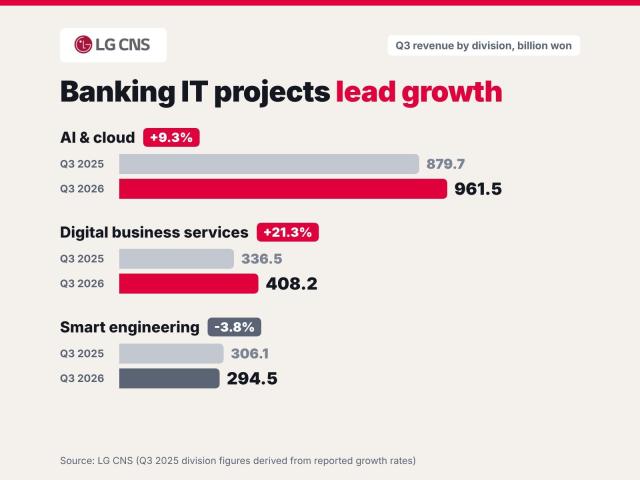
LG CNS on Oct. 30 posted in its preliminary earnings filing an operating profit of 138.2 billion won ($103.4 million) for the quarter ended September, up 15 percent from a year earlier. Growth in AI and cloud services and revenue from core banking system projects drove the increase. Revenue rose 9.3 percent to 1.66 trillion won. Digital business services posted the fastest growth of its three divisions, with revenue up 21.3 percent to 408.2 billion won. Smart engineering revenue edged down to 294.5 billion won as manufacturing activity slowed. Net profit fell 21.1 percent to 83 billion won.