Amazon has announced plans to sell its proprietary artificial intelligence (AI) chip, Trainium, externally, moving beyond its previous use solely within its cloud services. This marks Amazon's entry into the competitive global AI chip market, which has been dominated by Nvidia and AMD.During a conference call on October 29, CEO Andy Jassy stated, "Demand for Trainium is very strong, and we are receiving requests from customers to use the chips outside of Amazon Web Services (AWS). We plan to start doing so in late 2027." He added, "Selling chips externally will be a very significant business and will be entirely different from providing cloud infrastructure." This decision is seen as a strategic move to reduce reliance on expensive Nvidia graphics processing units (GPUs) and signals Amazon's intent to directly compete with Nvidia and AMD in the market.With Google already selling its own AI chip, the Tensor Processing Unit (TPU), Amazon's entry into external sales is expected to accelerate changes in the ecosystem of big tech companies developing their own chips.In response to the explosive demand for AI, Amazon is also rapidly expanding its core AWS infrastructure. Jassy noted, "We are currently adding one AI accelerator approximately every 14 seconds, and customers are eagerly consuming the increased capacity." As a result of these infrastructure investments, AWS reported third-quarter revenue of $46 billion, a 39.3% increase compared to the same period last year, marking its fastest growth in five years. The current backlog stands at $578 billion.Jassy acknowledged some negative factors, such as rising memory prices, but reaffirmed plans for a total capital expenditure (CAPEX) of $220 billion this year, primarily focused on building AI data centers. He projected that AWS revenue would grow by 40% in both 2027 and 2028, transforming into a $1 trillion business within the next 5 to 10 years.Additionally, Amazon reported explosive growth for its enterprise AI platform, Bedrock, with token processing volume increasing 17-fold and spending by Fortune 500 companies rising seven times.Regarding concerns about potential advertising revenue impacts from external AI agents like Meta's Muse and OpenAI's DALL-E, Jassy stated, "The majority of consumers still prefer to access retail sites directly." He added that Alexa, which combines customer purchase history with a streamlined payment ecosystem, will maintain its competitive edge.* This article has been translated by AI.
The collapse at the Ulsan Power Plant last November, which resulted in the deaths of seven workers, was caused by excessive cutting of columns during demolition work and miscalculations of the structure's load. The actual thickness of the columns was 15mm, but during the structural review, it was incorrectly applied as 24mm, indicating a combination of foundational data errors and inadequate safety assessments.On October 30, the Ministry of Land, Infrastructure and Transport released the findings of the investigation by the Ulsan Power Plant demolition accident investigation committee. The incident occurred on November 6 at the Ulsan Power Plant during the demolition of Units 4 to 6, specifically during the pre-weakening work on Boiler Tower No. 5, resulting in seven fatalities and two injuries.The investigation revealed that the accident began during the pre-weakening work, where columns and beams were cut before blasting. The columns were cut beyond their load-bearing limits, leading to local buckling and subsequent chain collapse of the entire structure.The foundational data used in the structural review was also found to be incorrect. The actual boiler tower had a design where the thickness of the columns decreased as the height increased, but only one measurement from the ground level was applied to the entire upper structure. The actual thickness of the steel plates at the initial collapse point, between 26.2m and 27.2m high, was 15mm, while the structural review used 24mm. Additionally, the weight of the structure was calculated to be 3,005.8 tons, which is 520 tons less than the actual weight of 3,525.8 tons.Safety assessments were also deemed insufficient. The possibility of local buckling due to the remaining columns being unable to bear the load was not considered, nor was there any safety margin to account for deformation of aging structures or damage during work. The investigation committee conducted a detailed structural analysis reflecting the actual dimensions and weight of the structure, predicting that local buckling would occur at the point where the collapse began.The investigation also confirmed management deficiencies by both the construction company and the client. The main contractor relied on the judgment of a specialized company for the weakening and blasting work without adequately verifying the consistency between the final construction details and site conditions. The client was found to have inadequately managed the work of participating entities while supervising the project directly without a separate construction project manager.To prevent future incidents, the investigation committee proposed strengthening site inspections for demolition work, establishing technical standards, enhancing design and construction management for high-risk demolition projects, and expanding client responsibilities. Lee Kyung-gu, the committee chair, stated, "We hope the results of the accident investigation will help prevent similar incidents," adding that a final report will be submitted to the Ministry of Land in November.The Ministry plans to develop improvement measures for demolition work based on the findings of this investigation and the investigation results of the SeoSeoMun High School demolition accident. Additionally, the ministry intends to notify relevant agencies to facilitate administrative actions and investigations regarding any legal violations.* This article has been translated by AI.
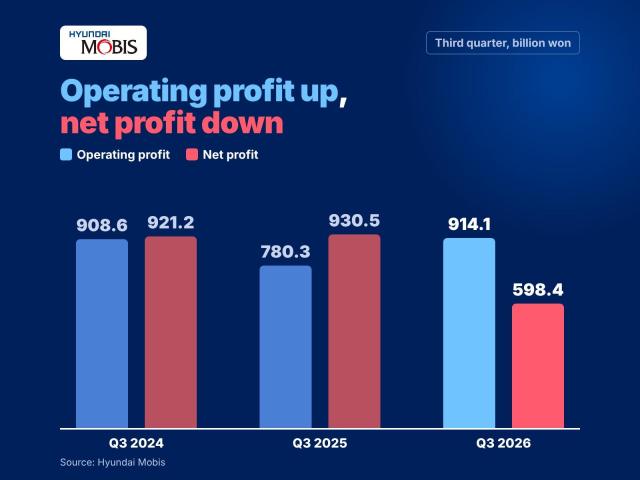
Hyundai Mobis on Oct. 30 posted in its preliminary earnings filing an operating profit of 914.1 billion won ($683.3 million) for the quarter ended September, up 17.2 percent from a year earlier. Higher sales of electric vehicle parts in Europe and steady after-sales parts sales drove the increase. Revenue rose 4.6 percent to 15.72 trillion won. Third-quarter operating profit returned to the level of 2024, when it was 908.6 billion won, after falling 14.1 percent in 2025 as tariff costs mounted. Net profit fell 35.7 percent to 598.4 billion won, its lowest third-quarter level in at least three years.
Hyundai Motor Group is moving forward with the construction of an artificial intelligence (AI) data center, accelerating its investment in the Saemangeum AI Valley. On October 30, the group announced that its affiliates had finalized their investment participation in the construction and operation of the AI data center after thorough review. Participating companies include Hyundai Motor, Kia, Hyundai Mobis, Hyundai Construction, and Hyundai AutoEver. Following the establishment of a special purpose company (SPC) for a 200 MW solar power project last month and the initiation of the AI data center's construction review process, two SPCs dedicated to the AI data center project will officially launch in November. The newly established companies will include a 'Data Center SPC' responsible for constructing hyper-scale data centers and infrastructure, and a 'GPU Service SPC' that will secure high-performance graphics processing units (GPUs) to provide services. Construction is planned to begin in March next year, with official services expected to start in early 2030. In February, Hyundai Motor Group announced plans to develop facilities on approximately 340,000 pyeong of land in the Saemangeum area, including an AI data center (58 trillion won), a robotics manufacturing and parts cluster (4 trillion won), an electrolysis plant (10 trillion won), solar power facilities (13 trillion won), and an AI hydrogen city (4 trillion won). Additionally, on the same day, the 'HMG Saemangeum Office' opened in Gunsan, North Jeolla Province. This office will house dedicated personnel to provide one-stop support for site permits, construction, project management, and communication with relevant government departments. Shin Seung-kyu, Vice President of Hyundai Motor Group's RH PMO, stated, "We plan to prioritize the construction of the AI data center in Saemangeum to accumulate and learn from large-scale data for the internalization of autonomous driving and physical AI technologies. The HMG Saemangeum Office symbolizes our commitment to advancing this project without disruption." Hyundai Motor Group aims to complete the Saemangeum AI data center and solar power facilities by 2029. The AI data center is intended to serve as a core infrastructure supporting the development of autonomous driving and robotics, among other physical AI technologies.* This article has been translated by AI.
북한이 한국군 감시초소(GP)와 K9 자주포, 미군 M1 에이브럼스 전차 등으로 추정되는 표적을 무인기로 타격하는 장면을 공개했다. 전술 자폭 무인기와 순항미사일뿐 아니라 핵탄두 탑재가 가능한 600㎜ 초대형 방사포까지 한꺼번에 동원해 대남 정밀타격 능력을 과시했다. 조선중앙통신은 김정은 북한 국무위원장이 지난 29일 열린 ‘무인항공기술발전-2026’ 전시회를 참관하고 무인기와 주요 무기체계의 위력 시위를 지켜봤다고 30일 보도했다. 전시장에는 전략·작전전술급 다목적 무인기와 자폭 무인공격기를 비롯해 30여종의 무인기가 등장했다. 북한은 전술 자폭 무인공격기와 다목적 무인기에서 발사한 공대지 미사일, 순항비행탄이 섬 표적을 “100%의 명중 정확도”로 타격했다고 주장했다. 북한 매체가 공개한 사진에는 자폭 무인기가 한국군 GP와 대포병레이더, K9 자주포, 미군 M1 에이브럼스 전차로 보이는 모의 표적을 공격하는 모습도 담겼다. 스텔스 형상 무인기와 일인칭 시점(FPV) 자폭 무인기, 무인기에서 발사되는 전술순항비행탄 등도 처음 공개된 것으로 분석됐다. 600㎜ 초대형 방사포의 대규모 동시사격도 이어졌다. 북한은 이 무기를 일명 ‘저격수’라고 부르며 전투사격을 군중 앞에 처음 공개했다고 밝혔다. 공개된 사진상 약 15발이 동시에 발사된 것으로 추정된다. 북한은 600㎜ 방사포를 전술핵탄두 ‘화산-31’을 탑재할 수 있는 핵심 전략무기체계로 선전해 왔다. 김 위원장은 “힘이 곧 평화이고 평화는 힘으로만 담보된다”며 “핵보유국의 기능을 점거하고 재래식 무력 강화에서도 비약적인 갱신을 이루는 것처럼 무인항공기술과 국방 인공지능 분야에서도 기적적인 결실을 만들어야 한다”고 강조했다. 양무진 북한대학원대학교 석좌교수는 “북한이 핵무력과 재래식 전력, 무인항공 전력을 중심으로 군사력을 강화하겠다는 구상을 재확인한 것”이라며 “무인기의 정찰·유도 기능과 초대형 방사포의 타격 능력을 결합해 대남 군사적 우위를 과시하려는 의도가 담겼다”고 분석했다.* This article has been translated by AI.
The Korea Small Business and Startups Agency (KOSME) announced on October 30 that it supported private investment attraction for 11 regional youth startups during the "2026 KOSME IR Mart for Regional Specialized Enterprises."The event, held on October 29 at the Four Points by Sheraton in Gangnam, Seoul, aimed to provide opportunities for private investment in youth startups with innovative technologies and growth potential based on regionally specialized industries, thereby strengthening the growth foundation of local startups.Approximately 30 representatives from venture capital firms and accelerators attended the event alongside the 11 youth startups recommended by youth entrepreneurship training centers nationwide.The participating companies showcased technologies and business models across various fields, including artificial intelligence, robotics, biotechnology, and smart equipment, presenting their market competitiveness, commercialization achievements, and future growth strategies.Following the presentations, one-on-one consultations with investment institutions and networking opportunities between companies and investors were conducted.Prior to the event, KOSME provided training to enhance the investment attraction capabilities of participating companies, including assistance in designing presentation materials and creating investment proposal documents that encapsulate each company's core technologies and business visions.After the event, KOSME plans to offer feedback based on evaluations from investment reviewers, highlighting each company's strengths and areas for improvement to help refine their business models and investment attraction strategies.Jo Han-kyu, Director of Human Resource Development at KOSME, stated, "The growth of regionally specialized youth startups is a foundation for enhancing the competitiveness of local industries. We will actively support promising youth startups in the region to strengthen their competitiveness and grow into innovative companies that drive the local economy."Additionally, KOSME reported on October 29 that through its youth entrepreneurship training program in Colombia, it provided education and mentoring to 596 local young entrepreneurs this year and supported investment attraction and international expansion for 100 technology-driven startups.* This article has been translated by AI.
The Global Church Growth Conference, commemorating the 50th anniversary of the International Church Growth Institute (CGI), will culminate in a prayer gathering at the Jamsil Student Gymnasium in Seoul on October 31. Under the theme "Spirit Across Generations," the conference, which began on October 28, has attracted over 3,000 pastors and missionaries from more than 50 countries. CGI was established in 1976 based on the ministry of the late Rev. Yonggi Cho. Over the past 50 years, it has hosted more than 600 seminars in 100 countries, promoting church growth and the Spirit movement. The prayer gathering on October 31 will kick off at 9 a.m. with a 73rd anniversary concert by Hansei University, followed by the CGI 50th Anniversary Prayer Gathering. Speakers will include Rev. Lee Yong-hoon, senior pastor of Yoido Full Gospel Church, along with Rev. James Morroco, Rev. John Milton Rodriguez, and Rev. Dag Heward-Mills. Rev. William Wilson is also expected to deliver a congratulatory message. Earlier, the opening ceremony held on October 28 at the main sanctuary of Yoido Full Gospel Church drew around 20,000 attendees, including overseas pastors, missionaries, and local congregants. Rev. Lee Yong-hoon, the second president of CGI, emphasized in his sermon titled "Arise and Shine" that the core driving force behind the revival of Yoido Full Gospel Church has been prayer, rather than systems or programs, highlighting the importance of repentance, the Word, unwavering faith, and prayer. During the conference, 20 workshops will cover topics such as next-generation ministry, missions, church planting, and media. On October 30, the Osanri Prayer Mountain Spirit Gathering and the Yoido Full Gospel Church Friday Spirit Gathering will take place. The conference will conclude on November 1 with a Sunday service at Yoido Full Gospel Church featuring international speakers. A CGI representative stated, "This 50th anniversary conference will not only commemorate the church growth history of the past half-century but also serve as a turning point for passing on the Spirit movement to the next generation."* This article has been translated by AI.
Han Byeong-do, the floor leader of the Democratic Party, on October 30, called for disciplinary action against Kim Tae-kyu, Lee Jin-sook, and Joo Jin-woo of the People Power Party, stating that their "outrageous remarks and actions as the 'three miscreants' continued throughout the national audit period."During a Supreme Council meeting held at the National Assembly, Han stated, "Silence is complicity, and complicity is agreement."He criticized Kim, who was present at the National Assembly's Operations Committee audit despite a resolution passed on October 2 calling for his expulsion due to his remarks denying the insurrection of Chun Doo-hwan and Yoon Suk-yeol. Han noted, "Kim refused to apologize and the People Power Party responded to the Democratic Party's demand for resignation by saying, 'We don't understand.' That member and that party," he said.Han further demanded that Kim, who has defended actions undermining constitutional order, "apologize to the public and resign from the Operations Committee."He also urged the People Power Party leadership to discipline Kim, along with another member who distorted the May 18 incident and Joo, who has engaged in cyber-stalking politics against the president and first lady.Specifically addressing Joo, Han remarked, "The political attacks have shifted from the president to the first lady, and now to the president's children," adding that accusations are being made without even the most basic verification procedures.He warned, "When lies are exposed, they turn themselves into victims, and they must take full responsibility for every word they utter and every accusation they make."* This article has been translated by AI.
The government and the financial sector will inject an additional 800 billion won into microfinance aimed at supporting low-income and vulnerable groups. This funding will double the annual microfinance supply to 600 billion won by 2028 and expand tailored financial products for youth and small business owners.The Financial Services Commission announced on October 30 that it held a 'microfinance funding donation agreement ceremony' at the Korea Financial Services Agency in Seoul, attended by Samsung Life Insurance, NH Nonghyup Financial Group, Shinhan, Woori, KB Kookmin, Hana, and IBK Industrial Bank, among others.Under this agreement, Samsung will contribute 200 billion won, while NH Nonghyup Financial, Shinhan Financial, Woori, KB Kookmin, Hana, and IBK Industrial Bank will each contribute 100 billion won. The total of 800 billion won will be paid in installments to each microfinance foundation over a maximum of five years.Based on this funding, the Financial Services Commission plans to gradually increase the microfinance supply from 400 billion won this year to 500 billion won next year, reaching 600 billion won by 2028. This represents a doubling compared to the previous annual level of 300 billion won.NH Nonghyup Financial plans to establish a separate microfinance foundation within this year and will begin providing funds to financially vulnerable groups in rural areas starting in the first quarter of next year. It will open eight branches nationwide in succession and introduce loans for low-credit farmers and young farmers for agricultural startup and operational funds.Specialized products will also be expanded by each foundation. The KB Microfinance Foundation will launch a product next month offering loans of up to 5 million won at an interest rate of 2.5% to 4.5% for young delivery platform workers aged 19 to 39. The Shinhan Microfinance Foundation provides asset formation support of up to 300,000 won quarterly, totaling 3 million won, to young loan borrowers who repay diligently.As of September this year, the Financial Services Commission plans to expand the number of microfinance branches from 168 to over 180 next year and establish a consultative body chaired by the vice chairman of the Financial Services Commission to regularly address field challenges and institutional improvement tasks.Lee Ok-yeon, chairman of the Financial Services Commission, emphasized, "Microfinance is an alternative financial model for South Korea that relies on social capital built on trust and relationships. Beyond funding, a more meticulous delivery system and the role of the field are of utmost importance."
SEOUL, October 30 (AJP) - South Korean stocks plunged nearly 4 percent in early morning trading on Friday, extending losses from the previous session as a selloff in U.S. technology shares weighed on the market and investors broadly sold shares of major companies in Seoul. Even record quarterly earnings from chipmakers Samsung Electronics and SK hynix failed to cushion the slide. The benchmark KOSPI stood at 5,706.68 points as of around 9:10 a.m., down 3.89 percent from Thursday's close of 5,937.66. The sharp decline followed a 1.24 percent loss the previous day, when the index surrendered the 6,000 mark just one session after reclaiming it. Foreign investors sold a net 72.2 billion won (US$53.9 million) of KOSPI shares, while institutions unloaded 88.3 billion won. Retail investors bought a net 141.8 billion won, absorbing part of the selling. Decliners outnumbered advancers 706 to 121. The heaviest pressure fell on semiconductor stocks, reversing much of the optimism generated by record third-quarter earnings and shareholder returns announced by the country's two largest chipmakers earlier this week. Samsung Electronics fell 3.45 percent to 224,000 won, while SK hynix plunged 7.01 percent to 1,419,000 won close to the opening bell. Samsung Electronics' preferred shares dropped 5.06 percent to 174,600 won, while SK Square, a major shareholder in SK hynix, declined 5.14 percent to 904,000 won. The losses came despite strong quarterly profits from both chipmakers. Samsung reported third-quarter operating profit of 107.4 trillion won Thursday and announced a 30 trillion won quarterly dividend, bringing its planned shareholder returns for 2026 to as much as 110 trillion won. Its rival SK hynix also reported record third-quarter operating profit of 83.33 trillion won Wednesday, alongside major shareholder returns and long-term supply agreements covering more than half of its planned production capacity for 2027 and 2028. The announcements initially supported chip shares, but Friday's selloff showed that strong earnings alone were no longer enough to reassure investors. The latest blow came from Wall Street overnight, where Google parent Alphabet plunged 12.64 percent after revenue fell short of market expectations and rising artificial intelligence (AI)-related spending reignited concerns over whether massive infrastructure investments would generate sufficient returns. The Nasdaq Composite fell 1.38 percent, while the S&P 500 declined 0.30 percent and the Dow Jones Industrial Average slipped 0.25 percent. Semiconductor shares also weakened, with Micron Technology dropping 4.98 percent and Advanced Micro Devices (AMD) losing 2.08 percent. The Philadelphia Semiconductor Index fell 1.42 percent, adding to concerns over the outlook for chip stocks in Seoul. The renewed AI concerns struck an already volatile Korean market. The KOSPI had surged a combined 9.93 percent over two sessions through Wednesday, buoyed by foreign buying and strong semiconductor earnings, before retreating Thursday. Friday's losses threatened to erase much of that rebound as foreign investors shifted back to selling. The downturn spread well beyond chipmakers. Samsung Electro-Mechanics sank 7.19 percent to 1,200,000 won, while battery maker LG Energy Solution fell 1.40 percent to 351,000 won. Hyundai Motor dropped 3.08 percent to 283,500 won, while financial stocks also weakened, with KB Financial Group losing 2.30 percent to 153,200 won. In healthcare, Samsung Biologics declined 0.59 percent to 1,358,000 won, while Samsung Life Insurance fell 3.96 percent to 267,000 won. The junior KOSDAQ index also suffered heavy losses, sliding 3.17 percent to 729.32 as of around 9:10 a.m. from Thursday's close of 753.23. Foreign investors sold a net 22.7 billion won, while institutions unloaded 26.4 billion won. Retail investors bought a net 58.9 billion won. Decliners overwhelmed advancers 1,385 to 235. Selling spread across biotechnology, battery materials, robotics and semiconductor equipment makers. Alteogen, a biotechnology company developing drug-delivery technologies that allow intravenous medicines to be administered through subcutaneous injections, fell 1.82 percent to 216,000 won. HLB, a biotechnology group focused on cancer treatments, lost 2.02 percent to 38,900 won. Battery-related shares also declined. EcoPro, the holding company of a battery-materials group, dropped 2.32 percent to 71,600 won, while its cathode-materials subsidiary EcoPro BM fell 2.28 percent to 89,900 won. Among technology stocks, semiconductor deposition equipment maker Jusung Engineering slid 4.46 percent to 169,100 won. EO Technics, a maker of laser processing equipment used in semiconductor and display production, plunged 6.39 percent to 388,500 won. Robotics shares were also caught in the selloff. Rainbow Robotics, a developer of industrial and humanoid robots, fell 5.16 percent to 358,500 won. The South Korean won, meanwhile, traded at 1,337.7 per dollar, compared with 1,336.8 in the previous session.