


Latest by
-
 SK hynix Unveils Full Lineup of AI Memory Products at Dell Forum SK hynix is expanding its collaboration with global clients by showcasing a comprehensive range of memory products for artificial intelligence (AI) data centers. The company is highlighting its capabilities in the AI infrastructure market by broadening its portfolio to include high-bandwidth memory (HBM), server DRAM, and enterprise solid-state drives (SSDs).On August 25, SK hynix participated in the 'Dell Technologies Forum 2026' held at COEX in Gangnam, Seoul, where it unveiled AI memory products, including HBM4 and HBM4E. The event featured physical HBM4 wafers, as well as SOCAMM2 server DRAM and three-dimensional stacked memory modules.The company also displayed enterprise SSDs, including products that support liquid cooling, high-capacity and low-power options, and its first quad-level cell (QLC) based enterprise SSD. These products are designed to meet the growing demands for computation, data storage, and processing in AI data centers.Notably, SK hynix delivered a keynote speech at the forum as a representative partner of Dell for the first time. Vice President Joo Young-pyo, in charge of system architecture, discussed the role of memory technology in the AI era and the direction of next-generation technologies.SK hynix began mass production of HBM4 for major clients in the second quarter of this year and is currently expanding its production capacity. The company has supplied 12-layer product samples of HBM4E to key customers and is preparing for mass production next year.Industry experts believe that as competition in AI infrastructure expands beyond GPU performance to include overall system optimization involving memory and storage, collaboration between memory manufacturers and server companies will become increasingly important.A representative from SK hynix stated, "We have solidified our partnership with Dell and showcased our technological capabilities as a full-stack AI memory company. We will expand our strategic partnerships with global tech giants."* This article has been translated by AI. 2026-08-26 09:52:10
 -
New Public Housing Sites May Exclude Seoul Greenbelt and Yongsan Park The government is expected to exclude Seoul's greenbelt and Yongsan Park from new public housing sites to be announced at the end of September or early October, following the housing supply measures introduced on August 13. With no agreement reached with the Seoul city government, additional sites are likely to be selected from greenbelt areas in Gyeonggi Province, such as Hanam and Goyang, which are close to Seoul. According to government sources on the 26th, the Ministry of Land, Infrastructure and Transport plans to unveil over 73,000 new public housing units next month, which are part of the remaining supply from the August 13 measures. Kim I-tak, the first vice minister of the ministry, stated on KTV on the 24th, “The greenbelt areas in Seoul are not included.” Yongsan Park is also expected to be excluded from the announcement due to unresolved differences with the Seoul city government. Previously, the government announced on August 13 that it would develop new housing sites for 27,200 units in three locations, including Gangseo District in Seoul and Namyangju and Gwangju in Gyeonggi Province. The plan aims to designate over 73,000 additional units by the end of the year, securing more than 100,000 new public housing units in the metropolitan area. Initially, there were expectations that the greenbelt areas in Seoul could be included in the new housing sites, as the government had designated some areas in Seoul and the metropolitan region as land transaction permission zones. There were also discussions about utilizing parts of Yongsan Park to provide housing for young people and newlyweds. However, the Seoul city government has consistently opposed the development of both the greenbelt and Yongsan Park. They argue that the greenbelt should be preserved for future generations and that the existing plan to develop Yongsan Park as a national park must be upheld. The government appears to have concluded that it is difficult to include sites without agreement from the Seoul city government. As a result, the additional housing sites are expected to be announced primarily in Gyeonggi Province. The areas designated as land transaction permission zones following the August 13 measures include ten cities in Gyeonggi Province—Seongnam, Uijeongbu, Anyang, Bucheon, Gwangmyeong, Goyang, Gwacheon, Guri, Hanam, and Gimpo—as well as Gyeyang District in Incheon. Industry insiders have identified the Gambuk District in Hanam as a strong candidate for one of the new sites. Located adjacent to Songpa and Gangdong Districts in Seoul, Gambuk was designated as a housing site for about 20,000 units in 2010 but had its designation revoked in 2015 due to resident opposition and project delays. The area around Daegok Station in Goyang, known for its excellent transportation conditions, is also being considered. The Seoul city government is proposing to utilize alternative sites instead of developing Yongsan Park. On the 25th, Seoul Mayor Oh Se-hoon suggested relocating the Tancheon Water Reclamation Center in Gangnam District and creating a “Southeast Youth-Specialized Industrial Complex” that combines residential and high-tech industrial facilities. The city estimates that utilizing about half of the 400,000 to 500,000 square meters of land for residential purposes could provide between 10,000 and 13,000 housing units. While both the government and the Seoul city government agree on the need to expand housing supply in the city center, ongoing conflicts over the preservation of valuable land may significantly affect the actual pace of supply, depending on the selection of housing sites in Gyeonggi Province and the outcomes of discussions on alternative sites. Meanwhile, Minister of Land, Infrastructure and Transport Kim Yoon-deok and Mayor Oh are scheduled to meet on the morning of the 26th to discuss new housing sites and supply plans for the Seoul city center. The key issues will likely revolve around narrowing the differences regarding the development of the Seoul greenbelt and Yongsan Park, as well as whether the government will accept the Seoul city government's proposals for alternative sites, such as the Tancheon Water Reclamation Center. 2026-08-26 09:52:00
-
SK Innovation Shares Plunge 14% Following Merger Announcement with SKIET SK Innovation's shares fell by over 14% in early trading after the company announced it would absorb its battery separator subsidiary, SK IE Technology (SKIET). Meanwhile, SKIET's stock rose by more than 5%, reflecting mixed market reactions.As of 9:25 a.m. on the Korea Exchange, SK Innovation's shares were trading at 107,400 won, down 14.08% or 17,600 won from the previous trading day. In contrast, SKIET's shares were up 5.28% at the same time.Both companies held board meetings the previous day, where they approved the merger plan. SK Innovation will absorb SKIET, with SK Innovation remaining as the surviving entity and SKIET being dissolved.The merger ratio was set at 1 to 0.1174540, meaning that for each share of SKIET, shareholders will receive approximately 0.117 shares of SK Innovation.The companies plan to finalize the merger on January 1, following board and shareholder approvals on November 24. New shares of SK Innovation resulting from the merger are expected to be listed on January 18.Market analysts view the merger as a strategy to enhance operational efficiency and financial stability by integrating SKIET, which has been struggling with poor performance. However, there are concerns that absorbing a loss-making subsidiary could increase SK Innovation's financial burden, which may have contributed to the decline in its stock price.SKIET has faced declining profitability due to a slowdown in the electric vehicle market and intensified price competition with Chinese firms, reporting operating losses of 291 billion won in 2024 and 246.4 billion won the previous year, along with a 63.5 billion won operating loss in the second quarter of this year.* This article has been translated by AI. 2026-08-26 09:52:00
-
Shinhan Financial Partners with Visa to Advance Stablecoin Payments 신한금융그룹이 글로벌 결제기업 비자와 손잡고 미래 결제사업 개발에 나선다. 신한금융은 서울 중구 본사에서 비자와 디지털자산·AI 기반 결제와 기업 간 거래(B2B) 등 미래금융 사업 추진을 위한 전략적 업무협약을 체결했다고 26일 밝혔다.이번 협약은 지난 4월 양사 주요 경영진이 논의한 미래금융 분야 협력 방향을 구체화한 것이다. 양사는 우선 스테이블코인 활용을 위한 금융 인프라 구축에 협력한다. 신한금융은 비자의 스테이블코인 플랫폼을 활용해 발행·송금·상환 등 핵심 기능을 검증하고 국내 금융환경에 적합한 한국형 사업모델을 공동 설계할 계획이다.스테이블코인을 활용한 카드대금 정산 등 금융서비스 개발도 추진한다. 이와 함께 AI 기반 미래 결제모델 구현과 B2B·기업과 소비자 간 거래(B2C) 결제사업 확대를 위한 공동 실증 및 차세대 금융서비스 개발에도 나선다.신한금융은 은행·카드·제주은행 등 주요 계열사의 금융 역량과 비자의 글로벌 결제 네트워크 및 디지털 기술을 결합해 국내외 디지털 금융시장 변화에 대응한다는 방침이다.진옥동 신한금융 회장은 “이번 협약을 통해 비자와의 오랜 파트너십을 디지털 금융 전반으로 확장하게 됐다”며 “신한의 금융 역량과 비자의 글로벌 인프라를 결합해 새로운 미래금융 모델을 함께 설계하고 고객에게 차별화된 금융 경험을 선보이겠다”고 말했다. * This article has been translated by AI. 2026-08-26 09:48:00
-
Song Hyung-gon Calls for Development of Fisheries as a Future Industry Song Hyung-gon, the chair of the Jeonnam Gwangju Special City Council, emphasized the need to develop the fisheries sector into a future growth industry that integrates production, processing, distribution, and export. According to the Jeonnam Gwangju Special City Council, Song made these remarks during the 12th Jeonnam Gwangju Special City Fisheries Management Conference held at the Yeonggwang Sportium National Sports Center on August 25. He highlighted the growth potential of the local fisheries industry and the necessity to enhance its competitiveness. Song particularly stressed the importance of recognizing the industrial value of fisheries amid discussions focused on advanced industries like AI and semiconductors. He stated, “The site of industry is not limited to places with factory chimneys,” and assessed Jeonnam Gwangju as a key hub for fisheries that not only supports the dining tables of South Korea but also connects to global markets. He further proposed that the fisheries sector should evolve into a converged industry that links production with processing, distribution, and export. Song remarked, “The sea itself is an industrial complex,” emphasizing the importance of organically combining resources, technology, capital, and human resources to enhance the competitiveness of the fisheries industry. The conference, themed “The Sea of Jeonnam Gwangju, Creating a Sustainable Future Together,” is taking place from August 25 to 26 in Yeonggwang, with over 3,000 participants, including fisheries managers from 15 cities and counties and marine and fisheries officials, seeking to explore the development direction of the local fisheries industry. The opening ceremony on August 25 was attended by Min Hyung-bae, the mayor of Jeonnam Gwangju Special City, council members, and heads of marine and fisheries-related organizations, featuring awards for outstanding individuals, scholarship presentations for talent development, and the reading of a resolution. Chair Song expressed hope that this event would serve as an opportunity to read the rapidly changing market trends together and find a path for greater advancement, while also thanking fisheries managers for their roles and efforts. Meanwhile, the Korean Fisheries Management Association of Jeonnam Gwangju Special City was established in 1991 and currently has 15 branches with over 12,000 members actively participating.* This article has been translated by AI. 2026-08-26 09:48:00
-
KB Kookmin Card Expands Financial and Digital Education for Youth, Engaging 3,460 Participants KB Kookmin Card announced on August 26 that it is launching a social contribution initiative aimed at enhancing financial literacy and digital skills among youth. The program, titled 'KB Kookmin Card Joyful Financial Classroom,' will conduct a total of 150 educational sessions for approximately 3,000 youths affiliated with youth facilities and elementary, middle, and high schools across the country. Professional financial educators will visit the participating institutions to provide age-appropriate training. Elementary students will learn basic financial concepts such as currency management and credit management, while middle and high school students will receive practical financial knowledge related to consumption, credit, savings, financial careers, and risk management. The program will also incorporate board games focused on topics like exchange rates, allowance management, credit, and investment to help students grasp financial concepts and principles more easily through experiential learning. In rural areas where digital education infrastructure is relatively lacking, KB Kookmin Card will operate the 'KB Kookmin Card Joyful Digital Classroom.' This year, around 460 students in grades 4 to 6 from 23 elementary schools nationwide are expected to participate. Students will learn about the principles and applications of generative artificial intelligence (AI) and engage in activities such as creating AI chatbots in the 'Barrier-Free AI Challenge' and completing robot missions using block coding in the 'Green Challenge with Robots.' KB Kookmin Card plans to train about 23 women with digital expertise as professional instructors to be dispatched to educational sites. This initiative aims to reduce the digital education gap in rural areas while also expanding economic participation opportunities for women with professional backgrounds.* This article has been translated by AI. 2026-08-26 09:44:10
-
Woori Bank to Provide 1 Trillion Won in Financial Support for Semiconductor and AI Industries Woori Bank is partnering with the Technology Guarantee Fund to provide 1 trillion won in financial support for future strategic industries, including semiconductors, physical artificial intelligence (AI), and AI data centers.On August 25, Woori Bank announced that it had signed a memorandum of understanding for the 'K-SPARK Korea Leap Forward Productive Finance Support' with the Technology Guarantee Fund.'K-SPARK' is a joint financial support system established by Woori Bank and the Technology Guarantee Fund to expand financial assistance for advanced industries such as semiconductors, physical AI, and AI data centers.Under the agreement, Woori Bank will provide special contributions and guarantee fee support to the Technology Guarantee Fund, which will then offer loans totaling 1 trillion won to small and venture companies with technological capabilities and growth potential. Additionally, to alleviate the financial burden on these companies, benefits such as increased guarantee ratios and a 1.0 percentage point reduction in guarantee fees will be provided.Jung Jin-wan, President of Woori Bank, stated, "I hope this agreement will provide practical assistance in financing companies related to semiconductors, physical AI, and AI data centers. We will continue to actively contribute to enhancing the global competitiveness of our companies and the national industrial competitiveness." 2026-08-26 09:44:00
-
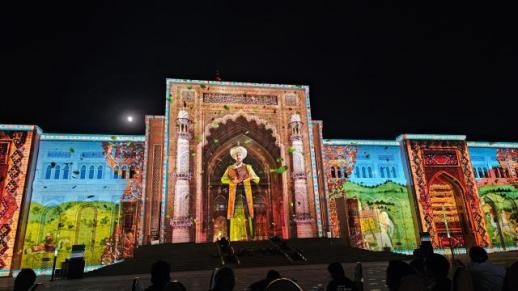 Tashkent turns Islamic heritage into living technology TASHKENT, August 26 (AJP) -For roughly 40 minutes Tuesday night, the massive façade of Uzbekistan's new Center for Islamic Civilization became a screen for a different telling of Islamic history. Astronomers, physicians, thinkers and poets appeared across the building in light, animation and digital imagery as music accompanied a narrative tracing the contribution of scholars from present-day Uzbekistan and the wider Islamic world to science, medicine, literature and other fields. The projection mapping show was followed by traditional Uzbek music and opera. The evening was more than an elaborate cultural performance staged for hundreds of foreign media executives, journalists, filmmakers and scholars visiting Tashkent. It distilled the ambition behind the center itself. Uzbekistan is seeking to present Islamic civilization not primarily through religion or monuments, but through a history of science, learning and intellectual exchange — and to use the tools of modern information technology to make that history understandable to a global generation raised on screens. Inside the same complex are ancient manuscripts and conventional museum collections alongside artificial intelligence avatars, immersive displays and a developing virtual-reality tour. The Center for Islamic Civilization, built on nearly 10 hectares beside Tashkent's historic Hazrati Imam complex, officially opened on March 17. Its galleries stretch from pre-Islamic Central Asia through what Uzbekistan describes as its first and second renaissances and toward President Shavkat Mirziyoyev's vision of a new "Third Renaissance." Mirziyoyev first presented the idea internationally at the United Nations General Assembly in September 2017, arguing that Islam should be associated with peace, human values and the pursuit of knowledge rather than violence and bloodshed. Construction began the following year. Eight years later, the question for Uzbekistan is no longer simply how to preserve that heritage, but to draw global attention. It is why the International Media Forum, "Islamic Civilization: A New Perspective — New Discoveries" was deliberately staged at the center by bringing in around 300 journalists, media executives, filmmakers, scholars and technology specialists from nearly 50 countries this week. And seen from inside the center, rather than through a government statement or museum brochure, the strategy becomes easier to understand. The building is intended not just as a repository of objects but as a communications platform. Imran Ahmad, regional representative for CNN International Commercial, told the forum that Uzbekistan did not lack stories. The difficulty was making those stories relevant to audiences elsewhere. Ahmad recalled visiting the country about two decades ago and again five years ago, saying the speed of modernization and a new sense of energy were immediately visible. Uzbekistan, he noted, occupied the heart of the ancient Silk Road and produced scholars who calculated the movement of the stars with extraordinary precision centuries ago. The question is how that history travels beyond Uzbekistan. Jahongir Ahmedov, first deputy culture minister and director of Uzbekistan's Cinematography Agency, said heritage should be something people can "see and hear and interact" with. Digital content, he said, would be particularly important in introducing younger Uzbeks to the achievements of earlier generations and turning that knowledge into a source of national confidence. The center provides a physical demonstration of what he meant. Visitors can move from manuscripts and historical exhibits into rooms where digital technologies attempt to reconstruct the people and ideas behind them. The same history can then be repackaged into films, books, immersive installations and online content. For Uzbekistan, that increasingly means treating cultural heritage not as a collection of objects to be viewed behind glass, but as an experience. The broader media forum has a similar ambition. Organizers say its central concept is to translate historical and spiritual heritage into the language of television, cinema, publishing, artificial intelligence and immersive museum technologies. Discussions this week cover the contributions of Islamic civilization to mathematics, astronomy, medicine, philosophy, literature, architecture and art. Ahmed Salim, founder of the British-based 1001 Inventions project, argued that doing so requires more than producing promotional material. "The most important message" is the stories societies choose to tell, he said, calling for what he described as "evergreen content" — films and other works that can continue to engage audiences across generations. Salim said the conventional historical narrative he encountered growing up in Britain moved from ancient Greece and Rome to Europe's so-called Dark Ages and then to the Renaissance, Galileo and Newton. That, he argued, presented an incomplete picture of human history. While scientific development slowed in parts of Europe, major advances were taking place elsewhere, including in the lands of present-day Uzbekistan and the wider Islamic world. Leaving those chapters out, Salim said, could foster both an inferiority complex among people whose history was ignored and a superiority complex among those taught that civilization advanced primarily through the West. Rediscovering those stories, he said, could produce not merely tolerance of other civilizations but "appreciation." Salim also emphasized "transmedia storytelling" — taking one historical story and redeveloping it across films, museum exhibitions, books, digital platforms and educational content. His organization has already been putting the idea into practice. Academy Award-winning actor Ben Kingsley narrates "Whispers of Wisdom," a film series created for the Center for Islamic Civilization about scholars and intellectual pioneers from Uzbekistan and the wider region. The production brings together the 1001 Foundation, Uzbek production company Spectre Films and director Shokhrukh Rasulov. Salim said one of his earlier productions on the history of science had reached an audience of more than 500 million people and continued to be shown in schools around the world — evidence, he argued, that historical content does not have to remain confined to museums or academic institutions. Rasulov told participants he had had the "privilege" of working with Kingsley in London on the first season of "Whispers of Wisdom." The series explores Uzbek scholars, historical figures and the legacies they left to the wider world. Rasulov said a second season was in preparation and that Benedict Cumberbatch, Ralph Fiennes, Liam Neeson, Mark Ruffalo and Antonio Banderas were among the actors being considered as its next host. Participants returning to the media forum next year could see the result, he said. Sergey Stanovkin, head of BBC Studios' commercial representation in Eurasia, approached the issue from the perspective of strategic communication. Uzbekistan's cultural heritage, he said, has the potential to become a source of national "soft power" if it is communicated internationally in ways that move beyond simply displaying a rich culture. That effort is increasingly extending into artificial intelligence. During the afternoon plenary session, Sirojiddin Ubaydullayev, director of Uzbek technology company NeoVex, demonstrated digital avatars being developed for the center. The project aims to allow visitors to speak directly with AI representations of historical scholars and figures rather than simply read descriptions about them. Ubaydullayev said the work began around two years ago and was initially complicated by inaccurate data and errors. Experts and researchers were therefore brought into the development process to improve the historical accuracy of both the avatars' appearance and their responses. "Our aim is to ensure visitors from all over the world" can interact with those ancestors, he said. The number of AI avatars at the center is now growing. A separate project is creating a 3D virtual tour accessible through mobile devices. Visitors using virtual-reality headsets will eventually be able to immerse themselves in reconstructed spaces, Ubaydullayev said, describing the current version as an initial prototype that is still being refined. The official forum program describes the projects as "Digital Avatar: Heroes of Islamic Civilization Speak to a New Generation" and "Uzbekistan 360°: A Living Heritage Platform." Yet technology was not presented as a replacement for more traditional ways of passing on knowledge. Hasanbey Kondu, chairman of Turkish publishing house Mega Basim, reminded participants that the forum was taking place at a time of geopolitical conflict and rapid technological change. Even in an age of artificial intelligence, he said, reading would never lose its importance. He pointed to "Iqra," meaning "Read," as a fundamental message of Islamic tradition, arguing that reading sharpens the mind and opens people to new perspectives. The symbolism is also built into the center itself. The word "Iqra" is inscribed on its Ulugh Beg Portal, which Mirziyoyev described at the center's March opening as reflecting the country's emphasis on science and education. During the day, participants debated how history can be translated into modern media without reducing it to promotion. At night, they watched one answer play across the building in light, sound and animation. Whether Uzbekistan can turn that spectacle into lasting global understanding remains an open question. AJP Takeaways Uzbekistan's Center for Islamic Civilization combines manuscripts and Islamic cultural heritage with AI avatars, virtual reality, film and immersive technologies to present Central Asia's historical contributions to science and learning to global audiences. • A nighttime multimedia show projected astronomy, medicine, literature and other achievements across the center's façade, visually capturing Uzbekistan's effort to link Islamic heritage with modern science and information technology. • International media and cultural figures at the Tashkent forum argued that Uzbekistan's challenge is not a shortage of historical material but turning overlooked Islamic and Central Asian scientific achievements into credible stories that global audiences can understand and appreciate. 2026-08-26 09:43:12
 -
Kangjin County Strengthens Community Welfare with Resident-Led Initiatives Kangjin County is taking steps to strengthen its community welfare system, empowering residents to identify and address local welfare issues. On August 25, Kangjin County conducted a training session titled '2026 Community Welfare Activation Support Project Capacity Building Training' at the Wellness Puso Center, attended by over 100 members, including chairs and members of the community service councils from various towns and villages. The training aimed to enhance the capacity of community service council members to respond effectively in the field, focusing on identifying welfare gaps and strengthening the local welfare safety net based on resident participation. Park Tae-young, director of the Korea Local Welfare Research Institute, explained the significance of resident participation and the process of residents discovering and solving community issues. He also presented practical strategies for the councils based on successful community welfare cases from across the country. Before the training, participants shared their commitment to identifying welfare gaps and implementing resident-centered community welfare practices. Representatives from 11 town and village community service councils and public chairs gathered to discuss building a local welfare safety net that involves both residents and administration. Kangjin County plans to continue this initiative beyond a one-time event, with on-site training in each town and village and visits to exemplary cases in other regions. From August 27 to 28, customized training will be conducted in Kangjin-eup, Chillyang-myeon, and Seongjeon-myeon, and on September 7, a visit to the community service council in Hwangdeung-myeon, Iksan City, is scheduled to observe community welfare operations. Kang Jin-won, the mayor of Kangjin County, stated, “The members of the community service councils, who know the local circumstances best, are the key players in discovering welfare gaps and connecting neighbors in need with the community. We will work to create a warm and tightly-knit welfare community that involves both residents and administration.”* This article has been translated by AI. 2026-08-26 09:40:10
-
Duolingo's Localized Marketing Strategy in South Korea Duolingo's green owl character is making waves on Instagram with various meme-based content. Offline, the app has made its presence felt at birthday cafes, Buddhist expos, and university festivals. By leveraging humor, character engagement, and fandom culture, Duolingo is expanding its user base in South Korea without relying on a rigid educational image.On August 26, we spoke with Ma Joo-yeon, Duolingo's country manager for South Korea, about the company's localization marketing and growth strategies.Ma, who joined Duolingo in October 2024 after a marketing career at global IT and content companies like Netflix and Line, noted that while Duolingo offered Korean language services, there was no dedicated team for the South Korean market at that time.According to Mobile Index, Duolingo's monthly active users (MAU) in South Korea surged from 620,000 in November 2024 to 2,082,084 in July 2026, a growth of approximately 3.4 times. In the same period, competitors like 'Malhaeboka' increased from 290,000 to 313,272 users, and 'Speak' grew from 240,000 to 266,546 users.As the domestic English learning app market expands, Duolingo has significantly widened its lead over competitors. Data from Mobile Index's core audience report indicates that in July, Duolingo accounted for 57.1% of the top 20% of users by app usage time among English learning apps. This growth, along with Duolingo's strategy to encourage daily app visits, has garnered attention in the local app industry.Ma's initial focus for the South Korean market was on Duolingo's positioning. He stated, "We aimed to make it less about education and more about lifestyle. Our priority is to ensure that Korean users do not perceive it as a boring language study app, but rather as a tool they actively use."The 'loose' owl character, Duol, exemplifies this strategy. Ma is responsible for adjusting the character's humor to align with Korean culture and sensibilities.Ma emphasized the importance of not just attracting users with memes and characters but also encouraging repeat visits. He highlighted the 'Duo Birthday Party' campaign, which adapted Duolingo's global 'Streak Revival' initiative to a Korean context by incorporating the birthday cafe culture popular among K-pop fans.In June, Duolingo hosted birthday parties for Duol at cafes in Yongsan, Hongdae, and Seongsu, offering gifts to visitors who verified their continuous learning streaks. Participants could share photos on Instagram to enter additional events, effectively linking app usage with offline activities and social media engagement.This approach, which goes beyond mere meme marketing to drive users back to the app, is central to Duolingo's strategy. Ma considers daily active users (DAU) a more critical metric than MAU. Duolingo's average daily DAU in South Korea increased from about 1.05 million in May to 1.14 million in July 2026.At the Nexon Developer Conference in June, Ma presented DAU as a key performance indicator for Duolingo, stating, "The core of Duolingo is DAU. Continuity is crucial in language learning. We focused on making users return to the app daily, which seems to have resonated in the domestic app market."Looking ahead, Ma plans to expand localized marketing efforts in South Korea. The company has broadened user engagement through participation in Buddhist expos, university festivals, and collaborations with K-pop idols. He cited the April Buddhist expo as an example of adapting global standards to the local cultural context."Cultural acceptance varies by region," Ma explained. "While other countries may approach religion cautiously, in Korea, even non-Buddhists attend the expo. It has become a cultural event enjoyed by the MZ generation. We considered this when participating in the expo, and the response was positive."New collaborations are also underway. In August, Duolingo partnered with the K-pop group ATEEZ for Instagram content, further connecting with the K-pop fandom. This collaboration has since expanded to other Duolingo channels in different countries.Ma expressed his hope that users would feel a sense of accomplishment at the end of each day, saying, "I want Duolingo to become a productive short-form experience that users can incorporate into their daily habits."* This article has been translated by AI. 2026-08-26 09:40:00