
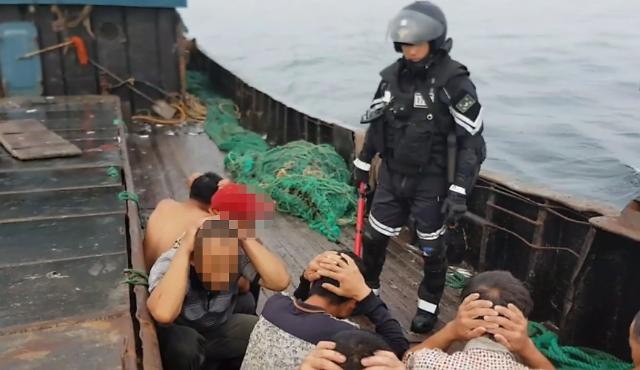
A file picture on a coastguard crackdown on illegal Chinese fishermen.[Yonhap News Photo]
Three Chinese fishermen were dead and 14 others were rescued unhurt by a coastguard vessel Thursday when their boat caught fire while being chased for alleged illegal fishing off South Korea's southwestern island.
Coastguard authorities said the 120-ton drift-net fishing boat was engulfed in a sudden and unknown blaze during its run to avoid an inspection in waters 70 kilometers (42 miles) southwest of Hong-do (island).
The coastguard said the ill-fated boat was within South Korea's exclusive economic zone (EEZ) at 9:45 am (0045 GMT) when coastguard officers stopped it and brought the blaze under control.
Three fishermen found unconscious in the engine room were transferred to the coastguard ship for cardiopulmonary resuscitation, but they were pronounced dead later.
China has tried to urge its fishermen to stop illegal fishing in waters of neighboring countries, but they continue to poach as fish stocks at home are depleted. Illegal operations by Chinese fishermen have caused diplomatic and security concerns along the Yellow Sea border between the two Koreas.
Aju News Lim Chang-won = cwlim34@ajunews.com

Copyright ⓒ Aju Press All rights reserved.
Related News
-
 Jindo's Seomang Port to Transform into National Key Fishing Port with $917 Million Investment
Seomang Port in Jindo County, South Jeolla Province, has been selected as the site for a national key fishing port development project, with a total investment of 917 billion won ($684 million), paving the way for it to become a central hub for the fishing economy in the southwestern coast of Korea.On November 13, Jindo County announced that Seomang Port was chosen in the Ministry of Oceans and Fisheries' project competition, which will expand port infrastructure and modernize seafood distribution systems over five years, from 2027 to 2031.The project aims to enhance the competitiveness of the local fishing industry by expanding the port's functions from primarily seafood production and sales to include storage, processing, distribution, and tourism.Seomang Port is a major crab production area and a key seafood distribution hub on the southwestern coast, recording sales of 32.7 billion won ($24.5 million) last year.However, the port has faced challenges due to a lack of storage and processing facilities, necessitating the expansion of distribution infrastructure to match production levels.In response, Jindo County developed a comprehensive plan linking port modernization with improvements to the seafood distribution system and participated in the project competition in May. After being selected as a preliminary candidate in July, the county finalized its project site designation following consultations with the Ministry of Oceans and Fisheries on the basic plan.The project will involve 605 billion won ($455 million) in national funding, 252 billion won ($190 million) in local funding, and 60 billion won ($45 million) in private investment.Key initiatives include expanding the small vessel dock on the south side, automating cargo handling, constructing a parking tower, improving port aesthetics and safety facilities, establishing a cold chain hub for temperature-controlled distribution, modernizing the auction hall, and expanding cold storage facilities and seafood processing complexes.Notably, this national key fishing port development project will also promote a new initiative worth 635 billion won ($478 million) and link it with an existing 282 billion won ($212 million) rural revitalization project to develop the Seomang Port area into a comprehensive seafood economy hub.With the establishment of infrastructure connecting seafood production, storage, processing, and distribution, the project is expected to improve the freshness and distribution efficiency of catch while enhancing the added value of local seafood.Additionally, it will create a foundation for attracting young people to settle in fishing villages.Jindo County plans to develop 25 rental housing units for young people and community facilities through a separate 10 billion won ($7.5 million) youth fishing village project near Seomang Port.The county aims to create job opportunities linked to the fishing industry, providing stable conditions for young people to settle and revitalizing fishing villages facing challenges from aging populations and declining numbers.Jindo County intends to organically link the national key fishing port development project with the national port expansion project, rural revitalization project, and youth fishing village project to simultaneously strengthen the competitiveness of the fishing industry and stimulate the local economy.Lee Jae-gak, the mayor of Jindo County, stated, "The selection of this project will elevate the competitiveness of Jindo's fishing industry and secure new growth momentum for the local economy. We will develop Seomang Port into a central hub for the southwestern coast's fishing economy and create a vibrant fishing village where young people can return, work, and settle."In July, Mayor Lee visited the Ministry of Oceans and Fisheries to advocate for the necessity of the Seomang Port national key fishing port development project and the early promotion of the national port expansion project, continuing efforts to secure national funding and project selection. Jindo County plans to collaborate with relevant agencies to refine detailed project plans and systematically manage the timelines for each initiative.* This article has been translated by AI.
-
Mokpo's Goha Island Selected for 3.0 Fishing Village Renewal Project
Goha Island in Mokpo, South Jeolla Province, has been selected as a site for the Ministry of Oceans and Fisheries' '2027 Fishing Village Renewal 3.0' project, marking a significant step toward improving the living conditions in this underdeveloped fishing community and revitalizing the local economy. Mokpo City, led by Mayor Kang Seong-hwi, announced that Goha Island secured a total of 7.9 billion won in national and provincial funding, including 7 billion won from the national budget and 900 million won from the provincial budget. The project will involve a total investment of 10 billion won, including 2.1 billion won from the city, and will be implemented over four years from 2027 to 2030 to enhance the fishing infrastructure and improve the living environment for residents. Fishing Village Renewal 3.0 is a government initiative aimed at improving living conditions in fishing communities facing challenges such as population decline and aging, while also establishing a foundation for economic activities utilizing local resources to enhance sustainability. Goha Island was selected based on a comprehensive evaluation of its potential for utilizing unique local resources, the feasibility of the project, community participation, and the commitment of local government. Mokpo City presented a distinctive project plan that connects Goha Island's historical, cultural, and tourism resources with improvements to residents' living conditions. A key component of the project is the establishment of a cultural welfare platform on the site of the former Chungmu School. The city plans to transform the existing school space into a cultural welfare hub for residents and tourists, aiming to extend visitor traffic from the coastal tourist attractions into the village. This initiative will provide cultural and welfare spaces for residents while offering tourists opportunities to experience the local culture and resources of Goha Island. Infrastructure improvements closely tied to residents' daily lives will also be pursued. Major projects include paving village roads, creating connecting pathways, installing solar panels and energy storage systems (ESS), reinforcing embankments, extending docks, dredging ports, and establishing small-scale direct sales outlets. The extension of docks and dredging of ports are expected to enhance the convenience of fishing activities and improve maritime transportation conditions, contributing to safer mobility for residents and strengthening the foundation for fishing village life. The renovation of village roads and connecting pathways will focus on alleviating inconveniences for residents and improving accessibility to the village. Additionally, the establishment of small-scale direct sales outlets aims to create a sales base for local seafood and connect tourist influx with residents' income. The city plans to complement facility expansion with training programs to strengthen community capacity and collaborative initiatives. The goal is to support residents in utilizing local resources and participating in tourism and economic activities, ensuring that the community can sustain itself even after the project's completion. Kim Dae-hyang, the head of Goha Island, expressed, "We are determined to create an island where residents want to live and tourists can enjoy their stay, and this selection for the project is a meaningful outcome of our efforts and those of Mokpo City." Mayor Kang Seong-hwi stated, "The passion, interest, and active participation of Goha Island residents were key factors in the selection of this project. We will implement it without delay to improve the living environment for residents and invigorate the fishing economy." He added, "We will encourage other island regions to actively participate in various projects while maintaining their unique resources and identities, striving to develop into beautiful and vibrant destinations." This project is significant as it aims to simultaneously improve living conditions and economic activity in fishing villages by linking Goha Island's tourism resources with residents' living spaces. However, given the substantial budget involved, ensuring effective operation and management after facility construction and securing tangible income increases for residents will be key challenges for the project's success. Meanwhile, Goha Island is known for its historical and marine tourism resources, attracting visitors with facilities such as a cable car and coastal deck. Mokpo City plans to expand the tourism infrastructure into the village living area through this Fishing Village Renewal 3.0 project while also improving residents' living conditions and revitalizing the local economy.* This article has been translated by AI.
-
Fishing Vessel Sinks Off the Coast of Yongju Island, All 7 Crew Members Safe
At 7:12 a.m. on November 9, a 32-ton fishing vessel registered in Jeju began sinking approximately 49 nautical miles (about 90.7 kilometers) south of Yongju Island in Tongyeong, South Korea, with seven crew members on board.The Tongyeong Coast Guard requested assistance from nearby fishing and commercial vessels and dispatched patrol boats to the scene.The sinking vessel is currently using its own pump to remove water, and it has been confirmed that the flooding has not progressed further.A fisheries guidance vessel from the Ministry of Oceans and Fisheries arrived at the scene to provide support.No injuries have been reported.Strong northeast winds of 16 to 18 meters per second and wave heights of 2 to 2.5 meters have been observed in the area.A representative from the Tongyeong Coast Guard stated, "The reported location is somewhat distant, and rescue teams are currently en route to the site."* This article has been translated by AI.