
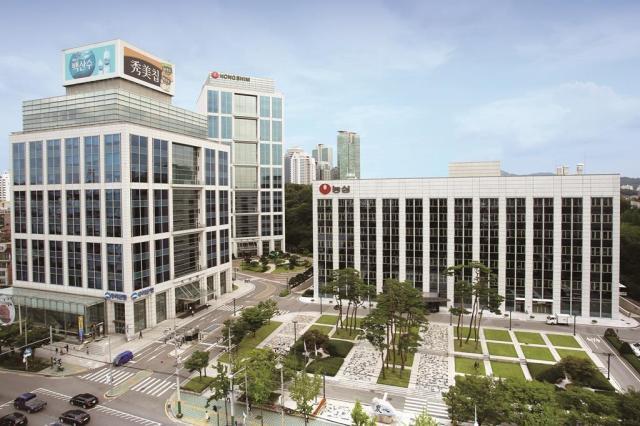
According to regulatory filings, the maker of Shin Ramyun instant noodles posted an operating profit of 49.7 billion won ($37.2 million) for the July to September period, down from 54.4 billion won a year earlier.
Its operating margin narrowed to 5.3 percent from 6.2 percent.
Revenue rose 6.7 percent to 929.6 billion won.
Net profit fell 41.3 percent to 29.7 billion won, and net profit attributable to parent-company shareholders also dropped 41.3 percent to 29.7 billion won.
Nongshim said the domestic business carried most of the cost burden, pointing to higher prices for palm oil and other raw materials, as well as ocean freight and energy costs tied to exports.
Cost of sales rose 7.4 percent and selling and administrative expenses rose 8.7 percent, both faster than revenue.
Palm oil futures in Kuala Lumpur averaged $1,174 per ton in the first nine months of 2026, compared with an average of $1,043 for 2025, according to the filing.
Bigger foreign exchange losses drove most of the fall in net profit. Losses on currency transactions rose to 13.4 billion won in the quarter from 1.9 billion won a year earlier, and total finance costs rose to 19.1 billion won from 2.4 billion won.
Overseas units did better, in the first nine months, operating profit at the US unit more than doubled to 44.5 billion won from 20.3 billion won. Revenue in the US rose 11.8 percent to 427.3 billion won.
Operating profit in China rose 37.2 percent to 15.8 billion won.
Shares of Nongshim traded at 365,500 won per stock as of 3:10 p.m., 4.69 percent lower than the day before.
Kim Dong-young
Kim Dong-young is a bilingual journalist at AJU Press (AJP), covering Korean tech, energy, and bio/pharma.
He reports from the field at events like CES and APEC, runs AJP's YouTube channels,
and is pursuing a master's at Sogang's MOT program.
Copyright ⓒ Aju Press All rights reserved.
Related News
-
 Long Lines for Fresh Ramen at the 2026 Gumi Ramen Festival
"Is this all for ramen?"On November 6, a curious line formed in front of Gumi Station in North Gyeongsang Province. People were waiting for instant ramen. Why would anyone travel to another city just to buy ramen that is available at a convenience store nearby? The answer was revealed at the 2026 Gumi Ramen Festival: for three days a year, attendees can purchase freshly fried ramen that is produced and shipped directly from the factory.The Gumi Ramen Festival, themed "The Longest Ramen Street in the World," took place from November 6 to 8 along a 475-meter stretch in front of Gumi Station. Now in its fifth year, the festival is a collaborative effort between Gumi City and Nongshim. It started in 2022 with 15,000 visitors and grew to 350,000 last year. This year, Gumi City anticipated attracting over 400,000 visitors, matching the local population of approximately 400,000.The festival's signature product, freshly fried ramen, sold around 480,000 packets last year. The bags filled with ramen earned the nickname "ramen backpacks" on social media. This year, the popularity remained high. By 1:30 PM on the first day, the line at Gumi Elementary School, where the sales booths were set up, extended about 400 meters to the street in front of Gumi Station.In line, 30-year-old Sung Min-kyu returned to the festival after attending last year. He couldn't forget the taste of the freshly fried ramen he bought last year and waited about two hours to purchase it again. "I wanted to come back because the booths were nice and the ramen was delicious last year," he said. "Buying ramen made on the same day is an experience you can't find anywhere else."As I passed the purchasing line and headed to the ramen restaurant, the menu caught my attention. From ramen with clams and abalone to dishes featuring cream and pork belly, there were many unique combinations. This year, 33 restaurants participated, including 25 ramen restaurants and eight ramen trucks. A special "half-portion ramen" was offered in nine varieties, allowing visitors to sample multiple dishes.Notably, this year introduced premium dishes like mushroom ramen and fried fish ramen made with pufferfish. The mushroom ramen, prepared by 65-year-old Oh Kwang-jin, was particularly enticing. He explained that he secured ingredients starting in late September. "The price of mushrooms has risen significantly, making it a burden, but since the premium menu is the main attraction of the festival, I felt I had to keep my promise," he said. "I wanted to showcase the flavors of our local ingredients by incorporating mushrooms into Korean ramen."Preparing a bowl of ramen for the festival requires months of planning. The organizing committee recruits participating chefs five months in advance, conducting cooking evaluations and interviews. After selection, the chefs refine their menus through consultations.Park Jong-soo, a 44-year-old restaurant owner in Sangmo-dong, Gumi, said, "It was a fierce competition, but the preparation process was enjoyable, and I feel proud to participate in the festival. I believe the festival will help promote Gumi and local eateries, which is exciting for small business owners."This year, the festival also featured the inaugural "Global Ramen Challenge," which attracted 1,263 teams from 80 countries. After two rounds of evaluations based on recipes and cooking videos, 13 teams from countries including the U.S., Poland, Mexico, Peru, Egypt, and Nigeria advanced to the finals.Lindsay Catherine, a 33-year-old participant from Seattle, said, "Among various ramen from different countries, Korean ramen suits my taste the best. I'm getting inspiration for new recipes by tasting different ramen at the festival."At the Ramen Workshop and Nongshim pop-up store, visitors had the chance to make their own ramen by selecting noodles, soup, and toppings, and decorating their containers. Many took photos in front of ramen sculptures to commemorate their experience.Nongshim and Gumi City collaborated to launch a special product, "Gumi Ramen Festival Noodles," made with 100% local wheat. This limited edition features a spicy beef broth with shiitake mushrooms, carrots, and bok choy. Nongshim produced a total of 200,000 packets at its Gumi factory, available for sale at the festival and on the Nongshim online store.According to Gumi City, last year's festival generated approximately 1 billion won in ramen and food sales over the three days. Nearby businesses saw sales of about 2.86 billion won, as identified through big data analysis.A local supermarket owner, Kim, noted, "Sales during the festival exceed ten times our usual revenue. It's the happiest time of the year." Park Dasom, a Gumi resident who brought friends from another region to the festival, said, "Gumi is more of an industrial city than a tourist destination, but it's great that people come here for experiences like this. Many people are learning about Gumi through the festival, which makes residents feel proud."Gumi City plans to turn the three-day festival into a year-round attraction. Currently, about 12 local restaurants offer festival menus year-round, with a goal to increase that number to 20 this year. They are also preparing to establish the "Gumi Ramen Museum," which will feature excellent menus and experiential exhibition spaces.Gumi Mayor Kim Jang-ho said, "This festival, which brings together local businesses, self-employed individuals, and farmers, is meaningful for regional development. We aim to grow the ramen festival into Asia's largest festival, surpassing Munich's Oktoberfest."* This article has been translated by AI.
-
Nongshim Launches Export-Only Factory in Busan to Boost Global Market Presence
Nongshim has officially launched its export-only factory in Busan, accelerating its strategy to penetrate global markets. The new facility aims to expand export volumes by producing 500 million noodle packages annually and flexibly responding to varying product and packaging demands across different countries.Located near the existing Nongshim factory in the Naksan National Industrial Complex in Gangseo-gu, Busan, the new export-only factory is a state-of-the-art production base built with an investment of 204.3 billion won. It began full operations on October 29 and features three production lines, including two for bag noodles and one for cup noodles, with plans to expand to a maximum of eight lines.During a visit to the factory on November 5, the interior buzzed with activity as advanced automated equipment operated continuously. The process of transforming the dough into thin noodles, followed by shaping, steaming, frying, and cooling, flowed smoothly. The bag noodle production speed at the Naksan factory is 600 packages per minute, which is 20% faster than the high-speed line at the Gumi factory. The cup noodle line produces 500 packages per minute.The factory's key competitive advantage lies in its ability to simultaneously increase production capacity and facilitate quick product changeovers. When switching between export countries or products, the factory has reduced the time required for changing recipes, packaging, labeling, and boxes from 120 minutes to just 30 minutes. Nongshim reports that this reduction has improved production efficiency by 17.6%.This efficiency stems from meticulous process design. The factory incorporates reserve tanks for pre-mixed ingredients and a cleaning system that allows preparation for the next production run while current products are being made. Servo motors minimize manual adjustments, and ample space accommodates various packaging specifications.Jeon Yun-yeol, the Naksan factory manager, stated, "We have equipped the facility to prepare for the next product change while producing, considering time reduction from the design stage."Artificial intelligence (AI) and smart factory technologies are integrated throughout the production site. An AI inspection system detects tiny holes in packaging, foreign substances, and printing errors, filtering out defective products. A predictive maintenance system analyzes vibration and current data to alert operators to potential malfunctions, preventing unexpected downtime. A magnetic transfer system maintains product alignment during high-speed production, while autonomous robots supply packaging materials.The new factory is optimally located about 4 kilometers from Busan New Port, facilitating overseas exports via maritime transport. Nongshim plans to supply primarily local factory products to the U.S. and China, while focusing on exports from the Busan and Naksan factories to Japan, Europe, Central and South America, and the Middle East. This strategy aims to efficiently consolidate and respond to diverse demands from multiple countries. The company also sees potential for reduced transportation times and logistics costs through the development of Arctic shipping routes, enhancing export competitiveness.With the addition of the Naksan factory's 500 million annual export capacity to the existing 700 million from the Busan and Gumi factories, Nongshim's total export supply capability has increased to 1.2 billion packages annually. Combined with production capabilities from local factories in the U.S. and China, Nongshim's overall global production capacity has expanded to a maximum of 6.2 billion packages.This expanded production base is expected to support the introduction of new products and diversification of overseas distribution networks. Nongshim plans to broaden its global market presence with products like the original Shin Ramyeon, Tumtang, and Rose stir-fried noodles, while accelerating the establishment of its products in major local retail stores and expanding into online and quick commerce. A new stir-fried noodle product launch is anticipated as early as the first quarter of next year. The company aims to increase its overseas sales proportion from 42.2% in the first half of this year to 61% by 2030.Ji Song-ha, head of Nongshim's global marketing division, remarked, "If the first purchase is driven by the influence of K-culture, subsequent purchases are based on taste and quality. More consumers are buying not just because it's Korean food, but because it's delicious ramen, and we expect continuous growth in global sales as we prepare for that."* This article has been translated by AI.
-
Who Does the Law Serve?
"Who does the law serve?"Interpretations may vary, but the law exists for all citizens and the entire national community, ultimately functioning to protect justice and the socially vulnerable.When powerful state authorities oppress ordinary citizens, large corporations undermine small businesses, and those in power suppress the weak, the law is often the only means for the vulnerable to respond. A nation governed by the rule of law relies on the realization of social justice through legal frameworks as its foundation.However, recent actions by the judiciary raise questions about adherence to fundamental principles. The fluctuating standards of fairness and justice in the law, bending according to the size and status of power, cast doubt on whether the judiciary is truly implementing social justice through the law.In light of the recent martial law situation, there are concerns about whether the judiciary's decisions regarding key figures indicted for insurrection and abuse of power align with the public's sense of justice.The court acquitted military commanders involved in the so-called 'Lotteria meeting' on the grounds of the unique nature of military hierarchy. Former Minister of Justice Park Sung-jae saw his sentence reduced from 25 years to 9 years on appeal, while former Prime Minister Han Duck-soo's sentence was cut from 23 years to 15 years. Park Jong-jun, who was sentenced to 4 years for obstructing the arrest of former President Yoon Suk Yeol, received a reduced sentence of 3 years on appeal due to acknowledgment of the charges and expressions of remorse.In a historic ruling, the court canceled the detention of former President Yoon, who faced a death penalty recommendation for insurrection, based on 'time' rather than 'day.' Ultimately, Yoon was sentenced to life imprisonment in the first trial, opening the door for a potential reduction in his sentence. Kim Geon-hee, indicted for bribery related to the sale of government positions, had her sentence reduced from 7 years to 5 years on appeal, while Kim Ki-hyun, a member of the National Assembly accused of delivering expensive bags to her, was acquitted in the first trial.The court's leniency towards those involved in insurrection starkly contrasts with the harsh judgments faced by ordinary citizens prosecuted for minor offenses. Cases such as a bus driver who fought a legal battle for years after being fired for embezzling 800 won, a security worker prosecuted for eating a 450 won choco pie and a 600 won snack from a workplace refrigerator, and a citizen sentenced to prison for stealing ramen from an unlicensed store due to hunger illustrate how the principle that 'all are equal before the law' feels like a fiction.In this context, the ruling Democratic Party is facing criticism for effectively establishing a 'fourth trial system' while attempting to create a law against legal distortion and conducting audits of Chief Justice Cho Hee-dae, but these efforts seem insufficient.Despite ongoing criticisms from the ruling party and civil society regarding political judgments, the judiciary appears undeterred amid declining approval ratings for President Lee Jae-myung and the ruling party. Attention is now focused on the next steps for Chief Justice Cho, whose term ends in June next year.The judiciary must reflect on whether it is responding to the voices of citizens who braved the cold rain to call for the impeachment of Yoon Suk Yeol, demanded severe punishment for the martial law troops involved in insurrection, and sought a more just and equitable society. It should question whether current rulings are serving justice for the vulnerable or merely providing a refuge that alleviates the legal responsibilities of those in power.The independence of the judiciary is not a shield to protect the powerful but a bulwark to uphold justice and trust for all citizens. The judiciary must remember that the moment the law loses the public's trust, the very foundation of the rule of law can collapse.* This article has been translated by AI.