
Continuing a tradition of affordability, the admission fee remains a mere 1,000 won ($0.69), unchanged since the rink's inauguration in 2004. Helmets and knee pads are available for free rental.


Han Jun-gu
Photojournalist, AJU PRESS (AJP)
Covering Asia's defining stories — from pressing issues and politics to culture and society — through a distinctly Asian lens.
Copyright ⓒ Aju Press All rights reserved.
Related News
-
 Warmer and wetter winter forecast for Korea
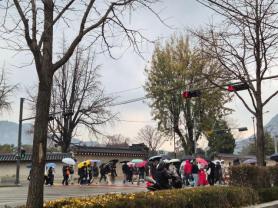
Wetter and warmer winter projected for Korea this year, according to Korea Meteorological Administration on Nov. 23, 2026. Photo of visitors around Gyungbok Palace, Gwanghwamun on Nov. 23, 2026. AJP Ryu Yuna SEOUL, November 23 (AJP) -A powerful El Niño is expected to bring South Korea a warmer and wetter winter, although sudden cold snaps and heavy snowfall could interrupt the milder weather, the Korea Meteorological Administration said Monday. In its outlook for December through February, the agency forecast above-normal temperatures and generally more rain and snow as warm, moist southerly winds flow into the Korean Peninsula. The El Niño that began in May is expected to peak in December and remain strong throughout winter. Sea surface temperatures in the equatorial Pacific monitoring region were 2.6 degrees Celsius above normal in October, the largest October anomaly since records began in 1950. For Korea, December and February each have a 50 percent chance of being warmer than normal, a 40 percent chance of temperatures near normal and a 10 percent chance of colder conditions. January has equal 40 percent probabilities of above-normal and near-normal temperatures, with a 20 percent chance of colder weather. The agency uses averages from 1991 to 2020 as its benchmark. El Niño, a recurring warming of the central and eastern tropical Pacific, changes atmospheric circulation far beyond the ocean itself. This winter, those changes are expected to strengthen high-pressure circulation east of Korea, drawing warmer air northward along its western flank. Those southerly winds also carry moisture, increasing the likelihood of rain and snow. December and February each have a 40 percent chance of above-normal precipitation and an equal probability of near-normal levels. January is more likely to be comparatively dry, with a 50 percent chance of normal precipitation, a 30 percent chance of above-normal amounts and a 20 percent chance of below-normal precipitation. A mild seasonal average, however, would not rule out spells of bitter cold. Reduced Arctic sea ice and extensive snow cover across eastern Eurasia could allow cold continental air to push south into Korea, producing sharp temperature swings. Cold, dry air crossing the relatively warm Yellow Sea could also generate snow clouds, bringing heavy snowfall to western areas. The wetter outlook may offer limited relief from accumulated rainfall shortages. The agency warned that the Seoul metropolitan area and Gangwon Province could still experience drought during winter because of low summer rainfall, with parts of Gangwon facing moderate or severe conditions. KMA Administrator Lee Mi-seon urged particular attention to damage from localized heavy snow and large temperature fluctuations, even as the season overall is expected to be warmer than usual. Tags: South Korea, El Niño, winter forecast, Korea Meteorological Administration, warmer winter, winter precipitation, cold snaps, heavy snowfall, Korean weather
-
 Ministry of Oceans and Fisheries and Korean Register Hold Safety Standards Webinar for Winter
The maritime authorities and the Korean Register have joined forces to prevent safety accidents among crew members as winter approaches. The two organizations plan to educate on safety regulations and address crew members' inquiries through a webinar. On November 23, the Ministry of Oceans and Fisheries and the Korean Register (KR) announced plans to encourage compliance with the 'Onboard Safety, Health, and Accident Prevention Standards' and the Maritime Labor Convention (MLC) certification inspection standards. The Ministry has established 'Onboard Safety, Health, and Accident Prevention Standards' and operates the 'MLC Certification Inspection System' to prevent occupational accidents among crew members. During winter, safety accidents are more likely due to cold waves, strong winds, and deck icing, making it essential to check heating facilities and implement measures to prevent slips and falls during onboard work. To this end, it is crucial to inform shipping companies and crew members about the need for safety accident prevention measures and encourage their implementation. To facilitate this, a webinar will be held on November 24 to explain the key contents of the 'Onboard Safety, Health, and Accident Prevention Standards' to operating institutions such as central administrative agencies, local governments, and public institutions, along with safety and health education and the onboard safety committee. The explanatory materials will also be distributed to private shipping companies that do not attend the webinar. Private shipping companies had previously held webinars last year and the year before. Additionally, from November 24 to February 4 of next year, there will be a concentrated effort to ensure strict compliance with MLC certification inspection standards. The Ministry plans to encourage shipping companies to focus on checking the working and living conditions of crew members during winter, including inspecting heating facilities and preventing slips and falls due to icing. Confirmed issues will be addressed according to relevant laws and certification procedures, supporting responsible safety management by shipowners and the establishment of working and living environments that meet international standards. Furthermore, onboard safety and health posters will be produced and distributed in both Korean and English to ensure that foreign crew members can also utilize them. The Ministry aims to support the proper implementation of existing systems and certification procedures on-site, continuously promoting a culture of safeguarding the lives and safety of crew members in collaboration with both public and private sectors. Meanwhile, the 'Onboard Safety, Health, and Accident Prevention Standards' apply to vessels subject to the 'Seafarers Act,' excluding fishing vessels, and also include vessels for fisheries testing, research, guidance, inspection, and training. MLC certification inspections are conducted for vessels engaged in international navigation with a gross tonnage of 500 tons or more. Kim Hye-jung, Director of the Shipping and Logistics Bureau at the Ministry of Oceans and Fisheries, stated, 'Safety accidents are more likely to occur during winter, requiring special attention,' and added, 'We will continue to work on preventing winter safety accidents through guidance and awareness improvement for shipping companies and MLC certification inspections.'* This article has been translated by AI.
-
Korean Air to offer passengers free winter coat storage
SEOUL, November 23 (AJP) - Korean Air will let passengers store their thick winter coats for free at airports during the winter months, the flagship carrier said on Monday. The service, available from Dec. 1 through Feb. 28, will allow international passengers to leave one winter coat per person for up to five days at airports in Incheon and Gimhae. Passengers must present a boarding pass showing a Korean Air flight number. They will have to pay an additional storage fee if they want to leave their coats for more than five days. The fee is 2,500 won (approximately US$1.70) per day at Incheon International Airport and 3,000 won per day at Gimhae International Airport. Korean Air said it operates the service in partnership with a professional clothing storage company to make winter travel more convenient for passengers flying to warmer destinations including Bangkok, Phuket, Da Nang, Ho Chi Minh City and Honolulu. Tags: Korean Air, winter travel, coat storage service, Incheon, Gimhae, airports