

Altimeter Capital CEO Brad Gerstner discusses with Premier Sage Partners' Ian Park at the UKF 82 Startup Summit held on Jan. 10, 2025, in Silicon Valley. AJP Joseph Kwak
REDWOOD CITY, January 13 (AJP) - The United Korean Founders (UKF) 82 Startup Summit brought together over 1,100 Korean entrepreneurs from around the globe in Silicon Valley on Jan. 10.
The summit, one of the largest overseas Korean startup communities, highlighted the crucial role of innovation in driving Korea's economic growth.
"Korean startups are not just thriving. They are becoming a source of hope and pride, achieving significant milestones in Silicon Valley," said Lim Jung-taek, Korea’s Consul General in San Francisco.
The event featured pitches from 28 startups, with discussions focusing on addressing Korea's economic slowdown and fostering innovation among large corporations.
Coxmax Chairman Lee Kyung-soo emphasized the global impact of the Korean beauty industry, stating, "In 2024, Korea’s cosmetics exports reached 14 trillion won ($9.5 billion), with Cosmax contributing 26 percent of that figure."

Vice Minister Kim Sung-sup of the Ministry of SMEs and Startups announced the launch of the K-Startup House in Menlo Park, a collaborative hub to support Korean startups in the U.S.
"It is gratifying to see a robust community emerging," said Kim said.
Notable attendees included IonQ co-founder and Duke University professor Kim Jung-sang, who drew parallels between the current state of quantum computing and the early days of personal computers. "Quantum computing today reminds me of computers in the 1960s - an era of enormous potential but requiring decades of effort," said Professor Kim.
The summit, which began in 2018, has experienced significant growth, with attendance more than doubling from 2023. AI expert and Stanford University professor Andrew Ng delivered the keynote address.
Participating institutions included the Seoul Business Agency, the Korea Startup Forum, and the Korea Trade-Investment Promotion Agency.
Copyright ⓒ Aju Press All rights reserved.
Related News
-
 27 Seoul-supported Companies Win 34 Awards at CES 2027
Is a camera necessary to detect if someone has fallen at home? UniUni, a startup supported by Ewha Womans University’s campus town, has developed technology to detect falls or fainting without video recording for home use. Another company, Rebodis from Seoul National University’s campus town, has created a knee-assisting robot that can be worn like clothing. These technologies, which maintain privacy while detecting accidents and assisting those with mobility difficulties, have been recognized with innovation awards at CES 2027.The Seoul Metropolitan Government announced on November 22 that 27 companies supported by its research and development (R&D) initiatives, including the Seoul Campus Town and Seoul Startup Hub, received a total of 34 innovation awards at CES 2027, including three top innovation awards.The Consumer Technology Association (CTA) evaluates the technological capabilities, functionality, and design of submissions ahead of CES, held annually in January in Las Vegas. The highest-rated products in each category receive top innovation awards.Safety Monitoring Without Cameras, Enhancing Image Quality with Depth InformationUniUni received the top innovation award in the smart home category for its 'Savvy Modular AI,' a safety detection technology that does not use cameras. This technology detects falls or fainting while reducing the burden of recording daily life on video. Utilizing the startup space and programs at Ewha Womans University’s campus town, UniUni also received an innovation award in the smart community category.Profugio, a company from Yonsei University’s campus town, won the top innovation award in the imaging category for its technology that enhances image quality using depth information, such as the distance between subjects and backgrounds. The Seoul Campus Town, operated jointly by the city and universities, supports startups from space provision to commercialization, investment attraction, and international expansion. This year, 730 startups in future industries like AI and biotech were selected from 13 universities.Three of Four Fintech Innovation Awards Go to Seoul-supported Firms, Analyzing Bankruptcy Risk with Transaction DataIn the fintech category, three out of four innovation awards were given to companies based in the Seoul Fintech Lab and the Second Seoul Fintech Lab.276 Holdings, which received the top innovation award, uses AI to analyze real-time transaction and payment flows between small and medium-sized enterprises. It is designed to detect risk signals in the supply chain before they appear in financial statements and to calculate credit ratings and bankruptcy probabilities for individual companies. This company received support for space, investment attraction, marketing training, and practical assistance for international expansion from the Seoul Fintech Lab.CrossHub received an innovation award for its integrated identity verification technology used in financial services, while KAB Labs received an award for its system that verifies trade documents using AI and facilitates payments and settlements with stablecoins. KAB Labs, based in the Second Seoul Fintech Lab, received 100 million won in research and development funding from the Seoul R&D project and participated in the startup and growth program of the Seoul AI Hub.Detecting Changes in Heart Failure Risk Through Voice; Wearable Robot Wins in Three CategoriesAIDOTCURE received an innovation award in the digital health category for its medical AI solution 'Heart to Voice,' which analyzes voice to detect changes in heart failure risk early. It was selected for the Seoul R&D bio-medical technology commercialization support project and received 400 million won in research and development funding over two years.Rebodis developed 'ReboStep,' an ultra-lightweight knee-assisting robot that can be worn like clothing by the elderly or those with walking difficulties. It won innovation awards in three categories: robotics, digital health, and accessibility/longevity. The Seoul National University Campus Town provided Rebodis with startup space and support for intellectual property applications and overseas market validation.AI R&D Budget Increased from 5 Billion to 7 Billion Won; Startup Hub Residency Extended to 4 YearsThe Seoul Metropolitan Government has invested 42.5 billion won in the Seoul R&D initiative this year, the largest amount in the past five years. This program supports small and medium-sized enterprises from technology development to validation, certification, and commercialization, with the AI R&D budget increasing from 5 billion won last year to 7 billion won this year. The maximum residency period at the Seoul Startup Hub has also been extended from the previous two years to four years. Startups can now extend their residency for two additional years, and support is provided for joint validation of technologies with large and medium-sized enterprises and for meeting with investors.Support facilities by industry are expanding to match the growth stages of companies. Since its opening, the Seoul Fintech Lab has supported 426 companies, while the Second Seoul Fintech Lab, specialized in nurturing early-stage companies, has expanded its support range to include prospective entrepreneurs starting this year.Centered around the Yangjae AI Cluster, the Seoul AI Hub provides high-performance computing resources and specialized training, nurturing 494 AI startups as of September this year. These companies have collectively raised 579.7 billion won in investments.Kim Hyun-woo, head of the Seoul Economic Office, stated, "We will continue to strengthen support at each growth stage so that promising companies can move beyond technology development to commercialization, investment attraction, and entry into global markets."* This article has been translated by AI.
-
LG Electronics and LG Innotek Win CES 2027 Innovation Awards, Showcasing Next-Gen Technology
LG Electronics and LG Innotek have demonstrated their next-generation technology by winning CES Innovation Awards announced by the Consumer Technology Association (CTA) ahead of the world's largest consumer electronics and IT exhibition, CES 2027.LG Electronics achieved a significant milestone by winning a total of eight awards, including the top innovation award for its OLED TV, gaming monitor, and premium home appliances. Notably, the world's first transparent and wireless TV, the 'LG Signature OLED T,' received the top innovation award in the art tech category, marking its second consecutive win. This achievement extends LG's record of winning the CES top innovation award for five consecutive years since 2023.The LG Signature OLED T features a premium display that can switch between transparent and black screen modes, offering 4K resolution and an open feel. Other award-winning products include the large wireless wallpaper TV 'LG Signature OLED W,' which incorporates agentic artificial intelligence, the 'LG UltraGear Gaming Monitor' with the world's first 1000Hz ultra-high refresh rate, and key home appliances like the WashTower.LG Innotek also received a CES 2027 Innovation Award for its next-generation vehicle lighting module, 'NexSlide C+.' This marks three consecutive years of winning CES Innovation Awards since 2025.The NexSlide C+ is a flexible vehicle lighting module that utilizes proprietary optical design and new material technology. It features the world's first 0.16mm thick directional film and a 0.13mm 3D micro-optic pattern film, achieving an overall thickness of less than 3mm.This module can create different 3D images depending on the viewing angle, significantly enhancing design flexibility for automotive manufacturers.LG Innotek plans to commercialize the NexSlide C+ targeting global automakers and parts suppliers, aiming for mass production in 2027.Both LG Electronics and LG Innotek plan to showcase their award-winning products, including these innovations, at CES 2027 in Las Vegas next January.* This article has been translated by AI.
-
 CES 2027 humanoids face a work challenge
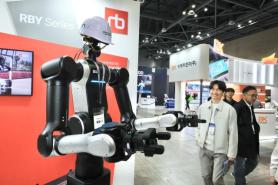
An RB-Y2 humanoid model from Rainbow Robotics at the Robo World 2026 held at KINTEX, Nov. 4, 2026. AJP Han Jun-gu SEOUL, November 20 (AJP) - Robots have been invading consumer technology shows since last year, and next year's CES in Las Vegas will test whether chipmakers such as Samsung Electronics and Nvidia can train them to outwork China's robot army. Chinese companies accounted for 21 of the 38 humanoid exhibitors at CES 2026, although Hyundai Motor Group-controlled Boston Dynamics took CNET Group's Best Robot award with Atlas. The next edition runs Jan. 6 to 9. The competition is expected to shift from crowd-pleasing stunts toward machines that can handle tools, move goods and complete tasks with less human intervention. "More than half will probably move toward autonomous work," said Park Dong-il, head of the advanced robotics research center at the Korea Institute of Machinery and Materials, who leads the team developing the state-backed KAIROS humanoid. "Especially in the United States, autonomous work is being put far out front." Only a handful of exhibitors emphasized their robots' work skills at the last show, drawing a lukewarm reception, Park said. Dancing, boxing and other athletic demonstrations will increasingly be taken for granted, with more companies expected to showcase practical tasks. But development is moving so quickly that the demonstrations themselves remain a work in progress. Edited and compiled by AJP. Graphics AI assisted "This field develops at a different speed. Two months should be seen as a completely new period," Park said. Companies may not settle on what to show until the day before the doors open, he added. Industry sources say Samsung plans to unveil two humanoids: HR, short for Human Reference, and HE, or Humanoid Extreme. HE is the higher-end model, with more degrees of freedom — independently controlled movements that provide greater flexibility for complex tasks. Samsung has not confirmed the plans. Samsung has also been testing a bipedal humanoid intended for round-the-clock work in factories and warehouses, with employees monitoring it in three shifts, according to sources. Much of the attention is likely to fall on its hands. The two models reportedly have five-fingered hands operated through tendon-like cables. A Samsung U.S. patent application published Oct. 22 describes a cable-driven finger mechanism, although the filing alone does not establish which technology will appear in the finished robots. "Without tendons, you would have to fit an actuator into every finger joint," said You Bum-jae, a principal research scientist and former head of humanoid development at the Korea Institute of Science and Technology, who developed the MAHRU humanoid. "With tendons, the actuators can gather in the palm, so the fingers can be made slimmer." That compact design brings its own engineering demands. "But you have to keep the tension constant so the cables never sag," You said. "Whether they have secured all those technologies, we will have to see." An AI Sapiens humanoid model from Robotis perform on a stage at the Robo World 2026 held at KINTEXT, Nov. 4, 2026. AJP Han Jun-gu Tendon-driven hands are a long-established concept, he added. Samsung will need to demonstrate what distinguishes its implementation. Boston Dynamics has taken a different approach with the GR3 hand unveiled for Atlas on Oct. 1. Its four fingers are driven directly at the joints, with 13 degrees of freedom. The design allows the robot to manipulate objects and operate tools, including gripping a handle while pressing a trigger. Park said Samsung's apparent emphasis on hand dexterity reflects the same push to prove that humanoids can perform useful work. Rainbow Robotics, the HUBO developer that Samsung took control of through a deal announced in December 2024, will not operate its own booth at CES. A company official said it would participate in a government-organized robotics pavilion and declined to discuss Samsung's plans. Oh Jun-ho, who led HUBO's development and co-founded Rainbow, continues to head Samsung's Future Robotics Office, which was incorporated into the company's new robotics unit in July. The Rainbow official declined to disclose the extent of his advice to Samsung. The competition extends well beyond the exhibition floor. Hyundai Motor Group aims to establish annual production capacity for 30,000 Atlas robots by 2028 as it prepares to introduce the machines into automotive manufacturing. LG plans to unveil a bipedal humanoid in the first quarter of 2027 using Nvidia's Isaac GR00T model and Jetson Thor computing platform. That timetable makes CES a possible debut venue, although LG's announcement did not identify the show. Tesla said in October that early production of Optimus had begun at its Fremont factory. It has announced no plans for the Las Vegas show. Chinese manufacturers already have a substantial lead in shipments. Unitree Robotics and AgiBot each shipped more than 5,000 humanoids in 2025, out of approximately 15,000 worldwide, according to figures reported by The Associated Press. Access to the U.S. market presents a separate hurdle. Since July 28, the Federal Communications Commission has restricted new equipment authorizations for foreign-produced advanced robotic devices, including covered humanoids made in South Korea, unless they receive conditional approval. For Korean developers, the challenge is also to establish that the components behind their demonstrations can compete. Edited and compiled by AJP. Graphics AI assisted "We have long been told that Korea lacks the technology to localize motors and joints," You said. "With competition from China so fierce, I wonder whether that competitiveness has been secured." Reliability remains another obstacle between a compelling demonstration and a machine that can earn its place on a factory floor. "Task success rates for models around the world are still below 90 percent," You said. "To unveil physical AI, performance has to go beyond that." "How well it works, we will only know on the day," Park said.