

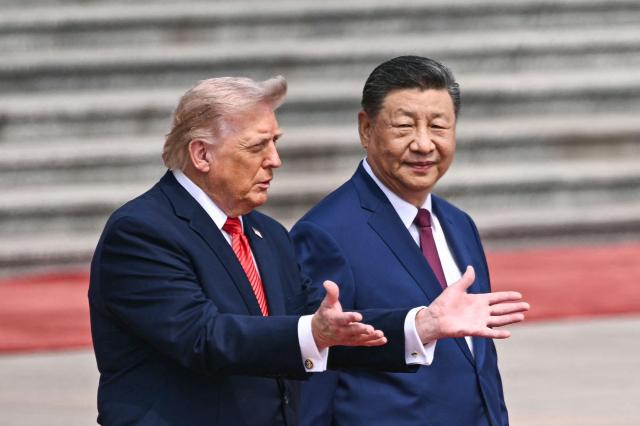
Bloomberg reported on May 13 that while the AI agenda was relatively minor during last year’s U.S.-China summit in Busan, it is expected to be more prominently discussed in this Beijing meeting. The last-minute inclusion of Jensen Huang, CEO of NVIDIA, in Trump’s delegation underscores this trend.
NVIDIA is a leading producer of advanced semiconductors central to the AI boom and is at the heart of the U.S.-China tech rivalry. Huang is recognized as a representative figure of U.S. semiconductor technology and has maintained regular contact with Chinese officials.
Bloomberg noted that following Huang's addition to the delegation, Chinese AI-related stocks rose, reflecting investor optimism about increased access to advanced AI semiconductors in China.
The Trump administration has been pushing for expanded sales of U.S. technology companies to China. In December, Trump authorized the export of NVIDIA's next-generation AI chip, the H200, to China, but reports indicate that the Chinese government has yet to allow related purchases.
However, the U.S. remains cautious about Chinese AI companies leveraging American technological advancements. Companies like OpenAI, Anthropic, and Google have expressed concerns that their AI models could be unfairly utilized in the development of products by Chinese competitors such as DeepSeek, Moonshot, and Minimax.
Michael Kratsios, the White House Chief Technology Officer, is also part of the delegation. A former AI company executive, he is known for drafting a memo in April warning about the risks of China developing cheaper and faster technologies using U.S.-made AI models. Bloomberg cited policy experts suggesting that Kratsios may convey similar messages in Beijing.
U.S. officials have stated that AI issues will be raised during the summit, although specific agenda items have not been disclosed.
Prospects for Communication Mechanism Agreements Over Major Deals
Bloomberg forecasts that significant agreements, such as easing U.S. export controls or expanding semiconductor sales, are unlikely to materialize. However, there is potential for the establishment of a new communication mechanism between the U.S. and China to discuss AI issues more regularly.
The cybersecurity risks posed by AI could also be a topic of discussion. The U.S. views rapidly advancing AI technology as a factor that could exacerbate cross-border threats, including cyberattacks, misinformation, and military miscalculations.
Additionally, the Chinese government’s recent order to reverse Meta Platforms' acquisition of the Chinese AI startup Manus is seen as another source of conflict, with analysts interpreting it as a measure to prevent the outflow of technology and talent to the U.S.
Other sensitive issues, including critical minerals, the Iran conflict, Taiwan, and trade, are also expected to be broadly discussed during the summit. However, the wide range of topics may hinder the likelihood of reaching substantial agreements.
Despite this, AI governance is cited as an area where limited cooperation between the U.S. and China could occur. Sun Chenghao, a researcher at Tsinghua University’s Center for International Security and Strategy, recently suggested that both sides could focus on the cross-border risks posed by AI and explore ways to promote risk classification and assessment systems that more countries can adopt, while also jointly seeking possible responses.
* This article has been translated by AI.
Copyright ⓒ Aju Press All rights reserved.