

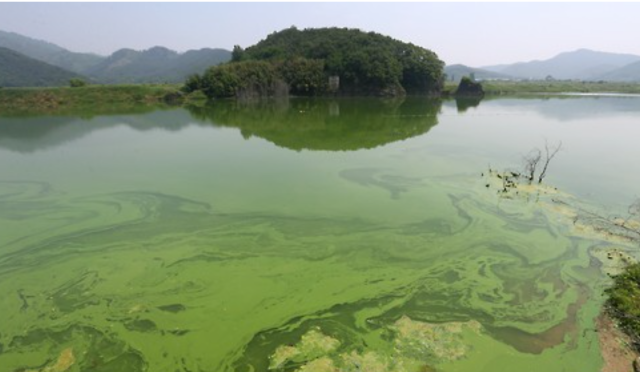
The Ministry of Climate, Energy and Environment announced on May 14 that the "First Seasonal Management System for Algal Blooms" will be in effect from May 15 to October 15, spanning five months.
Algal blooms have been occurring earlier and lasting longer due to climate change. Last year, the country recorded a total of 961 days with algal bloom alerts, the longest on record. The ministry noted that this year, higher temperatures and the possibility of heavy rainfall raise concerns about the influx of phosphorus, a substance that triggers algal blooms.
The core of this new strategy is to manage pollution sources intensively before algal blooms develop. The government plans to expand the number of algal bloom prediction sites from nine to thirteen, with a goal of increasing this to 28 sites by 2030, covering all water sources under algal bloom alerts. Additionally, the system for issuing bloom alerts on the day of sampling will be expanded from four locations on the Nakdong River to seven locations, including the Han, Geum, and Seomjin Rivers.
Kim Eun-kyung, the ministry's water environment policy director, stated in a briefing, "Starting this year, we will take action before algal blooms occur. We are transitioning from a reactive approach to a system that manages both pollution sources and water flow together."
Management in the agricultural and livestock sectors will also be strengthened. The government will implement measures to block nutrients from farmland before the rainy season and will expand the inspection period and frequency of compost piles from spring to both spring and fall. A mobile management system will be used to track and inspect the installation of covers and collection status of compost piles. Furthermore, projects to convert livestock manure into solid fuel and biogas will be expanded.
The government will also manage pollution sources from households. It will conduct specialized management of 322 small wastewater treatment facilities and significantly increase support for cleaning small septic tanks from 2,100 households last year to 10,500 this year. Environmental infrastructure, such as public livestock manure treatment facilities, will operate under stricter total phosphorus standards than legally required.
In the event of severe algal blooms, the government will implement emergency management measures by sequentially opening eight dams on the Nakdong River. This will be the first time the government has opened all eight dams to reduce algal blooms.
The opening period will last 2 to 3 days, with water levels potentially lowered by up to 2.2 meters. However, the decision to open the dams will be based on a comprehensive assessment of algal bloom alert levels, weather forecasts, and the trend of algal bloom spread.
The ministry plans to monitor groundwater impacts in real-time during the dam openings and will consider providing alternative wells if issues arise. A ministry official explained, "This is not a full opening; we plan to operate it gradually, considering both agricultural water use and improvements in water flow."
Safety management for drinking water and recreational activities will also be enhanced. The government will strengthen water purification management through the installation of barriers around intake areas and treatments with activated carbon and ozone, and will monitor algal blooms at major recreational facilities at least once a week. If algal blooms worsen, restrictions on swimming and water sports will be implemented.
Minister of Climate, Energy and Environment Kim Seong-hwan stated, "We will minimize the possibility of algal blooms this summer by blocking phosphorus discharge, which serves as nutrients for algal blooms, and by improving water flow in consultation with local communities."
* This article has been translated by AI.
Copyright ⓒ Aju Press All rights reserved.