

Eom Joo-sung, CEO of Kiwoom Securities, summarizes his financial entrepreneurship as the 'evolution of platforms.' Over the past 20 years, Kiwoom Securities has pioneered the domestic retail investor market, rewriting the history of online brokerage. However, the environment Eom faces today is different. The brokerage-centered growth model is encountering limitations, and competition from large securities firms and platform companies is intensifying.
He has proposed two solutions: a leap into large-scale investment banking and the expansion of retirement pensions and asset management platforms. His goal is to evolve from a company that merely facilitates transactions to a financial platform that manages customers' lifetime assets. At the same time, he must also address the challenge of restoring trust damaged by incidents such as the Youngpoong Paper crisis and system failures.
Eom's leadership ultimately poses the challenge of whether he can simultaneously achieve 'growth' and 'trust.'
Beyond the success of online brokerage to an asset management platform
Eom Joo-sung is a manager who understands Kiwoom Securities' DNA better than anyone. After joining Kiwoom Securities in 2007 following his tenure at Daewoo Securities, he has gained experience in investment management, private equity, strategic planning, and corporate finance. Notably, he contributed to expanding Kiwoom Securities' revenue base while leading the investment management division for an extended period and later designed the company's mid- to long-term growth strategy as head of strategic planning.
His appointment as CEO came during a tumultuous period. The CFD crisis and the Youngpoong Paper stock manipulation incident were deemed the biggest crises in Kiwoom Securities' history. Billions of won in provisions were incurred, and the group's management faced a series of resignations. The market began to question Kiwoom Securities' risk management capabilities and internal controls.
Upon taking office, Eom prioritized restoring trust over growth. He reorganized the risk management structure and established a group risk management team. He brought in internal control experts and built a three-tiered defense system linking operations, risk management, and auditing. This was not merely an organizational restructuring but a fundamental transformation of Kiwoom Securities.
However, he did not stop at defense. Eom began searching for a new growth model beyond the brokerage-centric structure that Kiwoom Securities had long relied on. The answer was an asset management platform. Eom emphasized, "Kiwoom, which set the standard for stock trading, must now set the standard for asset management."
This is not just a business expansion. It is a declaration to transition from a company that facilitates individual investors' transactions to a platform company responsible for customers' investments, pensions, and overall asset management.
Entering large-scale investment banking and creating new growth engines
One of the most significant achievements of Eom's leadership is the entry into large-scale investment banking. In 2025, Kiwoom Securities received approval from the Financial Services Commission for issuance of notes, becoming the sixth large-scale investment bank in South Korea. This achievement signifies more than just obtaining a qualification.
Issuance of notes allows securities firms to raise funds based on their own credit. This serves as a foundation for expanding corporate finance and venture capital investments. Eom has indicated that the funds raised through note issuance will be directed towards advanced industries, venture companies, and mid-sized enterprises. In fact, Kiwoom Securities has announced a strategy to allocate over 25% of the funds raised through note issuance to venture capital and maintain a corporate finance asset ratio of over 50%.
Results are already emerging. Kiwoom Securities achieved record-high operating profit of 1.4882 trillion won and net profit of 1.115 trillion won in 2025, marking the first time the company surpassed 1 trillion won in net profit.
However, Eom does not intend to stop there. He views large-scale investment banking not merely as a means of expanding size but as a hub connecting corporate finance, asset management, and platform businesses. The ultimate goal is to reduce reliance on brokerage and create a more stable and sustainable revenue structure.
In this regard, Eom Joo-sung differs from the typical online brokerage CEO. While Kiwoom Securities previously focused on expanding trading volume, he emphasizes the long-term growth of customer assets. This reflects his philosophy as a financial entrepreneur, prioritizing structural growth over short-term results.
Completing a 'lifetime financial platform' with retirement pensions and AI
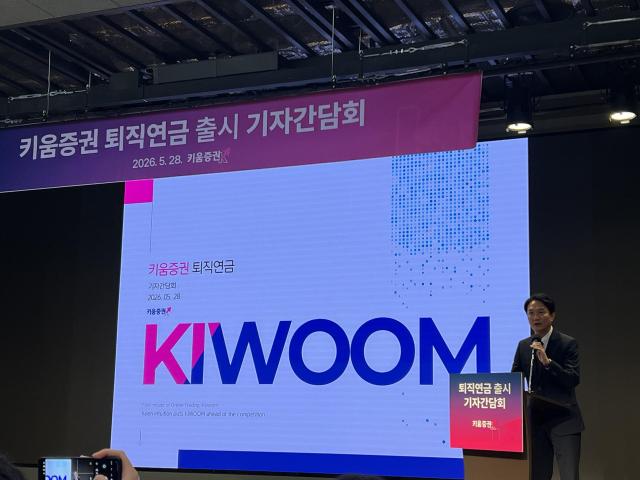
The future of Eom's leadership is most clearly reflected in the retirement pension business. Kiwoom Securities is set to make a significant entry into the retirement pension market in 2026, creating a new growth axis.
The current scale of the retirement pension market has surpassed 500 trillion won. Eom views this not merely as a financial product market but as a vast platform market for managing the public's retirement assets. Therefore, Kiwoom Securities has chosen a differentiated strategy of an online investment-type pension platform instead of physical branches.
Applying the existing mobile trading system (MTS) environment directly to the pension platform and providing AI-based portfolio services aligns with this strategy. Experienced investors can manage their investments directly, while novice investors receive asset allocation support from AI. This represents an attempt to transfer Kiwoom Securities' long-accumulated digital competitiveness into the pension market.
Eom also sees AI as a new growth driver. In his New Year’s address, he identified AI, data, information security, and system stability as key elements of future competitiveness.
Of course, challenges remain. The repeated HTS and MTS failures in 2025 exposed Kiwoom Securities' weaknesses. For an online brokerage, system failures are not merely technical issues but matters of trust. Customers do not trust a platform that is inaccessible when they need to trade. This is why Eom emphasizes the need for increased investment in IT infrastructure and strengthening system stability.
Ultimately, Eom Joo-sung's financial entrepreneurship aims to create a lifetime financial platform that extends customer relationships, which began with stock trading, into pensions, asset management, and corporate finance. He is working to transform Kiwoom Securities from a simple brokerage into a platform that manages the entire financial life of investors.
SWOT Analysis:
Strengths: Eom Joo-sung's leadership strength lies in platform competitiveness and execution. Kiwoom Securities has maintained the top market share in the domestic stock market for over 20 years, establishing a strong base of retail investors. With the approval for large-scale investment banking and entry into the note issuance business, as well as the retirement pension market, the company is successfully expanding its business portfolio.
Weaknesses: The reliance on brokerage remains high, and the aftereffects of past financial incidents and system failures persist. As an online platform company, issues with system stability can pose a critical weakness.
Opportunities: The expansion of the retirement pension market and the growing demand for AI-based asset management present new growth opportunities. The note issuance business can also serve as a stepping stone for enhancing corporate finance competitiveness.
Threats: Competition from new platform operators, including Toss Securities, and large securities firms is intensifying. Additionally, market volatility and increased regulatory scrutiny from financial authorities continue to pose challenges.
* This article has been translated by AI.
Copyright ⓒ Aju Press All rights reserved.