

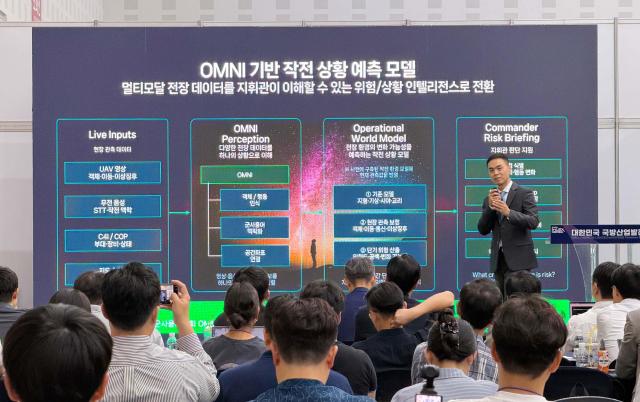
Naver Cloud announced on June 11 that it held a seminar focused on the application and strategies for defense AI, which can be executed on the battlefield, as part of the Sovereign AI-based Defense AX Development Strategy Seminar.
The seminar took place on June 10 at the Daejeon Convention Center (DCC) during the 'InLEX Korea Defense Industry Development Exhibition,' attended by officials from the defense, military, and ICT sectors.
During the seminar, Naver Cloud presented its core defense AI sovereignty strategy, featuring an omnimodal AI model that integrates text, voice, video, and maps into a single operational context, along with a Forward Deployed Engineer (FDE) system that places engineers in the field. This vision aims to go beyond simple development to achieve operational readiness in real-world scenarios.
Yoo Kyung-beom, Executive Director of Naver Cloud, discussed the topic 'Completing Defense AX with Sovereign AI: Naver Cloud's Next-Generation Full-Stack Battlefield Operations Strategy.' He highlighted how the full-stack capabilities of Sovereign AI, encompassing data centers, cloud infrastructure, AI models, and services, can be applied to the defense sector.
"The 'HyperCLOVA X Omnimodal' model can understand various battlefield data as a unified situation and can convert it into intelligible intelligence for commanders through a world model that predicts changes in the battlefield environment," he emphasized.
He also pointed out the advantage of providing a dedicated AI Data Center (AIDC) for defense. This includes a central data center that integrates and enhances learning from the data of the Army, Navy, Air Force, and Joint Chiefs of Staff, along with edge data centers that can respond even in communication-disrupted situations, such as forward command posts and naval vessels.
Naver Cloud proposed a unified defense AI infrastructure that connects seamlessly from central to battlefield edge. The company has experience operating hyperscale data centers and has established cloud infrastructure in a containerized modular format within customer-specific closed network environments.
Additionally, the FDE organizational structure, which deploys engineers to the field, was presented as a differentiating factor for Naver Cloud. This approach allows for rapid prototyping and validation, providing close support in actual operational environments to enhance capabilities. Naver Cloud aims to build an AI empowerment ecosystem applicable to real-world operations, leveraging Sovereign AI and defense-specific vertical AI.
Jung Nak-soo, Executive Director of Naver Cloud, presented on the essential conditions for building dedicated defense AI: a constructed cloud and ontology-based knowledge system. He proposed connecting siloed data from the Army, Navy, Air Force, and Marine Corps through an ontology-based approach to transform simple data into a knowledge system that understands meaning and context, thereby implementing a military decision-making support system based on clear inference pathways.
He also referenced international defense AX and ontology application examples, including the U.S. Joint All-Domain Command and Control (JADC2), Israel's AI-based target selection systems, Lavender and Gospel, and recent U.S.-Iran conflict cases, to illustrate that the transition to defense AI is a key competitive advantage for future command and control systems.
Jung emphasized that to implement the latest AI capabilities while completely preventing the external leakage of military secrets and operational data, a constructed cloud that guarantees perfect data control is essential. He proposed that the combination of Naver Cloud's constructed cloud and HyperCLOVA X could serve as the foundation for a defense AI integrated architecture.
Meanwhile, Naver Cloud established a dedicated organization for Defense AX on June 1, led by CEO Kim Yoo-won. The company's entry into the defense AI market is driven by the growing demand for Sovereign AI and public AX. Given the sensitive nature of security and regulations in the defense AI sector, this presents an opportunity for domestic companies, as applying foreign cloud or AI technologies may be challenging.
* This article has been translated by AI.
Copyright ⓒ Aju Press All rights reserved.