
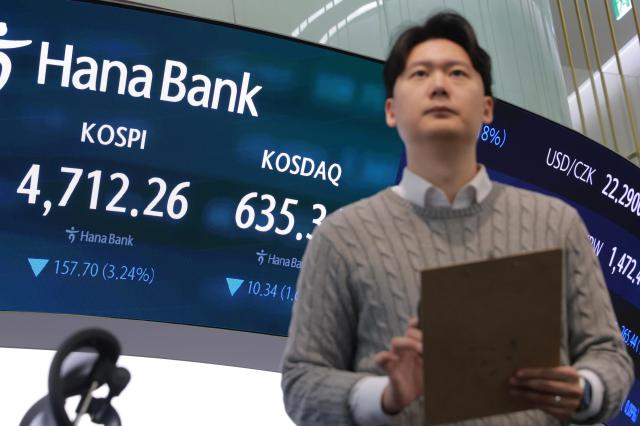
The KOSPI was down 4.27 percent from Friday’s close as of 11:20 a.m. Monday, extending the previous session’s 5.21-percent tumble. The benchmark has now lost more than half its value from its June intraday peak of 9,385.59.
Retail investors joined foreigners to rush to the exit, leaving institutions as the lone buyers among the three main investor groups after the government announced preparations to deploy a market stabilization fund.
The retreat below 4,700 took the index back to levels last seen around Jan. 13, when it closed at 4,692.64, erasing the spectacular advance that had made Korean equities a leading beneficiary of the global AI investment boom.
Samsung Electronics and SK hynix, which together account for more than 47 percent of the main board’s market capitalization, bore the brunt of the selling. Both were down more than 4 percent earlier in the morning as investors cut exposure to the chipmakers that had powered the rally.
The secondary KOSDAQ also fell below its previous intraday low for the year of 629.17. At 10:12 a.m., it was down 2.96 percent at 626.58.
The latest selloff followed another punishing session on Wall Street on Friday. The Nasdaq Composite slumped 5.28 percent and the Philadelphia Semiconductor Index plunged 10.73 percent.
Nvidia fell 14.01 percent to a 52-week low, slipping to fourth place by market capitalization. Sandisk, Micron, AMD, Broadcom and CoreWeave also suffered double-digit losses. At the center of the reversal is a widening loss of confidence in the profitability and financing of the AI buildout, compounded by turmoil at Nvidia and tighter restrictions on China’s access to advanced chips.
Nvidia announced Jensen Huang’s resignation as chief executive on Nov. 12. His departure has unsettled investors already questioning the interconnected investments and purchasing commitments tying the chipmaker to major AI developers and infrastructure operators.
U.S. Treasury Secretary Scott Bessent said Sunday that Washington was seeking answers about Nvidia’s chip sales to China. The administration has also tightened controls on Chinese access to advanced AI processors, adding uncertainty over future demand and the expansion of overseas data centers.
Korean brokerages warned that the market could fall further, although several said the speed and scale of the decline had left shares vulnerable to a sharp technical rebound.
Kiwoom Securities put a worst-case downside range at 4,200–4,300. Shinhan Securities saw the possibility of a retreat to 4,500, while Daishin Securities identified initial support at 4,510–4,580 and a second support range at 4,320–4,400.
Preparations for a stabilization fund could help restore confidence even if prices remained volatile, he added.
The won remained relatively steady at 1,346.5 per U.S. dollar as record-breaking exports extended into November, contrasting with the turmoil in equities.
Government bond yields continued to fall. The market turbulence adds to the case for the Bank of Korea to pause the tightening longer at Thursday’s final rate-setting meeting of the year.

Yuna Ryu covers finance, capital markets and Southeast Asian affairs.
She is drawn to the questions that numbers raise and the stories that data alone cannot answer.
Prior to journalism, she worked at Hyundai Motor Company and the Singapore Chamber of Commerce, focusing on business strategy and international affairs. She has also hosted diplomatic receptions and international conferences as an MC.
Ryu holds a master's degree in Media and Communication from Korea University, where her research focused on neuroscience-based studies of media effects.
Copyright ⓒ Aju Press All rights reserved.
Related News
-
 Blue House: KOSPI Drop Below 5000 Linked to U.S. Market Decline
The Blue House stated on November 23 that the recent increase in volatility in the domestic stock market, including the KOSPI falling below 5000, is influenced by declines in the U.S. stock market. Regarding the activation of the Securities Market Stabilization Fund, the Deputy Prime Minister for Economic Affairs will provide specific details.Kim Sung-wan, spokesperson for the Blue House, responded during a briefing at the Chunchugwan on questions about the causes of the recent stock market plunge and the government's response, saying, "I understand that the current instability in the stock market is linked to the U.S. stock market."He added, "The issue of leverage ETFs has been mentioned previously," and noted, "Today, the Deputy Prime Minister is expected to explain matters related to the stabilization fund during a press conference. I believe that specific details will be included in that explanation."Recently, the domestic stock market has experienced sharp corrections due to the combined effects of declines in the U.S. stock market and instability in global financial markets. The KOSPI dropped 5.21% on November 20, falling below the 5000 mark.In response, the government and financial authorities held an emergency market situation review meeting the day before to discuss trends in domestic and international financial markets and response measures. Deputy Prime Minister Lee Hyung-il, along with heads of economic and financial authorities, decided to begin preparations to activate the stabilization fund depending on market conditions.The stabilization fund refers to a mechanism where securities-related institutions and financial companies contribute funds to purchase stocks during sharp market declines to promote market stability. However, the actual activation and timing are expected to be determined based on market conditions.The opposition party has criticized the government's stock market support policies, arguing that they have exacerbated market instability.The People Power Party (PPP) has raised accountability regarding the introduction of ETFs and the decision to postpone the rebalancing of the National Pension Service's domestic stock allocation in relation to the recent stock market decline.Choi Bo-yoon, the PPP's chief spokesperson, called for the disclosure of materials related to the risk assessment and introduction process of leverage ETFs and demanded that the minutes of the National Pension Fund Management Committee meeting be submitted to the National Assembly.* This article has been translated by AI.
-
Daishin Securities Analyst: KOSPI Historically Undervalued, Caution Advised Against Panic Selling
Daishin Securities assessed on the 23rd that the KOSPI has entered a historically undervalued phase. As the KOSPI's price, value, and earnings have reached a deep bear market bottom, the firm suggested that investors should avoid panic selling and instead consider gradually increasing their positions.Lee Kyung-min, an analyst at Daishin Securities, stated, "The uncertainties related to artificial intelligence (AI) in the domestic market, concerns over further tightening, and foreign selling have pressured the KOSPI, causing it to fall below 5000 as feared." He added, "Even if it enters the 4500 range, this is a time to buy more rather than panic sell."The analyst pointed to a loss of confidence in AI hardware as a backdrop for the sharp decline in the U.S. stock market. He noted, "The uncertainties surrounding NVIDIA and Anthropic, which are central to the AI industry, have shaken investor sentiment," and emphasized that while short-term volatility due to unstable sentiment and deteriorating supply-demand conditions should be considered, the fundamentals have not been shaken, making this a time to hold.According to the analyst, since June 22, the KOSPI has fallen by 46.6%, while the 12-month forward earnings per share (EPS) has increased by over 35%. The price-to-book ratio (PBR) of the night futures index stands at 0.84, lower than the 0.88 recorded at the 2008 low presented in the report.The recent decline is attributed more to a contraction in the price-to-earnings ratio (PER) due to weakened investor sentiment and supply-demand instability than to a deterioration in corporate earnings outlook.The first support range for the KOSPI is set at 4510 to 4580, with a second support range of 4320 to 4400. The 4050 level is not seen as an immediate fundamental bottom, but is included in a bearish scenario for the first quarter of 2027, assuming a continued close below 4320 after a rebound falters. The recovery's first signal is identified as a return to the 4911 level.The analyst remarked, "Signals of a turning point are also emerging." He explained, "The U.S. medium-term macro risk index has re-entered the peak zone for risk-off signals, and the volatility index (VIX) surged to 35.9, reaching a previous high." He added that in Korea, the proportion of stocks held by pension funds has dropped to 20%, falling short of this year's plans, and the government is preparing to activate the stabilization fund, indicating a gradual strengthening of supply-demand safety nets.However, he recommended a strategy of gradual buying. The analyst advised, "The 4600 to 5000 range for the KOSPI is a zone for gradual buying. If it falls below 4600 at close, buying should stop, and we should observe whether it supports the second level. Approach slowly, considering 4911 as a short-term pivot point and the timing of actual fund injections from the stabilization fund."* This article has been translated by AI.
-
KOSPI opens below 4,800 as US chip rout sparks 'Black Monday' fears
SEOUL, November 23 (AJP) — South Korea's KOSPI opened 135.06 points, or 2.77 percent, lower at 4,734.90 on Monday, Korea Exchange data showed, after a semiconductor rout on Wall Street revived fears of an AI bubble. The KOSDAQ fell 1.66 percent to 634.93 at the open. ajunews The Philadelphia Semiconductor Index plunged 10.73 percent on Friday, and the Nasdaq Composite lost 5.28 percent, erasing all of its 2026 gains. Nvidia sank 14.01 percent amid reports that the SEC is examining potential accounting issues, adding to uncertainty since Jensen Huang's resignation as CEO. SK hynix's US depositary receipts fell 13.11 percent. Anthropic raised $81.34 billion in the largest IPO share sale ever a day earlier, but its debut failed to lift the AI trade. The KOSPI had already fallen 267.93 points, or 5.21 percent, to 4,869.96 on Friday, its lowest close since Jan 16. That capped a 7.95 percent weekly loss, during which foreign investors net sold 4.5159 trillion won, concentrated in Samsung Electronics and SK hynix. Monday's open left the index about 48 percent below its record close of 9,114.55 on June 22. Financial authorities are preparing to activate a stock market stabilization fund for the first time in 18 years.