
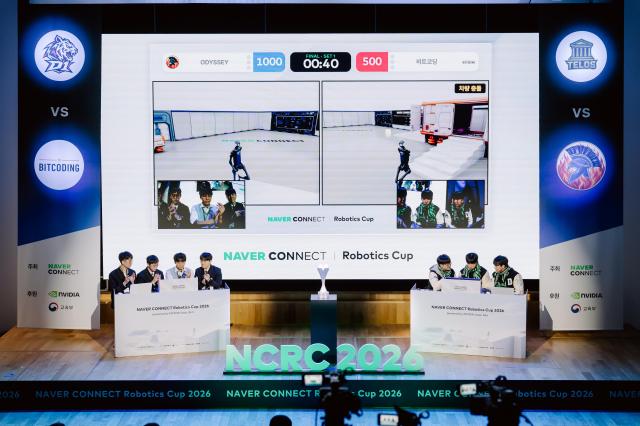
Four teams that cleared an online qualifying round met at Naver's Green Factory headquarters for the Naver Connect Robotics Cup 2026, sponsored by Nvidia and the Education Ministry.
Each team had spent about four months training its robot in Nvidia's Isaac Sim simulator through reinforcement learning, a trial-and-error training method.
The same robot model performed differently depending on which team had trained it. Walking speed, balance and the ability to handle stairs and slopes all varied with each team's training approach, the foundation said.
"It was meaningful to experience AI and robotics technology at a level students rarely get to access," said Odyssey, the team that won the grand prize.
Naver Connect will supply the schools of the top eight teams with "AI research stations," including three high-performance desktop PCs each, and release the students' research data as open source.
"We will continue to support diverse educational opportunities so students can grow into tech talent by experiencing future technologies firsthand," said Gong Gi-jung, the foundation's chairman.
Robotis, a Seoul-based robot maker, ran a comparable program for university students in August.
It lent its AI Sapiens humanoid and open-source software to teams from four universities, including Seoul National University and Yonsei University, which spent about a month teaching the robots taekwondo kicks, parkour moves and K-pop dance routines.
Those teams presented methods to narrow the sim-to-real gap, the mismatch that emerges when motions learned in simulation are carried over to physical hardware.
Robotis plans second and third rounds of the program, called Open Humanoid Gym, to widen participation in what it calls a K-humanoid ecosystem.

Kim Dong-young
Kim Dong-young is a bilingual journalist at AJU Press (AJP), covering Korean tech, energy, and bio/pharma.
He reports from the field at events like CES and APEC, runs AJP's YouTube channels,
and is pursuing a master's at Sogang's MOT program.
Copyright ⓒ Aju Press All rights reserved.
Related News
-
 Chinese Robots Enter Smartphone Production Lines, Large-Scale Commercialization in Sight
Chinese humanoid robots are being actively deployed in smartphone production sites, bringing large-scale commercialization of industrial robots into sight.According to China Fund News on November 23, Chinese smartphone component manufacturer Lansi Keji has entered into a strategic partnership with robot company Zhi Yuan Robot (Aizhi Bot) to deploy dozens of Zhi Yuan's industrial humanoid robots, the Jingling 2 (G2), in its smartphone testing production line.The Aizhi Bot robots will be used in the smartphone testing process. Specifically, they will perform automated loading and unloading tasks at testing workstations, interact with testing equipment, and carry out inspection tasks. The focus will be on processes that are repetitive and require frequent changes to the production line due to different smartphone models.The main competitive advantage of the Jingling G2 is its versatility. Existing industrial automation equipment must be installed for specific tasks, which means that when production lines change, there is a burden to retrofit or build new equipment. In contrast, the Jingling G2 can adapt to multiple production lines with a single universal robot body, increasing flexibility in production sites and reducing the burden of equipment investment, according to Zhi Yuan. It is also expected to replace personnel needed for repetitive processes and simultaneously enhance production efficiency and quality.Zhi Yuan has already accumulated experience applying the Jingling G2 in industrial settings. On June 23, several Jingling G2 robots were deployed at the Jiangxi Nanchang mass production factory of Chinese electronics contract manufacturer Longqi Keji. During a six-day live broadcast of the production line, the robots handled the entire quality inspection process of the tablet production factory. They demonstrated the ability to collaborate continuously with workers in line with the actual production speed, proving that robots can be applied to various operational processes.Aizhi Bot stated that the Jingling G2 has completed the entire process from process suitability verification to production line integration and on-site delivery, establishing a foundation for expanded application across multiple production sites with a standardized delivery and operation system. Peng Zhihui, co-founder and president and chief technology officer (CTO) of Aizhi Bot, emphasized that the core challenge of the embodied intelligence robot industry has shifted from technology demonstrations or future expectations to whether these robots can perform daily tasks in actual work environments.* This article has been translated by AI.
-
 CES 2027 humanoids face a work challenge
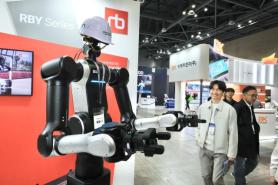
An RB-Y2 humanoid model from Rainbow Robotics at the Robo World 2026 held at KINTEX, Nov. 4, 2026. AJP Han Jun-gu SEOUL, November 20 (AJP) - Robots have been invading consumer technology shows since last year, and next year's CES in Las Vegas will test whether chipmakers such as Samsung Electronics and Nvidia can train them to outwork China's robot army. Chinese companies accounted for 21 of the 38 humanoid exhibitors at CES 2026, although Hyundai Motor Group-controlled Boston Dynamics took CNET Group's Best Robot award with Atlas. The next edition runs Jan. 6 to 9. The competition is expected to shift from crowd-pleasing stunts toward machines that can handle tools, move goods and complete tasks with less human intervention. "More than half will probably move toward autonomous work," said Park Dong-il, head of the advanced robotics research center at the Korea Institute of Machinery and Materials, who leads the team developing the state-backed KAIROS humanoid. "Especially in the United States, autonomous work is being put far out front." Only a handful of exhibitors emphasized their robots' work skills at the last show, drawing a lukewarm reception, Park said. Dancing, boxing and other athletic demonstrations will increasingly be taken for granted, with more companies expected to showcase practical tasks. But development is moving so quickly that the demonstrations themselves remain a work in progress. Edited and compiled by AJP. Graphics AI assisted "This field develops at a different speed. Two months should be seen as a completely new period," Park said. Companies may not settle on what to show until the day before the doors open, he added. Industry sources say Samsung plans to unveil two humanoids: HR, short for Human Reference, and HE, or Humanoid Extreme. HE is the higher-end model, with more degrees of freedom — independently controlled movements that provide greater flexibility for complex tasks. Samsung has not confirmed the plans. Samsung has also been testing a bipedal humanoid intended for round-the-clock work in factories and warehouses, with employees monitoring it in three shifts, according to sources. Much of the attention is likely to fall on its hands. The two models reportedly have five-fingered hands operated through tendon-like cables. A Samsung U.S. patent application published Oct. 22 describes a cable-driven finger mechanism, although the filing alone does not establish which technology will appear in the finished robots. "Without tendons, you would have to fit an actuator into every finger joint," said You Bum-jae, a principal research scientist and former head of humanoid development at the Korea Institute of Science and Technology, who developed the MAHRU humanoid. "With tendons, the actuators can gather in the palm, so the fingers can be made slimmer." That compact design brings its own engineering demands. "But you have to keep the tension constant so the cables never sag," You said. "Whether they have secured all those technologies, we will have to see." An AI Sapiens humanoid model from Robotis perform on a stage at the Robo World 2026 held at KINTEXT, Nov. 4, 2026. AJP Han Jun-gu Tendon-driven hands are a long-established concept, he added. Samsung will need to demonstrate what distinguishes its implementation. Boston Dynamics has taken a different approach with the GR3 hand unveiled for Atlas on Oct. 1. Its four fingers are driven directly at the joints, with 13 degrees of freedom. The design allows the robot to manipulate objects and operate tools, including gripping a handle while pressing a trigger. Park said Samsung's apparent emphasis on hand dexterity reflects the same push to prove that humanoids can perform useful work. Rainbow Robotics, the HUBO developer that Samsung took control of through a deal announced in December 2024, will not operate its own booth at CES. A company official said it would participate in a government-organized robotics pavilion and declined to discuss Samsung's plans. Oh Jun-ho, who led HUBO's development and co-founded Rainbow, continues to head Samsung's Future Robotics Office, which was incorporated into the company's new robotics unit in July. The Rainbow official declined to disclose the extent of his advice to Samsung. The competition extends well beyond the exhibition floor. Hyundai Motor Group aims to establish annual production capacity for 30,000 Atlas robots by 2028 as it prepares to introduce the machines into automotive manufacturing. LG plans to unveil a bipedal humanoid in the first quarter of 2027 using Nvidia's Isaac GR00T model and Jetson Thor computing platform. That timetable makes CES a possible debut venue, although LG's announcement did not identify the show. Tesla said in October that early production of Optimus had begun at its Fremont factory. It has announced no plans for the Las Vegas show. Chinese manufacturers already have a substantial lead in shipments. Unitree Robotics and AgiBot each shipped more than 5,000 humanoids in 2025, out of approximately 15,000 worldwide, according to figures reported by The Associated Press. Access to the U.S. market presents a separate hurdle. Since July 28, the Federal Communications Commission has restricted new equipment authorizations for foreign-produced advanced robotic devices, including covered humanoids made in South Korea, unless they receive conditional approval. For Korean developers, the challenge is also to establish that the components behind their demonstrations can compete. Edited and compiled by AJP. Graphics AI assisted "We have long been told that Korea lacks the technology to localize motors and joints," You said. "With competition from China so fierce, I wonder whether that competitiveness has been secured." Reliability remains another obstacle between a compelling demonstration and a machine that can earn its place on a factory floor. "Task success rates for models around the world are still below 90 percent," You said. "To unveil physical AI, performance has to go beyond that." "How well it works, we will only know on the day," Park said.
-
 AJP FAQ : Where did Korean humanoids start?
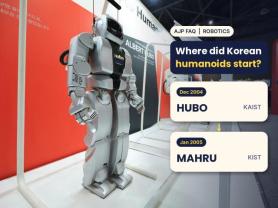
Edited and compiled by AJP. Graphics AI assisted Q1: Which were Korea's first humanoids? Korea's humanoid era began at KAIST, where professor Oh Jun-ho's team unveiled HUBO in December 2004. It was the country's first full-size bipedal humanoid, and each of its five fingers could move on its own. In January 2005, the Korea Institute of Science and Technology introduced MAHRU, a 150-centimeter, 67-kilogram robot developed by You Bum-jae's team. KIST called it the world's first network-based humanoid because it drew its intelligence from an external server. A later version, DRC-HUBO, won the 2015 DARPA Robotics Challenge and its $2 million top prize. Q2: Is Samsung new to humanoids? Not quite. Under a government project, Samsung built MAHRU 2, a follow-up to KIST's robot. It danced to "Arirang" for leaders at the APEC summit in Busan in November 2005. In 2012, Samsung's research arm unveiled Roboray, a 140-centimeter, 50-kilogram biped whose legs combined tendon-driven actuators with harmonic drives. In December 2024, Samsung raised its stake in Rainbow Robotics to 35 percent and became its largest shareholder. KAIST's HUBO researchers founded Rainbow in 2011, and HUBO creator Oh Jun-ho now heads Samsung's Future Robotics Office.