The Essence of the Korea-Japan Economic Community is an AI Industry Alliance
by HAN Joon ho Posted : June 11, 2026, 14:30Updated : June 11, 2026, 14:30
Share
facebook
twitter
URL
Text size
For a long time, there has been a belief in Japan's business community:
"Japan will reclaim its semiconductor dominance."
The glory of Japanese semiconductors, which dominated the world in the 1980s, remains deeply embedded in the collective memory of Japanese industry. Japan possesses the materials, equipment, and manufacturing technology, and there was a belief that it would eventually return to the top. However, Japan in 2026 is telling a different story.
An interview with Chey Tae-won, chairman of SK Group, published on June 10 in the Nihon Keizai Shimbun, carries significance beyond mere investment. SK announced plans to build AI data centers, referred to as 'AI factories,' in Japan, and also mentioned the possibility of constructing semiconductor factories there. What stands out is Chairman Chey's assessment that "all the necessary ecosystems are in place in Japan." This statement would have been typical of Japanese companies evaluating Korea in the past, but now Korean companies are beginning to assess Japan. This signals a shift in the global industrial landscape.
In fact, Japan is facing new challenges in the age of AI. The center of AI competition is the United States, with companies like NVIDIA, OpenAI, and Google leading the market. Meanwhile, China's manufacturing competitiveness is rapidly advancing. Caught in between, Japan has strong semiconductor equipment, materials, and precision manufacturing technology, but its presence in the AI ecosystem is limited.
The Japanese government's investment of tens of trillions of yen into the semiconductor company Rapidus reflects this urgency. There is a growing fear that losing semiconductors could jeopardize the future of manufacturing. However, a cold assessment reveals that Japan's deficiencies extend beyond just factories; it lacks the data and computational infrastructure essential for the AI era. Chairman Chey's statement that "what Japan needs more than semiconductor factories is AI factories" aligns with this perspective.
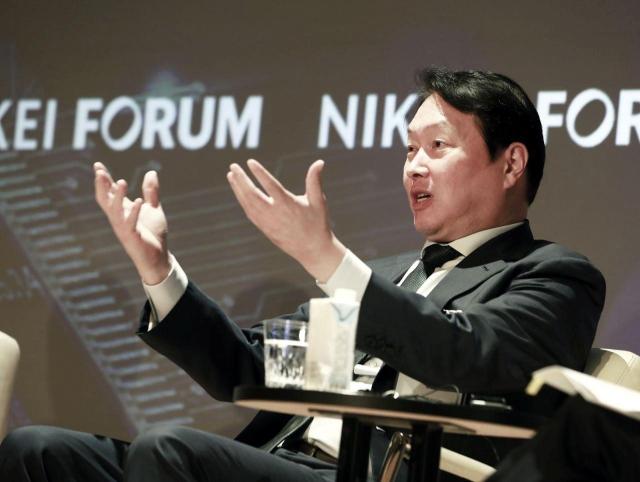
Notably, the Japanese business community is increasingly resonating with these assertions. At the recent Nikkei Forum held in Tokyo, business leaders from Japan and Korea spoke in unison about the need for collaboration in AI, semiconductors, energy, supply chains, shipbuilding, robotics, nuclear power, and healthcare. This is a scene that would have been unimaginable just a few years ago.
During Japan's export restrictions in 2019, the two countries clashed head-on over semiconductor materials. At that time, Japan was the technology leader, and Korea was the customer. However, the situation has changed. Korea has become the world's largest producer of HBM and a key player in the NVIDIA supply chain. Japan still possesses world-class materials and equipment technology. A structure is emerging where both countries are interdependent.
Chey Tae-won, chairman of SK Group and director of the Choi Jong-hyun Academic Foundation, speaks at the Nikkei Forum's Korea-Japan special session held at the Imperial Hotel in Tokyo on June 9, 2026. [Photo=SK Group]
Chey’s vision of a 'Korea-Japan economic community,' which he has advocated for years, should also be understood in this context. Many perceive it as merely a proposal for economic cooperation or the expansion of free trade. However, the essence of the economic community he envisions is not conventional free trade expansion; it is an industrial alliance for the AI era.
The United States is pursuing technological hegemony, while China leverages its vast domestic market. Europe is focused on regulation. Both Japan and Korea have their strengths, but individually, they face limitations in market size and influence. The argument is that the two countries must operate as a single industrial ecosystem in future industries such as AI data centers, semiconductors, energy, supply chains, shipbuilding, robotics, and healthcare.
Of course, the reality is not easy. Historical issues still exist, and political tensions can escalate at any moment. There remains a competitive mindset within both countries' industries. However, the AI era is not one where a single nation can independently solve all challenges as in the past. Japan needs Korea's AI semiconductor competitiveness, and Korea needs Japan's materials and equipment ecosystem. The two countries are entering a structure where they must be both competitors and collaborators.
The essence of the Korea-Japan economic community, as articulated by Chey Tae-won, is not merely the expansion of free trade. It is an industrial alliance necessary for survival in the AI era. The proposal is for cooperation across the entire spectrum of future industries, including semiconductors, data centers, energy, supply chains, shipbuilding, robotics, and AI manufacturing innovation.
The Korea-Japan economic community is not an idealistic notion. In an era of intensified U.S.-China technological rivalry, it represents the most realistic survival strategy available to Japan and Korea.
The changes beginning in Japan are not merely about cooperation; they are about survival.